
New World Record for Powered RC Endurance: 20 Hr., 50 Sec.
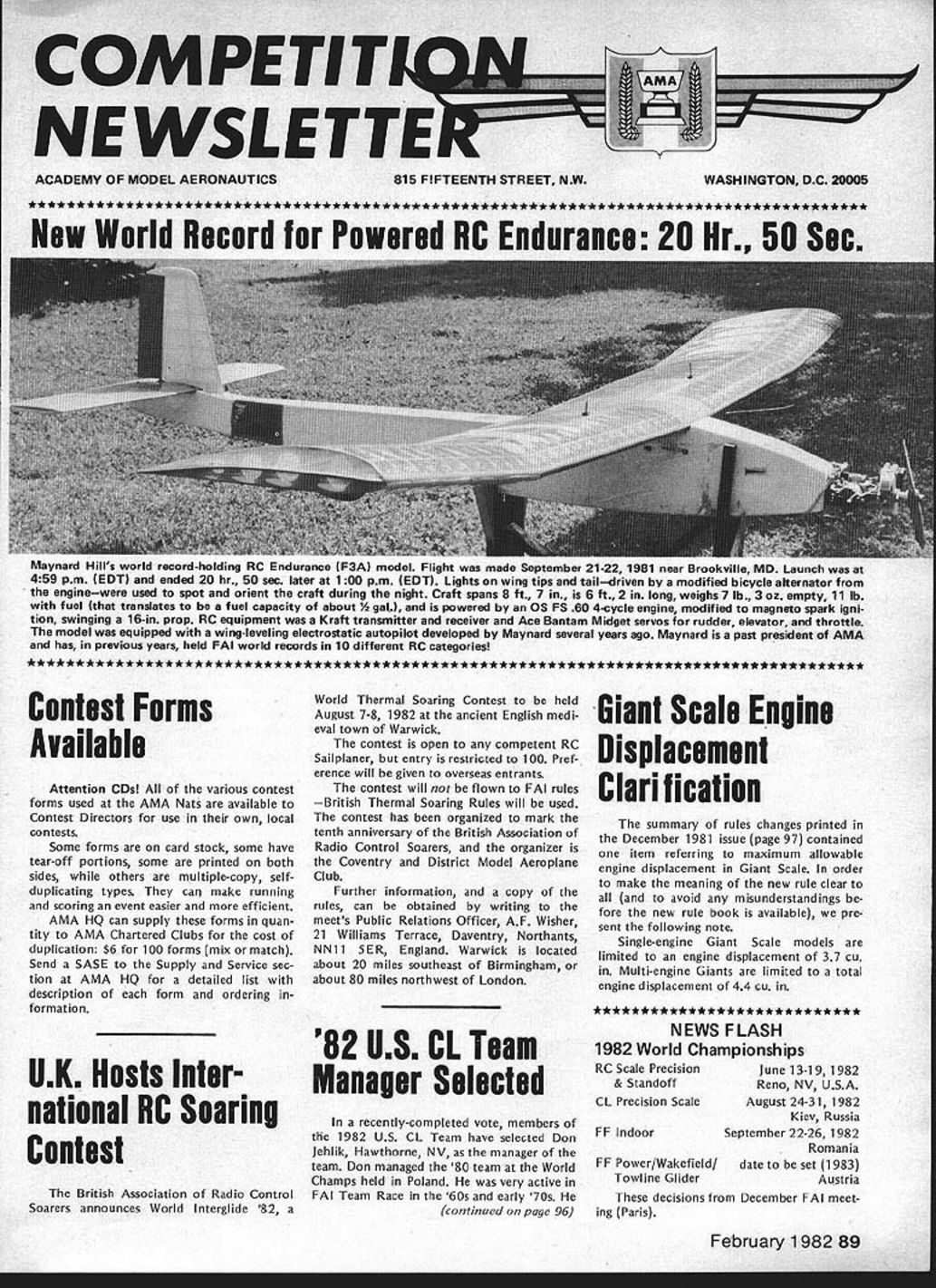
Maynard Hill’s world record–holding RC Endurance (F3A) model made a flight September 21–22, 1981, near Brookville, MD. Launch was at 4:59 p.m. (EDT) and ended 20 hr., 50 sec. later at 1:00 p.m. (EDT). Lights on wing tips and tail — driven by a modified bicycle alternator from the engine — were used to spot and orient the craft during the night.
Model data:
- Wingspan: 8 ft 7 in
- Length: 6 ft 2 in
- Empty weight: 7 lb 3 oz
- Weight with fuel: 11 lb (fuel capacity ≈ 1/2 gal)
- Engine: OS FS .60 4-cycle, modified to magneto spark ignition, swinging a 16-in. prop
- RC: Kraft transmitter; Ace Bantam Midget servos for rudder, elevator, and throttle
- Autopilot: Wing-leveling electrostatic autopilot developed by Maynard Hill
Maynard Hill is a past president of AMA and has held FAI world records in 10 different RC categories.
Competition Newsletter
Contest Forms Available — Attention CDs!
Various contest forms used at the AMA Nats are available for contest directors to use at local contests. Forms include card stock, tear-off portions, double-sided prints, and multiple-copy self-duplicating types. They can make running and scoring events easier and more efficient.
To order:
- AMA-chartered clubs: cost for duplication — $6 per 100 forms (mix & match)
- Send SASE to: Supply Service Section, AMA HQ for a detailed list and ordering information
UK Hosts International RC Soaring Contest
The British Association of Radio Control Soarers announces World Interglide ’82, the World Thermal Soaring Contest, to be held August 7–8, 1982, in the medieval town of Warwick, England. Contest open to competent RC sailplane pilots; entry restricted to 100. Preference will be given to overseas entrants. The contest will be flown to FAI rules; British Thermal Soaring Rules will be used. The event marks the tenth anniversary of the British Association of Radio Control Soarers.
Organizer: Coventry District Model Aeroplane Club. For further information and a copy of the rules write to:
- Meets Public Relations Officer A.F. Wisher
- 21 Williams Terrace, Daventry, Northants NN11 5ER, England
Warwick is about 20 miles southeast of Birmingham and about 80 miles northwest of London.
Giant Scale Engine Displacement Clarification
A summary of rules changes printed in the December 1981 issue contained an item referring to maximum allowable engine displacement for Giant Scale. To clarify the new rule before the new rule book is available, note the following:
- Single-engine Giant Scale models: limited to engine displacement of 37 cu in.
- Multi-engine Giant Scale models: limited to total engine displacement of 44 cu in.
News Flash
- 1982 World Championships:
- RC Scale Precision — June 13–19, 1982; Standoff, Reno, NV, USA
- CL Precision Scale — August 24–31, 1982; Kiev, Russia
- FF Indoor — September 22–26, 1982; Romania
- FF Power/Wakefield — date set for 1983
- Towline Glider — Austria (decisions at December FAI meeting, Paris, February 1982)
Photo captions from the event:
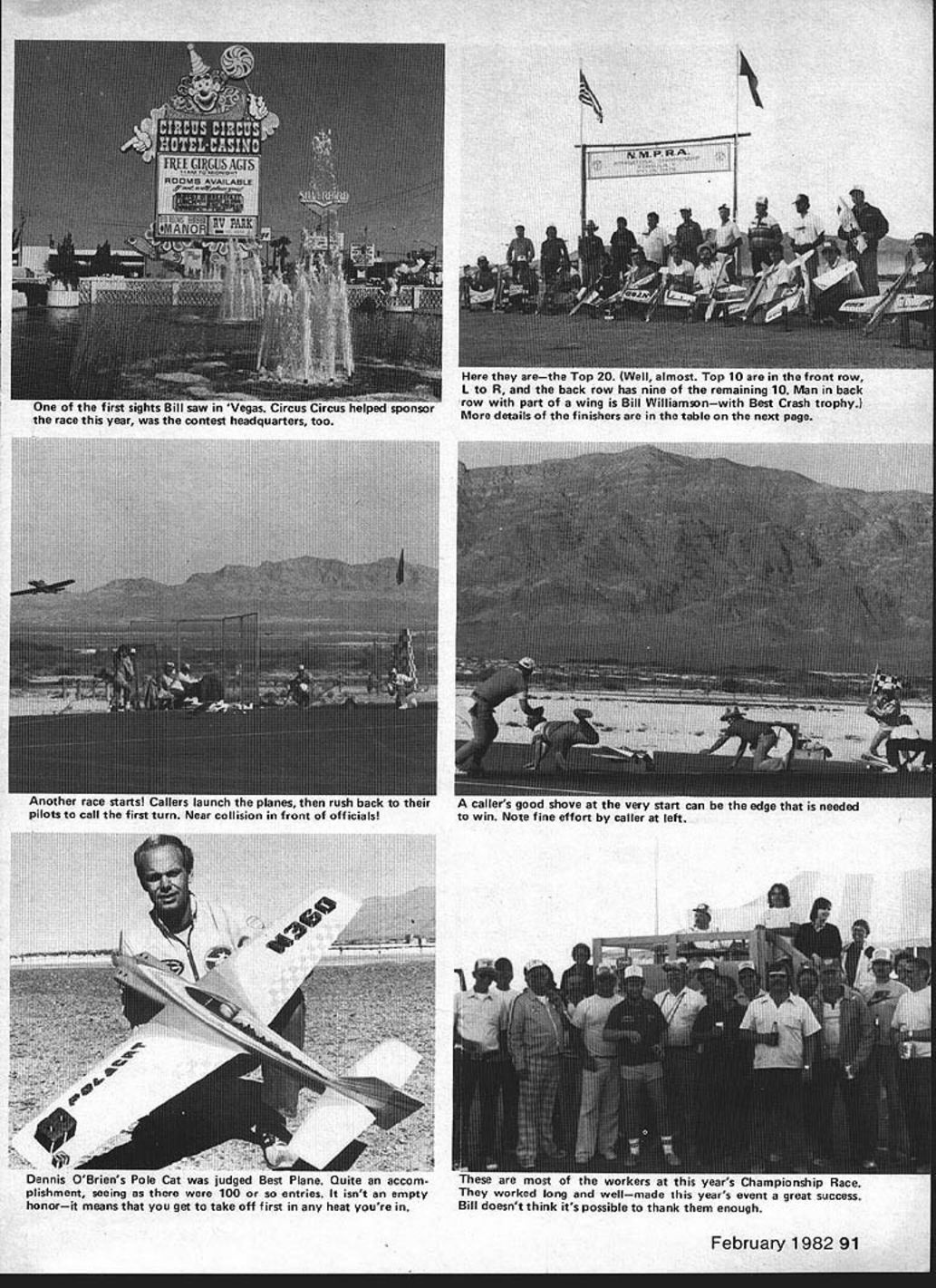
- One of the first sights Bill saw in Vegas: Circus Circus, which helped sponsor the race this year and served as contest headquarters.
- Here they are — the Top 20. (Top 10 are in the front row, left to right; the back row has nine of the remaining 10. The man in the back row with part of a wing is Bill Williamson — Best Crash trophy.)
- Another race starts! Callers launch the planes, then rush back to their pilots to call the first turn. Near collision in front of officials!
- A caller’s good shove at the very start can be the edge needed to win.
- Dennis O’Brien’s Pole Cat was judged Best Plane out of about 100 entries. The award means you get to take off first in any heat you’re in.
- Many of the workers at this year’s Championship Race are pictured. They worked long and well and made the event a great success.
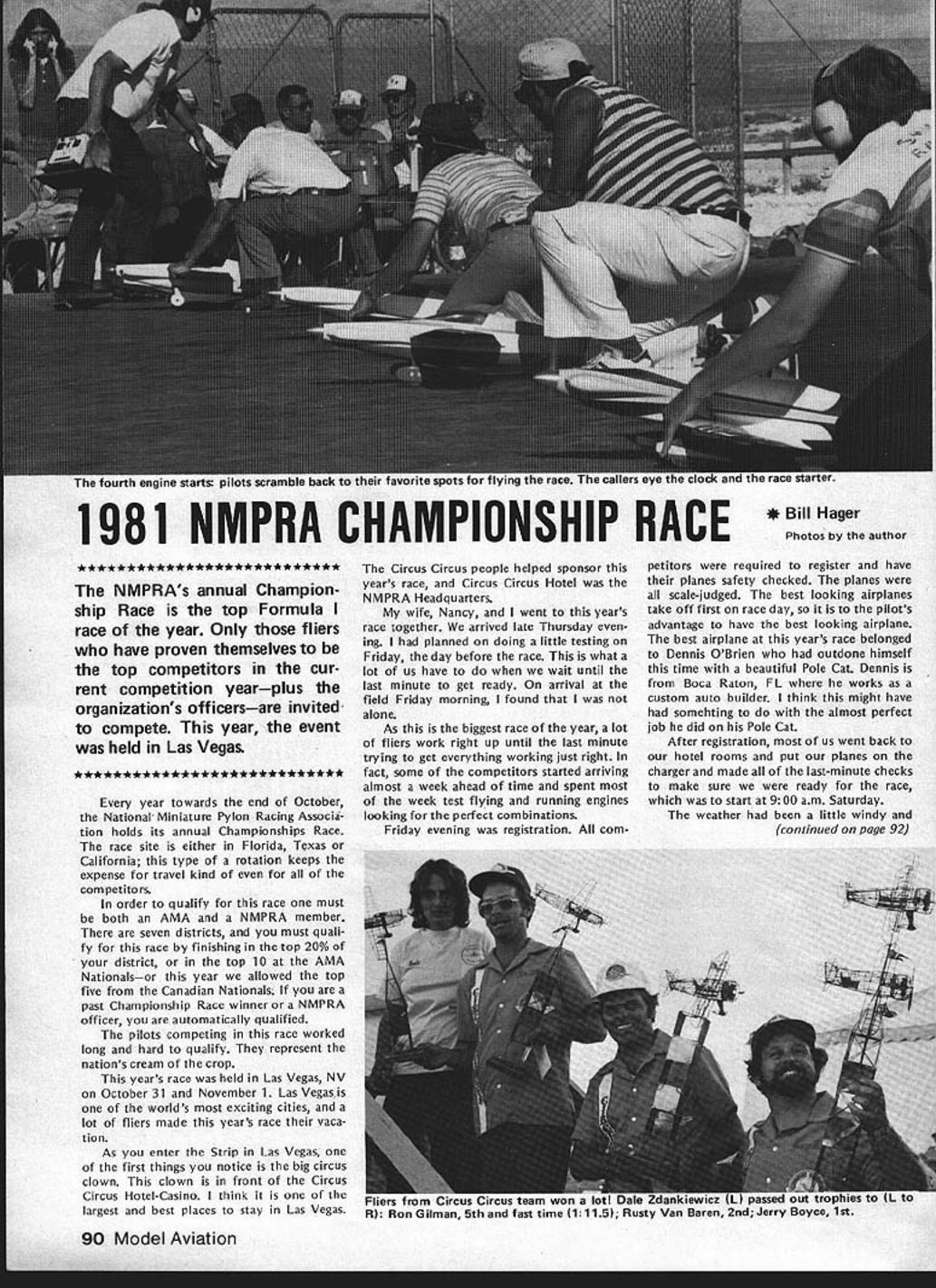
It was cool most of the week as a front had gone through. We were lucky for this one — the front had passed and the next two days were almost perfect.
Our Contest Director was Joe Zdankiewicz, and our flag man was Bruce Richmond. All the workers who helped out were experienced veterans and did a fantastic job.
The Competition
Racing on Saturday was fast and furious. Everyone was surprised to see Ron Gilman — one of the most consistent fliers around — get a zero in his first race when his engine quit for no apparent reason.
There were plenty of other people in the thick of it. At the end of Saturday’s racing we had five competitors with a perfect 16 points: Tom Christopher, Kent Nogy, Jerry Small, Jerry Boyce, and Rusty Van Baren. At one point we also had Jeff Bertken and Greg Doe in contention.
There were many flameouts and several zeros in the first round, but most fliers still had a chance to catch up on Sunday.
Saturday evening we held our annual banquet at the Frontier Hotel–Casino, where awards for national points for the year were presented. The top 10 received an NMPRA shirt; the first-place finisher received the annual trophy. This year’s winner was Gary Hover with 602.3 points. Gary is from Los Osos, CA, and is a building facilities manager for the county of San Luis Obispo.
I received a plaque of appreciation for serving as NMPRA president for the past three years — an honor I shared with my wife Nancy for her help.
Sunday racing started at 7:00 a.m. sharp; we wanted to get at least eight rounds in by 3:00 p.m. Weather was almost perfect: almost no wind, cool in the morning and about 80° in the afternoon.
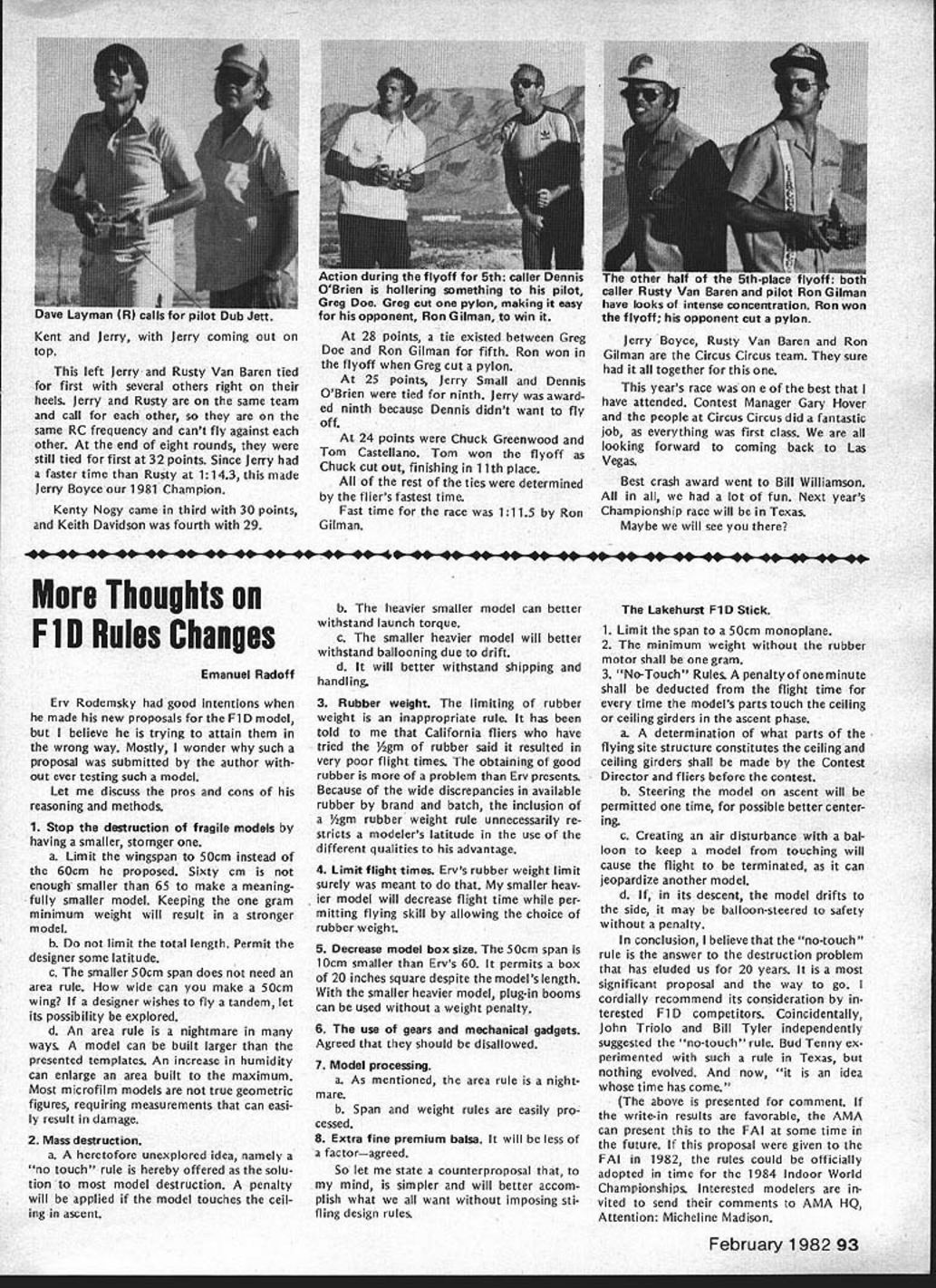
After round five, Jerry Boyce, Rusty Van Baren, and Kent Nogy were tied for first at a perfect 20 points. Round six produced a fantastic race between Kent and Jerry, with Jerry coming out on top. This left Jerry and Rusty tied for first, and after eight rounds they were still tied at 32 points. Jerry had the faster time (1:14.3) and was declared the 1981 Champion.
Kent Nogy finished third with 30 points; Keith Davidson was fourth with 29 points.
Tiebreak details:
- At 28 points: Greg Doe and Ron Gilman tied for fifth; Ron won the flyoff when Greg cut a pylon.
- At 25 points: Jerry Small and Dennis O’Brien tied for ninth; Jerry was awarded ninth because Dennis declined to fly off.
- At 24 points: Chuck Greenwood and Tom Castellano tied; Tom won the flyoff as Chuck cut out, finishing 11th.
- All other ties were determined by each flier’s fastest time.
Fastest time for the race: 1:11.5 by Ron Gilman.
Jerry Boyce, Rusty Van Baren, and Ron Gilman are the Circus Circus team. Contest Manager Gary Hover and Circus Circus staff ran a first-class event. This year’s race was one of the best attended and run; next year’s Championship race will be in Texas.
Maybe we’ll see you there.
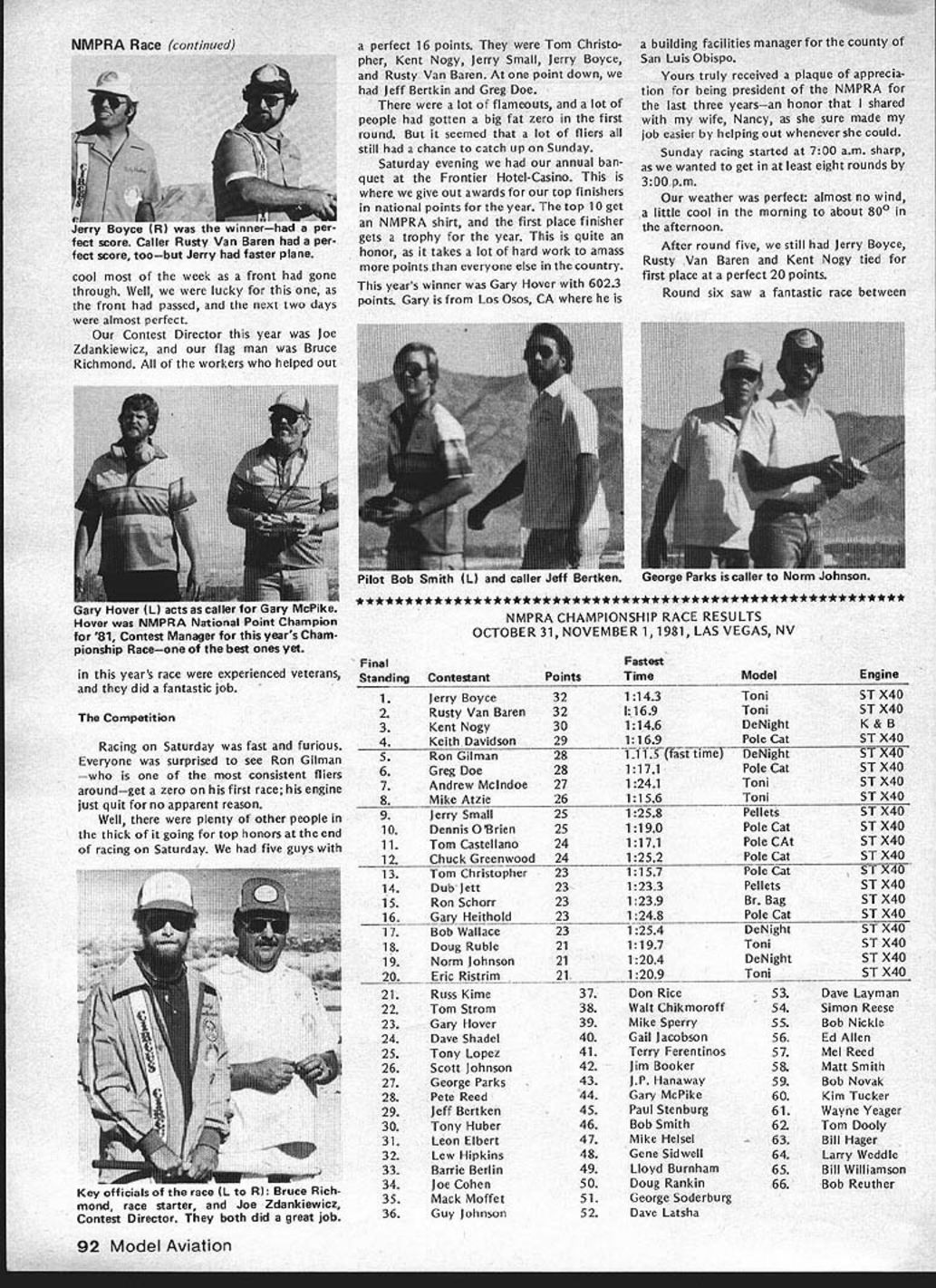
NMPRA Championship Race Results
October 31–November 1, 1981 — Las Vegas, NV
- Jerry Boyce — Points: 32; Fastest time: 1:14.3; Model: Toni; Engine: ST X40
- Rusty Van Baren — Points: 32; Fastest time: 1:16.9; Model: Toni; Engine: ST X40
- Kent Nogy — Points: 30; Fastest time: 1:14.6; Model: DeNight; Engine: K & B
- Keith Davidson — Points: 29; Fastest time: 1:16.9; Model: Pole Cat; Engine: ST X40
- Ron Gilman — Points: 28; Fastest time: 1:17.5 (fast time); Model: DeNight; Engine: ST X40
- Greg Doe — Points: 28; Fastest time: 1:17.1; Model: Pole Cat; Engine: ST X40
- Andrew McIndoe — Points: 27; Fastest time: 1:24.1; Model: Toni; Engine: ST X40
- Mike Atzie — Points: 26; Fastest time: 1:15.6; Model: Toni; Engine: ST X40
- Jerry Small — Points: 25; Fastest time: 1:25.8; Model: Pellets; Engine: ST X40
- Dennis O’Brien — Points: 25; Fastest time: 1:19.0; Model: Pole Cat; Engine: ST X40
- Tom Castellano — Points: 24; Fastest time: 1:17.1; Model: Pole Cat; Engine: ST X40
- Chuck Greenwood — Points: 24; Fastest time: 1:25.2; Model: Pole Cat; Engine: ST X40
- Tom Christopher — Points: 23; Fastest time: 1:15.7; Model: Pole Cat; Engine: ST X40
- Dub Jett — Points: 23; Fastest time: 1:23.3; Model: Pellets; Engine: ST X40
- Ron Schorr — Points: 23; Fastest time: 1:23.9; Model: Brown Bag; Engine: ST X40
- Gary Heithold — Points: 23; Fastest time: 1:24.8; Model: Pole Cat; Engine: ST X40
- Bob Wallace — Points: 23; Fastest time: 1:25.4; Model: DeNight; Engine: ST X40
- Doug Ruble — Points: 21; Fastest time: 1:19.7; Model: Toni; Engine: ST X40
- Norm Johnson — Points: 21; Fastest time: 1:20.4; Model: DeNight; Engine: ST X40
- Eric Ristrim — Points: 21; Fastest time: 1:20.9; Model: Toni; Engine: ST X40
- Russ Kime
- Tom Strom
- Gary Hover
- Dave Shadel
- Tony Lopez
- Scott Johnson
- George Parks
- Pete Reed
- Jeff Bertken
- Tony Huber
- Leon Elbert
- Lew Hipkins
- Barrie Berlin
- Joe Cohen
- Mack Moffet
- Guy Johnson
- Don Rice
- Walt Chikmoroff
- Mike Sperry
- Gail Jacobson
- Terry Ferentinos
- Jim Booker
- J.P. Hanaway
- Gary McPike
- Paul Stenburg
- Bob Smith
- Mike Hessel
- Gene Sidwell
- Lloyd Burnham
- Doug Rankin
- George Soderburg
- Dave Latsha
- Dave Layman
- Simon Reese
- Bob Nickle
- Ed Allen
- Mel Reed
- Matt Smith
- Bob Novak
- Kim Tucker
- Wayne Yeager
- Tom Dooley
- Bill Hager
- Larry Weddle
- Bill Williamson
- Bob Reuther
RC Sailplane Records
The San Fernando Valley Silent Flyers (SFVSF) club mounted an all-out attack on the AMA National Records for RC sailplanes and has had great success. A review of the national records list in the January 1982 issue shows six members of this club hold 28 national records.
This performance resulted from careful preparation of models, sanctioned record trials, and assembling special equipment for altitude verification. The Competition Newsletter publishes two brief articles by SFVSF members describing equipment and techniques used to measure sailplane altitude during record attempts.
Altitude Calculations for the SFVSF Record Trials
Michael Bame
Referring to the (not-published) diagram: base line c is the measured distance between two theodolites. Angles A and B are the azimuth angles measured by the theodolites. Angles D and E are the elevation angles measured by the theodolites. The altitude of the aircraft above the ground is h.
Since the three angles of any triangle add to 180°, angle C = 180° − (A + B). With angles C, A, and B, and base c known, the Law of Sines gives: c / sin C = a / sin A = b / sin B
Therefore:
- a = c (sin A) / sin C
- b = c (sin B) / sin C
With elevation angles D and E and triangle leg lengths a and b known, altitude h can be calculated by:
- h / a = tan E and h / b = tan D
Rewriting:
- h = a (tan E)
- h = b (tan D)
There are two values for h (from the two theodolites). Ideally they would be the same, but small tracking and reading errors make exact agreement unlikely. The two values for h are averaged.
The SFVSF Theodolite
Dave Peltz (AMA 968)
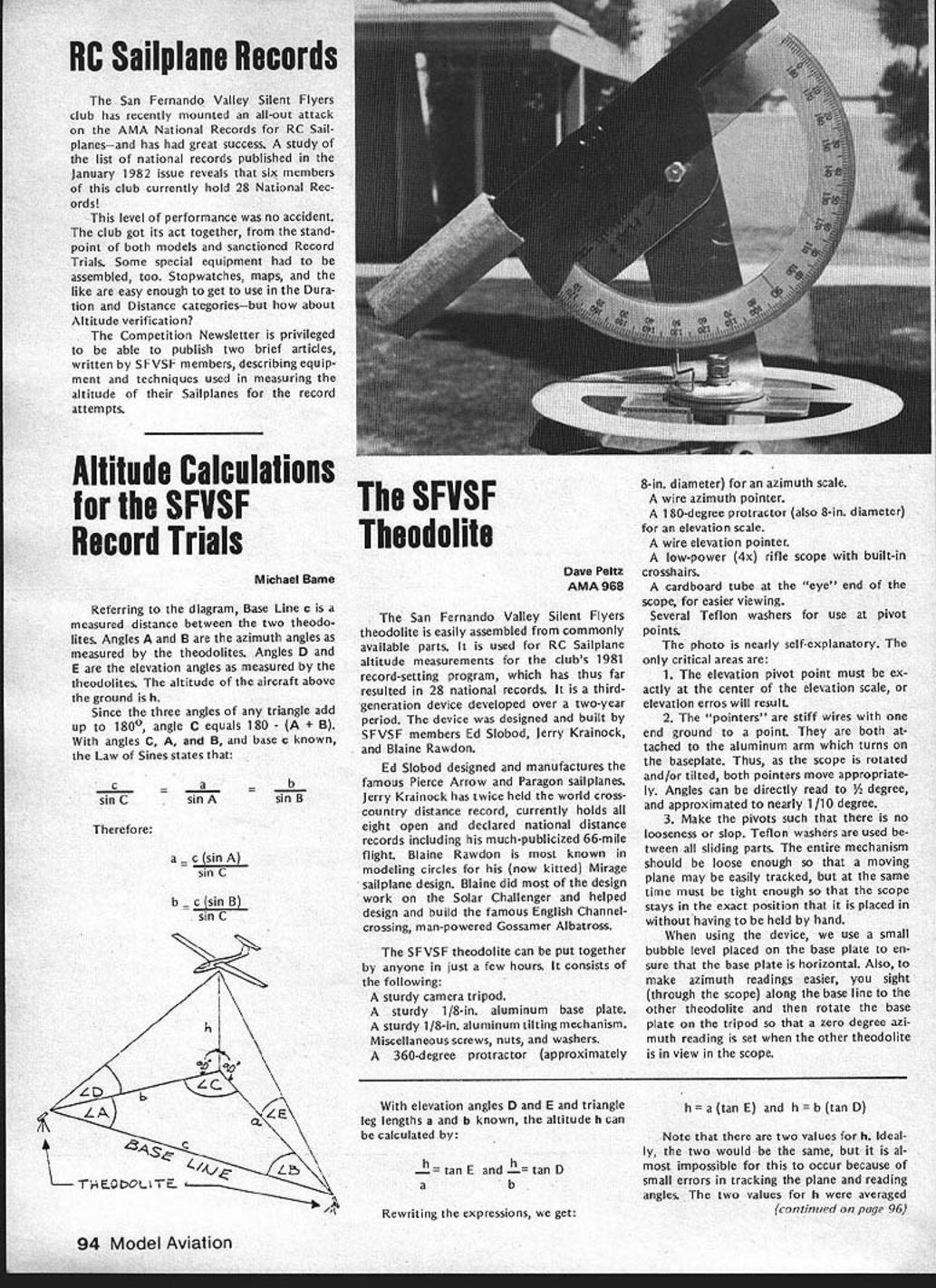
The SFVSF theodolite is easily assembled from commonly available parts and was used in the club’s 1981 record-setting program. It is a third‑generation device developed over two years by SFVSF members Ed Slobod, Jerry Krainock, and Blaine Rawdon.
Device contributors:
- Ed Slobod — designer and manufacturer of the Pierce Arrow and Paragon sailplanes
- Jerry Krainock — former world cross-country distance record holder; holds multiple national distance records
- Blaine Rawdon — designer of the Mirage sailplane and contributor to Solar Challenger and Gossamer Albatross projects
The theodolite can be built in a few hours and consists of:
- A sturdy camera tripod
- A 1/8-in. aluminum base plate
- A 1/8-in. aluminum tilting mechanism
- Miscellaneous screws, nuts, and washers
- A 360° protractor (≈8-in. diameter) for an azimuth scale
- A wire azimuth pointer
- A 180° protractor (≈8-in. diameter) for an elevation scale
- A wire elevation pointer
- A low-power (4x) rifle scope with built-in crosshairs
- A cardboard tube at the eye end of the scope for easier viewing
- Several Teflon washers for pivot points
Critical construction notes:
- The elevation pivot point must be exactly at the center of the elevation scale to avoid elevation errors.
- The pointers are stiff wires with one end ground to a point; both attach to the aluminum arm that turns on the base plate. As the scope is rotated or tilted, the pointers move appropriately. Angles can be read directly to 1/2° and approximated to nearly 1/10°.
- Make pivots without looseness or slop. Teflon washers are used between sliding parts. The mechanism should be free enough to track a moving plane but tight enough to hold the scope in position without being hand-held.
When using the device:
- Place a small bubble level on the base plate to ensure it is horizontal.
- To ease azimuth readings, sight along the base line to the other theodolite, then rotate the base plate so a zero-degree azimuth reading is set when the other theodolite is in view through the scope.
Transcribed from original scans by AI. Minor OCR errors may remain.

