
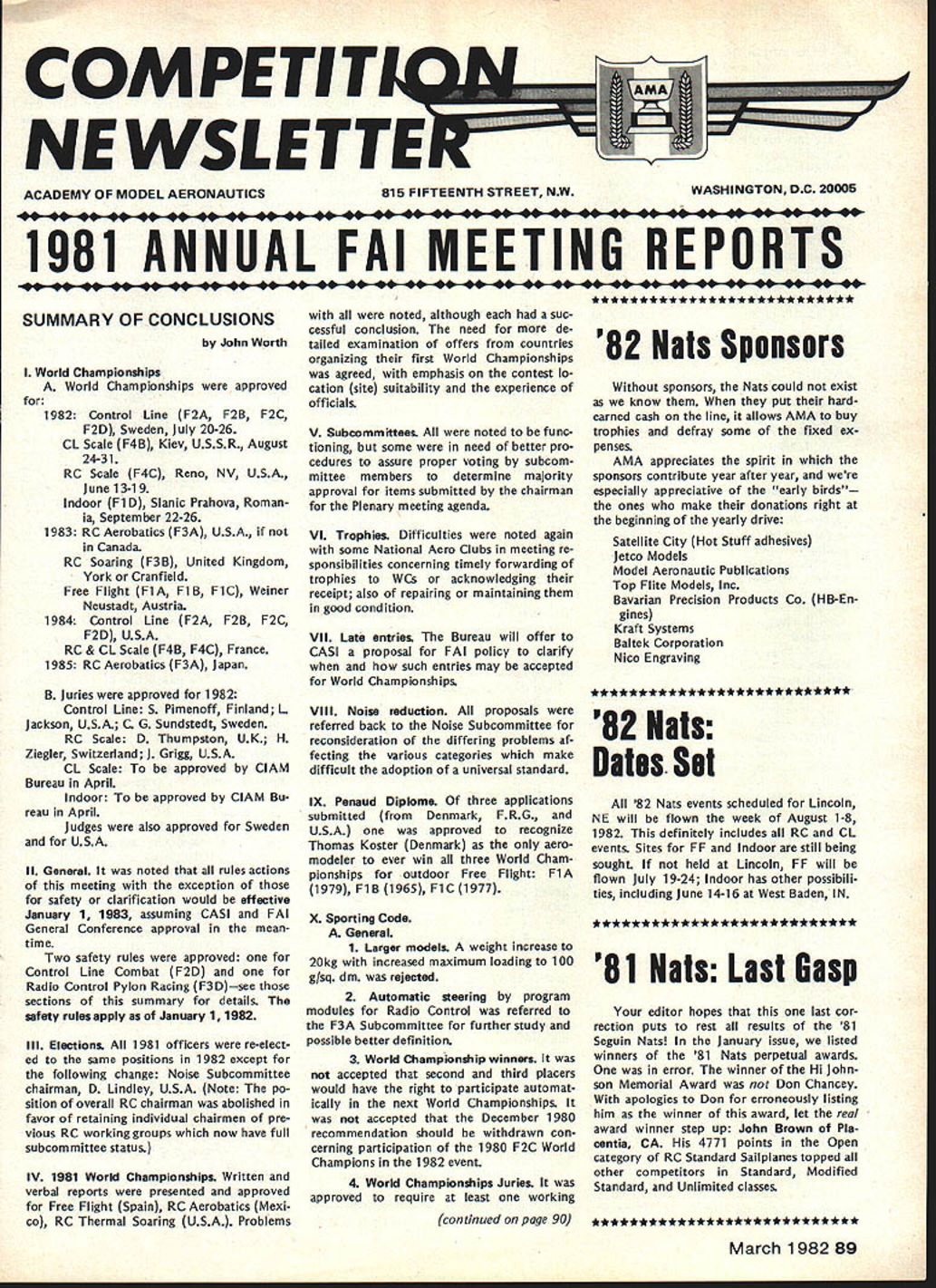
1981 ANNUAL FAI MEETING REPORTS
SUMMARY OF CONCLUSIONS by John Worth
I. World Championships
A. World Championships were approved for:
- 1982:
- Control Line (F2A, F2B, F2C, F2D), Sweden, July 20–26.
- CL Scale (F4B), Kiev, U.S.S.R., August 24–31.
- RC Scale (F4C), Reno, NV, U.S.A., June 13–19.
- Indoor (F1D), Slanic Prahova, Romania, September 22–26.
- 1983:
- RC Aerobatics (F3A), U.S.A., if not in Canada.
- RC Soaring (F3B), United Kingdom, York or Cranfield.
- Free Flight (F1A, F1B, F1C), Wiener Neustadt, Austria.
- 1984:
- Control Line (F2A, F2B, F2C, F2D), U.S.A.
- RC & CL Scale (F4B, F4C), France.
- 1985:
- RC Aerobatics (F3A), Japan.
B. Juries were approved for 1982:
- Control Line: S. Pimenoff (Finland); L. Jackson (U.S.A.); C. G. Sundstedt (Sweden).
- RC Scale: D. Thumpston (U.K.); H. Ziegler (Switzerland); J. Grigg (U.S.A.).
- CL Scale: To be approved by CIAM Bureau in April.
- Indoor: To be approved by CIAM Bureau in April.
- Judges were also approved for Sweden and for U.S.A.
II. General
- All rules actions of this meeting, except those for safety or clarification, would be effective January 1, 1983, assuming CIAM and FAI General Conference approval.
- Two safety rules were approved: one for Control Line Combat (F2D) and one for Radio Control Pylon Racing (F3D). The safety rules apply as of January 1, 1982.
III. Elections
- All 1981 officers were re-elected to the same positions in 1982 except for the following change: Noise Subcommittee chairman, D. Lindley, U.S.A.
- Note: The position of overall RC chairman was abolished in favor of retaining individual chairmen of previous RC working groups which now have full subcommittee status.
IV. 1981 World Championships
- Written and verbal reports were presented and approved for Free Flight (Spain), RC Aerobatics (Mexico), RC Thermal Soaring (U.S.A.).
- Problems with all were noted, although each had a successful conclusion.
- The need for more detailed examination of offers from countries organizing their first World Championships was agreed, with emphasis on contest site suitability and the experience of officials.
V. Subcommittees
- All were noted to be functioning, but some need better procedures to assure proper voting by subcommittee members to determine majority approval for items submitted by the chairman for the Plenary meeting agenda.
VI. Trophies
- Difficulties were noted with some National Aero Clubs in meeting responsibilities concerning timely forwarding of trophies to World Championships or acknowledging their receipt; also in repairing or maintaining them in good condition.
VII. Late entries
- The Bureau will offer to CIAM a proposal for FAI policy to clarify when and how such entries may be accepted for World Championships.
VIII. Noise reduction
- All proposals were referred back to the Noise Subcommittee for reconsideration of the differing problems affecting the various categories, which make difficult the adoption of a universal standard.
IX. Penaud Diplome
- Of three applications submitted (Denmark, F.R.G., and U.S.A.), one was approved to recognize Thomas Koster (Denmark) as the only aeromodeller to ever win all three World Championships for outdoor Free Flight: F1A (1979), F1B (1965), F1C (1977).
X. Sporting Code
A. General
- Larger models
- A weight increase to 20 kg with increased maximum loading to 100 g/sq dm was rejected.
- Automatic steering program modules for Radio Control
- Referred to the F3A Subcommittee for further study and possible better definition.
- World Championship winners
- It was not accepted that second and third placers would have the right to participate automatically in the next World Championships.
- It was not accepted that the December 1980 recommendation should be withdrawn concerning participation of the 1980 F2C World Champions in the 1982 event.
- World Championships Juries
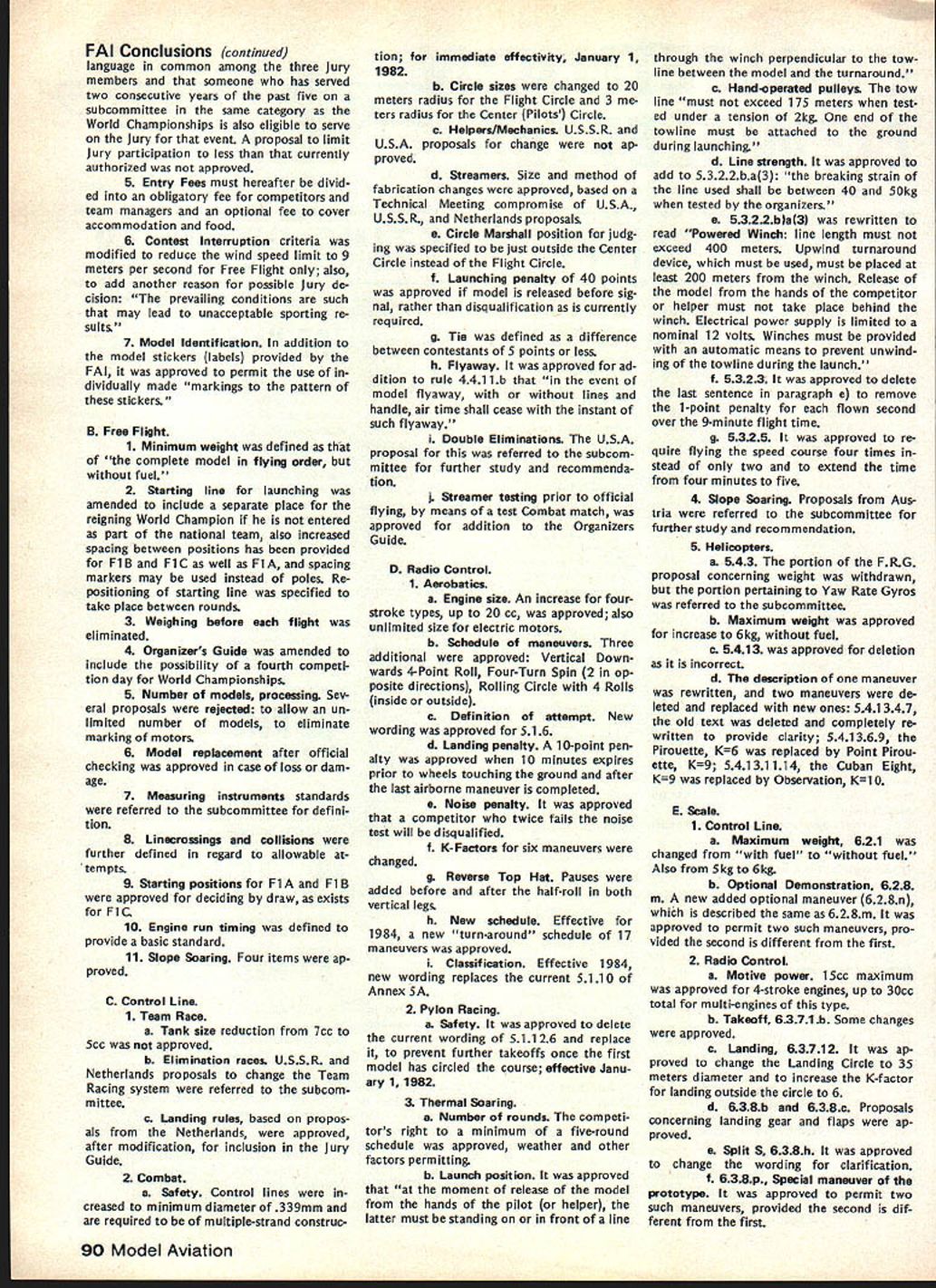
- It was approved to require at least one working language in common among the three Jury members and that someone who has served two consecutive years of the past five on a subcommittee in the same category as the World Championships is also eligible to serve on the Jury for that event.
- A proposal to limit Jury participation to less than that currently authorized was not approved.
- Entry Fees
- Entry Fees must hereafter be divided into an obligatory fee for competitors and team managers and an optional fee to cover accommodation and food.
- Contest Interruption criteria
- Modified to reduce the wind speed limit to 9 meters per second for Free Flight only.
- Added another reason for possible Jury decision: "The prevailing conditions are such that may lead to unacceptable sporting results."
- Model Identification
- In addition to the model stickers (labels) provided by the FAI, it was approved to permit the use of individually made markings to the pattern of these stickers.
B. Free Flight
- Minimum weight
- Defined as that of "the complete model in flying order, but without fuel."
- Starting line for launching
- Amended to include a separate place for the reigning World Champion if he is not entered as part of the national team.
- Increased spacing between positions provided for F1B and F1C as well as F1A; spacing markers may be used instead of poles.
- Repositioning of starting line specified to take place over rounds.
- Weighing before each flight
- Eliminated.
- Organizer's Guide
- Amended to include the possibility of a fourth competition day for World Championships.
- Number of models, processing
- Several proposals were rejected: allowing an unlimited number of models; eliminating marking of motors.
- Model replacement after official checking
- Approved in case of loss or damage.
- Measuring instruments standards
- Referred to the subcommittee for definition.
- Line crossings and collisions
- Further defined with regard to allowable attempts.
- Starting positions for F1A and F1B
- Approved to be decided by draw, as exists for F1C.
- Engine run timing
- Defined to provide a basic standard.
- Slope Soaring
- Four items were approved.
C. Control Line
- Team Race
- a. Tank size reduction from 7 cc to 5 cc was not approved.
- b. Elimination races: U.S.S.R. and Netherlands proposals to change the Team Racing system were referred to the subcommittee.
- c. Landing rules, based on proposals from the Netherlands, were approved, after modification, for inclusion in the Jury Guide.
- Combat
- a. Safety: Control lines were increased to a minimum diameter of 0.339 mm and are required to be of multiple-strand construction; for immediate effectivity, January 1, 1982.
- b. Circle sizes were changed to 20 meters radius for the Flight Circle and 3 meters radius for the Center (Pilot's) circle.
- c. Helpers/Mechanics: U.S.S.R. and U.S.A. proposals for change were not approved.
- d. Streamers: Size and method of fabrication changes were approved, based on a Technical Meeting compromise of U.S.A., U.S.S.R., and Netherlands proposals.
- e. Circle Marshall position for judging was specified to be just outside the Center Circle instead of the Flight Circle.
- f. Launching penalty of 40 points was approved if model is released before signal, rather than disqualification as previously required.
- g. Tie was defined as a difference between contestants of 5 points or less.
- h. Flyaway: It was approved for addition to rule 4.4.11.6 that "in the event of model flyaway, with or without lines and handle, air time shall cease with the instant of such flyaway."
- i. Double Eliminations: The U.S.A. proposal was referred to the subcommittee for further study and recommendation.
- j. Streamer testing prior to official flying, by means of a test Combat match, was approved for addition to the Organizers Guide.
D. Radio Control
- Aerobatics
- a. Engine size: An increase for four-stroke types, up to 20 cc, was approved; also unlimited size for electric motors. Two-stroke limit remains at 10 cc.
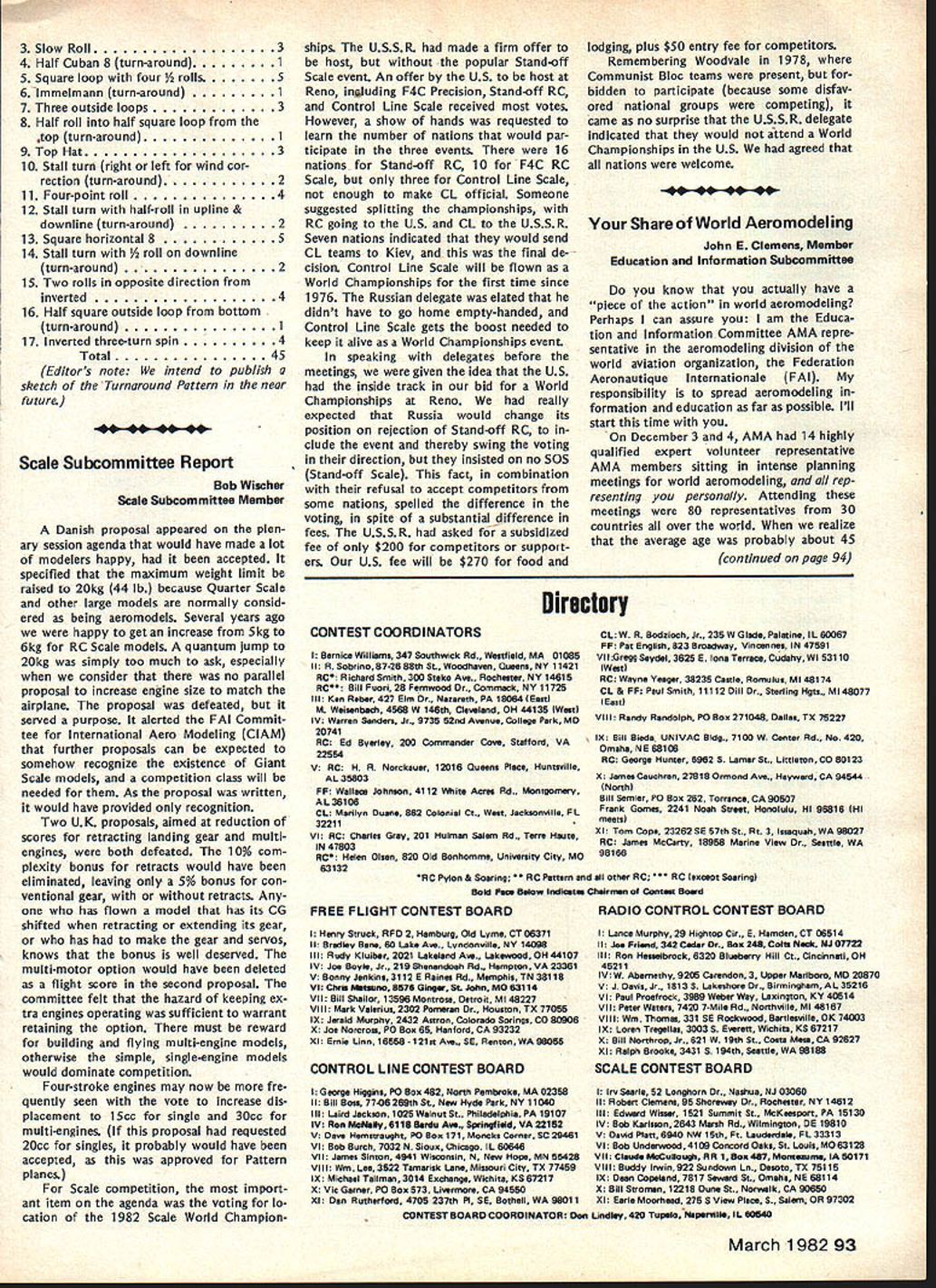
- b. Schedule of maneuvers: Three additional maneuvers were approved: Vertical Downwards 4-Point Roll; Four-Turn Spin (two in opposite directions); Rolling Circle with 4 Rolls (inside or outside).
- c. Definition of attempt: New wording was approved for 5.1.6.
- d. Landing penalty: A 10-point penalty was approved when 10 minutes expires prior to wheels touching the ground and after the last airborne maneuver is completed.
- e. Noise penalty: It was approved that a competitor who twice fails the noise test will be disqualified (test on the stand).
- f. K-Factors: K-factors for six maneuvers were changed.
- g. Reverse Top Hat: Pauses were added before and after the half-roll in both vertical legs.
- h. New schedule: Effective 1984, a new "turn-around" schedule of 17 maneuvers was approved.
- i. Classification: Effective 1984, new wording replaces the current 5.1.10 of Annex 5A.
- Pylon Racing
- a. Safety: It was approved to delete the current wording of 5.1.12.6 and replace it to prevent further takeoffs once the first model has circled the course; effective January 1, 1982.
- Thermal Soaring
- a. Number of rounds: The competitor's right to a minimum five-round schedule was approved, weather and other factors permitting.
- b. Launch position: Approved wording: at the moment of release of the model from the hands of the pilot (or helper), the latter must be standing on or in front of a line through the winch perpendicular to the towline between the model and the turnaround.
- c. Hand-operated pulleys: The tow line must not exceed 175 meters when tested under a tension of 2 kg. One end of the towline must be attached to the ground during launching.
- d. Line strength: It was approved to add to 5.3.2.2.b(a3): "The breaking strain of the line used shall be between 40 and 50 kg when tested by the organizers."
- e. Powered Winch (5.3.2.2.b(a3) rewritten): Line length must not exceed 400 meters. Upwind turnaround device, which must be used, must be placed at least 200 meters from the winch. Release of the model from the hands of the competitor or helper must not take place behind the winch. Electrical power supply is limited to a nominal 12 volts. Winches must be provided with an automatic means to prevent unwinding of the towline during the launch.
- f. 5.3.2.3: It was approved to delete the last sentence in paragraph e) to remove the 1-point penalty for each flown second over the 9-minute flight time.
- g. 5.3.2.5: It was approved to require flying the speed course four times instead of only two and to extend the time from four minutes to five.
- Slope Soaring
- Proposals from Austria were referred to the subcommittee for further study and recommendation.
- Helicopters
- a. 5.4.3: The portion of the F.R.G. proposal concerning weight was withdrawn, but the portion pertaining to Yaw Rate Gyros was referred to the subcommittee.
- b. Maximum weight was approved for increase to 6 kg, without fuel.
- c. 5.4.13 was approved for deletion as it is incorrect.
- d. The description of one maneuver was rewritten, and two maneuvers were deleted and replaced with new ones: 5.4.13.4.7 (old text deleted and rewritten); 5.4.13.6.9, Pirouette K-6 replaced by Point Pirouette, K-9; 5.4.13.11.4, the Cuban Eight, K-9 replaced by Observation, K-10.
E. Scale
- Control Line
- a. Maximum weight: 6.2.1 was changed from "with fuel" to "without fuel." Also raised from 5 kg to 6 kg.
- b. Optional Demonstration: 6.2.8.a — A new optional maneuver (6.2.8.n.) was added, described the same as 6.2.8.m. It was approved to permit two such maneuvers, provided the second is different from the first.
- Radio Control
- a. Motive power: 15 cc maximum was approved for 4-stroke engines, up to 30 cc total for multi-engine models of this type.
- b. Takeoff: 6.3.7.1.b — Some changes were approved.
- c. Landing: 6.3.7.12 — It was approved to change the Landing Circle to 35 meters diameter and to increase the K-factor for landing outside the circle to 6.
- d. 6.3.8.b and 6.3.8.c: Proposals concerning landing gear and flaps were approved.
- e. Split S, 6.3.8.h: Wording changed for clarification.
- f. 6.3.8.p: Special maneuvers for the prototype — It was approved to permit two such maneuvers, provided the second is different from the first.
XI. Records
- The agenda proposal to provide relief for pilots on long flights was approved.
XII. International Contest Calendar
- After some modifications, the 1982 calendar was approved.
XIII. 1982 Meetings
- A. Bureau — Paris, April 16.
- B. Plenary — Paris, December 2–3.
The 1981 CIAM Meeting
D. George Buso, Observer
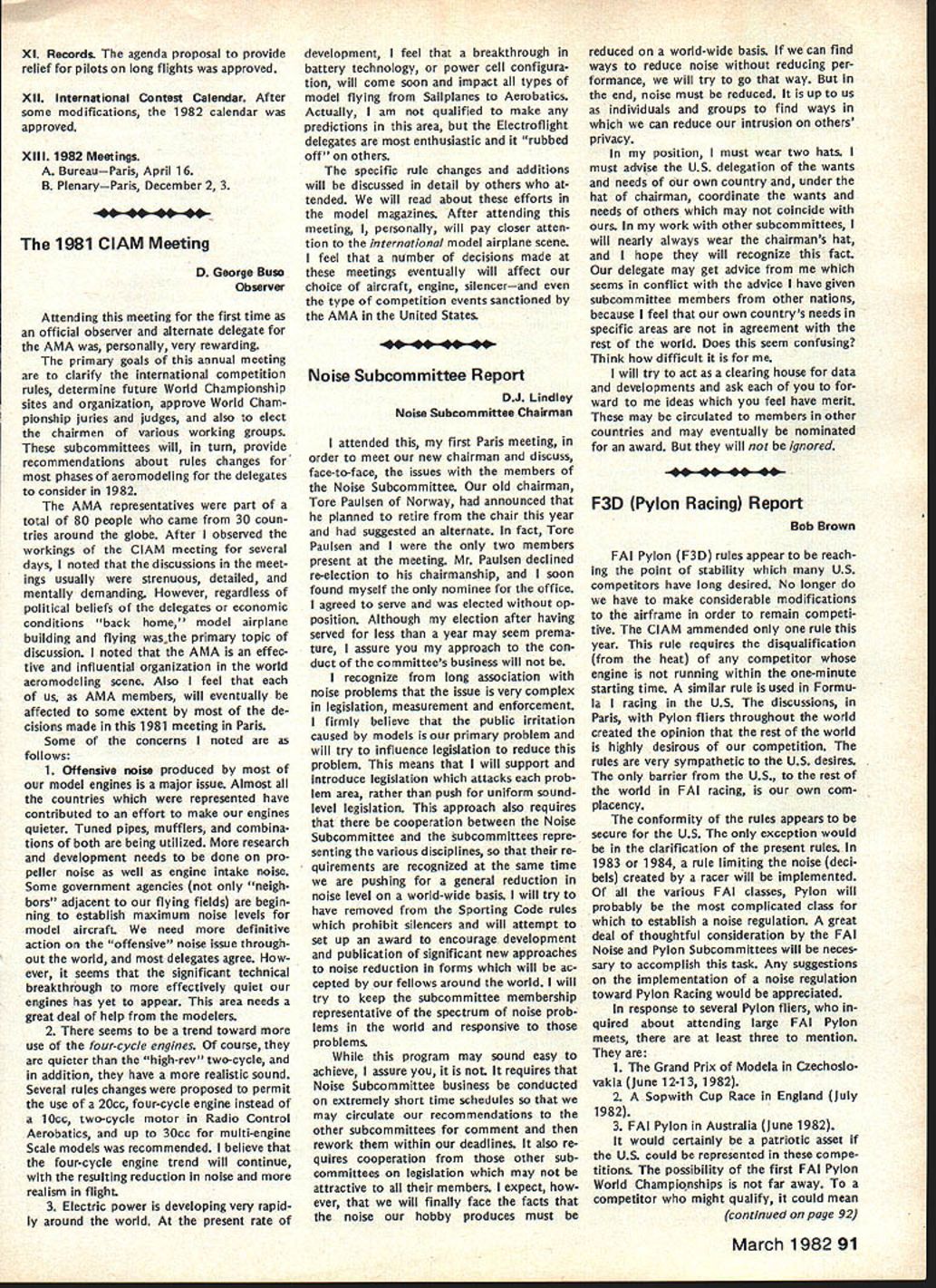
Attending this meeting for the first time as an official observer and alternate delegate for the AMA was, personally, very rewarding.
The primary goals of this annual meeting are to clarify the international competition rules, determine future World Championship sites and organization, approve World Championship juries and judges, and elect the chairmen of various working groups. These subcommittees will, in turn, provide recommendations about rules changes for most phases of aeromodelling for the delegates to consider in 1982.
The AMA representatives were part of a total of 80 people who came from 30 countries around the globe. After I observed the workings of the CIAM meeting for several days, I noted that the discussions were usually strenuous, detailed, and mentally demanding. However, regardless of the political beliefs of the delegates or economic conditions "back home," model airplane building and flying was the primary topic of discussion. I noted that the AMA is an effective and influential organization in the world aeromodelling scene. Also, I feel that each of us, as AMA members, will eventually be affected to some extent by most of the decisions made in this 1981 meeting in Paris.
Some of the concerns I noted are as follows:
- Noise
- Offensive noise produced by most model engines is a major issue. Almost all countries represented have contributed to efforts to make engines quieter. Tuned pipes, mufflers, and combinations of both are being utilized.
- More research and development needs to be done on propeller noise as well as engine intake noise. Some government agencies are beginning to establish maximum noise levels for model aircraft.
- More definitive action on offensive noise is needed worldwide, although a significant technical breakthrough to more effectively quiet engines has yet to appear.
- Four-cycle engines
- There is a trend toward more use of four-cycle engines. They are quieter than high-rev two-cycle engines and have a more realistic sound.
- Several rules changes were proposed to permit use of a 20 cc four-cycle engine instead of a 10 cc two-cycle motor in Radio Control Aerobatics, and up to 30 cc for multi-engine Scale models.
- I believe the four-cycle engine trend will continue, reducing noise and increasing realism in flight.
- Electric power
- Electric power is developing rapidly worldwide. A breakthrough in battery technology or power cell configuration could impact all types of model flying from sailplanes to aerobatics.
- Electrolight delegates are enthusiastic, and that enthusiasm spread to others.
The specific rule changes and additions will be discussed in detail by others who attended. After attending this meeting, I will pay closer attention to the international model airplane scene.
I feel that a number of decisions made at these meetings will eventually affect our choice of aircraft, engine, silencer—and even the type of competition events sanctioned by the AMA in the United States.
Noise Subcommittee Report
D.J. Lindley, Noise Subcommittee Chairman
I attended my first Paris meeting to meet our new chairman and discuss, face-to-face, issues with the members of the Noise Subcommittee. Our old chairman, Tore Paulsen of Norway, had announced he planned to retire and had suggested an alternate. Tore Paulsen and I were the only two members present at the meeting. Mr. Paulsen declined re-election to his chairmanship, and I soon found myself the only nominee for the office. I agreed to serve and was elected without opposition.
I recognize from long association with noise problems that the issue is very complex in legislation, measurement, and enforcement. I firmly believe that public irritation caused by models is our primary problem and will try to influence legislation to reduce this problem. This means I will support and introduce legislation which attacks each problem area, rather than push for uniform sound-level legislation.
This approach requires cooperation between the Noise Subcommittee and the subcommittees representing the various disciplines, so that their requirements are recognized while we push for a general reduction in noise level worldwide. I will try to have removed from the Sporting Code rules that prohibit silencers and will attempt to set up an award to encourage development and publication of significant new approaches to noise reduction in forms acceptable to modelers worldwide. I will try to keep the subcommittee membership representative of the spectrum of noise problems and responsive to those problems.
This program is not easy to achieve. It requires the Noise Subcommittee business to be conducted on extremely short timelines so we may circulate recommendations to other subcommittees for comment and rework within short deadlines. It also requires cooperation from those other subcommittees on legislation that may not be attractive to all their members. I expect that we will finally face the fact that the noise our hobby produces must be reduced worldwide. If we can find ways to reduce noise without reducing performance, we will pursue them. But in the end, noise must be reduced. It is up to us as individuals and groups to find ways to reduce our intrusion on others' privacy.
In my position I must wear two hats. I must advise the U.S. delegation of our country's wants and needs and, under the hat of chairman, coordinate the wants and needs of others which may not coincide with ours. In my work with other subcommittees, I will nearly always wear the chairman's hat, and I hope they will recognize this. Our delegate may get advice from me that seems in conflict with the advice I have given subcommittee members from other nations, because our country's needs in specific areas may not agree with the rest of the world. It is a difficult role.
I will act as a clearing house for data and developments and ask each of you to forward ideas you feel have merit. These may be circulated to members in other countries and may eventually be nominated for an award. They will not be ignored.
F3D (Pylon Racing) Report
Bob Brown
FAI Pylon (F3D) rules appear to be reaching the point of stability many U.S. competitors have long desired. No longer do we have to make considerable modifications to the airframe to remain competitive. CIAM amended only one rule this year: disqualification from the heat of any competitor whose engine is not running within the one-minute starting time. A similar rule is used in Formula 1 racing in the U.S.
Discussions in Paris with Pylon fliers throughout the world created the opinion that the rest of the world is highly desirous of our competition. The rules are sympathetic to U.S. desires. The only barrier from the U.S. to the rest of the world in FAI racing is our own complacency.
The conformity of the rules appears secure for the U.S., the only exception being the need for clarification of present rules. In 1983 or 1984, a rule limiting the noise (decibels) created by a racer will be implemented. Pylon will probably be the most complicated class for which to establish a noise regulation. A great deal of thoughtful consideration by the FAI Noise and Pylon Subcommittees will be necessary. Any suggestions on the implementation of a noise regulation toward Pylon Racing would be appreciated.
In response to inquiries about attending large FAI Pylon meets, at least three were mentioned:
- The Grand Prix of Modela in Czechoslovakia (June 12–13, 1982).
- A Sopwith Cup Race in England (July 1982).
- FAI Pylon in Australia (June 1982).
It would be a patriotic asset if the U.S. could be represented at these competitions. The possibility of the first FAI Pylon World Championship is not far away. To a competitor who might qualify, it could mean a trip outside the U.S. at AMA expense.
FAI Pylon Race (continued)
A trip outside the U.S. at AMA expense could be a possibility for a qualifying competitor. Does the current Formula I competition offer this?
F3B (Thermal Soaring) Report
Dan Pruss
The recent CIAM revived memories of controversies from the World Championships last July.
The most controversial agenda items this year were the Distance task (Task B) and the winches.
Task B proposals fell into three schools:
- Drop the event.
- Eliminate the 12-lap cap.
- Fly the event man-on-man.
- The first had some support, mainly from those who don't appreciate a sailplane's true performance measure.
- The elimination of the 12-lap cap had the strongest support, backed by studies from Swiss and Austrian clubs covering contests from 1977 through 1981. Their studies suggest the cap hinders a flier trying to make up for a poor flight.
- Man-on-man received little support due to problems observed in European contests: poor frequency control, re-flight problems, and non-random draws. Man-on-man would be considered only if a truly random selection could be guaranteed. Result: no change in Task B.
Winch proposals ranged from banning winches to imposing strict restrictions. Concerns included line stretching, models released 30 meters behind the winch, missile-like launches using 24-volt winches, and remote launching (all observed in Sacramento).
Settled measures:
- Electrical power limited to 12 volts.
- Breaking strain of the line shall be between 40 and 50 kg when tested by the organizers. (The original Australian proposal of 75 kg was reduced because one-millimeter monofilament line users required lower strength.)
Launch positions:
- For Tasks A and B, the release must be forward of the winch.
- For Task C, the model may be released along a line at right angles to the winch line and extending towards the safety line, to equalize advantage.
Other changes:
- Denmark proposed changing two-lap Speed to four laps; this was a notable proposal. Working time was changed to five minutes.
- The pulley system with a 75-meter line was approved. Regular hand tow remains at 150 meters.
- Five rounds must be flown to allow a throwaway round (instead of six or more under the old rule). For a World Championship, five rounds must be flown.
- The 7.5 mm nose radius is now official.
New organizer-friendly rules:
- Organizers may indicate launch direction, based on wind direction, before each preparation time.
- No second stopwatch will be required for timers during the Duration task because the new rule deletes the point reduction after nine minutes; the flier loses landing points, which will tend to limit overlong flights.
Not all was controversy. Fond memories of Sacramento included hospitality and helpfulness among competitors and teams, generosity with parts and support, and memorable moments like first-time sailplane rides arranged for visiting teams. These memories often outlast disputes over rules changes.
F3A (RC Aerobatics) Report
Ron Chidgey, RC Aerobatics Subcommittee Chairman
The current FAI RC Aerobatics (F3A) rules have been in force since 1978 with only minor revisions. The elimination of the A and B schedules was the biggest prior change, but the basic pattern has remained. For the 1983 World Championships we will fly essentially the same rules as now; the big change will arrive in 1984 with a new "turn-around" schedule effective for the 1985 World Championships.
Changes applicable for the present rules (effective January 1, 1983):
- Engine displacement
- Switzerland proposed, and it was approved, to increase allowable displacement of four-stroke engines to 20 cc and to allow electric motors of unlimited size. Two-stroke engines remain limited to 10 cc.
- Additional maneuvers
- Switzerland's proposal to add maneuvers was approved: Vertical downward 4-point roll (K=4); Four-turn spin (two in opposite directions) (K=4); Rolling circle with 4 rolls (rolling direction optional) (K=5). These are high K-factor maneuvers that can be done with reduced power and low noise.
- Definition of "attempt"
- New wording: "There is an attempt when the competitor is given permission to start. N.B. If the model fails to commence the takeoff within the three minutes allowed, the competitor must immediately make room for the next competitor. If, when the motor stops after the takeoff roll has begun but before the model is airborne, it may be restarted within the three-minute starting period."
- Landing-time penalty
- Since landing is no longer scored, a new penalty for failure to observe the 10-minute flight limit was established: a 10-point penalty if the 10 minutes expire after the last maneuver is completed but before the wheels touch the ground.
- Noise penalties
- A competitor who fails the noise test more than once will be disqualified (the test on the stand, not a spot check on the line).
- K-Factor changes
- The K-factor for several maneuvers was adjusted:
- Rolling Eight: K from 2 to 3.
- Three Reverse Outside Loops: K from 3 to 4.
- Inverted Spin: K from 3 to 4.
- Square Horizontal 8: K from 4 to 5.
- Aileron Turn: K from 3 to 2.
- Reverse Point Roll: K from 4 to 2.
- Reverse Top Hat
- The maneuver description was made compatible with the regular Top Hat, adding pauses before and after the half-rolls.
Note: These changes do not become effective until January 1983 for the FAI, although the U.S. may implement them earlier domestically.
Turn-around schedule
- The turn-around pattern was first presented last year and approved in principle. This year a schedule was proposed and adopted for the 1985 World Championships and will become effective January 1, 1984. The primary reason for adopting a turn-around pattern is to reduce the noise footprint and thereby reduce nuisance.
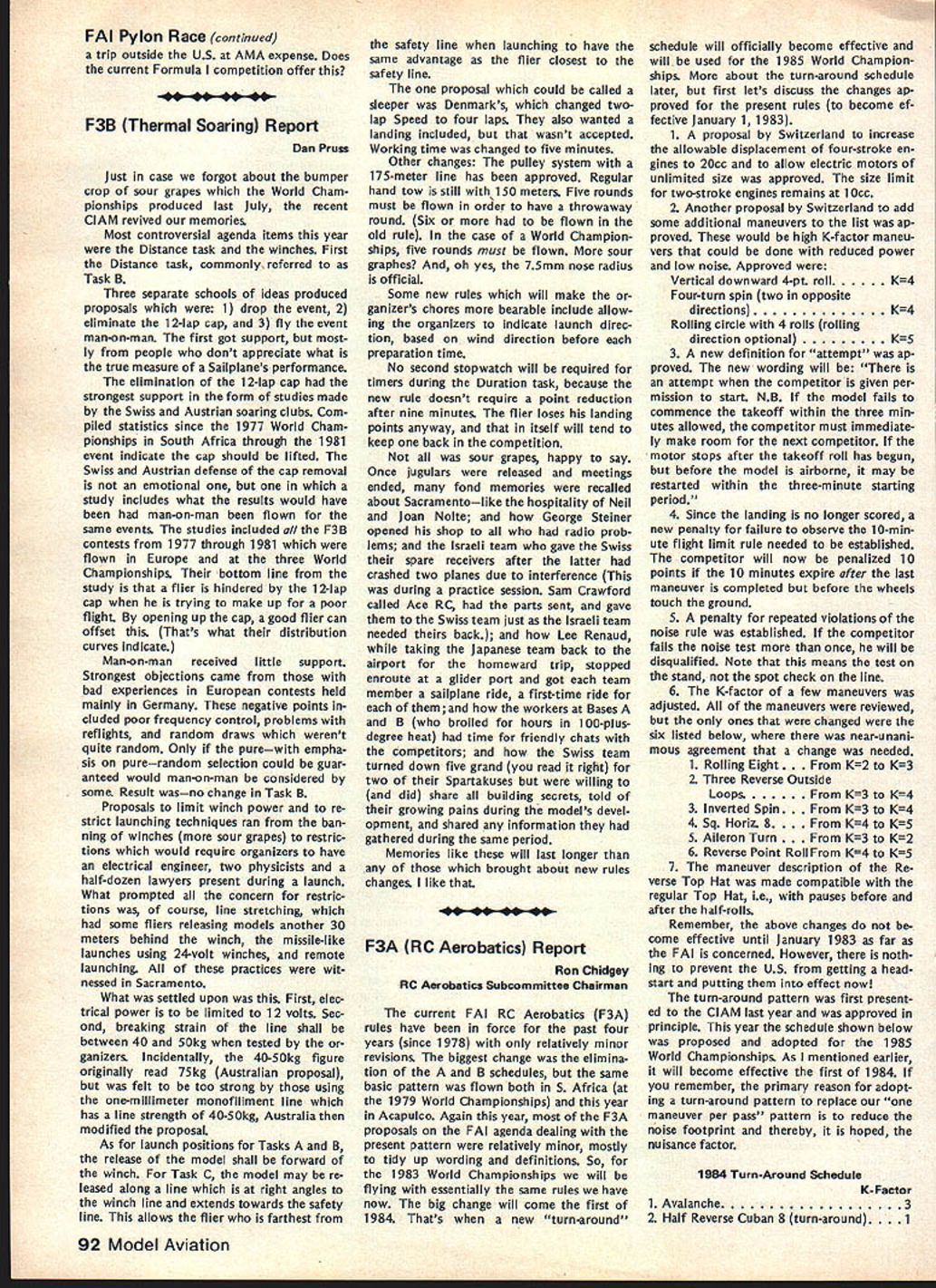
1984 Turn-Around Schedule (excerpt)
- Avalanche — K=3
- Half Reverse Cuban 8 (turn-around) — K=1
(Editor's note: A sketch of the Turnaround Pattern is intended for future publication.)
Scale Subcommittee Report
Bob Wischer, Scale Subcommittee Member
A Danish proposal on the plenary agenda sought to raise the maximum weight limit to 20 kg (44 lb.), recognizing Quarter Scale and other large models as aeromodels. Several years ago the limit was raised from 5 kg to 6 kg for RC Scale models. A jump to 20 kg was considered too large, especially with no parallel proposal to increase engine size. The Danish proposal was defeated, but it alerted CIAM that proposals to recognize Giant Scale models and a competition class for them can be expected.
Two U.K. proposals aimed at reducing scores for retracting landing gear and multi-engines were both defeated. One would have eliminated the 10% complexity bonus for retracts, leaving only a 5% bonus for conventional gear, with or without retracts. The committee felt the retract bonus is deserved given the CG shift and mechanical complexity involved. The second proposal would have deleted the multi-motor option as a flight score; this was also defeated because operating extra engines carries sufficient hazard to warrant reward for building and flying multi-engine models.
Four-stroke engines may become more common with the vote to increase displacement to 15 cc for single engines and 30 cc for multi-engines. (A 20 cc limit for singles likely would have been accepted if proposed.)
Selection of the 1982 Scale World Championships was the most important item. The U.S.S.R. offered to host but without the popular Stand-off Scale event. The U.S. offered to host at Reno, including F4C Precision, Stand-off RC, and Control Line Scale, and received most votes. A show of hands indicated 16 nations for Stand-off RC, 10 for F4C RC Scale, but only three for Control Line Scale — not enough to make CL official there. Someone suggested splitting the championships: RC to the U.S. and CL to the U.S.S.R. Seven nations indicated they would send CL teams to Kiev, and that was the final decision. Control Line Scale will be flown as a World Championship for the first time since 1976.
The U.S. expected Russia might change its position and include Stand-off RC, but they insisted on no SOS (Stand-off Scale). Their refusal to accept competitors from some nations also influenced voting despite a substantial fee difference. The U.S.S.R. had asked for a subsidized fee of $200 for competitors or supporters. The U.S. fee will be $270 for food and lodging, plus a $50 entry fee for competitors.
With delegates averaging about 30 years' experience and many delegates attending, the total expertise present at CIAM was overwhelming — on the order of thousands of years of combined modeling and leadership experience. This expertise went into decisions affecting the hobby and sport worldwide.
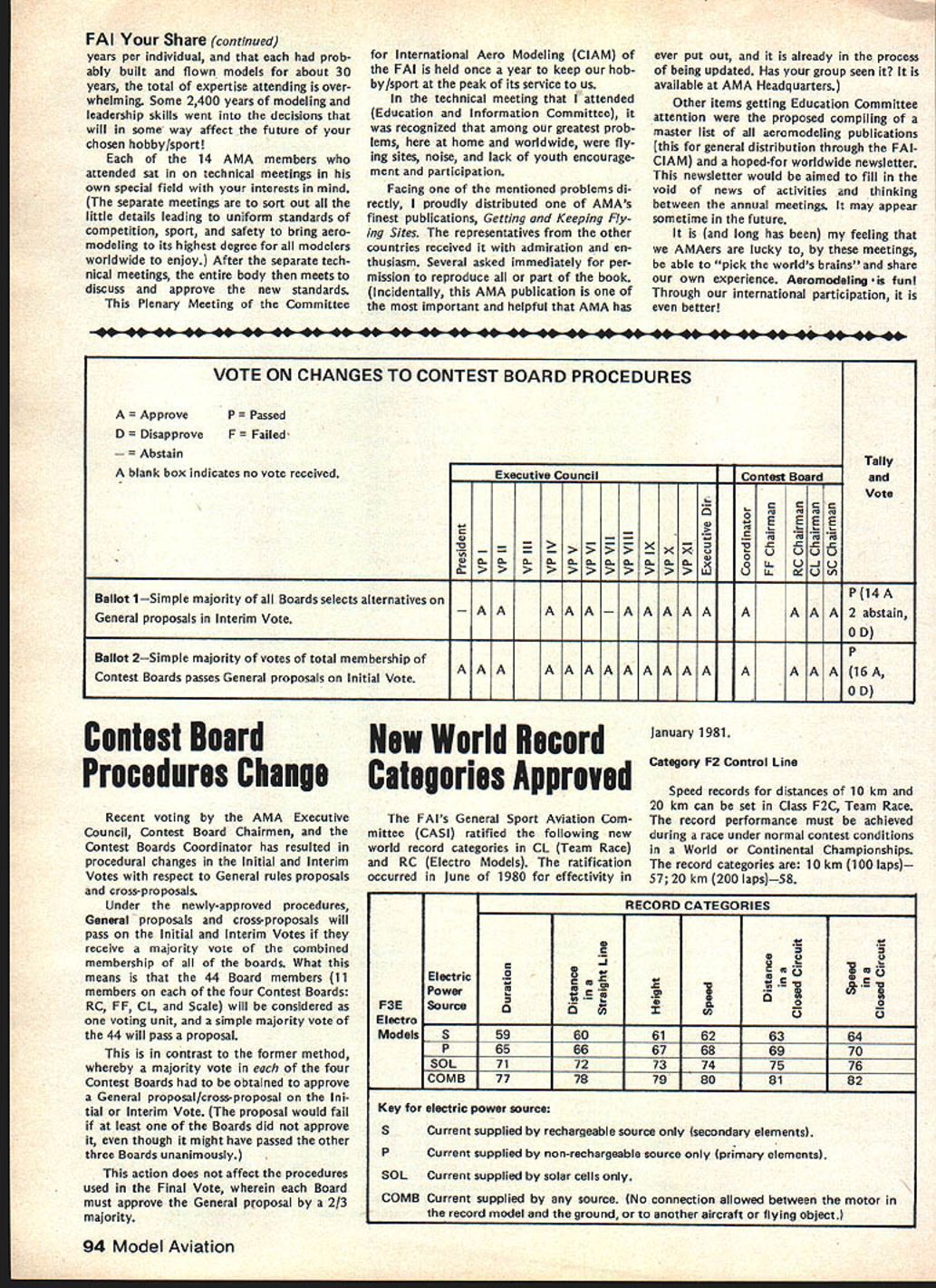
Each of the 14 AMA members who attended sat in on technical meetings in his own special field with U.S. interests in mind. The separate technical meetings sort out details leading to uniform standards of competition, sport, and safety. After technical meetings, the entire body meets to discuss and approve new standards. The annual Plenary Meeting of CIAM is held once a year to keep the hobby/sport at a high level.
In the technical meeting I attended (Education and Information Committee), flying sites, noise, and lack of youth encouragement and participation were recognized as major problems.
I distributed AMA's publication Getting and Keeping Flying Sites, which was received with admiration and enthusiasm by other countries; several asked permission to reproduce parts of it. This AMA publication is important and is being updated.
Other Education Committee items included compiling a master list of aeromodelling publications for general distribution through FAI-CIAM and the idea of a worldwide newsletter to fill news gaps between annual meetings.
It is my feeling that AMA members benefit from picking the world's brains at these meetings. Aeromodelling is fun, and international participation makes it even better.
F1D Rules Change: Another Voice
Thomas Vallee
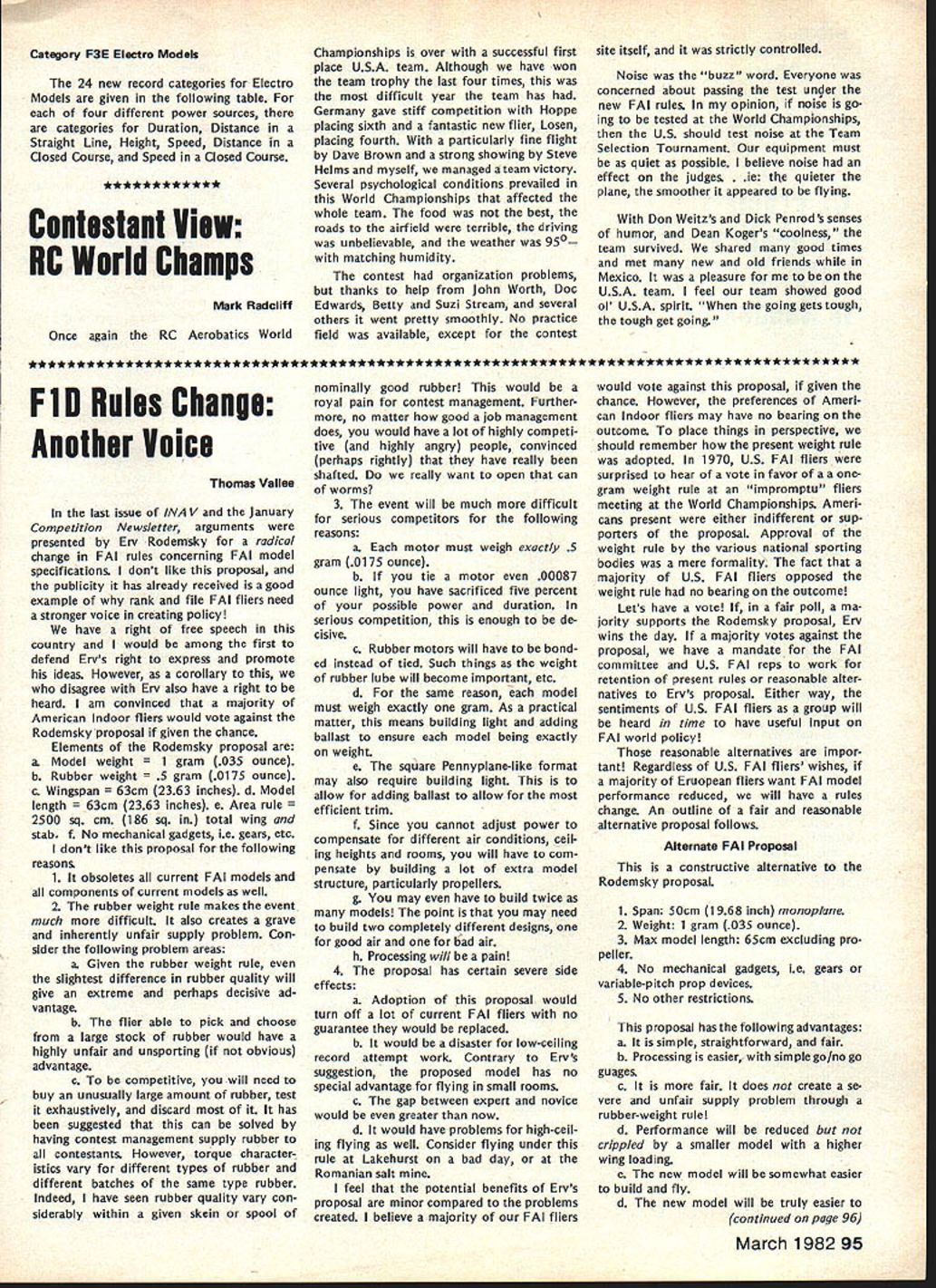
In previous issues, arguments were presented by Erv Rodemsky for a radical change in FAI rules concerning FAI indoor model specifications. I do not support this proposal, and the publicity it has received shows why rank-and-file FAI fliers need a stronger voice in creating policy.
I defend Erv's right to express and promote his ideas, but those who disagree also have a right to be heard. I am convinced a majority of American indoor fliers would vote against the Rodemsky proposal if given the chance.
Elements of the Rodemsky proposal:
- Model weight = 1 gram (0.035 ounce).
- Rubber weight = 0.5 gram (0.0175 ounce).
- Wingspan = 63 cm (23.63 inches).
- Model length = 63 cm (23.63 inches).
- Area rule = 2,500 sq. cm (186 sq. in.) total wing and stab.
- No mechanical gadgets, i.e. gears, etc.
I oppose this proposal for the following reasons.
- It obsoletes all current FAI models and components.
- The rubber weight rule creates a severe and unfair supply problem:
- Slight differences in rubber quality will give extreme and perhaps decisive advantages.
- A flier able to pick and choose from a large stock of rubber would have an unfair advantage.
- Competitive preparation would require buying large amounts of rubber, exhaustive testing, and discarding most of it.
- Supplying rubber to all contestants is not a satisfactory remedy because torque characteristics vary by type and batch; variation can occur even within a single skein.
- The event becomes much more difficult for serious competitors:
- Each motor must weigh exactly 0.5 gram.
- Small weight differences (e.g., 0.00087 ounce) can cost about 5% of possible power and duration.
- Rubber motors will likely have to be bonded instead of tied; lubricant weight and other details become critical.
- Each model must weigh exactly 1 gram, requiring precise ballast.
- The square Pennsylvania-like format may require building light to allow for ballast adjustments.
- Because power cannot be adjusted for varying air conditions, competitors may need multiple designs (e.g., different propellers) and possibly twice as many models.
- Processing will be onerous.
- Severe side effects:
- Adoption would turn off many current FAI fliers with no guarantee of replacements.
- Disaster for low-ceiling record attempts; the proposed model has no special advantage for small rooms.
- The gap between expert and novice would widen.
- Problems for high-ceiling flying on days with poor conditions.
I believe the potential benefits are minor compared to the problems created. A fair poll of U.S. FAI fliers would be desirable to determine sentiment and provide a mandate for U.S. reps.
Alternate FAI Proposal (constructive alternative to Rodemsky)
- Span: 50 cm (19.68 inch) monoplane.
- Weight: 1 gram (0.035 ounce).
- Max model length: 65 cm excluding propeller.
- No mechanical gadgets, i.e., gears or variable-pitch devices.
- No other restrictions.
Advantages:
- Simple, straightforward, and fair.
- Processing is easier with simple go/no-go gauges.
- Avoids a severe rubber-weight supply problem.
- Performance is reduced but not crippled by a smaller model with higher wing loading.
- The new model would be somewhat easier to build and fly.
- Better suited to small rooms and smaller model boxes.
I believe a majority of FAI fliers would prefer to fly under the present rules. If a change is inevitable, we should search for fair alternatives like the one above.
As I sit here holding my 0.5-gram, 5.5-inch loop of .062 rubber, the need for action seems obvious.
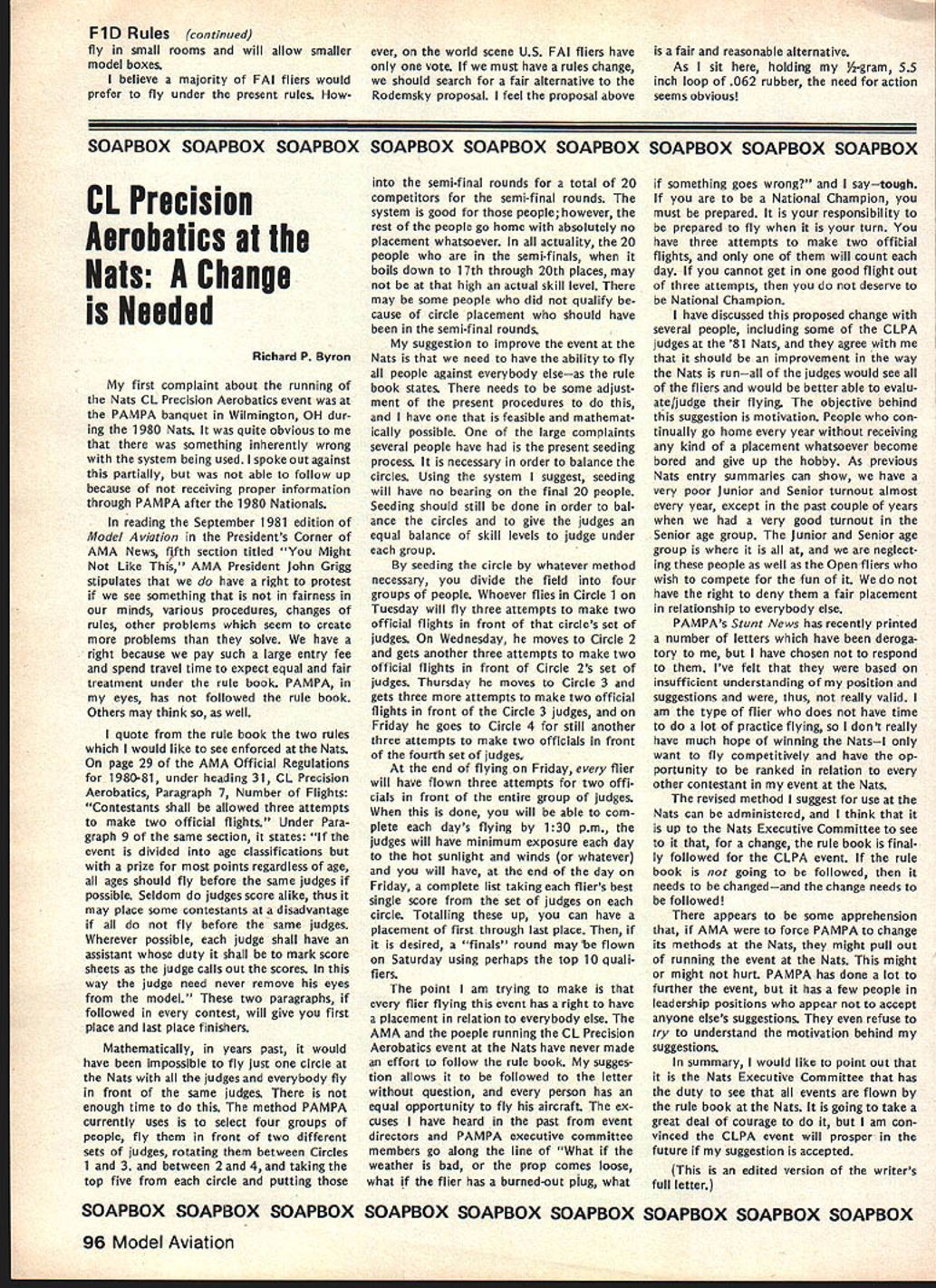
F1D Rules (continued)
- The alternate proposal would allow easier flying in small rooms and permit smaller model boxes.
- If a fair poll shows majority support for Rodemsky's ideas, he should prevail; if not, U.S. FAI reps should work to retain present rules or pursue reasonable alternatives.
(End of reformatted text.)
Transcribed from original scans by AI. Minor OCR errors may remain.

