
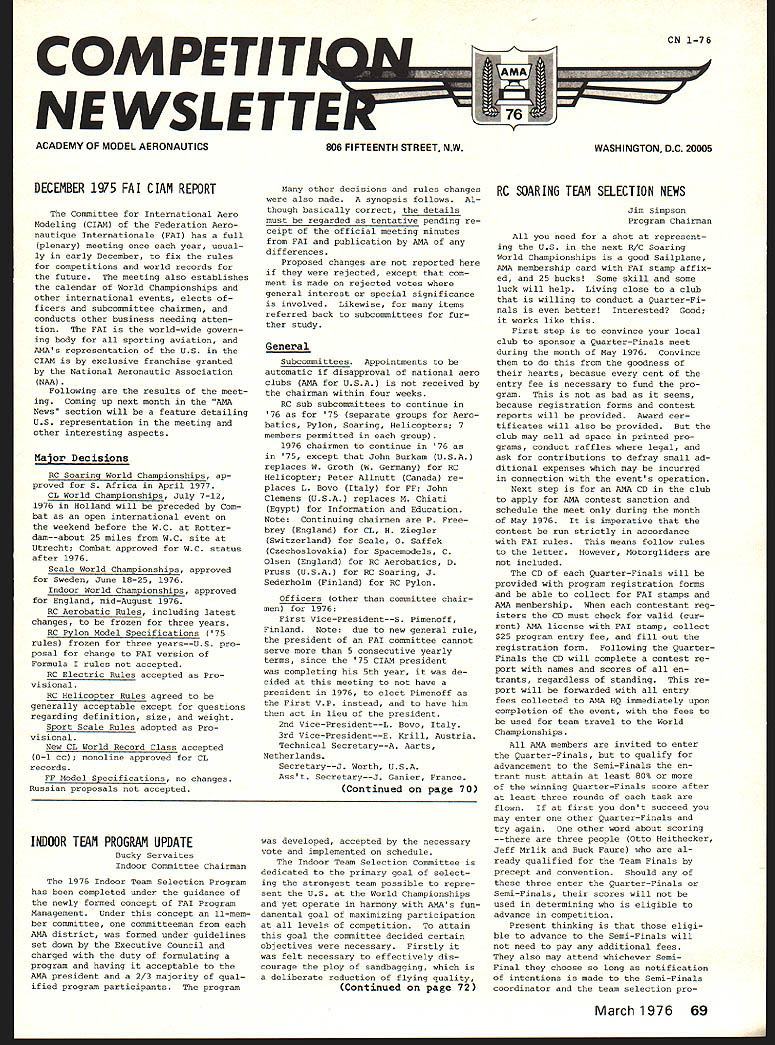
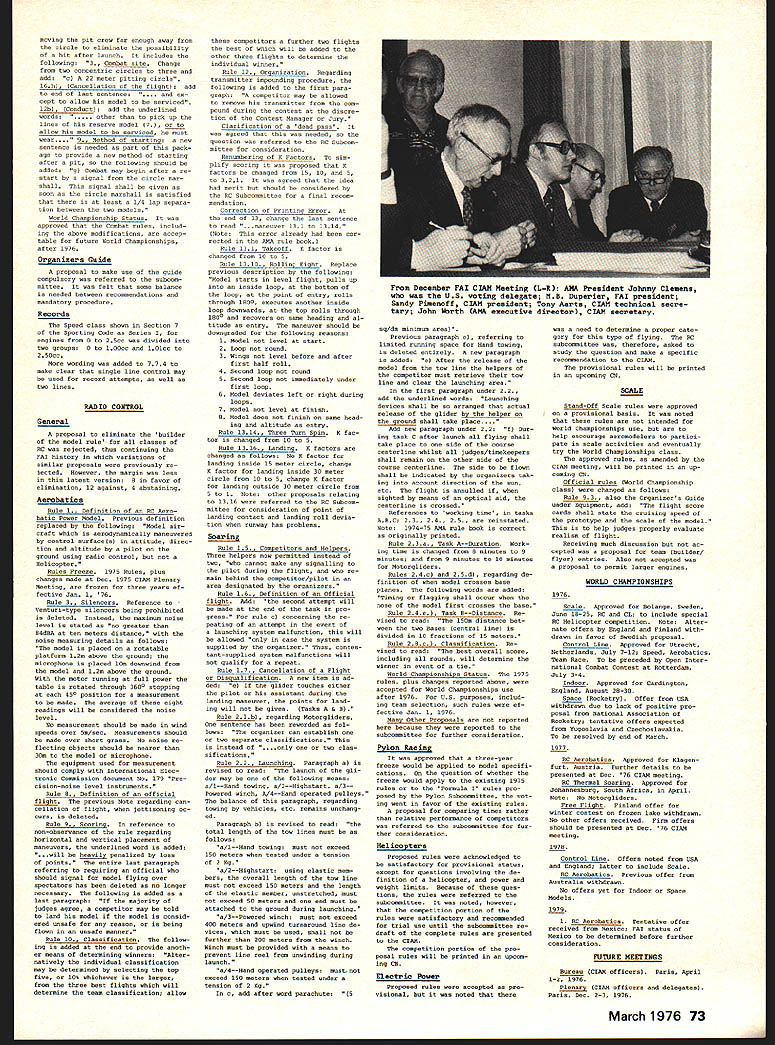
DECEMBER 1975 FAI CIAM REPORT
The Committee for International Aero Modeling (CIAM) of the Federation Aeronautique Internationale (FAI) has a full (plenary) meeting once each year, usually in early December, to fix the rules for competitions and world records for the future. The meeting also establishes the calendar of World Championships and other international events, elects officers and subcommittee chairmen, and conducts other business needing attention. The FAI is the world-wide governing body for all sporting aviation, and AMA's representation from the U.S. in CIAM is by exclusive franchise granted by the National Aeronautic Association (NAA).
Following are the results of the meeting. Coming up next month the AMA News section will feature a detailing U.S. representation in the meeting and other interesting aspects.
Major Decisions
RC Soaring World Championships, approved for S. Africa in April 1977.
CL World Championships, July 7-12, 1976 in Holland will be preceded by Combat open international event the weekend before. MC Rotterdam — about 25 miles from W.C. site at Utrecht; Combat approved for W.C. status after 1976.
Scale World Championships, approved for Sweden, June 18-25, 1976.
Indoor World Championships, approved for England, mid-August 1976.
RC Aerobatic Rules, including latest changes, frozen three years.
RC Pylon Model Specifications (75 rules) frozen three years — U.S. proposal for change to FAI version of Formula 1 rules not accepted.
RC Electric Rules accepted as provisional.
RC Helicopter Rules agreed to be generally acceptable except for questions regarding definition, size, and weight.
Sport Scale Rules adopted as provisional.
New CL World Record Class accepted (0–1 cc) monoline approved for CL records.
FF Model Specifications, no changes.
Russian proposals not accepted.
Many other decisions and rules changes were also made. A synopsis follows. Although basically correct, the details must be regarded as tentative pending receipt of the official meeting minutes from FAI and publication by AMA of any differences.
Proposed changes are not reported here if they were rejected, except that comment is made on rejected votes where general interest or special significance is involved. Likewise, for many items, referred back to subcommittees for further study.
General
Subcommittees: Appointments to be automatic if disapproval of national aero clubs (AMA for U.S.A.) is not received by the chairman within four weeks.
RC sub-subcommittees to continue in '76 as for '75 (separate groups for Aerobatics, Pylon, Soaring, Helicopters; 7 members permitted in each group). 1976 chairmen to continue in '76, '75 except that John Surkam (U.S.A.) replaces W. Groth (W. Germany) for RC Helicopter; Peter Allnutt (Canada) replaces L. Sovo (Italy) for F.F.; John Clemens (U.S.A.) replaces N. Chiati (Egypt) for Information and Education. Note: Continuing chairmen are P. Freebrey (England) for C.L.; H. Ziegler (Switzerland) for Scale; O. Saffek (Czechoslovakia) for Spacemodels; C. Olsen (England) for RC Aerobatics; D. Pruss (U.S.A.) for RC Soaring; J. Sederholm (Finland) for RC Pylon.
Officers (other than committee chairmen) for 1976:
First Vice‑President — S. Pimenoff, Finland. Note: due to new general rule, the president of an FAI committee cannot serve more than 5 consecutive yearly terms. Since the '75 CIAM president completed his 5th year, it was decided at this meeting to have the president in 1976 elected by the meeting; Pimenoff was elected First Vice‑President and will act in lieu of the president.
2nd Vice‑President — L. Bovo, Italy.
3rd Vice‑President — E. Erill, Austria.
Technical Secretary — A. Aarts, Netherlands.
Secretary — J. Worth, U.S.A.
Asst. Secretary — J. Ganier, France.
Soaring Selection (Cont.)
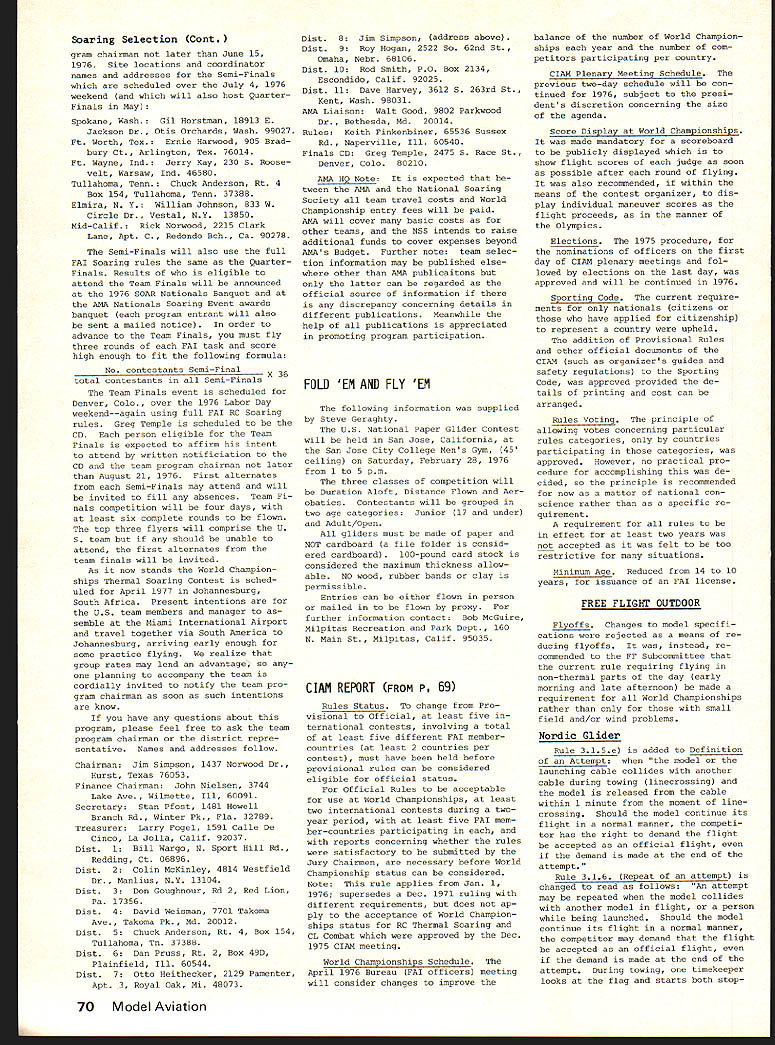
program chairman not later than June 15, 1976. Site locations and coordinators named and addresses for the Semi‑Finals which are scheduled over the July 4, 1976 weekend (and which will also host Quarter Finals in May):
- Spokane, Wash.: Gil Horstman, 18913 E. Jackson Dr., Otis Orchards, Wash. 99027.
- Ft. Worth, Tex.: Ernie Harwood, 905 Broadway Ct., Arlington, Tex. 76014.
- Ft. Wayne, Ind.: Jerry Ray, 230 S. Roosevelt, Warsaw, Ind. 46580.
- Tullahoma, Tenn.: Chuck Anderson, Rte. 4, Box 154, Tullahoma, Tenn. 37388.
- Elmira, N.Y.: William Johnson, 833 W. Circle Dr., Vestal, N.Y. 13850.
- Redondo Beach, Calif.: Rick Norwood, 2215 Clark Lane, Apt. C, Redondo Beach, Calif. 90278.
The Semi‑Finals will also use the full FAI Soaring rules the same as the Quarter‑Finals. Results of who is eligible to attend the Team Finals will be announced at the 1976 Soar Nationals Banquet and at the AMA National Soaring Event Awards banquet (each program entrant will also be sent a mailed notice). In order to advance to the Team Finals, you must fly three rounds of each FAI task and score high enough to meet the following formula:
total contestants in all Semi‑Finals X 36 ----------------------------------------- No. contestants in Semi‑Final
The Team Finals event is scheduled for Denver, Colo., over the 1976 Labor Day weekend — again using full FAI RC Soaring rules. Greg Temple is scheduled to be the CD. Each person eligible for the Team Finals is expected to affirm his intent to attend by written notification to the CD and the team program chairman not later than August 2, 1976. First alternates from each Semi‑Final may attend and will be invited to fill any absences. Team Finals competition will be four days, with at least six complete rounds to be flown. The top three flyers will comprise the U.S. team but if any should be unable to attend, the first alternates from the team finals will be invited.
It now stands the World Championships Thermal Soaring Contest is scheduled for April 1977 in Johannesburg, South Africa. Present intentions are for the U.S. team members and manager to assemble at the Miami International Airport and travel together via South America to Johannesburg, arriving early enough for some practice flying. We realize that group rates may lead an advantage, so anyone planning to accompany the team is cordially invited to notify the team program chairman as soon as such intentions are known.
If you have any questions about this program, please feel free to ask the team program chairman or the district representative. Names and addresses follow.
Chairman: Jim Simpson, 1437 Norwood Dr., Hurst, Texas 76053. Finance: John Nielsen, 3744 Lake Ave., Wilmette, Ill. 60091. Secretary: Stan Pfost, 1481 Howell Branch Rd., Winter Park, Fla. 32803. Treasurer: Larry Fogel, 1591 Calle De Cinco, La Jolla, Calif. 92037. Dist. 1: Bill Ryan, 9 Sport Hill Rd., Redding, Ct. 06896. Dist. 2: Colin McKinley, 4814 Westfield Dr., Manlius, N.Y. 13104. Dist. 3: Don Coughenour, Rte. 2, Red Lion, Pa. 17356. Dist. 4: David Weisman, 7701 Takoma Ave., Takoma Park, Md. 20012. Dist. 5: Chuck Anderson, Rte. 4, Box 154, Tullahoma, Tenn. 37388. Dist. 6: Dan Pruss, Rte. 2, Box 49D, Plainfield, Ill. 60544. Dist. 7: Otto Heitmecker, 2129 Parmeter, Rte. 3, Royal Oak, Mich. 48073. Dist. 8: Jim Simpson (address above). Dist. 9: Roy Hogan, 2522 So. 62nd St., Omaha, Neb. 68106. Dist. 10: Rod Smith, P.O. Box 2134, Escondido, Calif. 92025. Dist. 11: Dave Harvey, 3612 S. 263rd St., Kent, Wash. 98031. AMA Liaison: Walt Good, 9802 Parkwood Dr., Bethesda, Md. 20014. Rules: Keith Frankenhower, 65536 Sussex Rd., Naperville, Ill. 60540. Finals CD: Greg Temple, 2475 S. Race St., Denver, Colo. 80210.
FOLD 'EM AND FLY 'EM
The following information was supplied by Steve Geraghty.
The U.S. National Paper Glider Contest will be held in San Jose, California, at the San Jose City College Men's Gym, 745 Connelly, on Saturday, February 28, 1976 from 1 to 5 p.m.
There are three classes of competition which will be Duration, Altitude, Distance. Duration and Altitude contestants will be grouped in two age categories: Junior (17 and under) and Adult/Open.
All gliders must be made of paper and must not have cardboard; a file folder is considered cardboard. 100‑pound card stock is considered the maximum thickness allowed — no wood, rubber bands or clay is permissible.
Entries can be either flown in person or mailed in to be flown by person. For further information contact: Bob McGuire, Milpitas Recreation and Park Dept., 1600 W. Main St., Milpitas, Calif. 95035.
CIAM REPORT (FROM P. 69)
Rules Status.
To change from Provisional to Official, at least five international contests, involving a total of at least five different FAI members (countries), must have been held before provisional rules can be considered eligible for official status.
For Official Rules to be acceptable for use at World Championships, at least two international contests during a two‑year period, with at least five FAI member countries participating in each, must report participation and experience with the rules satisfactory to be submitted by the organizing country. The acceptance for RC Thermal Soaring and CL Combat was approved by the Dec. 1975 CIAM meeting.
World Championships Schedule.
The April 1976 Bureau (FAI offices) meeting will consider changes to improve the balance of the number of World Championships each year and the number of competitors participating per country.
CIAM Plenary Meeting Schedule.
The previously two‑day schedule will be condensed to a one‑day meeting, subject to the program director's discretion concerning the size of the agenda.
Score Display at World Championships.
It was made mandatory for a scoreboard to be publicly displayed which is to show flight scores of each judge as soon as possible after each round of flying. The highest scores displayed are to be available to the public and will be used in the contest scoring.
Elections.
The 1975 procedure for nominations of officers on the first day of the CIAM meeting and for the election on the last day was approved and will be continued in 1976.
Sporting Code.
The current requirement for only nationals (citizens of the country) to be representatives to CIAM was upheld. The addition of provisional rules and other official documents will be coordinated by the CIAM secretary and the national aero clubs' organizers.
Rules Voting.
The principle of allowing votes concerning particular rules categories only by countries participating in those categories was approved. However, no practical procedure for accomplishing this was decided; the principle is recommended for national convenience rather than as a specific rule requirement.
Minimum Age.
Reduced from 14 to 10 years for issuance of an FAI license.
FREE FLIGHT OUTDOOR FLYOFFS
Changes to model specifications for outdoor free flight flyoffs were rejected as a means of increasing flyoffs. It was, instead, recommended to the FAI subcommittee that the current rules requiring flying in more than three parts of the day (early morning and late afternoon) be made a requirement at all World Championships rather than only for those with small fields and/or wind problems.
Nordic Glider
Rule 3.1.5.1.06 is added to the Definition of an Attempt: when the model or the launching cable collides with another cable during a multi‑person launch, the attempt is considered null and the model may be relaunched; specific conditions and time limits apply as set out in the rule. watches. The other timekeeper looks at the towline to detect collisions and tanglings, and he will time the 1 minute period as mentioned in 3.1.5.2) in case of a linecrossing. As soon as there is no more risk of collisions and tanglings, he takes his stopwatch and continues normal timekeeping.
Nordic Glider, Wakefield & Power
Rules 3.1.8., 3.2.8., 3.3.8., respectively, regarding classification, are changed to delete reference to only one attempt for each flyoff flight and to replace the requirement for a four‑minute flyoff launch period with a 15‑minute launch period. In addition, for a Power flyoff, the organizer must establish a straight starting line with at least 10 meters between each starting point; start positions to be decided by a draw for each flyoff.
Coupe d'Hiver
The following underlined words were added to clarify the intent that the model may be weighed without the rubber motor installed: "Minimum weight of model 70 grams, not including the rubber motor."
The two‑man proposal, to permit both 80 and 100 gram models, was rejected.
INDOOR FREE FLIGHT
Rule 3.4.4. Definition of an Official Flight. Thirty‑second minimum time replaced by sixty‑second minimum.
Rule 3.4.7. Steering of Model. Previous rule replaced with the following:
"Steering of models (use of balloon and line or rod). To prevent a model from colliding with the structure of the building or its contents, or other models, a balloon(s) with its line attached, or a rod 2 to 8 meters in length, may be used to alter the course of the model, or to reposition it in another part of the flying space. There will be no time limit or restriction to the number of steering attempts, except that all steering shall be done from the front end of the model and never from behind.
"During the steering the propeller may get caught in the line/balloon(s)/rod and stop revolving. A second stopwatch, or preferably a double button watch, that records accumulated time, should be used. The total of propeller stopped time, which is deducted from the running total shown on the other two watches, while the line is in actual contact with the model during steering, any attempt to pay out line (to artificially gain height) will disqualify that flight.
"If the steerer cannot disengage the propeller after steering, all 3 watches are to be stopped together, and the total prop‑stopped time deducted as detailed above. No re‑flight is allowed other than if fouled by another model, during steering. The decision to steer is the responsibility of the competitor, and must be done by him, other than for physically handicapped or poor‑sighted persons, who may nominate someone else to do it for him. It is the steerer’s responsibility to observe the use of the steering equipment, and to warn the competitor if he is likely to endanger other models. If other models are fouled by the steerer, the fouled competitor has the choice of a substitute flight, which, if taken, is his score for that round."
Beginner's Class. Proposal for adoption of "Easy B" rules was referred to the FF Subcommittee for further study.
INDOOR TEAM PROGRAM UPDATE
Suckey Servaites, Indoor Committee Chairman
The 1976 Indoor Team Selection Program has been completed under guidance of the newly formed concept FAI Program Management. Under the concept an 11‑member committee (committeeman/AMA district) was formed under guidelines set down by the Executive Council, charged with the duty of formulating a program having acceptable AMA president 2/3 majority qualified program participants. Program and other decisions, rules changes, also made. Synopsis follows. Although basically correct, details must be regarded tentative pending receipt of official meeting minutes and FAI publication. AMA differences: Proposed changes reported rejected except comment made rejected votes general interest special significance involved. Likewise items referred back to subcommittees for further study.
General. Subcommittees Appointments: automatic disapproval national aero clubs. AMA USA received chairman within four weeks. RC sub subcommittees continue '76 '75 separate groups: Aerobatics, Pylon, Soaring, Helicopters. 7 members permitted group. 1976 chairmen continue '76 '75 except John Surkam USA replaces W. Groth W. Germany RC Helicopter Peter Allnutt Canada replaces L. Sovo Italy FF John Clemens USA replaces N. Chiati Egypt.
Information Education Note: Continuing chairmen P. Freebrey England CL H. Ziegler Switzerland Scale O. Saffek Czechoslovakia Spacemodels C. Olsen England RC Aerobatics U. Pruss USA RC Soaring J. Sederholm Finland RC Pylon Officers other committee chairmen 1976.
First Vice‑President S. Pimenoff Finland. Note: due new general rule president FAI committee cannot serve 5 consecutive yearly terms since '75. CIAM president completing 5th year decided meeting have president 1976 elect Pimenoff First VP instead have him act in lieu president. 2nd Vice‑President L. Bovo Italy. 3rd Vice‑President E. Erill Austria. Technical Secretary A. Aarts Netherlands. Secretary J. Worth USA. Asst Secretary J. Garnier France.
Competition Newsletter
FF TEAM SELECTION PROGRAM -- COMMENTS RE TEAM FINALS
Several times since the present team selection procedure was established, I have had people suggest that the final three will allow someone to take the team by having less total time than a guy who does make the team. The scenario that is put forth goes something like this. Consider a contestant who, after dropping two seconds on his final time, stays within the 60-second time allowed by the rules and makes the four‑minute flyoff flights. The apparent idea is also at this point that "Contestant A" who has dropped 20 seconds on his earlier flight and consequently has a greater total time than Contestant B, who only dropped two seconds for the flight, isn't eligible. This is not a valid assumption.
In the Contestant B's case, except for his five‑minute flyoff flights and going with a greater total time than Contestant A, then A will be the team member, not B. For example, if contestant B has an over‑run on his five‑minute flyoff flight, he loses, and Contestant A is in. In more than one case we have seen this occur.
It is important that all program participants realize the number of times the team selection procedure and its rules have been studied and adopted. The Committee recognized that the fact that the selection method was adopted in one area necessarily does not mean that the method is perfect. It was felt, however, that the present procedure provides a fair and workable means of selecting teams.
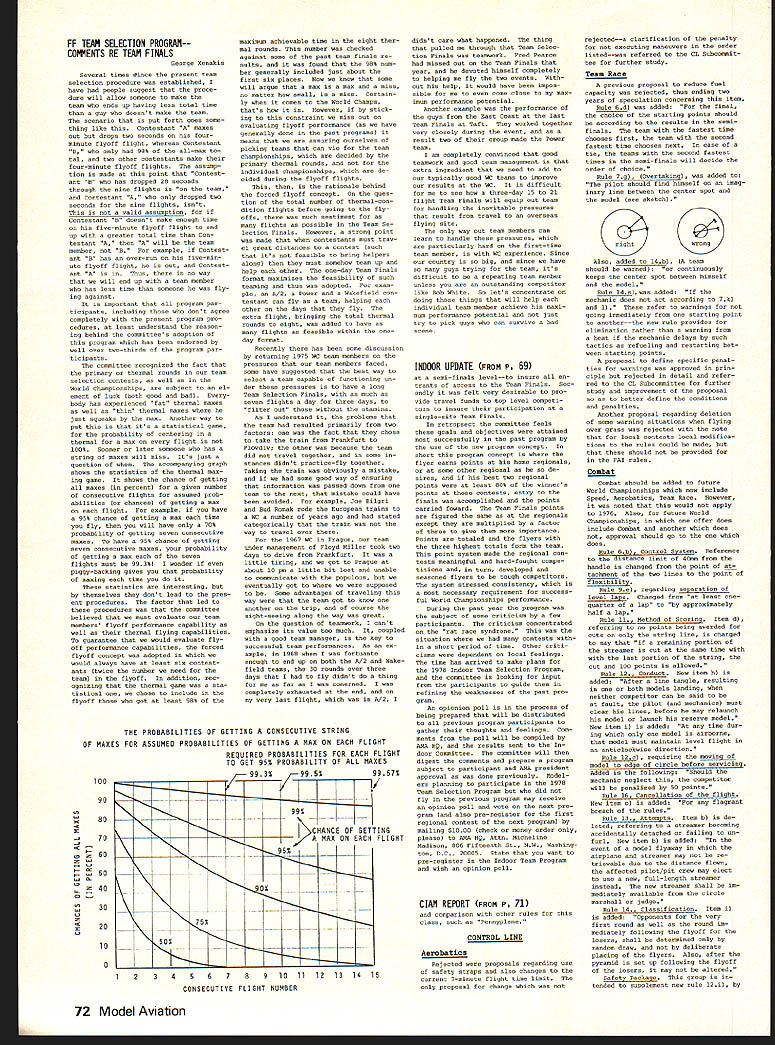
The probabilities of getting a consecutive string of maxes for assumed probabilities of getting a max on each flight (graph)
[Graph: THE PROBABILITIES OF GETTING A CONSECUTIVE STRING OF MAXES FOR ASSUMED PROBABILITIES OF GETTING A MAX ON EACH FLIGHT
- Horizontal axis: Consecutive flight number (1–15)
- Vertical axis: Chance of getting all maxes (percent)
- Curves shown for assumed probabilities: 50%, 75%, 90%, 95%, 99%]
INDOOR UPDATE (FROM P. 69)
Sucky Servaites, Indoor Committee Chairman
The 1976 Indoor Team Selection Program has been completed under the guidance of the newly formed concept FAI Program Management. Under this concept an 11‑member committee (committeemen AMA districts) was formed under guidelines set down by the Executive Council, charged with the duty of formulating a program having acceptable AMA and FAI participation. The program requires AMA president approval by a 2/3 majority. Qualification, program participants and other decisions and rules changes were also made; a synopsis follows.
Although basically correct, details must be regarded as tentative pending receipt of the official meeting minutes and FAT (FAI) publication. AMA differences and proposed changes reported were rejected except comments made and rejected votes of general interest or special significance involved. Likewise, items were referred back to subcommittees for further study.
General: Subcommittees appointments are automatic disapproval by national aero clubs. AMA USA received chairman within four weeks. RC sub‑subcommittees continue into 1976/75 as separate groups: Aerobatics, Pylon, Soaring, Helicopters. Seven members are permitted in a group. 1976 chairmen continue from 1975 except John Surkam (USA) replaces W. Groth (W. Germany) RC Helicopter; Peter Allnutt (Canada) replaces L. Sovo (Italy) FF; John Clemens (USA) replaces N. Chiati (Egypt) FF. Information/Education: continuing chairmen P. Freebrey (England) CL; H. Ziegler (Switzerland) Scale; O. Saffek (Czechoslovakia) Space Models; C. Olsen (England) RC Aerobatics; U. Pruss (USA) RC Soaring; J. Sederholm (Finland) RC Pylon. Officers and other committee chairmen for 1976: First Vice‑President S. Pimenoff (Finland). Note: due to a new general rule, FAI committee president cannot serve five consecutive yearly terms; since 1975 CIAM president completed his 5th year, the meeting decided to have the 1976 president elect Pimenoff as First VP to act in lieu of president. Second Vice‑President L. Bovo (Italy). Third Vice‑President E. Erill (Austria). Technical Secretary A. Aarts (Netherlands). Secretary J. Worth (USA). Asst. Secretary J. Garnier (France).
The Indoor Team Selection Committee dedicated its primary goal to select the strongest team possible to represent the US at the World Championships, yet to operate in harmony with the AMA's fundamental goal of maximizing participation levels in the competition. To attain the goal the committee decided certain objectives were necessary. Firstly, it felt necessary to effectively discourage ploys of sandbagging (deliberate reduction of flying quality)...
(The remainder of the Indoor Update discussion continues on procedures, qualification flights, selection mechanics and rules changes; details are available in the official minutes.)
RC SOARING TEAM SELECTION NEWS
Jim Simpson, Program Chairman
We need shots representing the US for the next R/C (Radio Control) Nearing World Championships. [Text continues discussing program needs, selection schedules and how contestants can participate; refer to full committee release for complete details.]
CIAM REPORT (FROM P. 71)
Control Line
Rejected were proposals regarding use of safety straps and also changes to the current stunt/contest flight time limits. The only proposal for changing which was not accepted — clarification of the penalty for not necessarily maneuvering in the ordered fashion versus required to the C/L Subcommittee for further study.
Team Race
A previous proposal to reduce fuel capacity was rejected; thus ending two years of speculation concerning this item.
Scale
The choice of the starting points should be according to the scale rules in the main finals. The team with the fastest time chooses first, the team with the second fastest time chooses next. In case of a tie, the team with the second fastest time (in combined times) shall conduct the order of choice.
Control Line (cont.)
Rule 7.3c — Overtrick? was added to the list of items and finalized so as not to be in the hands of the contest and only the panel (see sketch).
Also added to 14(b), (c) team should be warned for continuously keeping the contest spot between himself and the model.
Rule 13.4 — Clarification re: "the mechanism does not act according to 7.1 and 7.8" These refer to warning for not acting immediately from some starting point to another — the raw rule provides for elimination rather than a warning from a particular start in the mechanics delays by such tactics as recoiling and restarting both in the starting position.
Proposals to define specific penalties for warnings and disqualifications in certain circumstances were discussed; some refer to the display of the C/L function of the proposal as to better define the conditions and penalties.
More detailed discussion regarding selection of team members and traveling delegations were presented, but the committee asked that all such proposals and suggestions be included in the next official minutes for the record.
Aerobatics
Rejected were proposals regarding the selection of a new sequence for the contest; the present proposals for change were not accepted.
(End of CIAM Report summary.)
Competition Newsletter
moving the pit crew far enough away from the circle to eliminate the possibility of a hit after launch. It includes the following: 1) Combat — the change from two concentric circles to chase and avoid; 2) A new timer (similar to the 10 min. "search" timer) to be used if the contestant claims the flight is not to be scored; 3) Conduct — add the underlined words "whether than to pick up the lines of his reserve model (12), or to allow his model to be serviced, he must answer 'yes'." Model to be started only on a new sentence is needed as part of this package to provide a new method of starting after a pit, so the following should be added: "b) Contest may begin after a restart by a signal from the circle marshal. This signal shall be given as soon as the circle marshal is satisfied that there is at least a 1/4 lap separation between the two models."
Model Championship Status — It was approved that the Combat rules, including the above modifications, are acceptable for future World Championships, after 1976.
Organizers Guide
A proposal to make use of the guide compulsory was referred to the subcommittee. It was felt that some balance is needed between recommendations and mandatory procedures.
Recorders
The Speed class shown in Section 7 of the Sporting Codes as Series 2, for engines from 0.2 cc, was divided into two groups: 0 to 1.00cc and 1.001cc to 2.500cc.
More wording was added to 7.7.4 to make clear that single line control may be used for record attempts, as well as two lines.
RADIO CONTROL
General
A proposal to eliminate the 'builder' class of models for all classes of RC was rejected, thus continuing the AMA history in which variations of similar proposals were previously voted. However, the margin was sufficient that the club version is in favor of elimination, 12 against, 6 abstaining.
Aerobatics
Rule 8.5 (sequence) — A new Static Power Model. Previous definition replaced by the following: "Model aircraft which is aerodynamically non-powered by control surfaces is to be judged as a powered model with scores based on takeoff and landing." Note also Helicopters.
Rules Freeze: 1975 rules, plus changes made at Dec. 1975 CIAM Plenary Meeting, are frozen for three years effective Jan. 1, 1976. Rule 7.3 — Silences. Reference to venturi-type silencers being prohibited is deleted. Instead, the maximum noise level is stated as "no greater than 84dBA at ten meters distance," with noise measuring details as follows: "The model is placed on a rotatable platform in line above the ground; the microphone is placed on the ground at the specified distance, and the ground wave is measured from the sound pressure to the peak, for a measurement to be made." The new wording of the above is intended to permit controllers to measure sound levels more clearly.
No measurable cuts should be made in wind limits for speed. Measurements should be made over shorter times. No noise reflecting objects should be nearer than 30m to the model or microphone.
The equipment used for measurement should comply with International Electrotechnical Commission document 184. "Precision noise instruments" etc.
Scale, Model in sections and a book: Flight. The previous note regarding cancellation of flight when jettisoning occurs is deleted.
Rules: Soaring. In reference to non-aerobatic RC the idea regarding home/launch and vertical placement of control materials and electrical power is added: "A model will be heavily penalized by being outside the line." Further text added regarding requiring an official who should signal for model flying over spectators and how beacons may be used in competitions. The following is added as a last paragraph: "If the majority of judges agree, a competitor may be told to hand his model in the model is considered unsafe for any reason, or is being flown in an unsafe manner."
Race, CL, Classification. The following is added at the end to provide another means of determining winners: "Alternatively the individual classification may be determined by selecting the top three, or by whichever is the highest, from their three flights whichever will determine the team classification allowing these competitors a further two flights the best of which will be added to the other three flights to determine the individual winner."
Rule 12, Organization. Regarding transit and speed procedures, the following is added to the first paragraph: "If a contestant tries to withdraw to remove his transmitter from the loop during the contest at the discretion of the Contest Manager or jury." Clarification of 8 factors. To simplify scoring it was proposed that X factors be changed from 15, 10, 5, and 3 to 22, 11, 6, 3. It was agreed that the idea had merit but should be considered by the RC Subcommittee for a final recommendation.
Correction of Printing Error. At the end of 1.4, change the last sentence to read "Wherever 1.1, b refers to (Note: This error already had been corrected in the AMA rule book.)
Rule 11.2, Takeoff. 1 factor is changed from 1 to 0.5.
Rule 11.3, Rolling Flight. Replace previous sentence by the following: "Model starts in level flight, pulls up into an inside loop, then by the time the bottom of the loop is at the point of entry, rolls through 180 degrees across another inside loop and returns to the top point through outside loops and then continues in a small inside loop until the model has passed the entry point." The manoeuvre should be downward so the following reasons are noted:
- Model not level at start.
- Loop not level.
- Model half roll before and after first half roll.
- Second loop not level.
- Second loop not immediately under the first loop.
- Model deviates left or right during second loop.
- Model not level at finish.
- Model does not finish on same heading and altitude as start.
Rule 13.14, (from Rule 8.5) K factor is changed from 10 to 5.
Rule 13.20, Landing. A caution is added as follows: "If a factor for landing is used 15 meters x circle, change K factor from 10 to 5." Similarly for landing outside the landing circle, a factor is added in 10. The other proposals relating to 11.6 were referred to the RC Subcommittee for more information and landing roll deviations when runway has problems.
Soaring
Rule 1.5, Competitors and Helpers. Three helpers now permitted instead of two, with each one to be used only for retrieve, and who may be the official, and who remain behind the competitor/pilot in a separate designated sky. The organizers.
1.6.4, Definition of an Official. A flight director should attempt to be made at the end of the task in progress. "For rule c) concerning the procedure of an attempt in the event of a runaway system a number of rules will be allowed only in case the system is supported by the organizer, times, contestants supplied oxygen respectively."
Sporting for a restart: Rule 3.3, Cancellation of a Flight or Disqualification. A new item is added: "If the model touches either the pilot or his assistant during the landing maneuver, the pilots for landing maneuver are on the ground." This problem must be given. (Tasks A & B.)
Rule 2.1.b(1), regarding Motorgliders. One sentence has been rewritten as follows: "The organizer has to decide on the number of tows separate classifications." This is instead of "…only one or two classifications."
Ratio X.Y., Launching. Paragraph a) is revised to read: "The launch of the glider may be over of the following means: 1) hand launch, 2) winch 3) hi-start…, 4) hi-start, 5) pull-over, 6) other and operated pulleys" etc. The balance of this paragraph clarifies the allowable towing heights. "The winch must not exceed 10 meters when tested under a tension of 2kg." Where a headwind is to be used a correction is included: "In the event of a parachute: (5 m) or less." Other portions refer to hand towing, line to the pilot, etc.
Indoor Team Program Update
Sucky Servaites, Indoor Committee Chairman
The 1976 Indoor Team Selection Program has been completed under guidance of the newly formed concept CIAM Program Management. Under this concept an 11-member committee (committee-man and AMA district) formed under guidelines set down. The Executive Council charged the duty of formulating a program having acceptable AMA president 2/3 majority qualified program participants. Program other decisions and rules changes also were made; a synopsis follows. Although basically correct, details must be regarded as tentative pending receipt of the official meeting minutes in the FAI publication. AMA differences proposed changes reported rejected except comment noted. Rejected votes of general interest or special significance involved. Likewise items referred back to subcommittees for further study.
General Subcommittee Appointments: Automatic disapproval national aero clubs. AMA USA received chairman within four weeks. RC sub-subcommittees continue 76/75 separate groups. Aerobatics, Pylon, Soaring, Helicopters — 7 members permitted per group. 1976 chairmen continue 76/75 except John Surkam USA replaces W. Groth W. Germany RC Helicopter; Peter Allnutt Canada replaces L. Sovo Italy FF; John Clemens USA replaces N. Chiati Egypt for Information Education. Note continuing chairmen P. Freebrey England CL; H. Ziegler Switzerland Scale; O. Saffek Czechoslovakia Spacemodels; C. Olsen England RC Aerobatics; U. Pruss USA RC Soaring; J. Sederholm Finland RC Pylon. Officers other committee chairmen 1976: First Vice-President S. Pimenoff Finland. Note: due to new general rule president CIAM committee cannot serve 5 consecutive yearly terms. Since 1975 CIAM president completing 5th year decided meeting have president 1976 elect Pimenoff First VP instead have him act in lieu president. 2nd Vice-President L. Bovo Italy. 3rd Vice-President E. Erill Austria. Technical Secretary A. Aarts Netherlands. Secretary J. Worth USA. Asst Secretary J. Ganier France.
Indoor Team Selection Committee dedicated primary goal selecting strongest team possible represent US World Championships yet operate in harmony with AMA's fundamental goal maximizing participation levels in competition. To attain goal committee decided certain objectives necessary. Firstly felt necessary effectively discourage ploy sandbagging deliberate reduction flying quality.
RC Soaring Team Selection News
Jim Simpson, Program Chairman
Need shot representing US next R/C Nearing World Championships good Sail
[Note: Remaining text on this page continues on following page.]
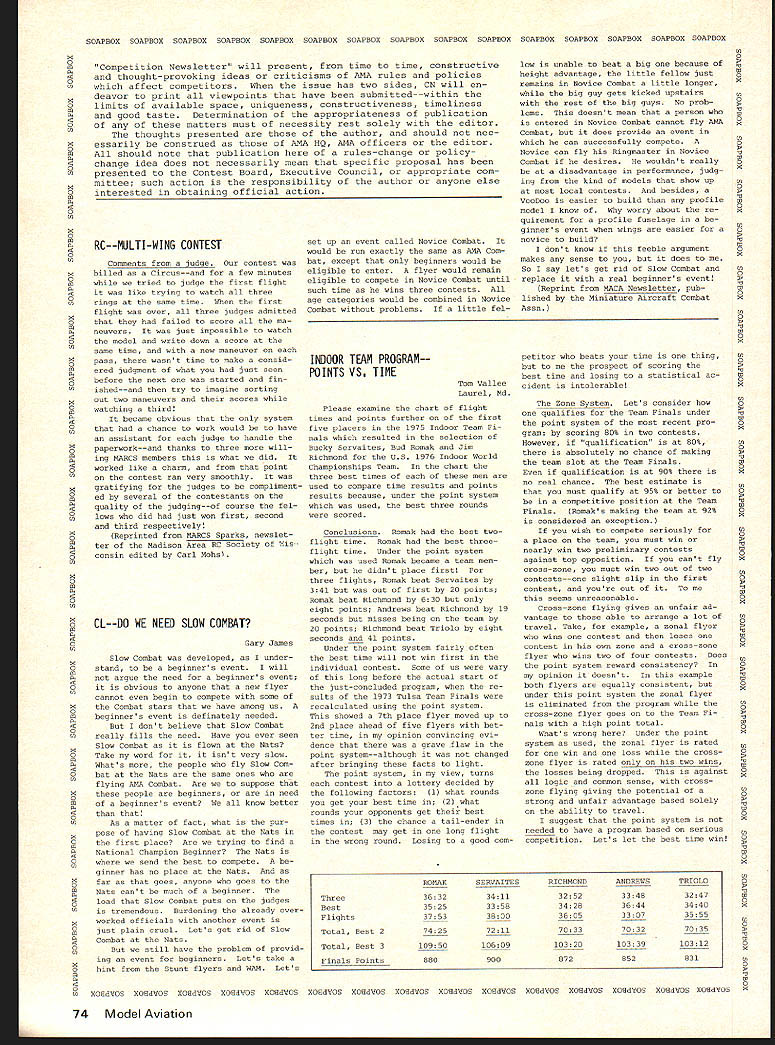
INDOOR TEAM PROGRAM--POINTS VS. TIME
Tom Willett Laurel, Md.
Please examine the chart of flight times and points further on of the first five places in the 1975 Indoor Team Finals which resulted in the selection of Lucky Servaites, Bud Romak and Tom Richmond for the U.S. 1976 Indoor World Championships Team. In the chart there are three items for each of these men used to compare time results and points results because, under the points system which was used, the best three rounds were scored.
Conclusions. Romak had the best two-flight time. Under the points system which was used Romak became a team member, but he didn't place first for three flights. Romak beat Servaites by 3:41 but was out of first by 20 points; Romak beat Richmond by 6:30 but by eight points; Andrews beat Richmond by 19 seconds but missed being on the team by 20 points; Richmond beat Triolo by eight seconds and 41 points.
Under the point system fairly often the best time will not win first in the individual contests. Some of us were wary of this long before the actual start of the just-concluded program when the results of the 1973 U.S. Team Finals were recalculated using the point system. This showed a lower-placing flyer moved up ahead of several flyers with better times. In my opinion this is convincing evidence that there was a grave flaw in the points system — although it is not certain that total flying times would always be better.
The point system, in my view, turns each contest into a lottery decided by the following factors: (1) what rounds you get your best time in; (2) what rounds your opponents get their best times in; (3) the chance a tail-ender in the contest may get in on a long flight in the wrong round. Losing to a good competitor who beats your time is one thing, but the prospect of scoring the best time and losing to a statistical accident is intolerable!
The Zone System. Let's consider how one qualifies for the Team Finals under the point system as used in the recent program by scoring in Zone contests. If the qualification standard is set high, there is absolutely no chance of making the team on the basis of raw times. Even if the qualification standard is lowered, the best estimate is that you must qualify at a very high percentage to be in a competitive position at the Team Finals. (Romak was an exception.)
If you intend to compete seriously for a place on the team you must win one or two preliminary contests or finish consistently among the top places to ensure a chance. Cross-zone flying gives an unfair advantage to those who can fly well under varying conditions; it makes the system less predictable and emphasizes luck of the rounds rather than absolute flying ability.
My recommendation is to select teams by total flying time (best three flights) with reasonable tie-breaking rules that reward consistency. Such a system places emphasis on actual performance — the times achieved — rather than leaving selection largely to the luck of which rounds produce long flights.
Let's let the best time win!
ROMAK SERVAITES RICHMOND ANDREWS TRIOLO Three Best Flights Best 36:12 34:11 32:52 33:48 32:47 2nd 35:25 33:58 34:28 36:44 34:40 3rd 37:53 38:00 36:26 33:07 33:55 Total, Best 2 74:25 72:11 70:?0 70:32 67:27 Total, Best 3 109:50 106:09 103:46 103:?9 100:?2 Finals Points 880 900 072 852 831
Transcribed from original scans by AI. Minor OCR errors may remain.

