
F3E (Electro-Flight): World Champs '84?
By Joe Beshar
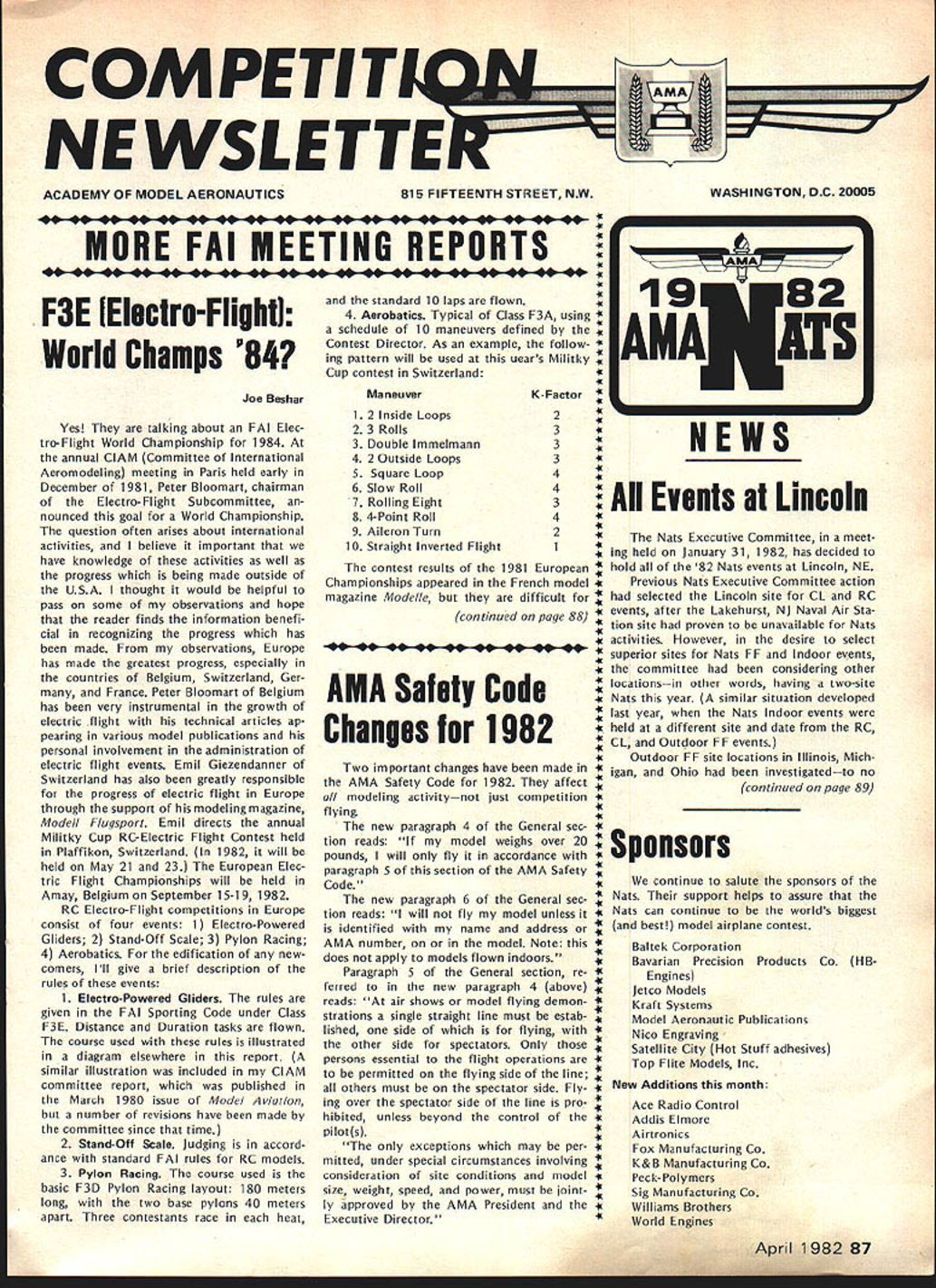
Yes — they are talking about an FAI Electro-Flight World Championship for 1984. At the annual CIAM (Committee of International Aeromodelling) meeting in Paris held early in December 1981, Peter Bloomart, chairman of the Electro-Flight Subcommittee, announced this goal for a World Championship.
International activities often raise questions, and it is important that we be aware of these activities and the progress being made outside the U.S.A. From my observations, Europe has made the greatest progress, especially in Belgium, Switzerland, Germany, and France. Peter Bloomart of Belgium has been very instrumental in the growth of electric flight with technical articles and administrative involvement. Emil Giezendanner of Switzerland has also been greatly responsible for the progress of electric flight in Europe through support of his modeling magazine Modell Flugsport. Emil directs the annual Militky Cup RC-Electric Flight Contest held in Pfaffikon, Switzerland (in 1982 it will be held on May 21–23). The European Electric Flight Championships will be held in Amay, Belgium on September 15–19, 1982.
RC Electro-Flight competitions in Europe consist of four events:
- Electro-Powered Gliders
- Stand-Off Scale
- Pylon Racing
- Aerobatics
Event descriptions
- Electro-Powered Gliders
- Rules are in the FAI Sporting Code under Class F3E.
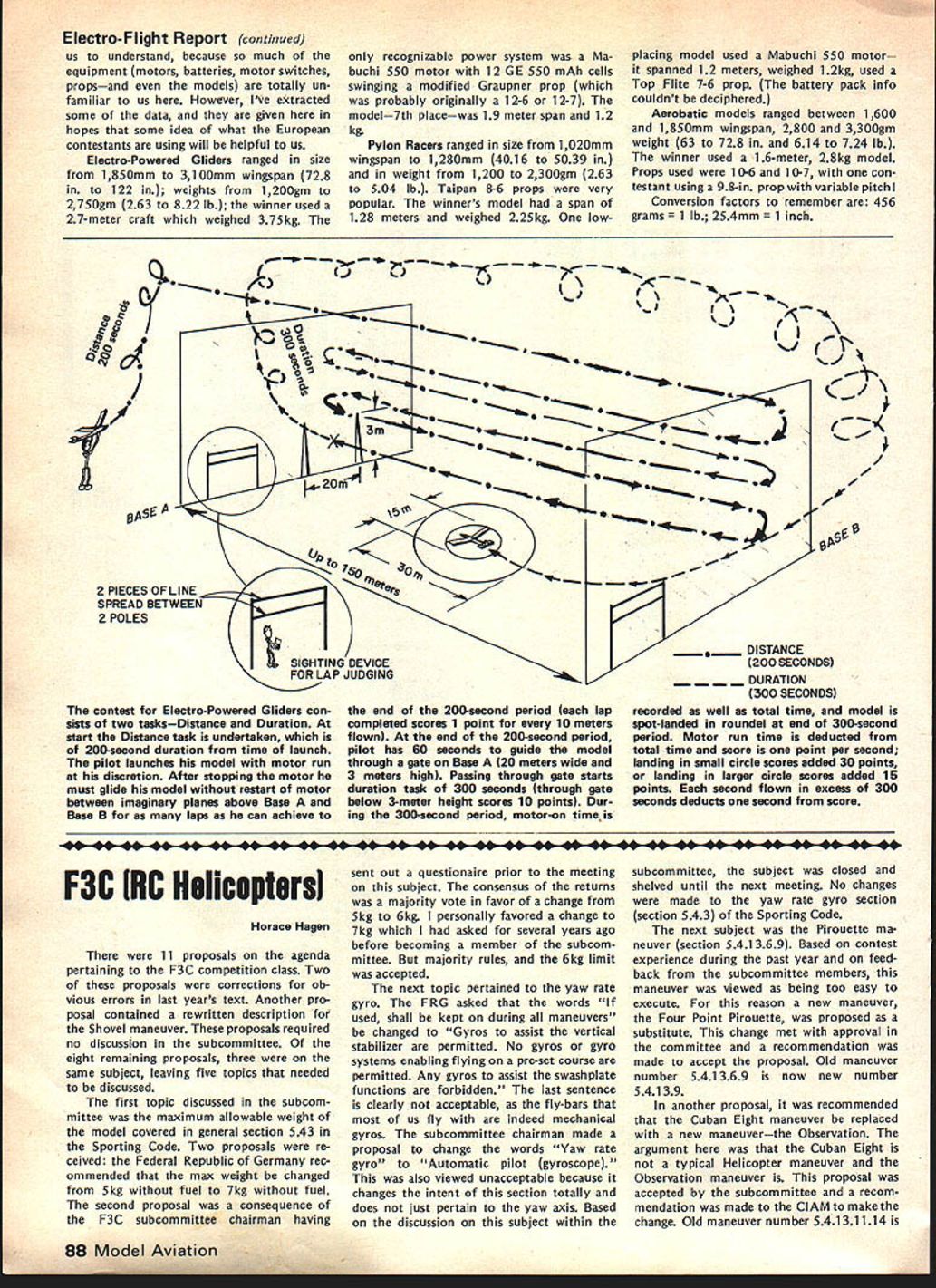
- Distance and Duration tasks are flown. (Course illustrated in CIAM materials; revisions have been made since earlier diagrams published in Model Aviation.)
- Stand-Off Scale
- Judging follows standard FAI rules for RC models.
- Pylon Racing
- Uses the basic F3D Pylon Racing layout: 180 meters long, with the two base pylons 40 meters apart.
- Three contestants race in each heat; standard 10 laps are flown.
- Aerobatics
- Typical of Class F3A, using a schedule of 10 maneuvers defined by the Contest Director.
- Example pattern used at this year’s Militky Cup (with K-factors shown):
- 2 Inside Loops — 2
- 3 Rolls — 3
- Double Immelmann — 3
- 2 Outside Loops — 3
- Square Loop — 4
- Slow Roll — 4
- Rolling Eight — 3
- 4-Point Roll — 4
- Aileron Turn — 2
- Straight Inverted Flight — 1
The contest results of the 1981 European Championships appeared in the French model magazine Modele, but many of the equipment details (motors, batteries, switches, props, and models) are unfamiliar to us. I’ve extracted some of the data here so readers can get an idea of what European contestants are using.
Equipment and sizes (summary)
- Electro-Powered Gliders
- Wingspan: 1,850–3,100 mm (72.8–122 in)
- Weight: 1,200–2,750 g (2.63–8.22 lb)
- Winner: 2.7 m craft, weighed 3.75 kg
- Recognizable power system: Mabuchi 550 motor with 12 GE 550 mAh cells, swinging a modified Graupner prop (probably originally 12x6 or 12x7).
- Examples: a 1.9 m model placed 7th; another small model spanned 1.2 m, weighed 1.2 kg, used a Top Flite 7x6 prop. (Battery pack details were often undecipherable.)
- Pylon Racers
- Wingspan: 1,020–1,280 mm (40.2–50.4 in)
- Weight: 1,200–2,300 g (2.63–5.04 lb)
- Taipan 8x6 props were popular.
- Winner: span 1.28 m, weight 2.25 kg.
- One low-placing model used a Mabuchi 550 motor; it spanned 1.2 m, weighed 1.2 kg, and used a Top Flite 7x6 prop. (Battery info unclear.)
- Aerobatic Models
- Wingspan: 1,600–1,850 mm (63–72.8 in)
- Weight: 2,800–3,300 g (6.14–7.24 lb)
- Winner: 1.6 m, 2.8 kg model.
- Props: 10x6 and 10x7 common; one contestant used a 9x8 prop with variable pitch.
Conversion factors: 456 grams = 1 lb; 25.4 mm = 1 inch.
Electro-Powered Gliders — Contest format (detailed)
- Two tasks: Distance, then Duration.
- Distance task:
- 200-second duration from time of launch.
- Pilot may run the motor at his discretion at launch; after stopping the motor he must glide (no restarts) between imaginary planes above Base A and Base B for as many laps as possible during the 200 seconds.
- Each lap completed scores 1 point per 10 meters flown.
- After the 200-second period:
- Pilot has 60 seconds to guide the model through a gate on Base A (gate is 20 meters wide and 3 meters high).
- Passing through the gate starts the Duration task (300 seconds). Passing through the gate below 3 meters scores 10 points.
- Duration task:
- Motor-on time and total time are recorded. Motor run time is deducted from total time; scoring is one point per second.
- Spot landing in the roundel at the end of 300 seconds: small circle landing adds 30 points; larger circle landing adds 15 points.
- Each second flown in excess of 300 seconds deducts one point from the score.
Electro-Flight Report (continued)
The final proposal discussed in committee was again from the FRG (Federal Republic of Germany): move the Autorotation maneuver from the Optional Maneuver section to the Required Maneuver section. The committee turned this down, feeling that pilots should not be forced to fly such a risky maneuver—especially when the machine is a Scale-type that requires many hours of construction. The intent of the Optional Maneuver list is to provide maneuvers of varying complexity (reflected by the appropriate K-factor), giving each pilot an opportunity to demonstrate his skills.
Maneuver renumbering note: some maneuver numbers were revised (for example, an old maneuver number 5.4.13.15.18 has been renumbered to 5.4.13.18).
A number of side discussions took place in Paris. I asked the F3C subcommittee chairman to redraw the Belgian Stall Turn sketch to improve clarity; he agreed to do so if I would provide a sketch. The CIAM noise subcommittee made an interesting report at the general meeting — noise appears to be a much bigger problem in Europe than it is here. Proposed noise limits are quite severe but likely achievable; I recommend that helicopter pilots adopt the same standards set for the other FAI RC classes.
Anyone interested in an up-to-date copy of the FAI RC Helicopter rules may send a SASE to:
- H. G. Hagen, 15 Parkway Place, Red Bank, NJ 07701.
Nats/Lincoln (continued)
Because the Wright-Patterson AFB site in Dayton is popular with Free Flight (FF) and Control Line (CL) fliers, permission had been sought to hold FF events there this year. In reply to a letter from AMA HQ, the base commander of WPAFB regretfully denied the request, citing expanded Air Force testing and sensitive equipment in the proposed area of flight and saying no suitable alternate space was available on base.
Therefore, all 1982 Nats activities are GO for Lincoln, NE during the week of August 1–8, 1982:
- RC and CL events will be flown at the air base.
- Indoor will be in the Eppley Auditorium.
- RC Soaring and Helicopters will be at the sod farm.
- Outdoor FF events may return to Mead (as in 1979), though a closer suitable site is still being sought.
Nats entry forms are not yet available — they won’t be for at least another month. Do not write to AMA HQ for one until an announcement appears in the Competition Newsletter.
FLYING NEAR AIRPORTS? BE CAREFUL!
Scale Team Manager Selected
John Guenther of Borden, IN has been appointed manager of the 1982 U.S. RC Scale team (FAI classes F4C, F4 Precision, and Sport Scale). The 1982 RC Scale World Championships will be held in Reno, NV on June 13–19.
The CL Scale (FAI class F4B) World Championships will be held in Kiev, U.S.S.R., August 24–31, 1982. The CL Scale team does not yet have a manager; Mike Gretz had been selected previously but had to decline due to scheduling conflicts.
'82 CL Team Assistant Manager
David Elias of Tequesta, FL has been named Assistant Team Manager for the 1982 U.S. CL Team. His duties will include travel arrangements and coordinating Combat contestant activities and interests.
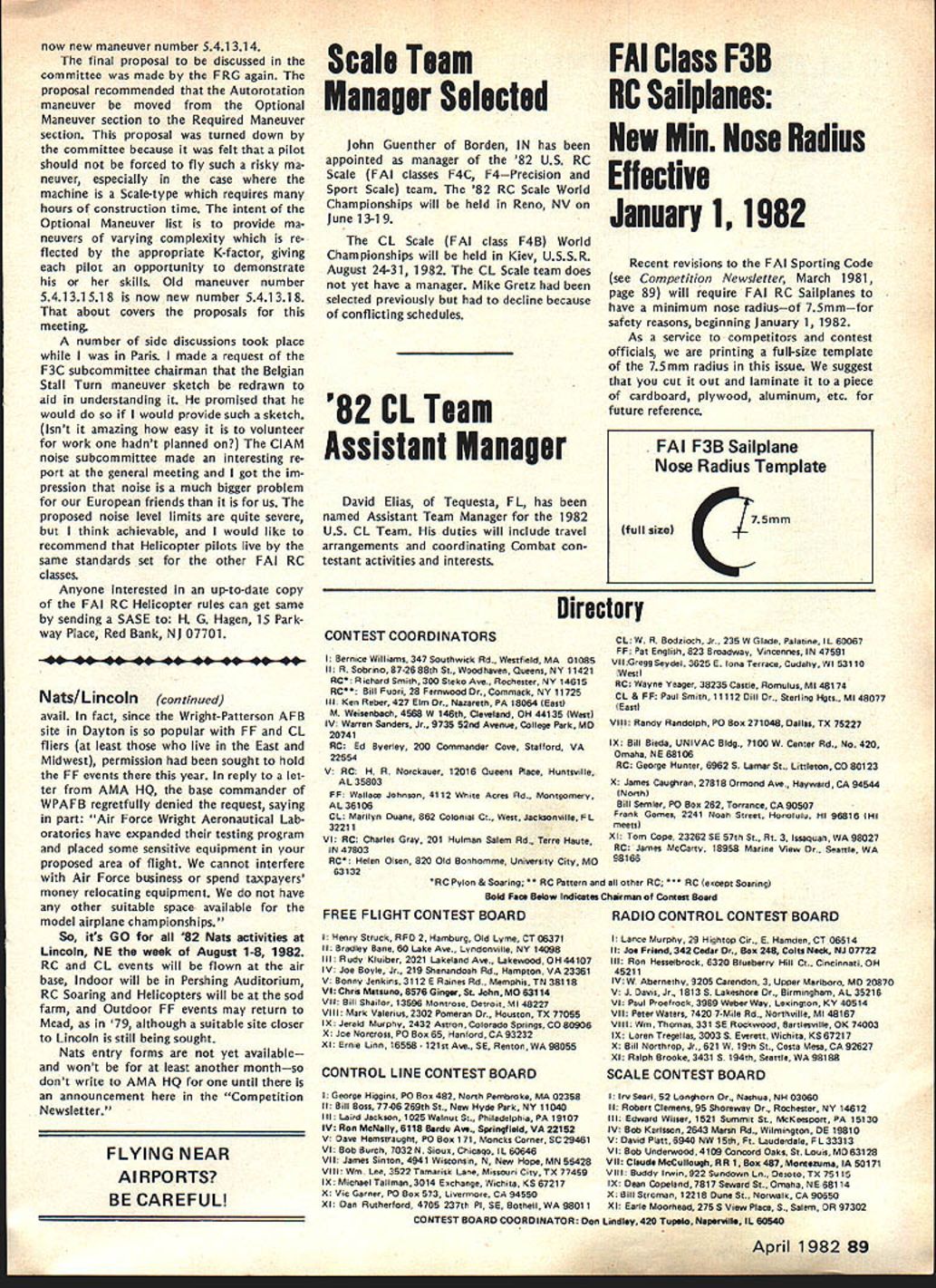
FAI Class F3B RC Sailplanes: New Minimum Nose Radius Effective January 1, 1982
Recent revisions to the FAI Sporting Code (see Competition Newsletter, March 1981, page 89) require FAI RC Sailplanes to have a minimum nose radius of 7.5 mm for safety reasons, effective January 1, 1982.
As a service to competitors and contest officials, a full-size template of the 7.5 mm radius was printed in that issue. It is suggested you cut it out and laminate it to cardboard, plywood, aluminum, etc., for future reference.
Transcribed from original scans by AI. Minor OCR errors may remain.

