
Competition Newsletter
AMA President Sets FAI Rules Proposal Procedures
AMA President John Griggs has established a formal procedure for handling proposed FAI competition rules changes. From the FAI's viewpoint, rules change proposals can be entertained from any Member delegate at the annual Plenary meeting in December. FAI technical meetings review the proposals and make recommendations to the CIAM delegates, who then vote on the proposals.
It has recently come to the attention of AMA officers that the AMA had no formal procedure for dealing with proposed rule changes submitted to AMA Headquarters by individual AMA members. In the past, rules proposals from the AMA were handled on a case-by-case basis, and nearly any proposal submitted to AMA HQ in a timely manner was forwarded to the CIAM meeting. This worked reasonably well while AMA member involvement in FAI rule making was minimal.
However, a few situations have developed that could have been very troublesome, including the potential embarrassment of having the U.S. vote against its own proposal. In one recent case a proposal almost made it to the CIAM (it did not, because it did not arrive at AMA HQ early enough to be put in the proper form for submittal to the FAI before the December meeting), and it turned out that the proposal was very controversial among the class of competition fliers affected by the rule proposal. The new FAI rule-proposal handling procedure can help to prevent a recurrence of these kinds of problems.
WORLD CHAMPIONSHIP TEAM SELECTION PROGRAMS
RC Aerobatics
U.S. participation in the bi-annual RC World Championships continues. The RC Aerobatics Team Selection Committee has voted on the 1983 team selection program. The new program is identical to that used in 1981, which was very well accepted by the competitors.
Qualification "Window"
Qualification for the team selection finals (Masters) tournament can be accomplished in any one of the following ways:
- Finish in the upper one-third of competitors in an AMA-sanctioned Masters class competition with five or more competitors making official flights.
- Participate in a minimum of five contests as a Masters class competitor during the qualification season.
- Finish in the top one-half in the AMA National Contest.
Aspirants using the first two options must make their competition flights in contests held between March 1, 1982 and October 31, 1982.
Deadline for mailing Performance Certification affidavits to AMA HQ is November 15, 1982.
How to Get Started
Those desiring to participate in the 1983 program should mail their $10 entry fee to AMA HQ, Attention: Micheline Madison. They will receive a blank qualifying affidavit by return mail. (An individual may be allowed to count one, and only one, contest performance prior to entering the program, provided the entry fee accompanies the declaration.)
The location of the Finals site, as well as the fee for that meet, will be determined in the near future by vote of the program participants.
The three previous (1981) team members are automatically qualified for the Finals.
RC Soaring
Recent F3B Team Selection Committee action approved the team selection program to be used in 1982 to select the U.S. team to compete in the 1983 World Championships.
Highlights of the program:
- Team aspirants can qualify for the Finals by placing in either of two quarter-finals (of their choice), which will be scheduled in April, May, and June. Since many quarter-finals can be held, the field will be narrowed by quarter-final winners competing in a semi-final.
- Program participants may enter only one semi-final (of their choice), which will be held on the first or second weekend in July.
- Thirty-six contestants will then be qualified to enter the Finals, plus three members of the 1981 team.
- The team Finals will be flown in Joliet, IL over the Labor Day weekend (September 4–6).
- The team members will select the Team Manager; the manager and the assistant selection process will follow subsequently.
Free Flight
The latest activity in the 1983 Free Flight Team Selection Program shows that program participants voted (56 to 40) to select Taft, CA as the site of the Finals (over Seguin, TX). The date will be announced later. In addition, the list of Selected Contests for 1982 was established.
The Team Selection Program has two paths to the Finals for prospective team members:
- Path 1: A series of local Qualification Trials and the Semi-Finals (all of which were concluded in 1981).
- Path 2: Winning in one (or more) of a series of Selected Contests held after the Semi-Finals are concluded.
Entry into the Team Selection Program and winning the right to enter the Finals is still open to interested modelers through the Selected Contest course of action.
Selected Contests for 1982
- U.S. FF Championships, Taft, CA, May 29–31.
- Utah State Aeromodellers Contest, Salt Lake City, UT, mid-June (contact Jon Zeisloft).
- Spring FAI Contest, Camp Borden, Canada, mid-June (contact Paul Crowley).
- Eastern States FF Championships, Gainesville, NY, June 26–27 (contact Tom Kerr).
- Fiesta of Five Flags, Pensacola, FL, June or July (contact Tom McLaughlin).
- MMM FAI Selected Contest, Denver, CO, July 3–4.
- Bong FAI Invitational, Bong Field, WI, July 10–11 (contact Ross Jahnke).
- AAA FF Contest, Friendswood, TX, July 17–18 (contact C.C. Johnson).
- Western States FAI Challenge, Tacoma, WA, mid-July.
- AMA Nats, Lincoln, NE, August 1–8.
Indoor
The latest activity in the 1983 Indoor team selection program finds the Team Selection Committee voting to repeat the 1980/1981 program, adding a Northwest regional zone, and defeating two proposals submitted by Manny Radoff (to award travel funds to the top three qualifiers in each district and to reduce the number of Finals official flights from nine to six).
Voting on the various items was:
- Approve repeat of the 1980/1981 program — 9 to 1.
- Approve Northwest zone — 10 to 0.
- Defeat reappointment of travel funds — 2 to 8.
- Defeat reducing number of Finals flights — 1 to 9.
Summary of approved team selection program:
- The team will be selected by participants accruing points earned in a series of local contests in 1982 and 1983 plus one regional contest (in any of the seven zones) in either year plus one single-site finals contest to be held in 1983. The three top scorers will comprise the new team.
- Program entrants must have a current AMA license with the $5 FAI stamp attached.
- The program can be entered either through AMA HQ or at a local meet. There is no restriction on when entry into the program can be made. The program can be accomplished entirely in 1983 if desired.
- Entry by a prior finalist living more than 500 miles from a regional contest could be made at the finals if desired—provided penalty fees were paid.
To register for the program by mail, send $3 to AMA HQ, Attention: Micheline Madison, who will send a form for entering a local meet on a prepaid basis.
For either a local or a regional contest to be eligible to award program points, it must have a minimum of three contestants. Only the highest number of points earned at any one local contest will count towards a participant's total. Scoring at a local contest will be based on the best two out of six flights, with the top score receiving 10 points and other scores receiving proportionate points. Members of the current Indoor team may bypass the local contests and automatically receive 10 points.
At a regional contest, a contestant must receive 75% of the top score at that contest in order to qualify for the finals. The single best regional contest performance is counted for team selection scoring. There is no restriction on cross-zone flying. Scoring at a regional contest is the best two out of six flights, with the top score receiving 100 points. Other scores are a percentage of the 100 points, based on an entrant's time divided by the winning time.
The team final will be conducted at a site to be selected later. The contest will be held over a three-day period and will be conducted by rounds—three rounds per day. Scoring will be on the basis of the best two out of nine flights, with the top score receiving 1,000 points. Other scores will receive proportional points. The maximum score obtainable in the program is 1,110 points.
Entry fees:
- $3 to enter a local contest.
- $15 to enter at the regional contest level without having flown in a local meet—either payable in advance to AMA HQ or at the regional meet ($12 of this will be refunded if the entrant later enters a local meet and flies there).
- Regional entry fee for a contestant who has registered and flown in a local meet is $10.
For prior finalists living more than 500 miles from the closest regional meet and electing not to fly in a local or regional contest, the finals can be entered for a $35 fee, and the participant will receive 75 points for the "missed" regionals. The normal entry fee for the finals (for participants who have flown in a regional meet) is $15.
Travel assistance to the finals will be awarded only to those participants winning a first place (100 points) in a regional contest. The amount of assistance will be determined by the Indoor Committee based on the funds available.
One regional contest will be held in each of the two years 1982 and 1983 in each of the seven regional zones: East, Southeast, Midwest, Southwest, Mountain, West, and Northwest.
RC Helicopter World Record Applications
The FAI has recently received applications for two RC Helicopter World Records for straight-line and closed-course speed, made in flights on April 9, 1982 by two modelers in the U.S.S.R.
- Vyatil Makeev flew 82.56 km/h (51.3 mph) in a straight line.
- Igor Tsybisov flew 63.72 km/h (39.59 mph) in a closed circuit.
These records will not be official until ratified by the FAI.
RC Sailplane Rules Interpretation
The following item is published to satisfy the requirements of the Contest Board Procedures.
David L. Peltz of Chatsworth, CA submitted a rules change proposal that is being handled as a rules interpretation by the RC Contest Board. The proposal/interpretation affects the course layout and procedures to be used when attempting to establish a Speed record for RC Sailplanes (section 48 of the 1982–83 rule book, paragraph and note entitled "Speed").
In preliminary voting, the RC Contest Board voted to handle this request as an interpretation requiring No Immediate Ruling. However, this course of action requires that the item under consideration be published (in Model Aviation or the Competition Newsletter) "at the earliest possible date."
The interpretation proposes to change the wording of the Speed section of Paragraph 48 of the rule book to read as follows:
Speed. The Speed measurement course shall be along a straight line of 150 meters (492 ft.). The start–finish line (Base A) shall be an imaginary vertical plane perpendicular to the course. A similar imaginary vertical plane (Base B) shall exist at the opposite end of the course. Suitable sighting devices defining the imaginary vertical planes at both Bases A and B shall be erected. The imaginary line directly between the sighting devices is defined as the course center line. For safety purposes, all flying will be done only on one side of the course center line. The side to be used shall be the side furthest from any spectator areas. Any crossing of the course center line during the flight shall void the flight.
During a continuous flight and after release from the launch line, the model must first make at least one 180-degree turn before entering the course by crossing Base A while flying in the direction of Base B. It must cross Base B, turn around, cross Base A, turn around again, cross Base B, turn around again and then leave the course by again crossing Base A. Officials acting as flagmen shall observe and signal the model's crossing of Base A and Base B each time it occurs. The pilot must remain at Base A and may stand beneath the sighting device.
Official recorded time starts when the model enters the course and stops when it leaves the course. All timing must be done by at least three officials operating digital electronic timing devices capable of direct readings to at least 1/100 sec. The average of the two readings closest to each other will be used as the official recorded time. A full description of the methods and equipment used must be submitted with the record claim, containing sufficient proof of accuracy of the course, sighting and timing equipment, and competence of the operators.
Any launch will be permitted that meets current FAI rules, except that the maximum launch-line length shall be limited to the AMA maximum of 300 meters (984 ft.). The flier will have two minutes to complete the task from release from the launch line and ending with the completion of the Speed run. A fourth timer will ensure that this time is not exceeded.
Logic Behind the Proposed Change
Dave Peltz states that the currently defined Speed task has been attempted numerous times over nearly twenty years by highly experienced fliers and officials, and the task has never been completed because it is too difficult. In addition, he states that the present requirement for entering the Speed course at an altitude of 50 meters (164 ft., 5 in.) or less creates an unsafe condition. He notes that the existing timing accuracy requirements exceed those used for a similar task at the 1981 Soaring World Championships.
Voting Deadlines
Modelers are advised that a Final Vote ballot on this item will be mailed out (on about June 25) to the RC Contest Board approximately four weeks after this item is published, with a 10-day turnaround time. Modelers who wish to comment on this proposal/interpretation must hurry to get their comments to their RC Contest Board member before the Final Vote date—which will be about July 7, 1982—and should plan for a delay.
FCC License Requirement
Every RC flier should have his own FCC (Amateur Radio Service) license. License application forms are available from AMA HQ, attention Carl Maroney. Please enclose a pre-addressed, stamped envelope with each request.
Restrictions on RC Flying on 50–54 MHz (Six Meter) Band
Based on a 1980 decision concerning model aircraft operations in which the AMA was involved, an FCC order (dated November 6, 1980) stated very definitely that you can only operate six-meter RC equipment if you hold a currently active Amateur Radio Service (HAM) license of Technician class or higher. The strict interpretation of this order means that a HAM radio operator who decides to become an R/Cer cannot be flight-trained by a non-HAM modeler. Even further, he cannot use a "buddy-box" unless both parties have a valid Amateur Radio Service license of the proper class.
There are other ramifications of this FCC ruling: having an entire club fly on six meters using one member's license is contrary to the FCC rule and has never been permitted or condoned by the AMA. By the same reasoning, the family of a six-meter R/Cer should not be allowed to fly on the parent's FCC license.
If you want to fly legally on six meters (and gain many of its advantages), you must first obtain the necessary Amateur Radio Service (HAM) license.
The 1984 FAI RC Pattern
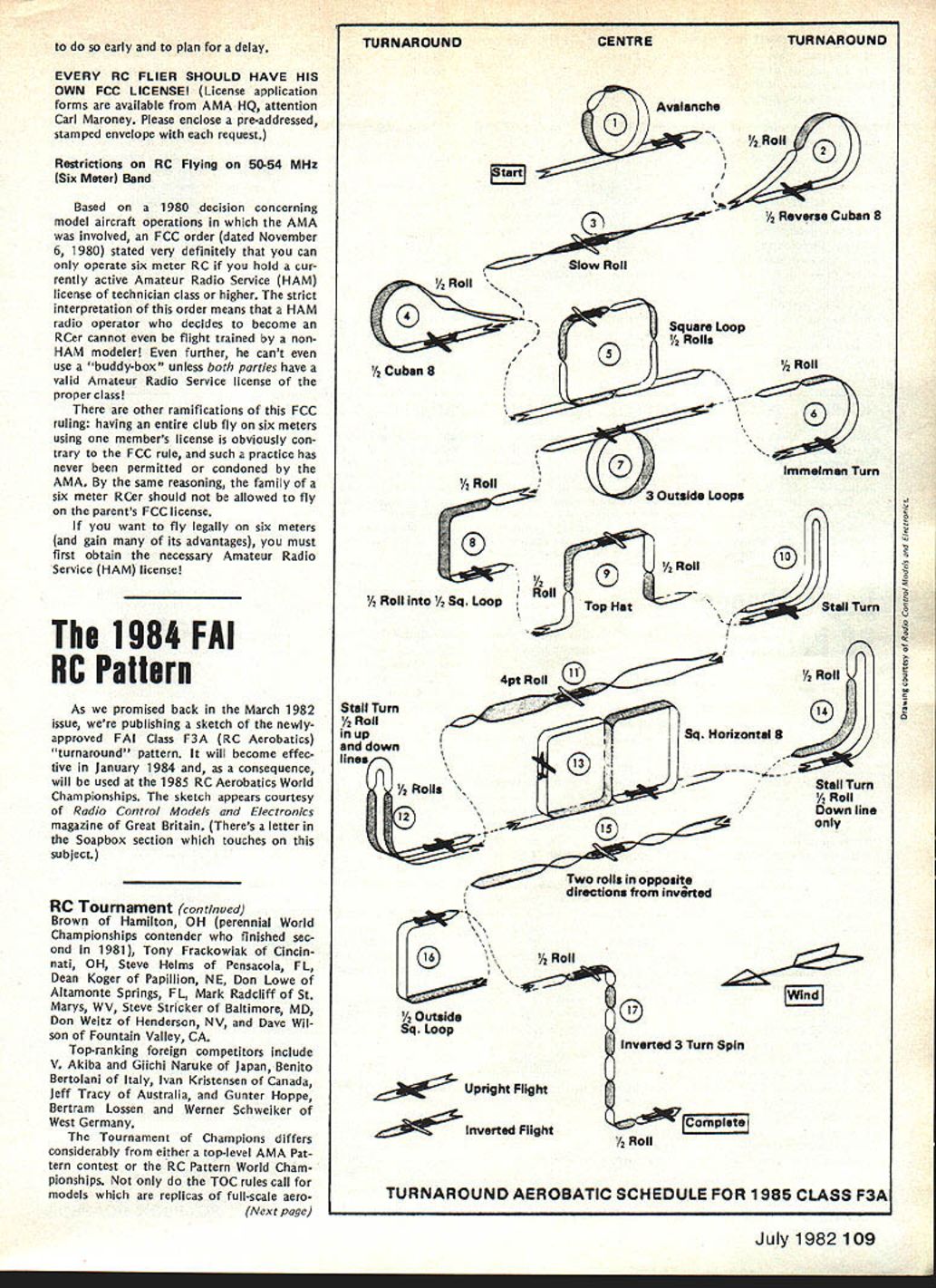
As promised in the March 1982 issue, a sketch of the newly approved FAI Class F3A (RC Acrobatics) "turnaround" pattern is being published. It will become effective in January 1984 and, as a consequence, will be used at the 1985 RC Aerobatics World Championships. The sketch appears courtesy of Radio Control Models and Electronics magazine of Great Britain.
RC Tournament (continued)
Top U.S. competitors mentioned include:
- Brown of Hamilton, OH (perennial World Championships contender who finished second in 1981)
- Tony Frackowiak, Cincinnati, OH
- Steve Helms, Pensacola, FL
- Dean Koger, Papillion, NE
- Don Lowe, Altamonte Springs, FL
- Mark Radcliff, St. Marys, WV
- Steve Stricker, Baltimore, MD
- Don Weitz, Henderson, NV
- Dave Wilson, Fountain Valley, CA
Top-ranking foreign competitors include V. Akiba and Gihichi Naruke of Japan; Benito Bertolani of Italy; Ivan Kristensen of Canada; Jeff Tracy of Australia; and Gunter Hoppe, Bertram Lossen, and Werner Schweiker of West Germany.
The Tournament of Champions differs considerably from either a top-level AMA Pattern contest or the RC Pattern World Championships. Not only do the TOC rules call for models that are replicas of full-scale aerobatic aircraft, they also require pilots to use the Aresti style of flying, where the model's flight is judged for the entire period that it is within a scoring "box." Additionally, contestants must fly Known Compulsory, Unknown Compulsory, and Free programs. The maneuvers duplicate those flown by full-scale aircraft and are graded on a universal point system based on the degree of difficulty of each maneuver.
Dr. James ("Doc") Edwards of New Albany, MS will head a judging panel of internationally recognized aerobatics experts. The Contest Director will be Phil Krafft of Oceanside, CA, a world-recognized leader in the development of RC systems and a former RC World Champion.
The contest site will be the RC Model Airport in Las Vegas, and spectators are invited free of charge. For further information and/or hotel reservations, write to: Circus Circus Hotel/Casino, PO Box 14967, Las Vegas, NV 89114.
FAI Procedures (continued)
The new FAI rule-proposal handling procedure is intended to prevent problems such as controversial proposals being forwarded without adequate review.
U.S. Proposals to CIAM: Procedures
No proposal will be submitted to the CIAM as an agenda item by the U.S. delegation unless it has first:
A. Been reviewed by the associated Team Selection Committee and approved by a majority of that committee.
B. Been reviewed by the U.S. representative to the associated CIAM subcommittee (approval by the U.S. representative is not required).
C. Been reviewed by the AMA President and by the U.S. voting delegate to the CIAM after item A above has been accomplished. (According to the AMA Bylaws, the AMA President has final authority on any FAI matters.)
In the case where no Team Selection Committee exists for the area affected by a proposed FAI rules change, item A will be waived; in such cases, item B must then include the approval of the U.S. representative to the CIAM committee.
A proposed FAI rule change must be initially sent to AMA HQ (Attention: Micheline Madison) where it will be copied and sent to the appropriate person or committee for review. Deadline for initial submission is July 15. The reviewing party or parties must complete their review and return the proposal, with their vote and comments, by September 1. From that point, the U.S. CIAM delegation will handle the proposal.
Proposed rules changes and the subsequent review/vote will be publicized in the Competition Newsletter if time permits. The ultimate fate of any proposal that makes it to the CIAM will be publicized in the AMA delegation's report of the annual CIAM meeting (which appears in the Competition Newsletter in about the March issue).
Transcribed from original scans by AI. Minor OCR errors may remain.

