
Competition Newsletter
1983 FF World Championships Set for Australia
September 28 through October 4, 1983, at Goulburn, New South Wales, Australia. That's where many of the world's Free Flight aeromodelers will be heading for the 1983 FF World Championships. For the first time, the prestigious World Championships will leave the Northern Hemisphere. Perhaps this competition will see more participation from the Asian and Indonesian modeling fraternity.
Goulburn, New South Wales appears in the Reader's Digest Great World Atlas. It is located approximately 95 miles southwest of Sydney, and approximately 370 miles northeast of Melbourne. It is approximately 7,500 statute miles from Los Angeles, CA.
New Dist. X Rep for FAI RC Aerobatic Team Selection Committee
AMA District X vice-president Jim Scarborough recently ratified the selection of Jim Kimbro as the new District X representative on the FAI RC Aerobatics Team Selection Committee. Jim replaces Rick Horn, who retired from that post.
Acting according to established guidelines, committee chairman Dave Brown caused a ballot to be distributed to the program participants, who elected Jim to the post, subject to Jim's district vice-president's approval.
Quarter Midget Pylon Racing: Nelson .15 Carb Legal
In a recent letter to AMA President John C. Grigg, Henry Nelson, manufacturer of the Nelson .15G competition engine, asserted that the .240-bore RC carburetor (Catalog No. RC002) and its associated adapter ring (Catalog No. RC102) meet the availability requirements of the AMA rules for competition in Quarter Midget Pylon Racing.
Attention CDs and Contest Coordinators!
At their August 1981 meeting, the AMA Executive Council directed that certain changes should be made in the handling of sanction applications, and a new procedure, involving deadlines, was adopted. This was used for the first time in 1982. Since the change was radical and has been used only once before, it is again being brought to the attention of Contest Directors (CDs) and Contest Coordinators.
Protecting Dates of Traditional Meets
- Contest Directors must submit sanction applications for traditional meets before January 1, 1983, in order to have assurance of the date being protected.
Sanction Applications
- The AMA Executive Council expressed its desire that all other sanction applications should also be submitted by January 1 (if possible).
Contest Coordinator Deadline
- Except for meets scheduled for the first quarter of 1983, Contest Coordinators have until February 1, 1983, to do all of their coordinating before they are required to approve any of the sanction applications. First-quarter sanction applications should be handled as expeditiously as possible.
- Contest Coordinators are urged to send approved sanction applications to AMA HQ immediately after the February 1 deadline so the meets can be listed in the all-1983 Contest Calendar in the May issue.
- Sanction applications arriving at AMA HQ after February 18, 1983 will probably not get into the all-'83 Contest Calendar.
Bad News: Lakehurst Not Available as 1983 Nats Site
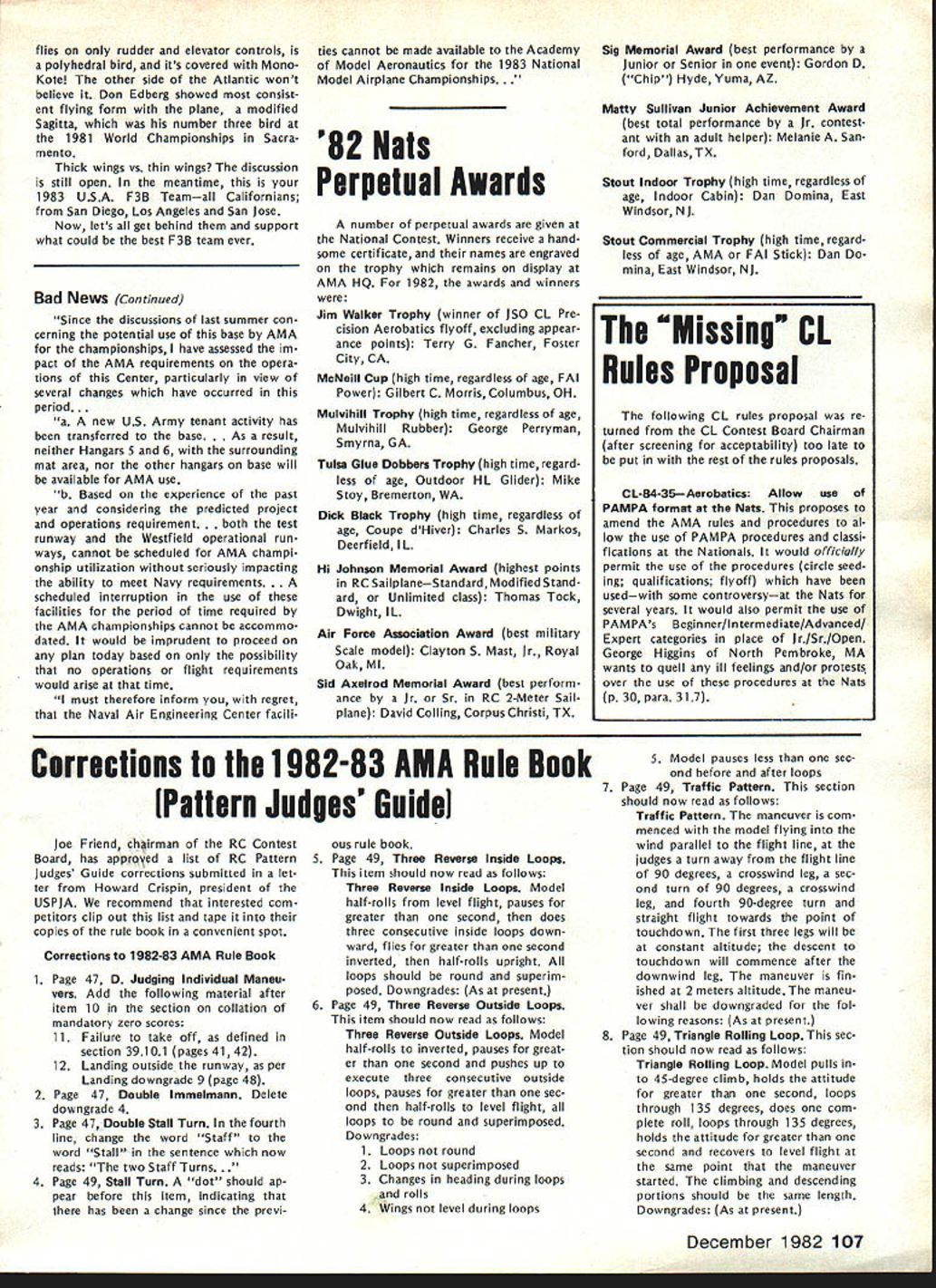
In response to a letter from AMA Assistant Executive Director Vince Mankowski, dated August 27, 1982, Captain R. M. Kraft, Commanding Officer of the Lakehurst Naval Air Engineering Center, sent a letter concerning the availability of the Lakehurst facility as a 1983 Nats site. His letter stated, in part:
"A. A new U.S. Army tenant activity has been transferred to the base. As a result, neither Hangars 5 and 6, with the surrounding mat area, nor the other hangars on base will be available for AMA use.
B. Based on the experience of the past year and considering the predicted project and operations requirement, both the test runway and the Westfield operational runways cannot be scheduled for AMA championship utilization without seriously impacting the ability to meet Navy requirements. A scheduled interruption in the use of these facilities for the period of time required by the AMA championships cannot be accommodated. It would be imprudent to proceed on any plan today based on only the possibility that no operations or flight requirements would arise at that time.
I must therefore inform you, with regret, that the Naval Air Engineering Center facilities cannot be made available to the Academy of Model Aeronautics for the 1983 National Model Airplane Championships."
FLASH! Indoor World Champs Results
Slanic-Prahova salt mine, Romania — Morar Aurel led the Romanian team to victory in the Indoor World Championships here. Dave Pymm of Great Britain finished second, as did the British team. Jim Richmond was third, as was the U.S.A. team. The other national teams competing finished in the following order: Poland — 4th; Japan — 5th; Yugoslavia — 6th; Hungary — 7th; West Germany — 8th; Finland — 9th; Canada — 10th; Italy — 11th; Netherlands — 12th; Switzerland — 13th. A complete report will be published in a future issue.
Nats Trophies
We published the list of Nats winners in last month's issue. Every name appearing in that list represents a competitor who should have received a Nats trophy.
If your name appears there and you did not pick up your trophy at the Nats, you can still get it. Send your name, address, AMA number, and event/place of the trophy to AMA HQ, Attention: Frank Ehling. Include a check or money order for $10 to cover postage and handling. This offer cannot be extended past January 31, 1983.
Second Call for Masters Tournament Site Bids
We published an invitation for Masters Tournament site bids in the September 1982 issue. To date, only one bid has been received at AMA HQ. Clubs still considering submitting a bid should be reminded that the deadline for receiving bids at AMA HQ is December 1, 1982.
The one bid received was drafted by Burns R. Fields, Jr., president of the Gateway RC Club of Jacksonville, FL. The site location would be the club field on 103rd Street in Jacksonville. The club now hosts two annual meets at this field: the Glen Sig Memorial Pattern Meet and the Rebel Rally.
Soaring Team Finals
Dan Pruss Photographs by Jim Slater
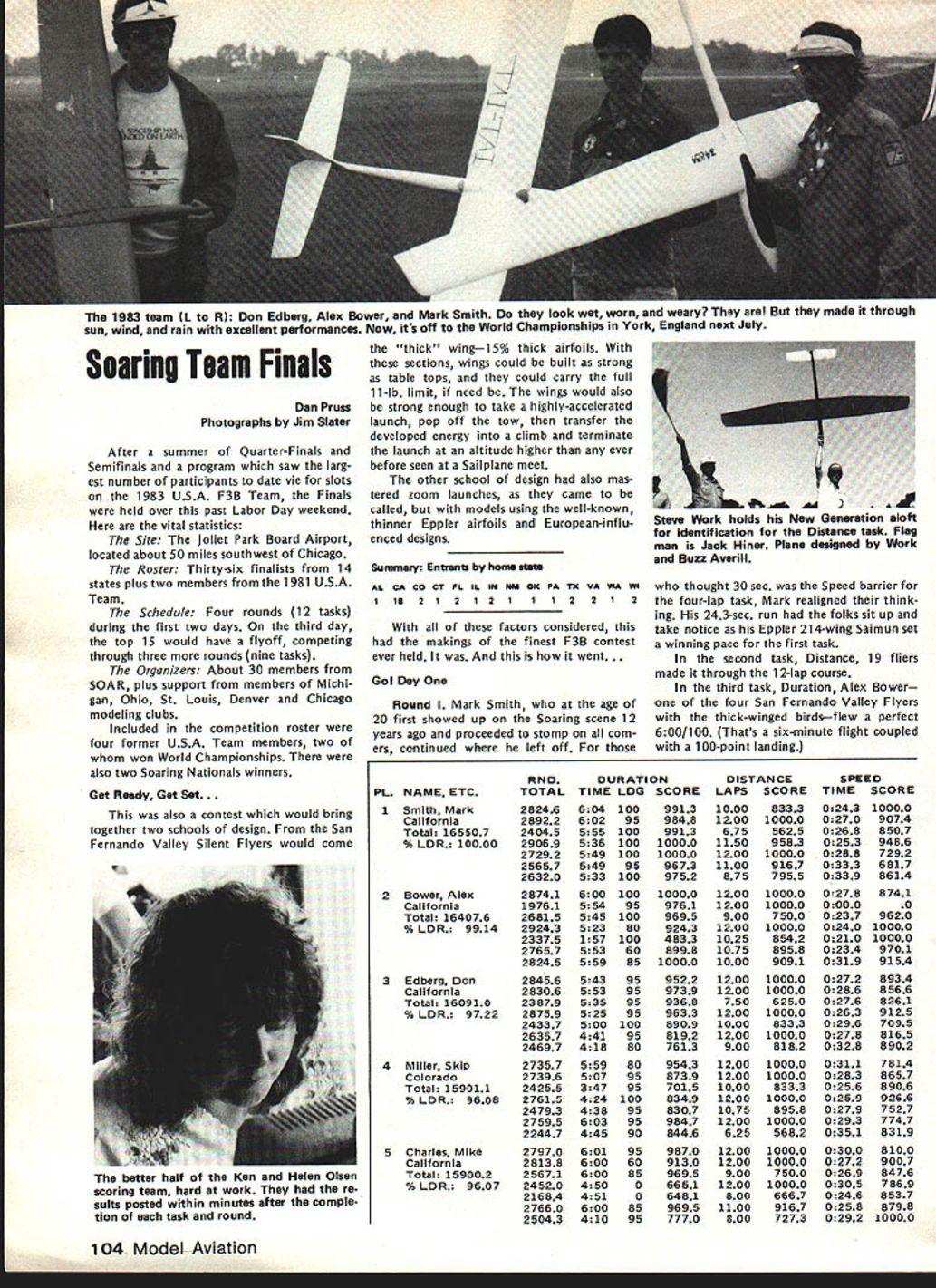
After a summer of Quarter-Finals and Semifinals and a program which saw the largest number of participants to date vie for slots on the 1983 U.S.A. F3B Team, the Finals were held over Labor Day weekend. Here are the vital statistics:
- The Site: The Joliet Park Board Airport, located about 50 miles southwest of Chicago.
- The Roster: Thirty-six finalists from 14 states plus two members from the 1981 U.S.A. Team.
- The Schedule: Four rounds (12 tasks) during the first two days. On the third day, the top 15 had a flyoff, competing through three more rounds (nine tasks).
- The Organizers: About 30 members from SOAR, plus support from members of Michigan, Ohio, St. Louis, Denver and Chicago modeling clubs.
Included in the competition roster were four former U.S.A. Team members, two of whom were World Champions. There were also two Soaring Nationals winners.
Get Ready, Get Set...
- This contest brought together two schools of design. From the San Fernando Valley Silent Flyers came the "thick" wing — 15% thick airfoils. With these sections, wings could be built very strong, carry the full 11-lb. limit if needed, and absorb highly accelerated launches, transferring that energy into very high launches.
- The other school used thinner Eppler airfoils and European-influenced designs, also capable of strong zoom launches.
Summary: Entrants by home state
- (Detailed roster omitted here.)
With all of these factors considered, this had the makings of the finest F3B contest ever held. It was. And this is how it went...
Go! Day One
Round I
- Speed: Mark Smith (age 20) set a winning pace with an Eppler 214 wing Saimun, posting a remarkable 24.3-second four-lap run.
- Distance: 19 fliers made it through the 12-lap course.
- Duration: Alex Bower — one of the four San Fernando Valley Flyers with thick-winged birds — flew a perfect 6:00/100 (six-minute flight coupled with a 100-point landing).
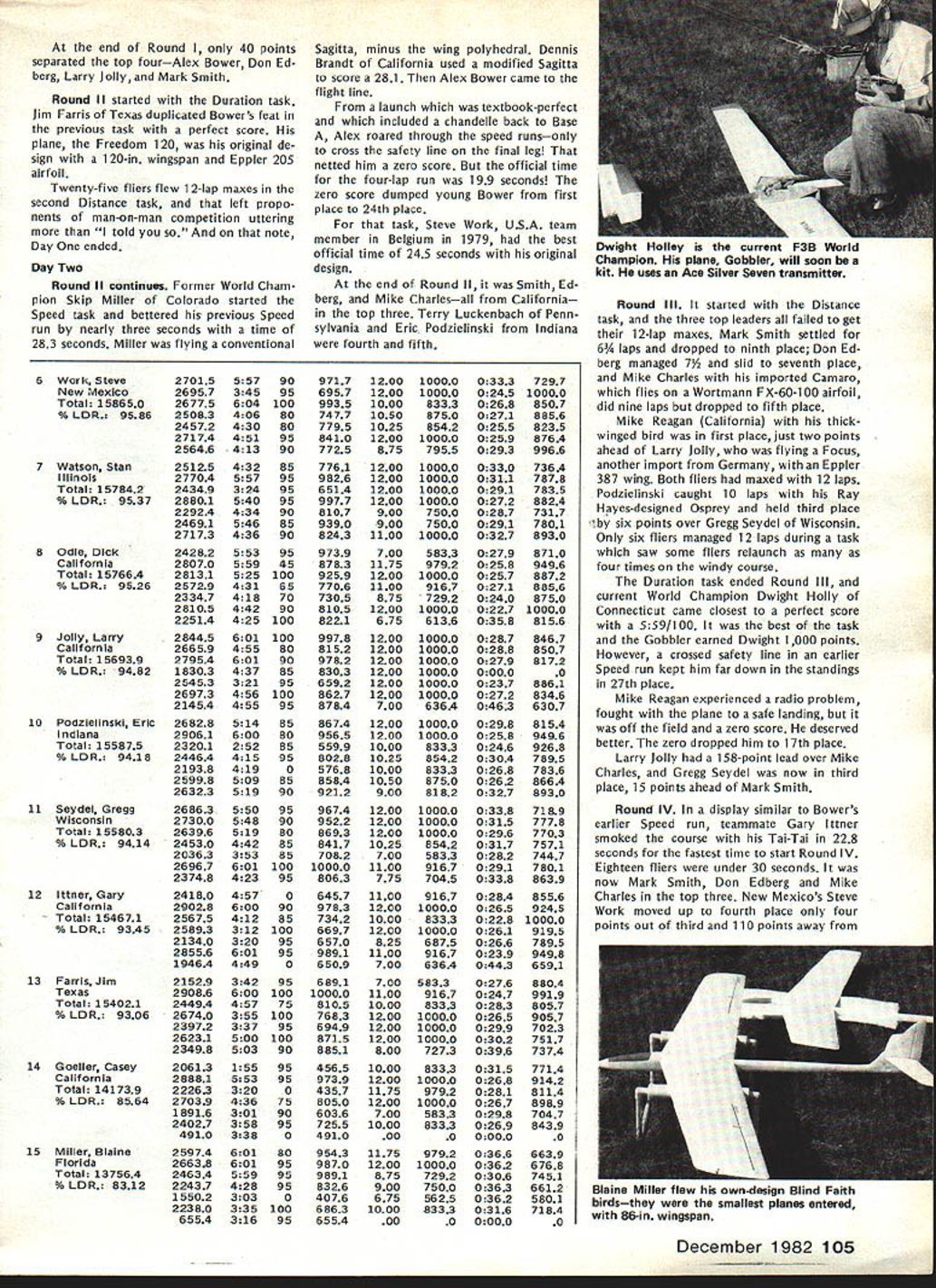
At the end of Round I, only 40 points separated the top four: Alex Bower, Don Edberg, Larry Jolly, and Mark Smith.
Round II
- Duration: Jim Farris of Texas duplicated Bower's feat with a perfect score flying his Freedom 120 (120-in. span, Eppler 205 airfoil).
- Distance: Twenty-five fliers flew 12-lap maxes.
- Day One ended with strong performances and spirited competition.
Day Two
Round II (continued)
- Speed: Former World Champion Skip Miller of Colorado bettered his previous Speed run with a 28.3-second time. Dennis Brandt (CA) scored 28.1. Alex Bower flew an official time of 19.9 seconds but crossed the safety line on the final leg, earning a zero and dropping from first to 24th place in standings.
- Best official Speed of the task: Steve Work (USA team member in 1979) with 24.5 seconds.
- End of Round II standings: Smith, Edberg, and Mike Charles (all from California) were the top three.
Round III
- Distance: The three top leaders all failed to get 12-lap maxes. Mark Smith settled for 6¼ laps (dropped to ninth), Don Edberg 7½ (dropped to seventh), Mike Charles nine laps (dropped to fifth).
- Leading after Distance: Mike Reagan (CA) in first, two points ahead of Larry Jolly; Gregg Seydel (WI) and Eric Podzielinski (IN) were near the top as well.
- Duration: World Champion Dwight Holley of Connecticut scored 5:59/100, the best of the task, but a prior crossed safety line kept him down in 27th place.
- Radio trouble: Mike Reagan experienced a radio problem, causing a zero and dropping him to 17th place.
- Standings: Larry Jolly led Mike Charles by 158 points, Gregg Seydel was in third, 15 points ahead of Mark Smith.
Round IV
- Speed: Gary Ittner opened Round IV with a 22.8-second Tai-Tai pass; 18 fliers were under 30 seconds.
- Top three: Mark Smith, Don Edberg, and Mike Charles.
- New Mexico's Steve Work moved up to fourth.
Round V
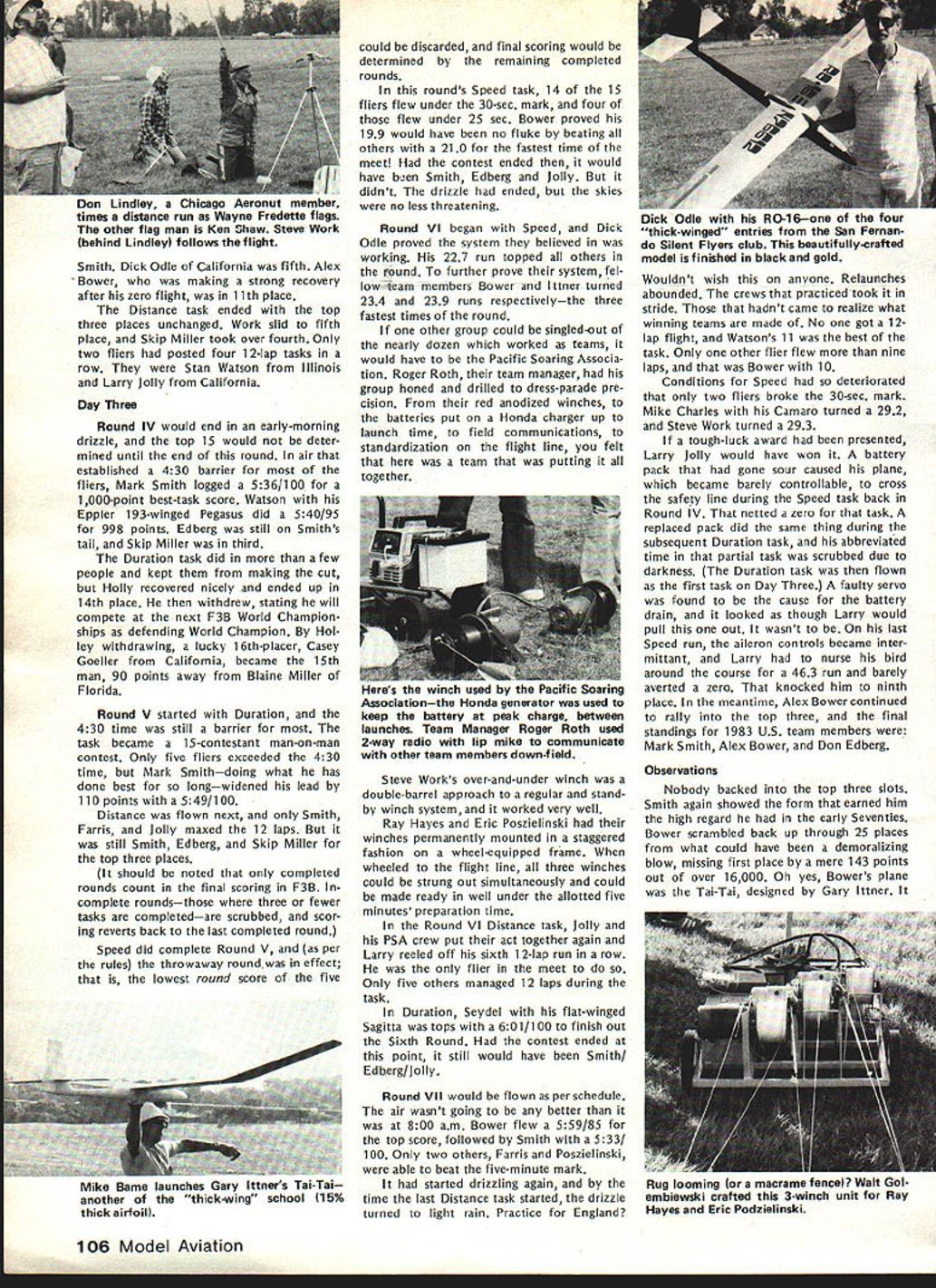
- Duration: The 4:30 barrier persisted; only five fliers exceeded 4:30. Mark Smith widened his lead with a 5:49/100.
- Distance: Only Smith, Farris, and Jolly maxed the 12 laps.
- Note: Only completed rounds count in final scoring; incomplete rounds (three or fewer tasks completed) are scrubbed and scoring reverts to the last completed round.
- The Speed task completed Round V. The throwaway round rule applied: each competitor could discard his lowest round score of the five.
- In Speed, Alex Bower recorded a 21.0-second run — the fastest official time of the meet (his 19.9 was disqualified for the safety-line violation). Had the contest ended then the top three would have been Smith, Edberg, and Jolly.
Round VI
- Speed: Dick Odle led the round with a 22.7 run. Team members Bower and Ittner posted 23.4 and 23.9 — the three fastest times of the round.
- Team organization: The Pacific Soaring Association (PSA), managed by Roger Roth, demonstrated excellent team logistics (red anodized winches, charged batteries, field communications, flight line standardization).
- Winch innovations: Steve Work's over-and-under winch and Ray Hayes/Eric Podzielinski's staggered, wheel-mounted winches were notable.
- Distance: Larry Jolly and his PSA crew achieved Jolly's sixth consecutive 12-lap run — the only flier to do so.
- Duration: Gregg Seydel topped with a 6:01/100 to finish Round VI.
- If the contest had ended at this point, the top three would still be Smith/Edberg/Jolly.
Round VII (Flyoff)
- Duration: Bower flew a 5:59/85; Smith posted 5:33/100. Only four fliers beat five minutes.
- Weather: Drizzle turned to light rain; relaunches were frequent. Crews that had practiced handled it better.
- Distance: No one managed a 12-lap flight; Watson's 11 laps were best. Relaunches and adverse conditions affected many.
- Speed under deteriorated conditions: Only two fliers broke the 30-second mark — Mike Charles (29.2) and Steve Work (29.3).
- Tough luck for Larry Jolly: a sequence of battery and servo troubles led to zeroes and scrubs; he eventually finished ninth.
- Final U.S. team members: Mark Smith, Alex Bower, and Don Edberg.
Observations
- Nobody backed into the top three slots. Mark Smith showed the same form that earned him high regard in the early 1970s. Alex Bower recovered spectacularly from a 24th-place drop to finish narrowly behind first; he missed first place by 143 points out of over 16,000. Bower's plane was the Tai-Tai, designed by Gary Ittner — a polyhedral bird flying on only rudder and elevator controls and covered with MonoKote.
- Don Edberg showed the most consistent flying with a modified Sagitta, his number three bird at the 1981 World Championships in Sacramento.
- Thick wings vs. thin wings remains an open discussion. The 1983 U.S.A. F3B Team is all Californians — from San Diego, Los Angeles, and San Jose. Now, let's all get behind them and support what could be the best F3B team ever.
'82 Nats Perpetual Awards
A number of perpetual awards are given at the National Contest. Winners receive a certificate, and their names are engraved on trophies which remain on display at AMA HQ. For 1982, the awards and winners were:
- Jim Walker Trophy (winner of JSO CL Precision Aerobatics flyoff, excluding appearance points): Terry G. Fancher, Foster City, CA.
- McNeill Cup (high time, regardless of age, FAI Power): Gilbert C. Morris, Columbus, OH.
- Mulvihill Trophy (high time, regardless of age, Mulvihill Rubber): George Perryman, Smyrna, GA.
- Tulsa Glue Dobbers Trophy (high time, regardless of age, Outdoor HL Glider): Mike Stoy, Bremerton, WA.
- Dick Black Trophy (high time, regardless of age, Coupe d'Hiver): Charles S. Markos, Deerfield, IL.
- Hi Johnson Memorial Award (highest points in RC Sailplane—Standard, Modified Standard, or Unlimited class): Thomas Tock, Dwight, IL.
- Air Force Association Award (best military Scale model): Clayton S. Mast, Jr., Royal Oak, MI.
- Sid Axelrod Memorial Award (best performance by a Jr. or Sr. in RC 2-Meter Sailplane): David Colling, Corpus Christi, TX.
- Sig Memorial Award (best performance by a Junior or Senior in one event): Gordon D. ("Chip") Hyde, Yuma, AZ.
- Matty Sullivan Junior Achievement Award (best total performance by a Jr. contestant with an adult helper): Melanie A. Sanford, Dallas, TX.
- Stout Indoor Trophy (high time, regardless of age, Indoor Cabin): Dan Domina, East Windsor, NJ.
- Stout Commercial Trophy (high time, regardless of age, AMA or FAI Stick): Dan Domina, East Windsor, NJ.
The "Missing" CL Rules Proposal
The following CL rules proposal was returned from the CL Contest Board Chairman (after screening for acceptability) too late to be printed with the rest of the proposals.
- CL-84-35 — Aerobatics: Allow use of PAMPA format at the Nats. This proposes to amend the AMA rules and procedures to allow the use of PAMPA procedures and classifications at the Nationals (seeding; qualifications; flyoff), and to permit PAMPA's Beginner/Intermediate/Advanced/Expert categories in place of Jr./Sr./Open. George Higgins of North Pembroke, MA proposed this to quash any ill feelings and/or protests over the use of these procedures at the Nats.
Corrections to the 1982-83 AMA Rule Book (Pattern Judges' Guide)
Joe Friend, chairman of the RC Contest Board, approved a list of RC Pattern Judges' Guide corrections submitted in a letter from Howard Crispin, president of the USPJA. Competitors are advised to clip out this list and tape it into their copies of the rule book.
Corrections to 1982-83 AMA Rule Book
- Page 47, D. Judging Individual Maneuvers. Add the following after item 10 in the section on collision of mandatory zero scores:
- 11. Failure to take off, as defined in section 39.10.1 (pages 41–42).
- 12. Landing outside the runway, as per Landing downgrade 9 (page 48).
- Page 47, Double Immelmann. Delete downgrade 4.
- Page 47, Double Stall Turn. In the fourth line, change "Staff" to "Stall" so the sentence reads: "The two Stall Turns..."
- Page 49, Stall Turn. Add a dot indicating there has been a change since the previous rule book.
- Page 49, Three Reverse Inside Loops. Revised description:
- Three Reverse Inside Loops. Model half-rolls from level flight, pauses for greater than one second, then does three consecutive inside loops downward, flies for greater than one second inverted, then half-rolls upright. All loops should be round and superimposed. Downgrades: (As at present.)
- Page 49, Three Reverse Outside Loops. Revised description:
- Three Reverse Outside Loops. Model half-rolls to inverted, pauses for greater than one second and pushes up to execute three consecutive outside loops, pauses for greater than one second and then half-rolls to level flight. All loops to be round and superimposed. Downgrades:
- Loops not round
- Loops not superimposed
- Changes in heading during loops and rolls
- Wings not level during loops
- Page 49, Traffic Pattern. Revised description:
- Traffic Pattern. The maneuver is commenced with the model flying into the wind parallel to the flight line, at the judges a turn away from the flight line of 90 degrees, a crosswind leg, a second turn of 90 degrees, a crosswind leg, and a fourth 90-degree turn and straight flight towards the point of touchdown. The first three legs will be at constant altitude; the descent to touchdown will commence after the downwind leg. The maneuver is finished at 2 meters altitude. Downgrades: (As at present.)
- Page 49, Triangle Rolling Loop. Revised description:
- Triangle Rolling Loop. Model pulls into a 45-degree climb, holds the attitude for greater than one second, loops through 135 degrees, does one complete roll, loops through 135 degrees, and holds the altitude for greater than one second and recovers to level flight at the same point that the maneuver started. The climbing and descending portions should be the same length. Downgrades: (As at present.)
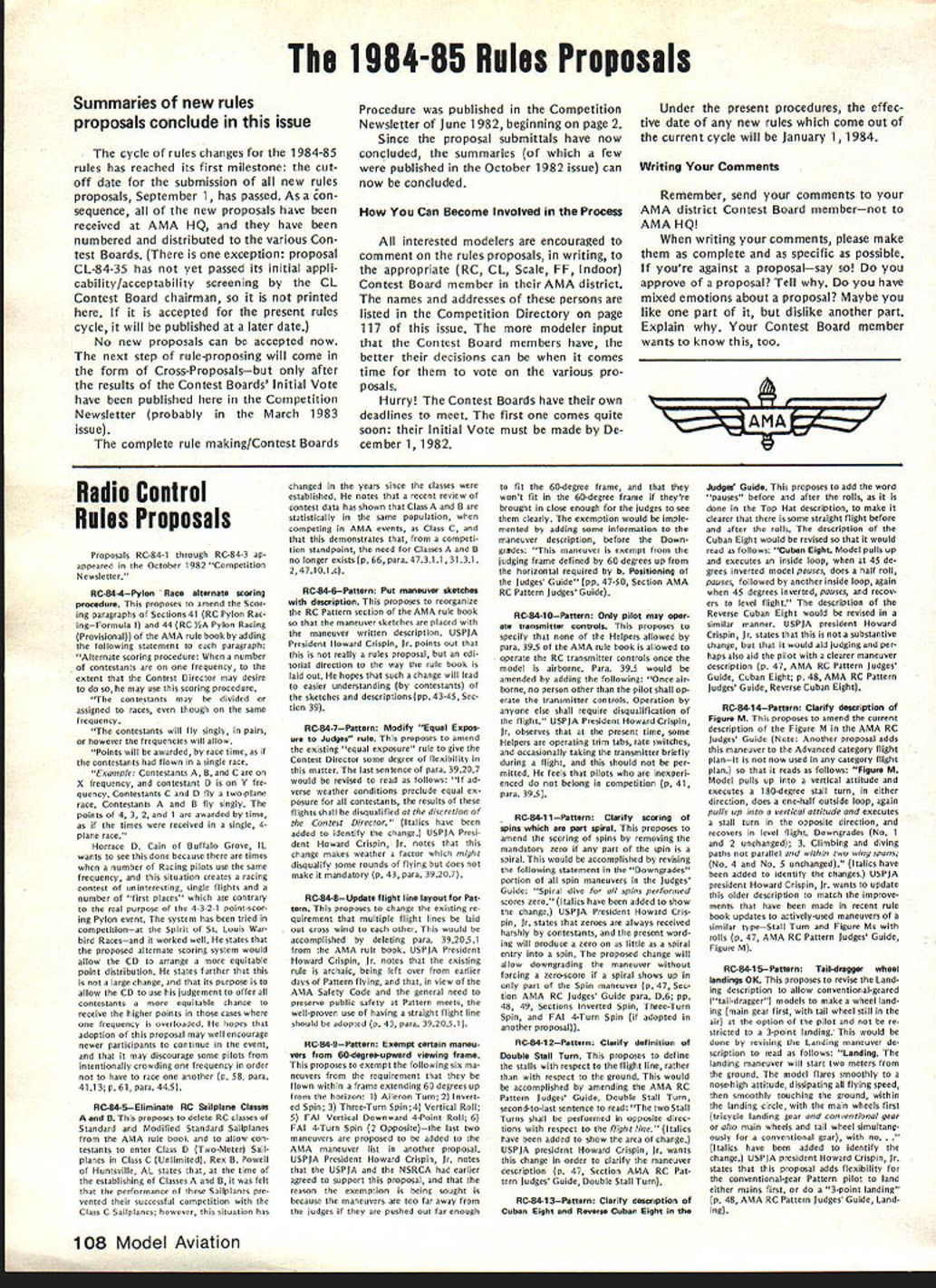
The 1984-85 Rules Proposals
Summaries of new rules proposals conclude in this issue
The cycle for the 1984–85 rules reached its submission deadline (September 1). All new proposals have been received, numbered, and distributed to the various Contest Boards (with the exception of CL-84-35, still under screening).
No new proposals can be accepted now. The next step will be Cross-Proposals after Contest Boards' Initial Vote results have been published (probably March 1983 issue).
The complete rule making/Contest Boards Procedure was published in the Competition Newsletter of June 1982, beginning on page 2.
How You Can Become Involved in the Process
All interested modelers are encouraged to comment on the rules proposals, in writing, to the appropriate Contest Board member in their AMA district. Names and addresses of these persons are listed in the Competition Directory (page 117 of this issue). The more input Contest Board members have, the better their decisions will be when voting on proposals.
Hurry! Contest Boards have deadlines. Their Initial Vote must be made by December 1, 1982. Under present procedures, the effective date of any new rules from this cycle will be January 1, 1984.
Writing Your Comments
Remember: send your comments to your AMA district Contest Board member — not to AMA HQ.
When writing comments, be complete and specific. If you're against a proposal, explain why. If you approve, say so and why. Mixed feelings? Explain the parts you like and dislike so the Contest Board member can use your input.
Radio Control Rules Proposals
Proposals RC-84-1 through RC-84-33 appeared in the October 1982 Competition Newsletter. Below are selected proposals and summaries.
RC-84-4 — Pylon "Race" alternate scoring procedure
- Amend scoring paragraphs of Sections 41 (RC Pylon Race — Formula 1) and 44 (RC Sky Pylon Racing — Provisional) to allow an alternate scoring procedure when multiple contests share one frequency and the CD must divide time. Contestants may be divided into races (singles, pairs, triples), and points are awarded by race as if all times were from a single race to yield equitable point distribution. Proponent: Horace D. Cahn, Buffalo Grove, IL.
RC-84-5 — Eliminate NAC Spline Case A and B
- Delete RC Spline Classes A and B and allow contestants to enter Class D (Two-Meter Sailplanes) in Class C (Unlimited). Rationale: performance parity across classes. Proponent: Rex B. Trzonk, Huntsville, AL.
RC-84-6 — Pattern: Put maneuver sketches with descriptions
- Reorganize RC Pattern section so maneuver sketches are placed with the written description for easier understanding. Proponent: Howard Crispin, Jr., USPAI President.
RC-84-7 — Pattern: Modify "Equal Exposures to the Judges"
- Amend last sentence of para. 39.19.70 to give the Contest Director discretion when adverse weather precludes equal exposure. Proposed wording adds: "If adverse weather conditions preclude equal exposure for all contestants, the results of the flight shall be decided on the basis of the Contest Director's decision." Proponent: Howard Crispin, Jr.
RC-84-8 — Pattern: Update flight line layout for Pattern
- Delete para. 39.20.5 which requires multiple flight lines to be laid out across each other; this provides flexibility and improves public safety and compliance with the AMA Safety Code. Proponent: Howard Crispin, Jr.
RC-84-9 — Pattern: Exempt certain maneuvers from the 60-degree viewing frame requirement
- Exempt maneuvers such as Downward Eight, Cuban Eight, Reverse Cuban Eight from the 60-degree viewing-frame requirement by adding exemption text to maneuver descriptions.
RC-84-10 — Pattern: Only pilot may operate transmitter controls
- Specify that none of the engines or flight controls allowed may be operated by anyone other than the pilot during flight — eliminates handler operation that affects flight while the pilot flies. Mixed comments on restrictiveness.
RC-84-11 — Pattern: Clarify description of maneuvers
- Amend maneuver descriptions to align text with sketches and current practice (e.g., Cuban Eight, Downward Eight).
RC-84-12 — Pattern: Tail-dragger wheel landings OK
- Revise landing descriptions to allow conventional-gear (tail-dragger) models to be landed and judged without penalty provided landing meets criteria.
(Additional RC pattern proposals and paragraph references follow in the AMA proposals packet.)
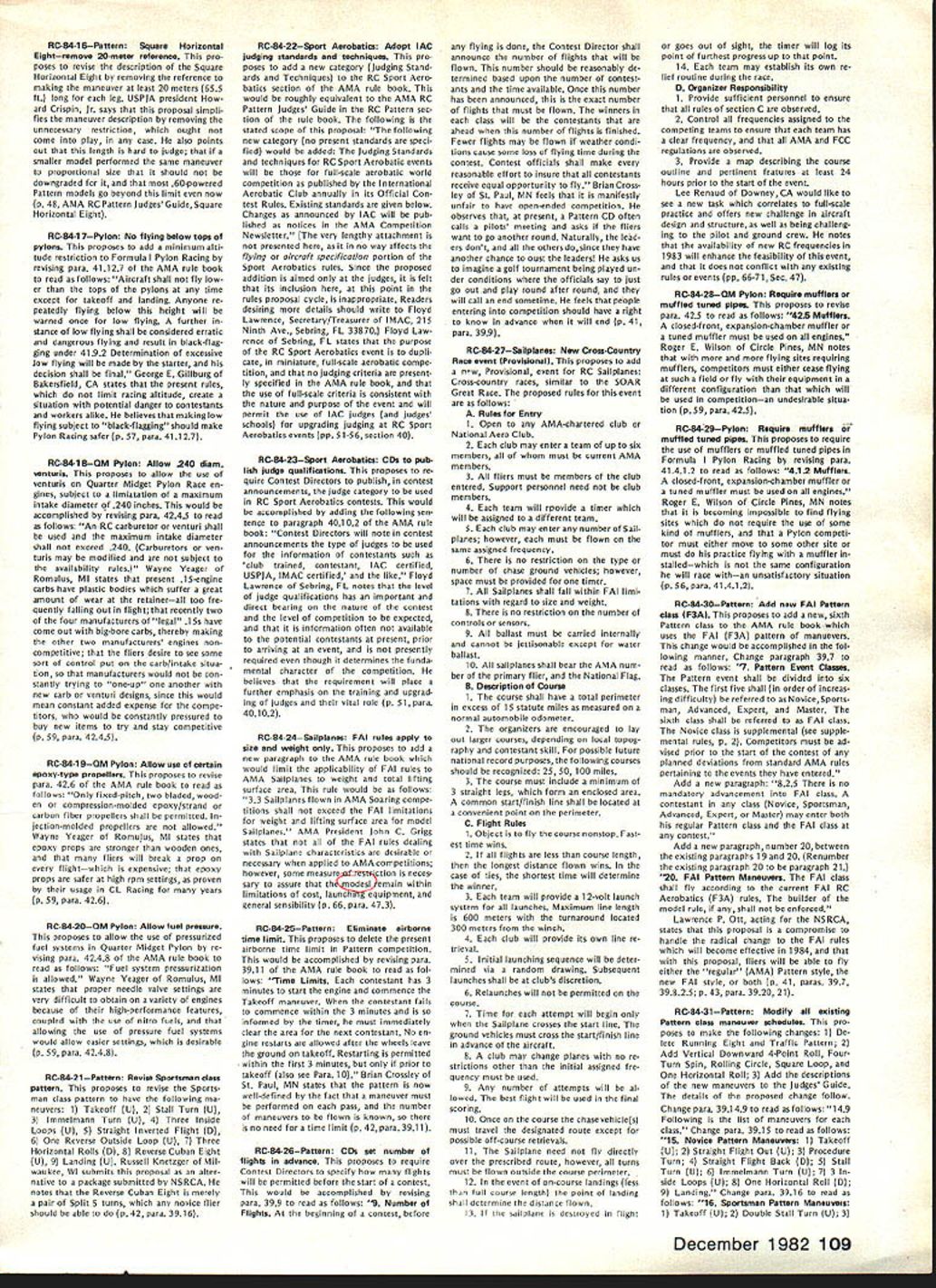
RC-84-15 — Pattern: Square Horizontal Eight — remove 20-meter reference
- Remove the reference requiring each leg to be at least 20 meters long; the length is hard to judge and unnecessary. Proponent: Howard Crispin, Jr.
RC-84-17 — Pylon: No flying below tops of pylons
- Add minimum altitude restriction for Formula 1 Pylon Racing: aircraft shall not fly lower than the tops of the pylons except for takeoff and landing. Repeated low flying leads to warning and then black-flagging. Proponent: George E. Gillibrand, Bakersfield, CA.
RC-84-18 — QM Pylon: Allow .240 carb
- Allow venturis/carbs up to .240" intake diameter for Quarter Midget Pylon Race engines and remove availability constraints. Proponent: Wayne Yeager, Romulus, MI.
RC-84-19 — QM Pylon: Allow use of certain epoxy-type propellers
- Permit fixed-pitch, two-bladed wood or glass-epoxy propellers; disallow injection-molded propellers. Proponent: Wayne Yeager.
RC-84-20 — QM Pylon: Allow use of pressurized fuel systems
- Allow pressurized fuel systems in Quarter Midget Pylon (revise para. 42.4.8 to read: "Fuel system pressurization is allowed"). Proponent: Wayne Yeager.
RC-84-21 — Pattern: Revise Sportsman class pattern
- Proposes a revised Sportsman class maneuver list (takeoff, stall turn, Immelmann, three inside loops, three inside rolls, reverse outside loop, etc.).
RC-84-22 — Sport Aerobatics: Adopt IAC judging standards and techniques
- Add a Judging Standards and Techniques category to RC Sport Aerobatics modeled on International Aerobatic Club standards, modified for RC. Proponent: Floyd Lawrence, Sebring, FL.
RC-84-23 — Sport Aerobatics: CDs to publish judges' qualifications
- Require Contest Directors to publish judges' credentials in contest announcements. Proponent: Floyd Lawrence.
RC-84-24 — Sailplanes: FAI rules apply to size and weight only
- Limit FAI rule applicability to weight and total lifting surface area for AMA Sailplanes. Proponent: John C. Grigg, AMA President.
RC-84-25 — Pattern: Eliminate airborne time limit
- Delete present airborne time limit in Pattern competition; revise para. 39.11 to change engine/starting/restart rules accordingly.
RC-84-26 — Pattern: CD set number of flights in advance
- Require the Contest Director to announce the number of flights to be flown at the start of the contest. Proponent: Brian Cross, St. Paul, MN.
RC-84-27 — Sailplanes: New Cross-Country Race event (Provisional)
- Propose a new provisional Cross-Country Race event for RC Sailplanes modeled on SOAR/Great Races. Includes rules for entry, course description, flight rules, and contestant responsibilities. Proponent: Lee Renaud, Downey, CA.
RC-84-28 — GM Pylon: Require muffler tuned pipes
- Require closed-front, expansion-chamber mufflers or tuned mufflers on all engines in GM Pylon. Proponent: Roger E. Wilson, Circle Pines, MN.
RC-84-29 — Pylon: Require mufflers/muffled tuned pipes
- Require mufflers or muffled tuned pipes in Formula 1 Pylon Racing (similar to RC-84-28). Proponent: Roger E. Wilson.
RC-84-30 — Pattern: Add new FAI Pattern class (F3A)
- Add a new Pattern class to use the FAI (F3A) pattern of maneuvers, creating an FAI Class alongside AMA Class patterns.
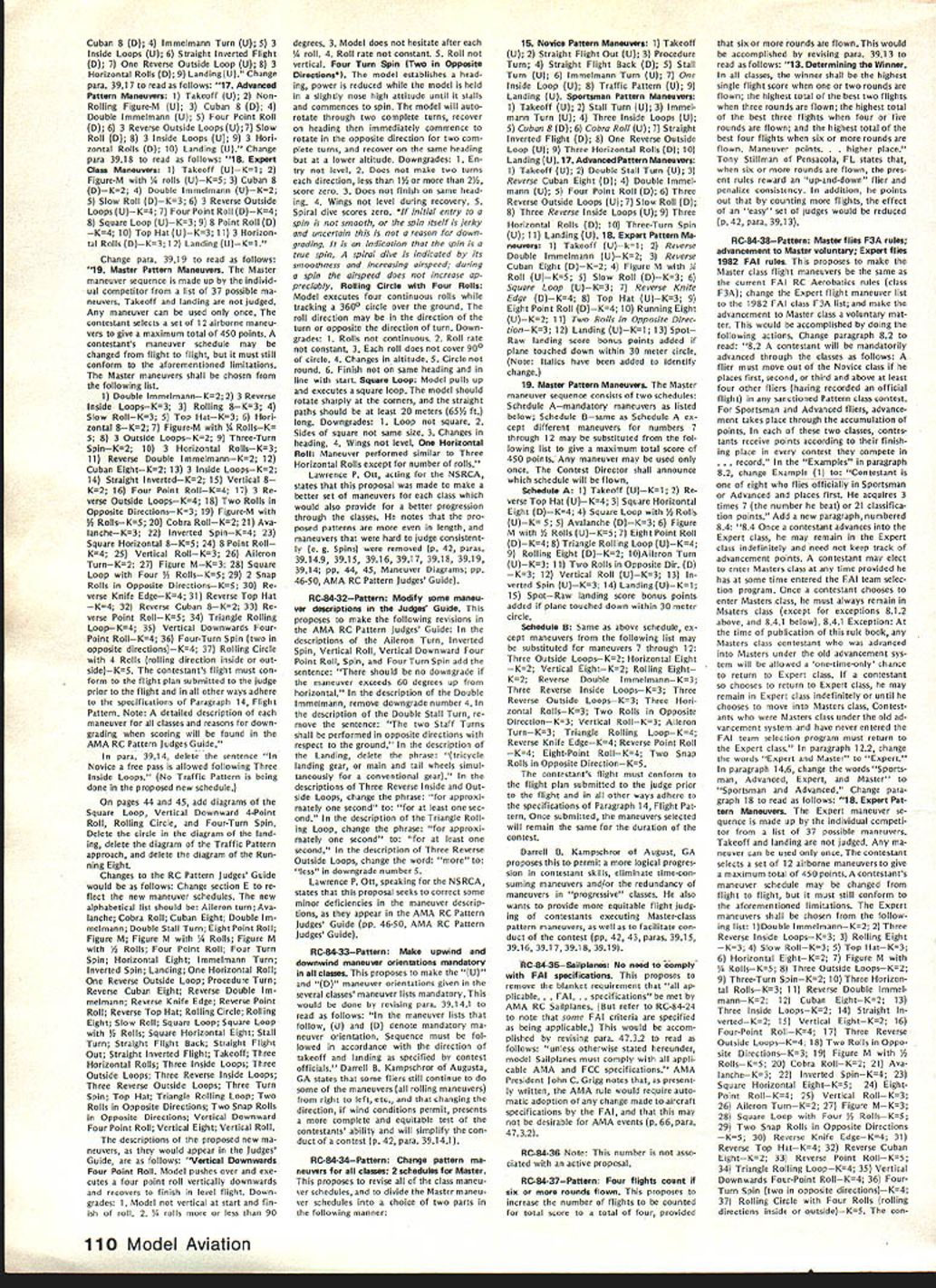
RC-84-31 — Pattern: Modify all existing Pattern class maneuver schedules
- Proposes modifications to Beginner, Novice, Sportsman, Advanced, and Expert classes (details in proposals packet).
(End of RC proposals summary. Additional proposals and detailed text appear in the AMA packet.)
Control Line Rules Proposals
(Proposals CL-84-1 and CL-84-2 appeared previously. Below are additional CL proposals.)
CL-84-3 — Crashes, line tangles, and fly-aways do not end Combat matches
- After a collision, line tangle, or fly-away, competitors may repair and continue within match time. If a model cannot be repaired/replaced in time, the opponent is declared the winner.
CL-84-4 — Maximum weight for Combat models
- Change maximum weight limit for Combat models from 4 lb. to 4 lb. 8 oz. Intended to allow greater design flexibility.
CL-84-5 — No points for using twine in Slow Combat
- Delete para. 34.3 and replace with: "Only control lines of the approved type shall be used. The use of twine shall disqualify a flight."
CL-84-6 — Delete "Builder of the Model" rule from Carrier
- Delete paragraph 30.14; proponents argue the rule is unprovable and unenforceable and that removal would encourage newcomers.
CL-84-7 — Increase Profile Carrier wingspan to 50 in.
- Modify para. 30.3 to allow Profile Class wingspan of 50 in. to permit more models/kits to qualify.
CL-84-8 — Delete 60-degree nose-high rule; substitute maximum low speed flight time
- Replace subjective 60-degree rule with a measurable maximum low-speed flight time of 150 seconds.
CL-84-9 — Correct maneuver description for Outside Square Loops
- Amend the Outside Square Loops description to align with published sequence and geometric intent.
CL-84-10 — Correct geometric diagram; Square Horizontal Eights
- Amend geometric notes and descriptions to correct contradictions with spherical-flight references.
CL-84-11 — Landings: eliminate "one-lap" rule
- Delete the requirement about the model stopping within one lap of touchdown; provide a more flexible landing description for judges.
CL-84-12 — Precision Aerobatics — allow special procedures at the Nats
- Amend "Number of Flights" rule to permit variations used at the Nats on a trial basis.
CL-84-13 — Delete certain records procedures from CL General section
- Remove redundant record-procedure paragraphs to increase accuracy of CL section.
CL-84-14 — Define "pressure fuel system"
- Add a definition and cross-reference: "A pressure fuel system is one in which pressure from any source is imposed on the fuel in addition to pressure from gravity, centrifugal force, vent tubes and the carburetor."
CL-84-15 — Redefine "fuselage" in Slow Combat
- Require the fuselage to be continuous from the engine mount to the stabilizer to disallow tail-boom-only designs.
CL-84-16 — Scrub no more than 3% in Slow Combat
- Limit allowable scrub to no more than 3% of total course time to maintain engine relevancy.
CL-84-17 — Provide for "end of match" in Slow Combat
- After both strings are cut and on judge’s signal, both fliers must fly level and counter-clockwise to prevent intimidation tactics.
CL-84-18 — Increase line thickness for engines up to .25 cu. in. Combat
- Change minimum line diameter from .012" to .015" for improved safety.
CL-84-19 — Increase control line thickness to .020 in. in Formula 40 Speed
- Increase minimum control line diameter (safety measure).
CL-84-20 — Increase line thickness in Rat Racing
- Increase required diameters to improve safety margins.
CL-84-21 — Standard fuel in all Speed events except Rat
- Impose a standard fuel mix (40% nitromethane, 20% lubricant, 40% methanol) supplied by organizers to equalize competition. Proponent: Gene Hempel, Speed Advisory Committee.
CL-84-22 — Revise Slow Rat
- Comprehensive revisions to Slow Rat rules: profile construction, tank location, carburetor restrictions, fuel supply (max 10% nitro), engine displacement limit (.36 cu. in.), standardization of available engines, multi-strand line requirements, race formats, and more. Proponent: Frank E. Williams, Houston, TX.
CL-84-23 — Add second 70-lap qualifying race to Scale Racing
- Add a second 70-lap qualifying race to provide more practice and opportunity. Proponent: Frank E. Williams.
CL-84-24 — Mandate three fliers in Scale Racing heats
- Require three-flier heats except when odd entrant numbers force two-up races.
CL-84-25 — Add feature race to Scale Racing
- Add one final "feature" three-up 140-lap race among the top three finishers from finals.
CL-84-26 — Stabilizer specification for Slow Combat
- Require stabilizer width of at least 3 in. and same width as elevator.
CL-84-27 — Specify canopy for Slow Combat
- Require canopy to be same material as model, at least 2 in. length, and sufficient height to enclose a 2 in. by 3 in. cylinder.
CL-84-28 — Ban "soft" tank in Slow Combat
- Disallow collapsible ("soft") fuel tanks to avoid inconsistent fuel delivery.
CL-84-29 — Specify vertical stabilizer in Slow Combat
- Require vertical stabilizer area of at least 3 sq. in.
CL-84-30 — Fuselage specification for Slow Combat
- Require a full fuselage, not pod-and-boom construction.
CL-84-31 — Add Wing Over option to Precision Aerobatics pattern
- Add a standard Wing Over (non-reverse) as an option for beginning and novice pilots.
CL-84-32 — Revise New Carrier landing description
- Define a landing as complete when the model comes to rest; landing is scored at the point first brought to rest.
CL-84-33 — Navy Carrier: only three 60-degree nose-high variations permitted
- Limit the number of 60-degree nose-high variations in the current sequence to three.
CL-84-34 — Precision Aerobatics: No flight loss for minor part loss
- Loss of minor objects or parts (wheels, hatches, trims, etc.) should not automatically cause loss of flight points if safety/airworthiness is not compromised.
CL-84-36 — Precision Aerobatics: Redefine landing to remove "one-lap rule"
- Similar to CL-84-11, with additional clarification and inclusion of a "descent not smooth" error.
CL-84-37 — Precision Aerobatics: Clarify Beer Ball Closer
- Change wording to "normal level flight" to remove ambiguity.
CL-84-38 — Amend Landing downgrades
- Proposes downgrading rather than automatic loss for nose-overs and certain landing anomalies due to unreliability of control surfaces.
(End of Control Line proposals.)
Scale Rules Proposals
SC-84-1 — Revise static scoring of Sport Scale Sailplanes
- Increase static points for Finish, Color and Markings from 10 to 15 and change Original Design Model wording. Proponent: Kenneth Huff, Petersburg, VA.
SC-84-2 — Twenty-pound weight limit for Sport Scale
- Increase max allowable weight for single-engine Sport Scale models from 15 to 20 lb to allow more modelers to compete. Proponent: David A. Platt, Plantation, FL.
SC-84-3 — Clarify Proof of Accuracy rule
- Add a statement to para. 53.4.4 to avoid downgrading when photos cannot show every side. Proponent: David R. Platt.
SC-84-4 — Amend Landing downgrades
- Delete automatic loss for nose-over on landing to prevent unfair scoring due to control surface reliability.
SC-84-5 — Revise static judging area for RC and CL Sport Scale
- Change static judging setup from a 15-ft radius circle to a pair of parallel lines 15 ft apart so no part of a model is closer than 15 ft to judges. Proponent: Robert Underwood, St. Louis, MO.
SC-84-6 — Varied judging distance for RC Sport Scale
- Specify judging distances for Accuracy of Outline and Finish/Color/Markings based on wingspan (table ranges from 9 ft to 35 ft according to span). Proponent: William C. Northrop, Newport Beach, CA.
SC-84-7 — Judge Craftsmanship at judge's discretion
- Allow craftsmanship judging to be done at any distance the judge deems necessary and permit touching the model during craftsmanship evaluation.
SC-84-8 — Indoor/Outdoor Rubber Scale: delete Double Surface basic points
- Remove the dedicated 18 static points for double-surface wing/tail and reallocate points to other categories to better reflect workmanship and finish. Proponent: Robert Clemens, Rochester, NY.
SC-84-9 — No mufflers in CL Sport Scale
- Delete muffler requirement for CL Sport Scale; mufflers add weight and detract from scale appearance. Proponent: Paul M. Smith, Sterling Heights, MI.
SC-84-10 — Delete mufflers in CL Precision Scale
- Same rationale as SC-84-9 for CL Precision Scale.
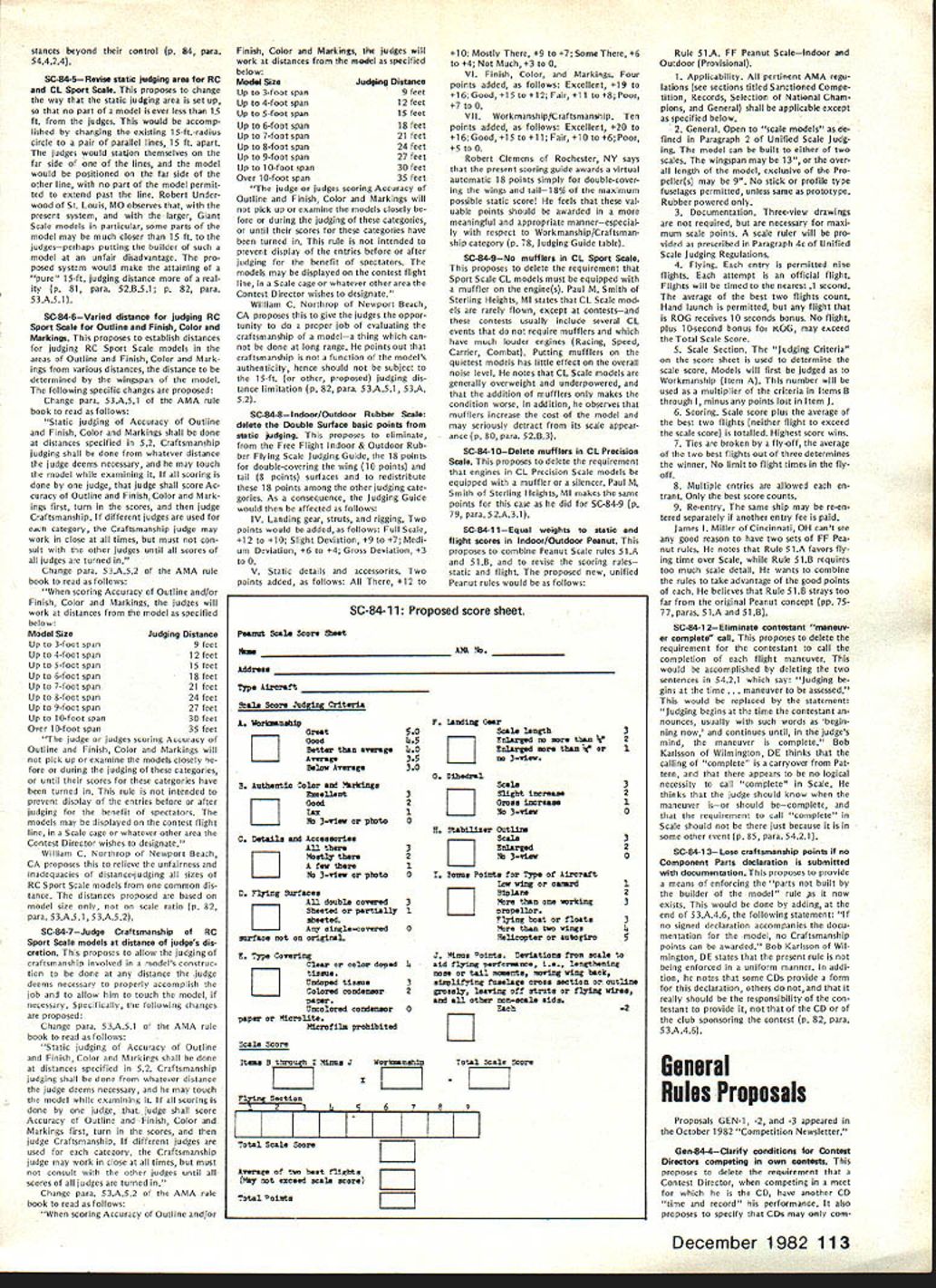
SC-84-11 — Equal weights to static and flight scores in Indoor/Outdoor Peanut
- Combine Peanut rules and revise scoring so scale and flight receive balanced treatment. Proponent: James J. Miller, Cincinnati, OH.
SC-84-12 — Eliminate constant "maneuver-to-maneuver" contests
- Adjust wording so judging begins when the contestant announces the planned maneuver and continues until the judge deems it complete; prevents automatic loss when weather prevents completion.
SC-84-13 — Lose craftsmanship points if no Component Parts declaration submitted
- Enforce the "parts must be built by the modeler" rule by making submission of a component parts declaration mandatory or craftsmanship score is zero.
(End of Scale proposals summary.)
General Rules Proposals
(GenR-1, -2, -3 previously published. Selected additional Gen proposals follow.)
GenR-4 — Clarify conditions for Contest Directors competing in own contests
- Delete requirement that a Contest Director must not be listed as a winner when competing in an event he directs, and adopt standard procedures for CD participation and record keeping.
Gen-84-5 — Clarify Contest Director appointment and responsibilities
- Revise para. 1.5 to better define how to become a Contest Director, responsibilities for staffing key positions, and requirement to ensure judges/timers are physically capable.
Gen-84-6 — Change deadline for Contest Director contest report
- Increase the normal deadline for CD contest reports from seven days to 30 days, except when an incident might lead to an insurance claim (retain seven-day rule for those cases). Proponent: Horace Cain, Buffalo Grove, IL.
Gen-84-7/Gen-84-8 — Provide for substitute/alternate Contest Directors
- Establish procedures for appointing a substitute CD if the named CD is unable to perform duties, either by AMA district vice-president appointment or by allowing naming an alternate when applying for a sanction. Proponent: Robert Mues, Oakland, CA.
Note: The following proposals could affect activities outside sanctioned competition and are subject to AMA Executive Council review.
Gen-84-9 — Establish maximum weight for model aircraft
- Specify a maximum model weight for AMA-sanctioned competitions and AMA-insured activities (originally proposed 40 lb.; later increased by Executive Council to 55 lb. / 25 kg). Proponent: William C. Northrop.
Gen-84-10 — Prohibit gaseous boosts and methanolised propellants in AMA activities
- Clarify that gaseous boosts and metal-bladed propellers are not permitted in AMA-sanctioned competitions or AMA-insured activities. Proponent: William C. Northrop.
Gen-84-11 — Extend ban on hazardous model fuels
- Extend paragraph 4.7 to explicitly apply to AMA-sanctioned competitions, AMA-insured activities, and AMA-insured flying sites.
Gen-84-12 — Record application responsibilities
- Make the filer (competitor) responsible for submitting record applications within 14 days (postmark), instead of relying solely on the CD. Proponent: Ron McNally, Springfield, VA.
Gen-84-14 — Allow novice contestants extra flights in Class A, AA meets
- Allow novice contestants extra flights to help them compete more fairly with experienced fliers.
Gen-84-15 — Delete Rocket Power event
- Delete Rocket Power section due to lack of commercially available rocket engines/pellets. Proponent: Harry Murphy, Anderson, IN.
Gen-84-16 — Add new Electric Power class
- Divide Electric Power into two classes by battery pack size (6 or fewer Ni-Cad cells vs. more than 6) to preserve a beginner/low-budget class and top-level competition parity. Proponent: Richard Covalt, Anderson, IN.
Free Flight Rules Proposals
FF-84-1 — Establish new AMA Nordic A-1 Glider class
- Add a new Towline Glider class similar to FAI Nordic A-1 but with a lower minimum weight (5.08 oz vs. FAI 7.76 oz) to preserve small-field, fun-to-fly models. Proponent: Dan Dominis, East Windsor, NJ.
FF-84-2 — Specify size of CO2 motor fuel tanks
- Set a fixed relationship between CO2 motor displacement and tank size to avoid forcing competitors to use the smallest motor to maximize run time. Proponent: Bill Rosene, Pine Grove Mills, PA.
FF-84-3 — Allow novice contestants extra flights in Class A, AA meets
- Similar intent as Gen-84-14 for Free Flight novice competitors.
FF-84-4 — Provide for High-Technology class in Indoor HLG
- Establish two Indoor Hand-Launched Glider classes: one for "high-tech" designs (folders, flapped/carbon-fiber types) and another for traditional models to preserve fairness and encourage broader participation. Proponent: Dan Dominis.
FF-84-5 — Specify size of Rubber motor fuel tanks
- Propose size limits for rubber motors to prevent unfair advantages and preserve sporting aspects of rubber-powered Free Flight.
FF-84-6 — Add new Indoor Rubber category
- Comprehensive proposal to improve Indoor participation, provide progressions for beginners, and create classification bridging Beginner to FAI indoor contests. Proponent: Jack Carter, Rains, VA.
(Note: National records would not be maintained for some proposed Indoor events.)
Closing Notes
- The cycle of proposals is extensive and detailed. Contestants and interested modelers are urged to review full proposal texts in the AMA proposals packet and to send timely, specific comments to their district Contest Board members before the Contest Boards' initial vote deadlines.
ACADEMY OF MODEL AERONAUTICS
Transcribed from original scans by AI. Minor OCR errors may remain.

