
Competition Newsletter
Indoor: More Bad News
The Indoor community is on the verge of losing one of its favorite flying sites: the Northwood Institute in West Baden, IN. AMA HQ has learned that the Northwood Institute is going to cease operations in September 1983. Whether this means that the atrium flying site will be permanently closed to modelers is not known; however, the contestant lodging and meals packages which have been offered for "big" Indoor events in recent years will not be available after the closing date.
We wonder: are there any other heretofore-undiscovered Indoor sites left in the East or Midwest?
U.S. Bids for '83 RC Aerobatics World Champs
Subject to final approval by the FAI's CIAM in December 1982, the 1983 RC Aerobatics World Championship will be held in Pensacola, FL in October. We will publish more information (date, site location, contestant/supporter housing) from time to time as information becomes available.
RC Soaring Team Manager
By unanimous vote, the members of the 1983 U.S. RC Soaring team have elected Richard Odle, Simi Valley, CA, as the team manager. The team will travel to the World Championships in England sometime in 1983 (exact date and location will not be available until after the FAI's CIAM meeting in December 1982).
Planning Future AMA Nats
On December 11, 1982, the AMA Executive Council and the Nationals Executive Committee will meet to discuss future National Contests.
In recent years, it has become more obvious that very serious problems must be solved if the Nats is to continue in its historical style of organization and operation. For example, the 1982 Nats had to be switched—almost at the last minute—from the Lakehurst Naval Air Station in New Jersey to Lincoln, NE. The year before the site had to be changed from San Antonio to the USAF Auxiliary Field at Seguin, TX. At the Lincoln Nats, it has been impossible to hold the FF events anywhere near the same site as CL and RC, and Indoor fliers have expressed dissatisfaction at the low-ceiling site there.
Some AMA officials believe that the last-minute Nats site selections have discouraged attendance at the Nats. Many modelers point out that sites selected late in the season make it very difficult for them to plan vacation time to allow them to attend. Some are disappointed at the "unpopular" sites chosen: Seguin, TX; Lincoln, NE; Lake Charles, LA. Veteran Nats competitors appear to favor the more traditional sites in areas near Chicago, Los Angeles, Philadelphia, and Dayton, for example.
Voices are heard which cry out for the establishment of a "permanent" Nats site. Some points are made against this suggestion—the fact that recruiting Nats officials would soon become difficult and/or expensive, since the local fliers would soon tire of having to do all the work without ever having a chance to compete.
Suggestions are made to hold separate "category" Nats: one for FF; another for RC and CL; another for Indoor. Opponents cite the logistics costs to support such an effort, such as travel and expense for AMA HQ personnel and "imported" event officials.
There even appears to be a growing swell of concern as to just what the Nats is supposed to accomplish. Is it a National Championship? Is it a National Contest? What objective is it supposed to fulfill? Should it be the yearly ultimate challenge for competition modelers in all of the events? Should it be sort of a gigantic recruitment showcase for the non-modelling public?
---
Free Flight Team Finals
Clarence Haught Photos by the author
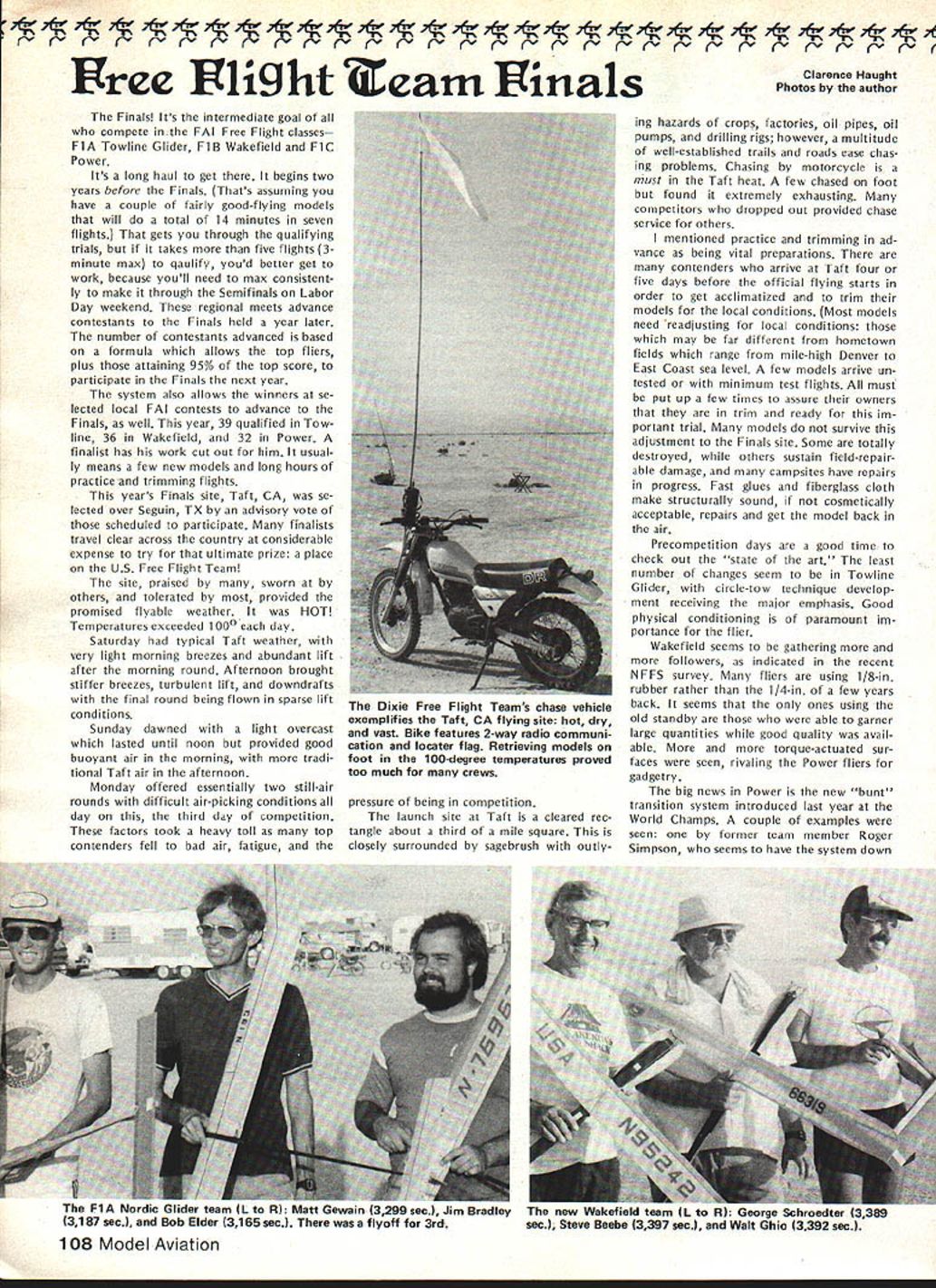
The Finals! It's the intermediate goal of all who compete in the FAI Free Flight classes—F1A Towline Glider, F1B Wakefield and F1C Power.
It's a long haul to get there. It begins two years before the Finals (that's assuming you have a couple of fairly good-flying models that will do a total of 14 minutes in seven flights). That gets you through the qualifying trials, but if it takes more than five flights (3-minute max) to qualify, you'd better get to work, because you'll need to max consistently to make it through the Semifinals on Labor Day weekend. These regional meets advance contestants to the Finals held a year later. The number of contestants advanced is based on a formula which allows the top fliers, plus those attaining 95% of the top score, to participate in the Finals the next year.
The system also allows the winners at selected local FAI contests to advance to the Finals, as well. This year, 39 qualified in Towline, 36 in Wakefield, and 32 in Power. A finalist has his work cut out for him. It usually means a few new models and long hours of practice and trimming flights.
This year's Finals site, Taft, CA, was selected over Seguin, TX by an advisory vote of those scheduled to participate. Many finalists travel clear across the country at considerable expense to try for that ultimate prize: a place on the U.S. Free Flight Team!
The site, praised by many, sworn at by others, and tolerated by most, provided the promised flyable weather. It was hot—temperatures exceeded 100° each day.
Saturday had typical Taft weather, with very light morning breezes and abundant lift after the morning round. Afternoon brought stiffer breezes, turbulent lift, and downdrafts with the final round being flown in sparse lift conditions.
Sunday dawned with a light overcast which lasted until noon but provided good buoyant air in the morning, with more traditional Taft air in the afternoon.
Monday offered essentially two still-air rounds with difficult air-picking conditions all day on this, the third day of competition. These factors took a heavy toll as many top contenders fell to bad air, fatigue, and the pressure of being in competition.
The launch site at Taft is a cleared rectangle about a third of a mile square. This is closely surrounded by sagebrush with outlying hazards of crops, factories, oil pipes, oil pumps, and drilling rigs; however, a multitude of well-established trails and roads ease chasing problems. Chasing by motorcycle is a must in the Taft heat. A few chased on foot but found it extremely exhausting. Many competitors who dropped out provided chase service for others.
Practice and trimming in advance are vital preparations. Many contenders arrive at Taft four or five days before the official flying starts in order to get acclimatized and to trim their models for the local conditions (most models need readjusting for local conditions that may be far different from hometown fields, which range from mile-high Denver to East Coast sea level). A few models arrive untested or with minimum test flights. All must be flown a few times to assure their owners that they are in trim and ready for this important trial. Many models do not survive this adjustment to the Finals site. Some are totally destroyed, while others sustain field-repairable damage, and many campsites have repairs in progress. Fast glues and fiberglass cloth make structurally sound, if not cosmetically acceptable, repairs and get the model back in the air.
Precompetition days are a good time to check out the "state of the art." The least number of changes seem to be in Towline Glider, with circle-tow technique development receiving the major emphasis. Good physical conditioning is of paramount importance for the flier.
Wakefield seems to be gathering more and more followers, as indicated in the recent NFFS survey. Many fliers are using 1/8-in. rubber rather than the 1/4-in. of a few years back. It seems that the only ones using the old standby are those who were able to garner large quantities while good quality was available. More and more torque-actuated surfaces were seen, rivaling the Power fliers for gadgetry.
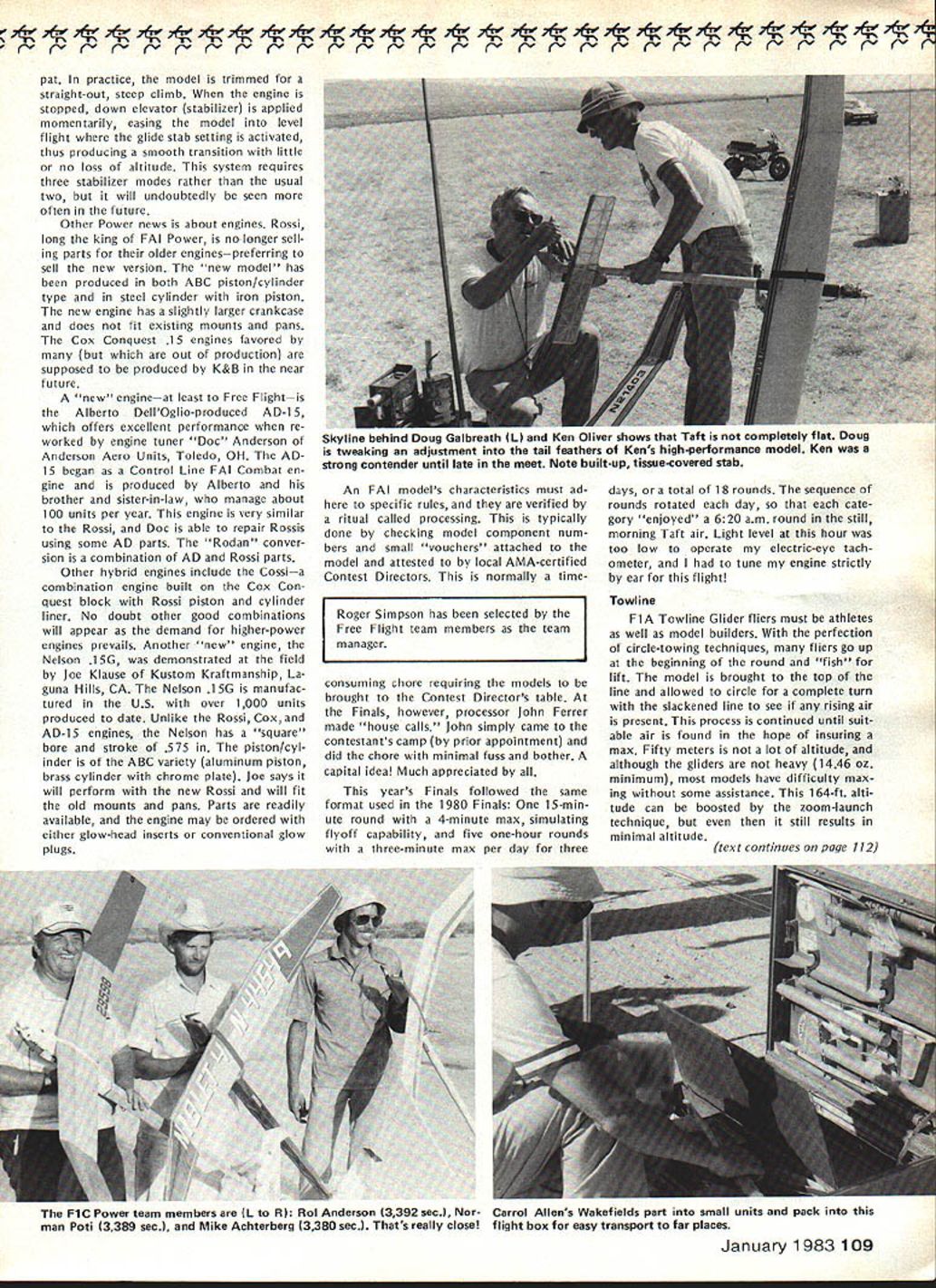
The big news in Power is the new "bunt" transition system introduced last year at the World Champs. A couple of examples were seen: one by former team member Roger Simpson, who seems to have the system down to a high degree of refinement. In practice, the model is trimmed for a straight-out, steep climb. When the engine is stopped, down elevator (stabilizer) is applied momentarily, causing the model into level flight where the glide stab setting is activated, thus producing a smooth transition with little or no loss of altitude. This system requires three stabilizer modes rather than the usual two, but it will undoubtedly be seen more often in the future.
Other Power news is about engines. Rossi, long the king of FAI Power, is no longer selling parts for their older engines—preferring to sell the new version. The "new model" has been produced in both ABC piston/cylinder type and in steel cylinder with iron piston. The new engine has a slightly larger crankcase and does not fit existing mounts and pans. The Cox Conquest .15 engines favored by many (but which are out of production) are supposed to be produced by K & B in the near future.
A "new" engine—at least to Free Flight—is the Alberto Dell'Oglio-produced AD-15, which offers excellent performance when reworked by engine tuner "Doc" Anderson of Anderson Aero Units, Toledo, OH. The AD-15 began as a Control Line FAI Combat engine and is produced by Alberto and his brother and sister-in-law, who manage about 100 units per year. This engine is very similar to the Rossi, and Doc is able to repair Rossis using some AD parts. The "Rodan" conversion is a combination of AD and Rossi parts.
Other hybrid engines include the Cossi—a combination engine built on the Cox Conquest block with Rossi piston and cylinder liner. No doubt other good combinations will appear as the demand for higher-power engines prevails. Another "new" engine, the Nelson .15G, was demonstrated at the field by Joe Klause of Kustom Kraftmanship, Laguna Hills, CA. The Nelson .15G is manufactured in the U.S. with over 1,000 units produced to date. Unlike the Rossi, Cox, and AD-15 engines, the Nelson has a "square" bore and stroke of .575 in. The piston/cylinder is of the ABC variety (aluminum piston, brass cylinder with chrome plate). Joe says it will perform with the new Rossi and will fit the old mounts and pans. Parts are readily available, and the engine may be ordered with either glow-head inserts or conventional glow plugs.
An FAI model's characteristics must adhere to specific rules, and they are verified by a ritual called processing. This is typically done by checking model component numbers and small "vouchers" attached to the model and attested to by local AMA-certified Contest Directors. This is normally a time-consuming chore requiring the models to be brought to the Contest Director's table. At the Finals, however, processor John Ferrer made "house calls." John simply came to the contestant's camp (by prior appointment) and did the chore with minimal fuss and bother. A capital idea! Much appreciated by all.
This year's Finals followed the same format used in the 1980 Finals: one 15-minute round with a 4-minute max, simulating flyoff capability, and five one-hour rounds with a three-minute max per day for three days, or a total of 18 rounds. The sequence of rounds rotated each day, so that each category "enjoyed" a 6:20 a.m. round in the still-morning Taft air. Light levels at this hour were too low to operate my electric-eye tachometer, and I had to tune my engine strictly by ear for this flight!
Roger Simpson has been selected by the Free Flight team members as the team manager.
Towline
F1A Towline Glider fliers must be athletes as well as model builders. With the perfection of circle-towing techniques, many fliers go up at the beginning of the round and "fish" for lift. The model is brought to the top of the line and allowed to circle for a complete turn with the slackened line to see if any rising air is present. This process is continued until suitable air is found in the hope of ensuring a max. Fifty meters is not a lot of altitude, and although the gliders are not heavy (14.46 oz. minimum), most models have difficulty maxing without some assistance. This 164-ft. altitude can be boosted by the zoom-launch technique, but even then it still results in minimal altitude.
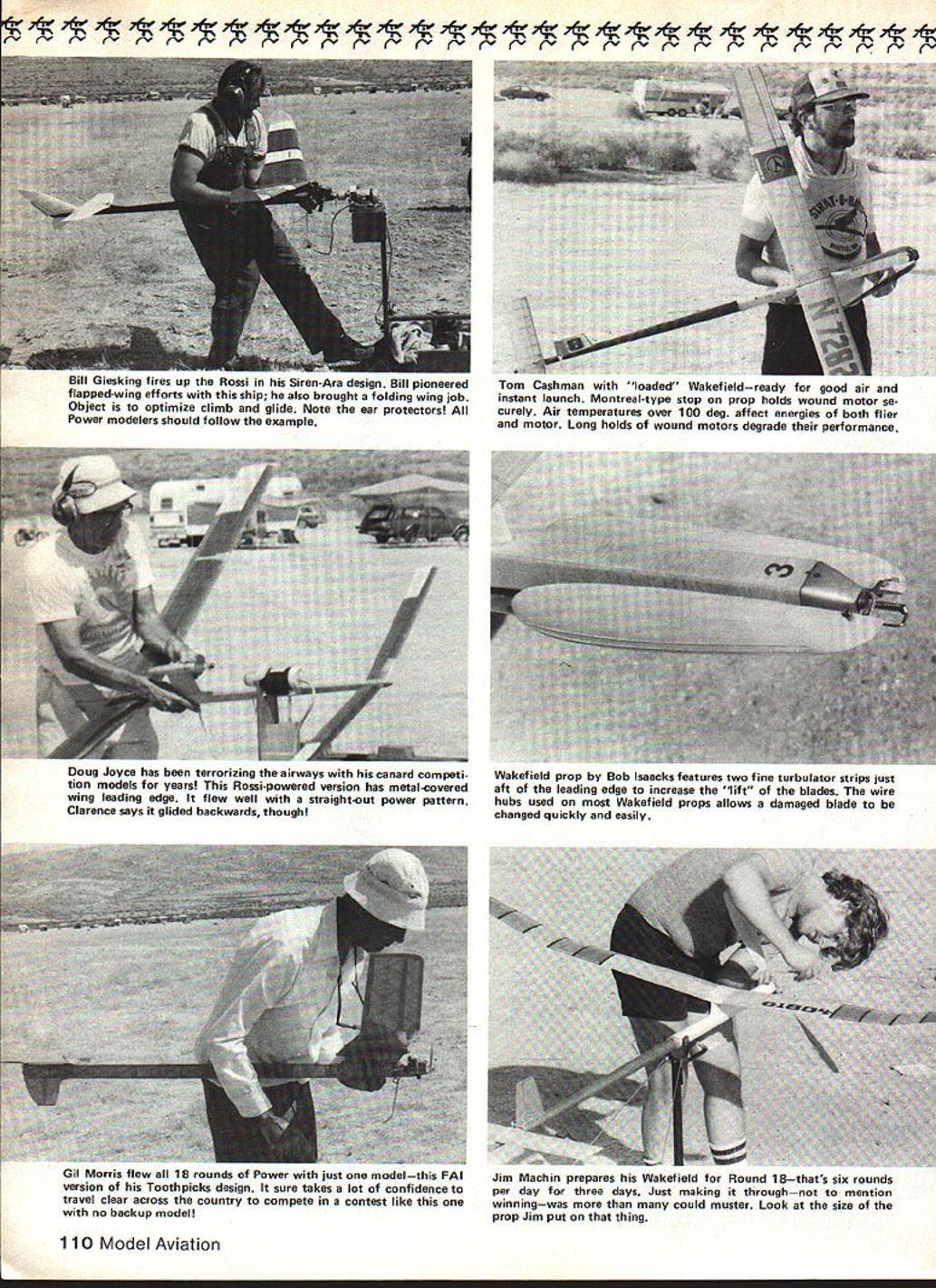
Bill Giesking fires up the Rossi in his Siren-Ara design. Bill pioneered flapped-wing efforts with this ship; he also brought a folding wing job. Objective is to optimize climb and glide. Note the ear protectors! All Power modelers should follow the example.
Tom Cashman with "loaded" Wakefield—ready for good air and instant launch. Montreal-type stop on prop holds wound motor securely. Air temperatures over 100° affect energies of both flier and motor. Long holds of wound motors degrade their performance.
Doug Joyce has been terrorizing the airways with his canard competition models for years! This Rossi-powered version has a metal-covered wing leading edge. It flew well with a straight-out power pattern. Clarence says it glided backwards, though!
Wakefield prop by Bob Isaacks features two fine turbulator strips just aft of the leading edge to increase the "lift" of the blades. The wire hubs used on most Wakefield props allow a damaged blade to be changed quickly and easily.
Gil Morris flew all 18 rounds of Power with just one model—this FAI version of his Toothpicks design. It sure takes a lot of confidence to travel clear across the country to compete in a contest like this one with no backup model!
Jim Machin prepares his Wakefield for Round 18—that's six rounds per day for three days. Just making it through—not to mention winning—was more than many could muster. Look at the size of the prop Jim put on that thing.
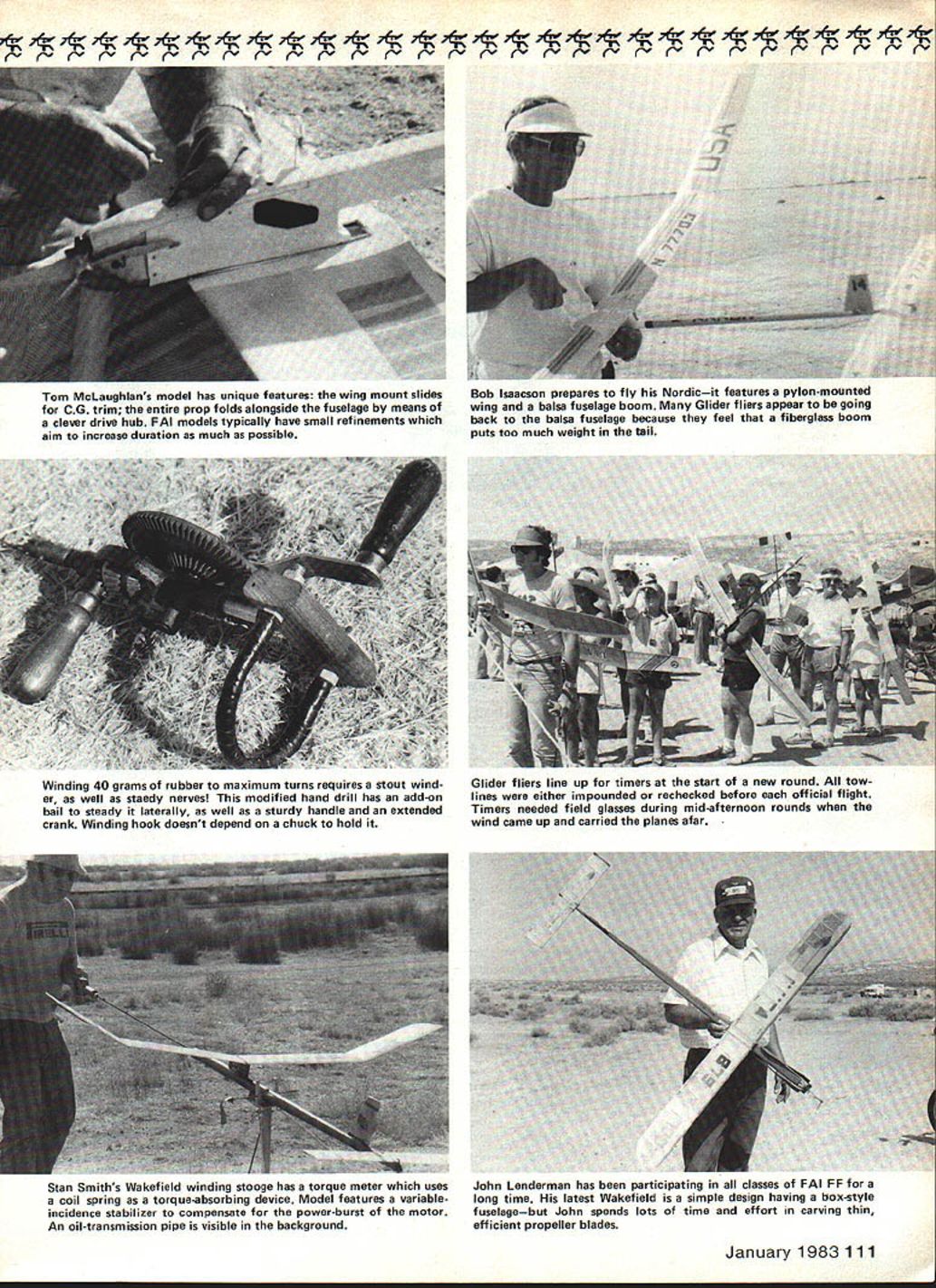
Tom McLaughlan's model has unique features: the wing mount slides for C.G. trim; the entire prop folds alongside the fuselage by means of a clever drive hub. FAI models typically have small refinements which aim to increase duration as much as possible.
Bob Isaacson prepares to fly his Nordic—it features a pylon-mounted wing and a balsa fuselage boom. Many Glider fliers appear to be going back to the balsa fuselage because they feel that a fiberglass boom puts too much weight in the tail.
Winding 40 grams of rubber to maximum turns requires a stout winder, as well as steady nerves. This modified hand drill has an add-on bail to steady it laterally, as well as a sturdy handle and an extended crank. The winding hook doesn't depend on a chuck to hold it.
Glider fliers line up for timers at the start of a new round. All tow-lines were either impounded or rechecked before each official flight. Timers needed field glasses during mid-afternoon rounds when the wind came up and carried the planes afar.
Stan Smith's Wakefield winding stooge has a torque meter which uses a coil spring as a torque-absorbing device. Model features a variable-incidence stabilizer to compensate for the power-burst of the motor. An oil-transmission pipe is visible in the background.
John Lenderman has been participating in all classes of FAI Free Flight for a long time. His latest Wakefield is a simple design having a box-style fuselage—but John spends lots of time and effort in carving thin, efficient propeller blades.
---
Competition Newsletter
FF Team Finals (Continued)
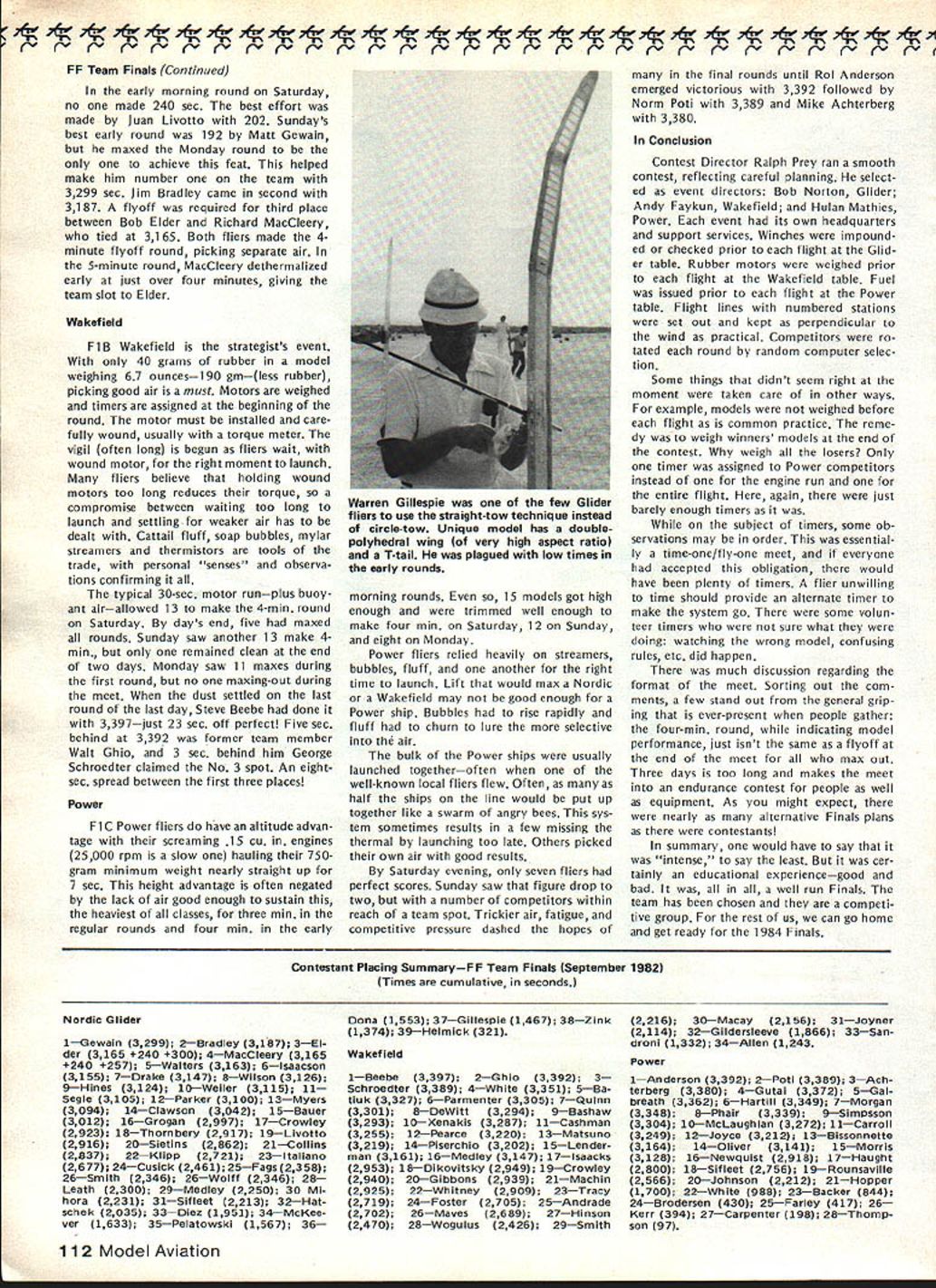
In the early morning round on Saturday, no one made 240 sec. The best effort was made by Juan Livotto with 202. Sunday's best early round was 192 by Matt Gewain, but he maxed the Monday round to be the only one to achieve this feat. This helped make him number one on the team with 3,299 sec. Jim Bradley came in second with 3,187. A flyoff was required for third place between Bob Elder and Richard MacCleery, who tied at 3,165. Both fliers made the 4-minute flyoff round, picking separate air. In the 5-minute round, MacCleery dethermalized early at just over four minutes, giving the team slot to Elder.
Wakefield
F1B Wakefield is the strategist's event. With only 40 grams of rubber in a model weighing 6.7 ounces—190 gm—picking good air is a must. Motors are weighed and timers are assigned at the beginning of the round. The motor must be installed and carefully wound, usually with a torque meter. The vigil (often long) is begun as fliers wait, with wound motor, for the right moment to launch. Many fliers believe that holding wound motors too long reduces their torque, so a compromise between waiting too long to launch and settling for weaker air has to be dealt with. Cattail fluff, soap bubbles, mylar streamers and thermistors are tools of the trade, with personal "senses" and observations confirming it all.
The typical 0.30-sec. motor run—plus buoyant air—allowed 13 to make the 4-min. round on Saturday. By day's end, five had maxed all rounds. Sunday saw another 13 make 4-min., but only one remained clean at the end of two days. Monday saw 11 maxes during the first round, but no one maxing-out during the meet. When the dust settled on the last round of the last day, Steve Beebe had done it with 3,397—just 23 sec. off perfect! Five sec. behind at 3,392 was former team member Walt Ghio, and 3 sec. behind him George Schroedter claimed the No. 3 spot. An eight-sec. spread between the first three places!
Power
F1C Power fliers do have an altitude advantage with their screaming .15 cu. in. engines (25,000 rpm is a slow one) hauling their 750-gram minimum weight nearly straight up for 7 sec. This height advantage is often negated by the lack of air good enough to sustain this, the heaviest of all classes, for three min. in the regular rounds and four min. in the early morning rounds. Even so, 15 models got high enough and were trimmed well enough to make four min. on Saturday, 12 on Sunday, and eight on Monday.
Power fliers relied heavily on streamers, bubbles, fluff, and one another for the right time to launch. Lift that would max a Nordic or a Wakefield may not be good enough for a Power ship. Bubbles had to rise rapidly and fluff had to chute to lure the more selective into the air.
The bulk of the Power ships were usually launched together—often when one of the well-known local fliers flew. Often, as many as half the ships on the line would be put up together like a swarm of angry bees. This system sometimes results in a few missing the thermal by launching too late. Others picked their own air with good results.
By Saturday evening, only seven fliers had perfect scores. Sunday saw that figure drop to two, but with a number of competitors within reach of a team spot. Trickier air, fatigue, and competitive pressure dashed the hopes of many in the final rounds until Rol Anderson emerged victorious with 3,392 followed by Norm Poti with 3,389 and Mike Achterberg with 3,380.
In Conclusion
Contest Director Ralph Prey ran a smooth contest, reflecting careful planning. He selected as event directors: Bob Norton, Glider; Andy Faykun, Wakefield; and Hulan Mathies, Power. Each event had its own headquarters and support services. Winches were impounded or checked prior to each flight at the Glider table. Rubber motors were weighed prior to each flight at the Wakefield table. Fuel was issued prior to each flight at the Power table. Flight lines with numbered stations were set out and kept as perpendicular to the wind as practical. Competitors were rotated each round by random computer selection.
Some things that didn't seem right at the moment were taken care of in other ways. For example, models were not weighed before each flight as is common practice. The remedy was to weigh winners' models at the end of the contest. Why weigh all the losers? Only one timer was assigned to Power competitors instead of one for the engine run and one for the entire flight. Here, again, there were just barely enough timers as it was.
While on the subject of timers, some observations may be in order. This was essentially a time-on/time-off meet, and if everyone had accepted this obligation, there would have been plenty of timers. A flier unwilling to time should provide an alternate timer to make the system go. There were some volunteer timers who were not sure what they were doing; watching the wrong model, confusing rules, etc. did happen.
There was much discussion regarding the format of the meet. Sorting out the comments, a few stand out from the general griping that is ever-present when people gather: the four-min. round, while indicating model performance, just isn't the same as a flyoff at the end of the meet for all who max out. Three days is too long and makes the meet into an endurance contest for people as well as equipment. As you might expect, there were nearly as many alternative Finals plans as there were contestants!
In summary, one would have to say that it was "intense," to say the least. But it was certainly an educational experience—good and bad. It was, all in all, a well-run Finals. The team has been chosen and they are a competitive group. For the rest of us, we can go home and get ready for the 1984 Finals.
---
Rule Proposal Correction
In preparing the summary of the rules proposals printed in the December 1982 issue, an important part of the Scale rules proposal SC-84-8 (Indoor/Outdoor Rubber Scale: delete the Double Surface basic points from static judging) was omitted.
The omitted provision is as follows: "The model's wing and tail surfaces must be covered on both sides unless the subject aircraft utilized single-surface covering and this fact is shown in the proof-of-scale presentation. Any models using single-surface covering without proof-of-scale will be disqualified."
---
More Rules Proposals
From out of the dark shadows come a few more rules proposals—after we told you last month that the summaries "conclude in this issue!" (These are items which had been retained by the various Contest Board chairmen for pre-release screening—and which had not been returned to AMA HQ in time to be included in last month's big summary.)
These few rules proposals (assuredly the last ones for this cycle!) are printed here for the record—since by the time this article is in the hands of the modelers, the Contest Boards' deadline for Initial Vote ballots (December 1, 1982) will have been reached. However, until the Final Vote is made September 1, 1983, it's not too late for modeler comment to the appropriate AMA district Contest Board members (their names and addresses appear in the Competition Directory elsewhere in the "Competition Newsletter").
Scale Rules Proposals
#### SC-84-14 — RC Sport Scale: Bonus points for craftsman builders
This proposes to revise para. 53.A.6 by adding the following: "A contestant who has built his plane from scratch, plans or original design shall receive a point bonus of 5 points. Proof must be presented to the static judges." Oliver C. Moses of New Castle, DE wants to reward those modelers who keep the creative art of model building alive by using their craftsmanship to build most of their models as deserved reward. He notes that it takes a lot of time and skill to build from "scratch," rather than from a kit, and that those who do make such an effort should receive extra points (p. 83, para. 53.A.6).
#### SC-84-15 — RC Precision Scale: Separate AMA Precision Scale from FAI rules
This proposes to revise para. 53.D.1 to read as follows:
- "1. General. The rules for Precision Scale are made up as follows:
a) Static judging is performed according to the Unified Scale Judging Regulations (Section 50). Maximum points—450; b) Flight Judging is performed according to sections 7, 8, and 9 of the RC Sport Scale rules (Section 53.A) and the Scale Flight Judging Guide (Section 54). Maximum points—100; c) The flight score achieved is multiplied by 4.5 to create a 1:1 parity with the Static Score; d) The contest score thus equals: Average of best two flights x 4.5 + Static."
David R. Platt of Plantation, FL believes that the FAI Precision Scale rules are not usable by U.S. modelers for the type of modeling done here, and that the AMA rules should not be tied to the FAI rules until those rules change to something which can be used in the U.S. He does not believe that AMA Scale rules should be needlessly complicated by the inclusion of the FAI Complexity Factors (p. 84, para. 53.D.1).
#### SC-84-16 — Unified Judging Regulations: Amend if SC-84-15 is accepted
This proposes to make the Unified Scale Judging Regulations (para. 50) applicable to RC Precision Scale, as well as to CL Precision Scale and FF Outdoor Gas Scale in the event that rule proposal SC-84-15 passed, thereby making the AMA rule book more accurate. The change would be to amend the subhead of para. 50 to read: "For RC and CL Precision Scale and FF Outdoor Gas Scale." David R. Platt notes that this proposal is of a procedural nature only (p. 73, section 50 subhead).
#### SC-84-17 — Let RC Giant Scale into Precision
This proposes to amend para. 53.D.2.6 so that models presently built to the Giant Scale rules (Section 53.B) can be entered in Precision Scale. This would be accomplished by changing para. 53.D.2.6 to read as follows: "Models shall weigh no more than 40 lb. ready for flight, except for fuel." In addition, para. 53.D.2.7 would be changed to read the same as a modified 53.B.2.1: "Powered by an engine(s) of less than 3.7 cu. in. Multi-engines must not total more than 4.4 cu. in. If powered by a four-stroke engine(s), the maximum allowable displacement is increased by a factor of 20% or 4.44 cu. in. for single-engine models, 5.28 cu. in. for multi-engine models."
David R. Platt of Plantation, FL notes that Giant Scale builders have, at the present time, no Precision Scale event. In addition, he observes that interest in the present Precision Scale event is declining, since the rules no longer reflect the wishes of the builders in terms of models they want to build; it is obvious that today's Scale modeler builds larger models, and rather than build small ones required by the rules, he simply does not enter. Dave says that adopting this proposal will be a solution to both problems, and that simply having two classes of Precision Scale is impractical, as entries would not be great enough to justify two classes (p. 84, para. 53.D.2.6, 53.D.2.7).
#### SC-84-18 — RC Sport Scale static judging form
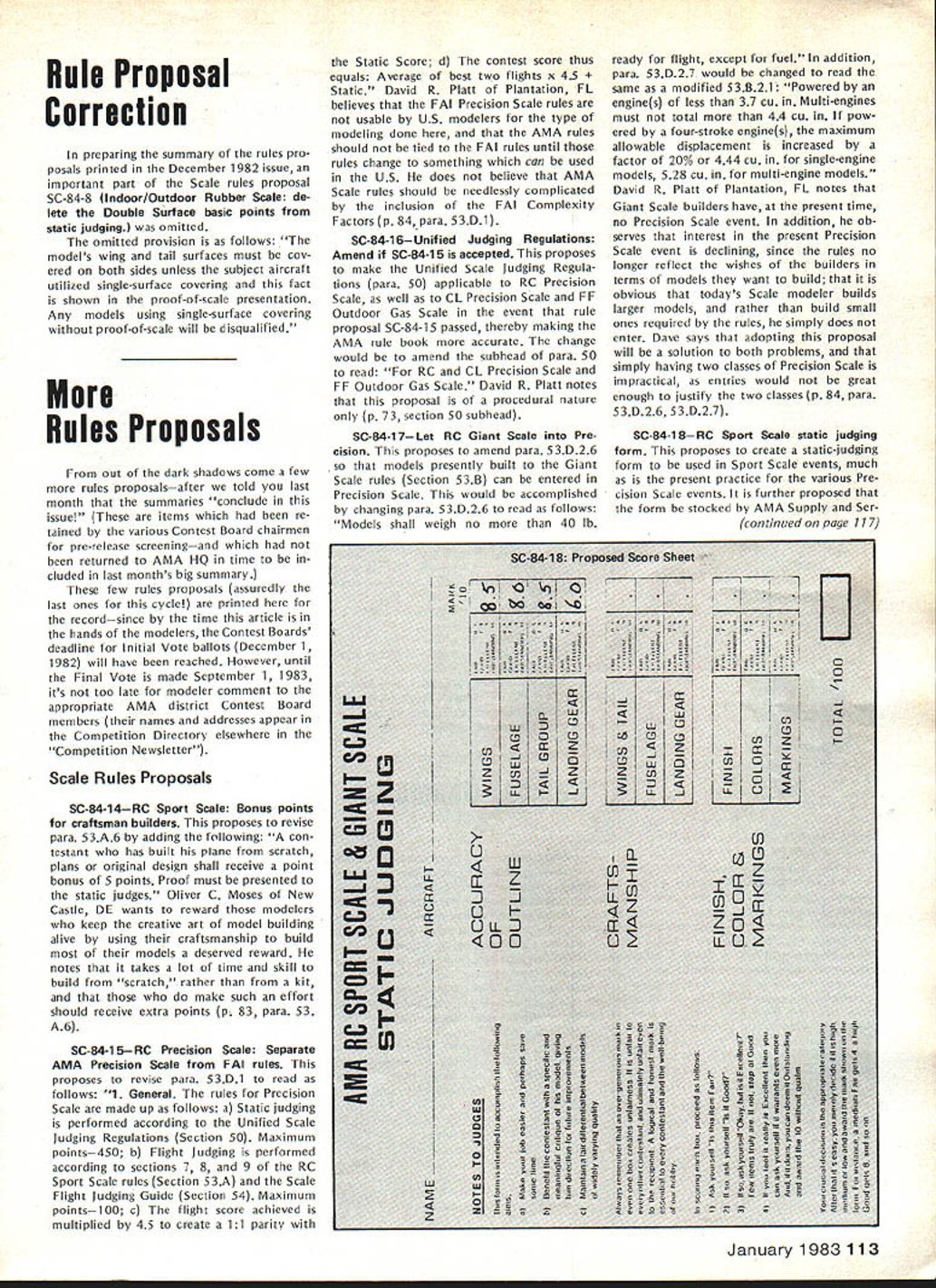
This proposes to create a static-judging form to be used in Sport Scale events, much as is the present practice for the various Precision Scale events. It is further proposed that the form be stocked by AMA Supply and Service.
(The suggested form is reproduced here for comment.) This would be accomplished by creating and stocking a suitable form, and by revising Para. 53.A.6 by adding the following: "The static judging form (available from AMA HQ) will be used to enter scores." David R. Platt of Plantation, FL says that Sport Scale can be improved by regularizing the judging, and that one of the easiest ways to do this is to adopt a static judging form. He claims that use of the form would result in more consistent judging and would also let the builder know, through study of the build-out form, what is expected, so that he can improve (p. 82, para. 53.A.6).
Control Line Rules Proposal
#### CL-84-38 — Combat: Change "start-of-combat" criteria back to 1980-81 rules
This proposes to delete para. 33.8.2.3 from the AMA rule book and replace it with the "old" 1980-81 rule: "8.2.3 Neither pilot may attack, evade, or maneuver for position unless both aircraft are flying and both pilots are in the pilots' circle." Gary Frost of Ballwin, MO does not like the new (1982-83) rule and states that implementing it requires additional contest equipment (for audible and/or visual signals), requires a judge (or judges) to be in the circle near the pilots, and takes control away from the pilots (he wants Combat to remain as individual as possible). (Revise p. 37, para. 33.8.2.3.)
---
Competition Newsletter
World Championships Commentaries
Control Line — A Vision of Victory
Doc Jackson
The wind echoed softly as the light slowly faded in the spring sky over the river. The old wizard sighed and slowly rose to walk a little along the banks of the Delaware before returning home for the evening. Strange, he mused, that a sign should come again after four long years of silence. Well, there would be a call later. This evening perhaps, or in the next few days. That was how it had always gone in the past.
These strange tournaments involving the Ahmans were a source of discomfort because the signs were usually dim and hard to read. He had been lucky before with the predictions involving the Bear, the Jelly Man, and Bobby White Shoes. This time it had only been the rustling of the leaves in the sycamores along the Delaware, but it was a message like the others before it; soft and difficult to interpret clearly.
Coming suddenly after such a long time, he was not certain he had caught it all. Maybe the caller would be able to make sense of it, or at least to help. The tribe of the warrior, for example. He was of the Ahman nation all right, but not the Pampa tribe as in the past. From Mecca or somewhere? And the names—Stubby, Animal, Dago Ron, Von(?) Lopez and the Bayou Snake—colorful at the least. But none of those was him—that much was clear—his name had been indistinct. Oh well, nothing to do for now but wait.
"Doc," the voice was strained and excited on the other end of the line as the wizard slowly came awake. "We need help on account of we ain't got nothin' to show for two lousy trips to this here F-Eh-Yi deal overseas. Ah mean, we come purty close with Phancy Phil, till he got robbed at the end. Anyways, the whole deal was sour—awful weather in that Liverpool place and ah don't even want to remember the name of the last one, it was so bad. But that ain't what this call is about, Doc! It's time to do sumthin'! Ah got no gripes, mushelf, but we had some good guys on them two trips and nuthin', but nuthin' to show for it. This time it's got to be different!"
"Calm down, George," said the wizard, who recognized the voice of the old man Bayou Snake. Cantankerous at times, he really was a softy underneath the mustache and the rest of the rough exterior. "I have good news and bad news, George," said the wizard. "The good news is that I got a message and it says that things are definitely going to be better for you this year. The bad news is that the message was garbled and I'm afraid there is no second chance. You may be able to help, George."
"'Whaddaya mean help, Doc? You got another o them wierd visions or such I heard of before on them old trips?'"
"'Yes, George, I have. Some things are beginning to make sense—but not all. What of this Animal and Stubby?'"
"'Aw they're nice fellers, Doc. Stubby's a great Combat flier, and the Deceitrol Animal ain't bad at all, since he gave up running boats at the Holiday Inn and came back to where it's at. Are they in for sumthin' big?'"
"'Well... yes they are, George, you are all going to share in a big victory celebration at the Great Tournament of F-Eh-Yi's. But... there are two things that must come true first if you are to enjoy a victory.'"
"'Well, get it out Doc—what has to come true?'"
"'It seems that you must find a warrior for this combat that is pure and true, unlike any before him. He must truly believe in his mission and be so true to his cause that all will see it in him and believe in his strength. He will need this truth at a critical hour when all seems lost,' said the old wizard."
"'That's an awful thing to ask, Doc,' replied the Snake, 'You sure about this and that critical hour stuff?'"
"'Yes, George,' the wiz answered. 'That much was clear. In this time of need, your champion will find help in the counsel of an old, wise man, but the message did not identify him, either. He will help to turn despair into the chance for triumph. After that turn, none will threaten your champion—victory will be his. That is all I know.'"
"'Jeez, Doc—who is this guy, what's his name?' said George."
"'I heard only this which I did not comprehend. "Remember well the name, for victory shall be no fluke."'"
"'Hee, hee, hee . . .' the old Snake's laugh trailed off as the wizard hung up, shrugged, and with a puzzled look, returned to sleep.
---
Combat Champion
Tom Fluker, Jr.
Since September 1981 I had been looking forward to this trip. Not only had I never been to Europe, but I had never flown on a commercial airline—it was a great experience.
In New York we had to change planes and, of course, our main concern was making sure that the model box made the change with us. It did—no problem. However, the ticket agent made a typo error on our boarding pass that put us on the wrong flight. Fortunately, the error was discovered in time and we made like O.J. Simpson and made our flight.
We arrived in Sweden at 9:30 Saturday morning, their time. We picked up the van and started off to Stockholm for some sightseeing, since we had seven hours to waste before Richard (Stubblefield) and George (Cleveland) were due to arrive. This proved too much; the jet lag hit, so we went back to the airport and sacked out in the van. George, Mitchell (Cleveland), and Richard arrived on time with their big cowboy hats looking like true Texans, and we all loaded up and headed to Oxelösund, found the hotel and settled in.
Sunday, we were up early to see the contest site and get started with our practice. The flying site was beautiful. Even the practice site was great. The only problem was the accessibility. The equipment had to be carried to both places from a distant parking lot, unless we chose to chance breaking the law by driving on the bicycle path.
As a whole, the Combat was run very loosely. The judges were allowing many fouls to pass. They were more interested in good Combat than in disqualifying people.
The competition looked strong. Fred Meyer of Holland and Vernon Hunt of the United Kingdom each had strong Nelson engines and good planes. The Danes weren't fast, but they had planes that could literally turn on a dime. And, of course, the Russians—Titov and Dorshnko—both seemed as if they might win, as they had good motors and quick planes.
Throughout the competition, all three of the U.S. team members had trouble with taking too much streamer. This eventually cost Richard and Gary (Arnold). In most all matches, it took at least two cuts to win. Against Mata of Spain, I took all of the streamer on the first pass, but—fortunately—I got away with it. In the other matches, I got the cuts I needed and, for the most part, stayed out of trouble. Thanks to an FAI jury that listened and that was interested in seeing that fair-play prevailed, I was given a re-fly against Titov after the circle judge had failed to enforce the line-tangle rule. After it was all over, I found all the work had paid off—I had won.
Now, as I think about the World Championships, it's like a dream. The banquet was nice, with everyone taking pictures. The announcement of the U.S.A. team winning capped off the evening.
I would like to publicly thank all of the people who helped me to get ready—Pete Storrie, Bill Estill, Bill Lee, Joe and Mac McKinzie, Duke Fox, and Fox Manufacturing. Thanks also to George Cleveland and Richard Stubblefield. Not only did they help me prepare, but their prematch advice gave me the knowledge and confidence that I needed. Thanks to my sister Lori—she's a good cheerleader.
---
Aerobatics Champ
Les McDonald
After winning my third World Championship, the most important item is to thank the people who helped so much.
Thanks to Dave Elias who handled the logistics with his usual businesslike approach. His efforts started months before our departure, and his relaxed attitude certainly contributed to the team members' sanity.
Thanks to Jack Durie and the courteous people of both SAS and Eastern Airlines. My model box was always in good hands. These airlines have the most helpful, efficient employees I have ever traveled with.
Thanks to John Ehlik, our team manager, who realizes the bottom line is winning and generates a team spirit that makes you proud to be representative of the U.S.A.
Thanks to the Miami Streamsters, the Hialeah Miami Springs RC Club, and all the people who helped with financing my personal expenses related to my travel and participation. Thanks also to those who purchased FAI patches and to the manufacturers that picked up the tab for uniforms, plus all the other little things that can cost so much.
Thanks to the officers and membership of PAMPA; without their help it would almost be impossible for a current champ to defend his title independently.
A very special thanks, once again, to Stan Powell who provides me with his custom K&B engines.
The most important thanks goes to my wife, Nancy. She has tolerated my horrible pre-contest personality for more years than we care to remember and always seems to keep me in touch with reality.
Congratulations to Ted Fancher, Bob Baron, and Bill Werwage who again won the team cup by a much larger margin than the scores reflect. They performed to the high standards expected from American Stunt fliers and again should have dominated the scoreboard.
Congratulations to our new Combat champion, Tom Fluker, and his teammates for winning the team trophy. As usual, Combat was very exciting and Tommy was a popular winner.
The Swedish Aero Club did an outstanding job of organizing the meet and deserves a tip of the hat for providing excellent practice areas. The food and housing far surpassed the usual standard, so for the first time I didn't come home 10 pounds lighter. The Swedes didn't overlook a single detail, and much to everyone's surprise, the weather was perfect during our entire stay.
There is a definite possibility that the 1984 Champs will be held here in the U.S.—we hope around Philadelphia. Everyone seemed quite excited about this, and I know we can stage an event with all the color and excitement that should be part of a World Championship.
---
Speed Flier
Edwin Gifford
What was it like, going to the World Championships? Like the Olympics, that's what. Mostly it was the little things and the big things and being there. Little things, like being greeted by team manager Don Jehlik (an old friend) and being made to feel like a team member by all the other team members. Yes, the team feeling was strong.
Little things like running into Tom Fluker in the hallway and exchanging good luck wishes—before he became World Champion. Big things like watching World Champion Les McDonald's final flight on his way to doing it again. We all were caught up in the excitement as Tom Fluker fought his way to the top of the world. What a happy time it was, with everyone thronging around him to congratulate him.
It was a big thing for me to be there and help former World Champion Chuck Schuette in the pits. Between him and Carl Dodge, I had the best pit crew ever.
The best is being there where it's at, mostly. Being there as Carl, trying to keep the battery clips from hitting the prop on Chuck's plane, stuck his finger into the prop disk. Ouch! But he shrugged it off and kept going.
Of course, there was the "big moment" when I was flying, knowing that I was really putting in a flight at the World Champs. I had de-tuned by putting on a smaller-than-usual prop to ensure posting a time. This is very important to team points. I was glad that I did, as I couldn't get in another official time due, I think, to too large a venturi. True, I wish I had done better, but everyone who didn't win feels the same way.
No team member was arrogant in winning nor complacent in losing. No poor losers either. It made me proud to sing our national anthem for our winners at the closing ceremony.
Even my wife came away saying, "At the next one..."
---
Team Racer
Walt Perkins
My memories of the 1982 Control Line World Championships come back in stop-action flashes, like photographs—flip through my album and get a feel for the trip: everyone assembles in the SAS lounge at Kennedy... the usual pleading to give the model boxes special treatment... arrival in Sweden, not as cold as expected... lush, green countryside... beautiful clear weather... check into comfortable hotel accommodations—home for the next two weeks... openly warm, Swedish hospitality... "jet lag," can't sleep, can't wake up... very nice contest site... plenty of practice facilities close to the hotel... great food... test new model... no speed—try something else... beautiful weather... more testing... J.E. "tunes" a prop... still no speed, but a broken engine mount... greet old friends, meet some new ones... rest of team arrives... Cleveland's outrageous cowboy hat... check out the jogging trail—I survived one kilometer... Doc and J.E. go six kilometers; Doc hardly sweating... new models not working, getting very frustrated... a second broken engine mount... Gary Arnold reports local beach is quite interesting... Theo arrives after thirty hours on various airplanes and sleeps for two days... loan out Dremel... lights go out... Dremel returns "belly-up"... Ron Colombo submits second report on local beach scene... evening team meeting in Park... spiffy team shirts and hats—thanks, Don... more great weather... Rob comes by and we talk "engines"... still more testing, a third broken engine mount... get out "old reliable" models and find respectable speed... opening ceremony is complete with flags and marching band... organizers run a smooth processing... Suraev comes by and we talk "engines" with sign language and sketches (Theo takes copious notes)... Suraev's connecting rod has tiny roller bearing... J.E.: "I think we're in trouble"... Stubblefield confirms all the beach rumors... more beautiful weather... practice in the "cage"... get a look at Les' new model: too much... watched a drunk bathing in the Park fountain... "relaxed" with John, Bernie, Colin, and Stevie (boy, can they drink some beer)... Jed and Larry have a very fast model... further fine weather... Sharon picks up some local educational literature... racing high; we make the semi-final round... racing low; Jed and Larry record two "no times"—racing real low; Tom and John have mechanical trouble that results in a slow time... Russians rip off very fast times... J.E.: "If I know we're in trouble"... watch Combat matches—too exciting... Gary's relaxed, Richard's aggressive, and Tom's efficient... more fantastic weather... very tough semi-final racing... Russians continue to roll... our perfect three-flip race is ruined by two laps too little fuel... missed the final by 0.5 seconds... a sub-seven-minute final, and it could have been faster... the Rossi brothers and all the Italians go wild over their second-place finish... Les wins Stunt again, leading from the start... watch Fluker's rematch with Titov—no contest... watch Fluker's final flight—can't stand the emotion... the announcer: "Winner, and new World Champion..." (long pause), "Tom Fluker, U.S.A."... field awards ceremony: the "National Anthem" played twice... awards banquet crowded... Combat and Stunt teams win; U.S.A. wins four of eight gold medals... too much brandy with the Spaniards... Werwage announces to all his retirement from Stunt competition... visit Shapovalov/Onufrienko and go over their model and engine with a fine-tooth comb (Theo takes copious notes)... final thought: tomorrow, the beach... wake up to rain, go shopping instead... Chinese Team Racers visit with interpreter, camera, notebook, and questions... many "goodbyes" during the day... pack up feeling "spent"... great food one last time... J.E. and I win an automobile Combat match, complete with streamers, on the way to the airport—two cuts to one... lots of "next time" talk on the plane going home... Werwage announces to all his return to Stunt competition and begins to design the next killer model.
Those are the high points, I hope you enjoyed the show. Thanks, Don (Jehlik) and Dave (Elias), for promoting team spirit and taking care of all the details. Thanks, Susan and Diane, for supporting J.E. and me during the preparations. Thanks, AMA, for the opportunity to represent the U.S.A.—it was fun.
---
Scale Control Line Team Manager
John Preston
Fantastic but also frustrating. Those two words are the most appropriate I can find to summarize my experiences as the manager of the U.S. team that recently participated in the 1982 C/L Scale World Championships in Kiev, U.S.S.R.
The contest itself was outstanding. However, the work of a team manager begins many months before the start of the competition. Planning for the August trip began upon receipt of the initial letter of invitation in April. This letter was very brief and essentially mentioned only the contest dates (August 19-26) and the location, Chaika Stadium, Kiev. It also stated that "countries that confirm their entrance" would be provided with further information. We responded affirmatively immediately but received no further communication until July, by which time we had already made our travel plans with the exception of obtaining the necessary visas. My expeditions to the Consular Division of the Russian Embassy in Washington, DC could alone be the subject of a complete article. Communication through bulletproof glass is not my forte. To cut a long story short, our visas were finally picked up by Penny Hudson, from AMA HQ, only a week before the scheduled date of departure while all team members were attending the 1982 Nats.
Neither I nor any of the three team members had ever travelled to a foreign country with a model box in tow. The largest of these boxes contained Jeff Perez's B-17 and measured 80 x 36 x 18 in., which exceeds your everyday tourist's baggage allowance by quite some margin. If I live to be 100, I will never forget the problems we encountered in transporting those boxes halfway around the globe! There has to be a better way.
Our point of departure was chosen as Chicago, due to its proximity to the three team members. It had another attraction: an Air France flight to Paris that, once a week on Saturdays, connects with an Aeroflot flight direct to Kiev. Any other route to Kiev would have been via Moscow with an intermediary stop at a major European city (London, Paris, Vienna, etc.). In addition to being unattractive because of the extra plane change, this latter route would have necessitated an overnight stop in Moscow, so we elected to take the more direct route through Paris and arrive in Kiev four days early.
Although our departure date was Friday the thirteenth of August, the outbound trip was essentially uneventful. All team members arrived in Chicago on schedule, and after a not unreasonable amount of sweat, we got those dreaded model boxes to the Air France ticket counter. A prior telephone conversation with this airline had forewarned them about the size of the boxes, and in no time at all Cathy O'Leary, a supervisor at their ticket counter, had them checked in and on their way to the AF Boeing 747. (Future team managers take note: Air France are good guys!)
Charles de Gaulle Airport in Paris can be described in one word—big. There are several terminals with buses to transport passengers to and fro. Although we were twice misdirected to the wrong terminal for the Kiev flight, upon arrival at the correct location our spirits were raised by the sight of the model boxes sitting next to an Aeroflot TU-154 (known by some as a 727ski). So far so good, but arrival at Kiev's Borispol Airport didn't go quite as smooth.
In none of the correspondence that we received from the U.S.S.R. prior to leaving for the contest had the name of any hotel been mentioned. We assumed, therefore, that we would be met upon arrival and taken to a hotel. This assumption proved to be correct, but the person who greeted us in Kiev could speak no English, and the vehicle he had brought was a mini-bus that would not accommodate the boxes with the three models. So a search began for a truck or other vehicle big enough to transport the model boxes. As you might guess, rental trucks in the U.S.S.R. are not abundant, and the search took over five hours. It was close to 1:00 a.m. on Sunday morning before we finally got the boxes loaded and set off from the airport for our hotel in Kiev. We were one tired team before we checked in to the Dnieper Hotel, which was to be our home until the start of the contest.
The Dnieper Hotel turned out to be the No. 1 Intourist hotel in Kiev. It was located on a square at the end of the main street (Kreshchatik Street). Since we had four days to wait before the start of the contest, the hotel's location could not have been better. We spent those four days taking pictures of everything and anything. Kiev is a very beautiful city, and abounds in photogenic buildings, monuments, museums, and other sights. A lot of film was exposed between the four of us. I was personally surprised that we were allowed complete freedom to roam around at will. It was no different from being a tourist in any U.S. city, except that the appearance of the city was quite a lot different. It was much cleaner than any city I've visited in the U.S.—or for that matter, anywhere else in the world. Kiev was celebrating the 1,500th anniversary of its founding in 1982. One wonders what New York City or Washington, DC will look like when they are 1,500 years old!
When Thursday, August 19 finally rolled around, we were transported to the Motel Prolisok, located on the outskirts of the city and very close to Chaika Stadium, the contest location. In case the word "stadium" conjures up visions of a baseball type of stadium, let me describe it. Chaika is what can best be described as a center for technical sports. We have no equivalent in the U.S. A rough guess would be that it covers about 900 acres, much of which was a grass airfield. On the edge of the airfield were parked a number of Antonov-2s used for parachuting, Yak 18s and 50s for acrobatics, Wilgas for glider towing, and a number of sleek sailplanes that I couldn't identify.
There were hangars, a control tower with administrative buildings, and even dormitories located at the edge of the field. Chaika also has an auto race track, a motorcycle speedway, a paved RC model runway, and last but not least, two paved Control Line circles surrounded by chain-link fencing and complete with bleachers for spectators. This latter area also included concreted, individual pits that could be secured by a padlock. In short, the facilities were close to being perfect. The only criticism we might make would be in regard to the distance from the flying circles to the hangars used for static judging and overnight model storage. Watching the contestants lug their models on foot almost a quarter-mile every morning and evening made me glad I was a team manager and not a contestant!
The contest itself was described by Dick Byron in the December 1982 issue. However, I would like to record some personal impressions. The foremost of these was the friendliness of the people that we had contact with. You should bear in mind that the U.S. was the only country outside the communist bloc nations to send a team to this event. The only other persons from the 'free' world, apart from our team members, were three judges and one jury member. However, the disparity in political views of East and West was not a factor in how we were treated. One might say it was red carpet all the way, both on and off the contest site.
We found souvenirs from the West were in great demand. Fortunately, we were equipped with a large number of lapel pins, patches, decals, bumper stickers, and T-shirts. I had a T-shirt commemorating one of the U.S. Scalemasters contests that featured a P-38. This went to Jerry Ostrowski of Poland whose entry was also a P-38. I don't believe that Jerry had the shirt off his back at any time during the contest! Our team also took part in the official translation for the contest, by Yury Gulin. Yury performed an outstanding job in translating all PA announcements, speeches at opening and closing ceremonies, and banquets. He was also in great demand at the many after-hours parties where much of the exchanging of souvenirs took place. I hope we meet Yury again.
Another person who earned special mention was our Intourist translator, Raisa Pauchachova. Raisa was assigned to the U.S. team for the duration of the contest and was a mine of knowledge on the history of Kiev. Although she spent many hours sitting in the bleachers just waiting for us, there was always a smile on her face and never a complaint. There were many other people who, because of our trip to this contest, we can now call our friends. Space precludes a list of names. In case you are wondering, Russian people as individuals are really no different than you and I. They may live in somewhat different circumstances, but that didn't affect their hospitality towards us foreigners. For the duration of our stay in Kiev, we were treated like VIPs.
Our return to the U.S. was via Moscow and London, and it proved to be a part of a trip that we would like to forget. We could have extended our stay in Kiev and caught the once-a-week direct flight back to Paris to avoid a return through Moscow. In retrospect, this would have been advisable. However, we didn't know prior to this trip what a painful experience it is to haul model boxes around Europe. Since there are daily flights back to the West via Moscow, and since none of us had ever seen this city except on television, we elected to return by this route and stop for a couple of days to do the tourist bit in Red Square. Had we not elected to spend those two days in Moscow, we might have been richer today—but I doubt if we would have succeeded in getting the model boxes out of the U.S.S.R. because of the problems we encountered in transferring them from one airport to another.
Flights from Kiev arrive at Moscow's domestic airport, Vnukovo. Departure of all international flights is from Sheremetyevo Airport, clear on the other side of the city. It took us almost a complete day to transfer those boxes from one airport to the other. We had been told by the contest administrators in Kiev that we would be met at Vnukovo by someone with a truck to take the boxes to Sheremetyevo. The truck didn't materialize. There was only a car available at the Sheremetyevo end to take us to the hotel that was part of the travel arrangements made through Intourist in the U.S. We were told by our handlers at the hotel to make the necessary arrangements at the hotel service desk for a truck to transfer the models the following day. So one of our two days of sightseeing was lost due to those blankety-blank boxes.
The crowning blow came upon our departure from Moscow, when we were charged an exorbitant excess baggage fee to transport the boxes from Moscow to London. This was over six times the cost of their transport all the way from Chicago to Kiev! Thank goodness we took an American Express card. (There is much truth in the statement: "Never leave home without it.")
My strong advice to future FAI contestants is to build your models so that they will dismantle into small segments. I guarantee that the smaller your box the smaller will be the pain in your neck when you try to ship it to a foreign country.
Despite the problems encountered in shipping our models and despite the fact that we didn't win, my opinion is that it was well worth the effort and I would encourage other teams to participate when the chance arises.
John Preston U.S. Team Manager
---
Radio Control Team Manager
John Guenther
There were 43 contestants from 14 countries; the high altitude of Reno, NV—5,000 ft. plus—combined with the summer heat created a "density altitude" problem which tested the skills of all of the model fliers at this RC Scale World Championships.
It was interesting to note that British-type aircraft designs dominated the competition, but no matter what model the contestants had, engine performance (or lack of it) played havoc with the flying and contributed to at least 10 crashes. High nitro—up to 25% in several cases—was the "fuel of the day."
Anyone that has any serious intentions of qualifying for a future U.S. RC Scale Team had better familiarize himself with the current FAI rules and regulations. The modeler must be capable of planning and building his model around the extra-bonus-point system and have an understanding of the K-factor method of flight scoring (both of which are important aspects of FAI competition). The modeler must have the ability to build light, not fly like some "hot dog," and have complete confidence in himself and his equipment.
Our F4 (Stand Off) Scale team was soon to learn these cold facts when competition began in earnest. I felt that Phil Sibille put in a couple of high-scoring flights with his veteran Spitfire Mk IX, even to witness the judges reward him with flight scores that were much lower than anyone expected. This seemed to hold true for several other contestants, too, because flying scores were to be controversial all week.
Cliff Tacic was able to use the FAI "attempt" rule to good advantage because of continued engine/fuel/prop problems with his Spezio Tu-Hofer (an American home-built design of the late Fifties).
Charlie Chambers was breaking new ground with the first ducted fan in World Championships history. He had prepared a beautiful Grumman Cougar, received high static points, and was well on his way to doing well in the competition until mechanical problems and altitude caused a "wipe-out" crash with the model.
The F4C (Precision) team had three very impressive models and capable fliers, did well in static scoring, but had a terrible time up on the flight line! George Rose was the only member who was able to demonstrate consistency in flying, since Bob Wilsher crashed early in the competition and was soon followed by Earl Thompson's bad crash.
Bob is noted for his scale detail and complexity on his models; however, his Ryan SCW was very badly damaged when it crashed. I felt that Bob and George's experience (as veterans of other World Championships) was a real asset to this 1982 team, and especially for me as the team manager. On more than one occasion, I was able to seek out these fellows for advice or insight on a particular issue or problem. Their ability to contribute to the "general understanding" of things helped me to avoid a few awkward moments as I went along doing my job.
Earl Thompson, the third member of the Precision team, is known for his high degree of craftsmanship on his models, and his FW-44J was no exception. I felt that Earl had one of the most impressive models entered in the Precision event. He had some early problems with "overkill" on his documentation, but was able to redo it before static judging began. Earl suffered mechanical problems from the outset of flying. These problems contributed to the eventual crash of his fine model.
It appears to me that the expertise and level of flying, as I witnessed it, was no better or worse than what I have observed at the Mint Julep Scale Meet or at the 1981 U.S. Scale Masters Championship. From round to round, the flying was quite consistent for everyone, with little or no radical changes taking place in the scoring. The high altitude concerns were very valid indeed.
Monty and Patty Groves, along with the cooperation of the Hill Country Flyers, the Reno RC Club, and AMA, did their best to provide a smooth-running event. However, the location and problems that arose at Reno caused controversy and concern throughout the entire week. Another site should have been chosen, I feel, which would have lent better conditions for flying and spectating.
As far as competitors are concerned, I know for a fact that there are a good number of very capable, experienced, and dedicated Scale modelers/fliers in this country from which an excellent U.S. RC Scale Team could be selected. Our 1982 team was quite capable, had the necessary contest record and background behind it, but was not able to give the winning performance that was expected of it.
I am a firm believer in the value of tough competition at home before any U.S.A. team participates in any international event. This is where I feel our team was at a disadvantage, as we entered the FAI competition this past June. We do not regularly compete in FAI Scale events or under FAI rules and regulations. When we enter an event such as the RC Scale World Championships, we find ourselves in the awkward position of having to familiarize ourselves with a whole new set of rules and regulations even before we can begin to feel confident with the model! Bummer! I wish more clubs and contests would address themselves to offering FAI RC Scale as an additional event, as is currently being done in the Mint Julep Scale Meet.
As team manager, I had to rely on the advice and guidance of Micheline Madison at AMA HQ for a lot of the information that was vital to my position. She is certainly one person AMA needs to keep around for a long time!
As the team manager, I was a diplomat, coach, boss, babysitter, technician, crying shoulder, "go-for" counselor, friend (I hope), "mouthpiece," and authority-figure for the U.S. team. I had to (try) settle disputes on scoring, flying problems, logistics, equipment failure/repair, etc., and make sure everyone was as "happy" as could be expected. I had to approach the FAI Jury on two separate occasions concerning irregularities involving the French team and their models. These protests were solved with no serious consequences (we'll see about that in Paris in 1984).
After returning home and reflecting back on this busy week, I would like to advise AMA and future FAI teams to select their team managers for two terms. The work involved with all of the organizational topics, issues, and duties is beyond belief! There was no format for me to really follow. Monty Groves was able to shed some light, Bob Underwood certainly aided me with his prior knowledge and feelings, but I pretty much had to "wing it" to find things out and get things done. If a person (not necessarily me!) could serve two terms, then the initial questions and problems could be easily solved. I am preparing a complete notebook that I plan to pass on to the next RC Scale Team manager. I hope the information contained in it will aid that person in his job and duties.
For me, the 1982 World Championships was a real turn-on! I am now preparing a model to fly in the 1983 qualifying event for FAI RC Scale ... maybe someday I'll have the privilege to represent the U.S.A. as a team member!
---
Rules Proposals (Continued)
See Scale and Control Line proposals above.
Transcribed from original scans by AI. Minor OCR errors may remain.

