
Competition Newsletter
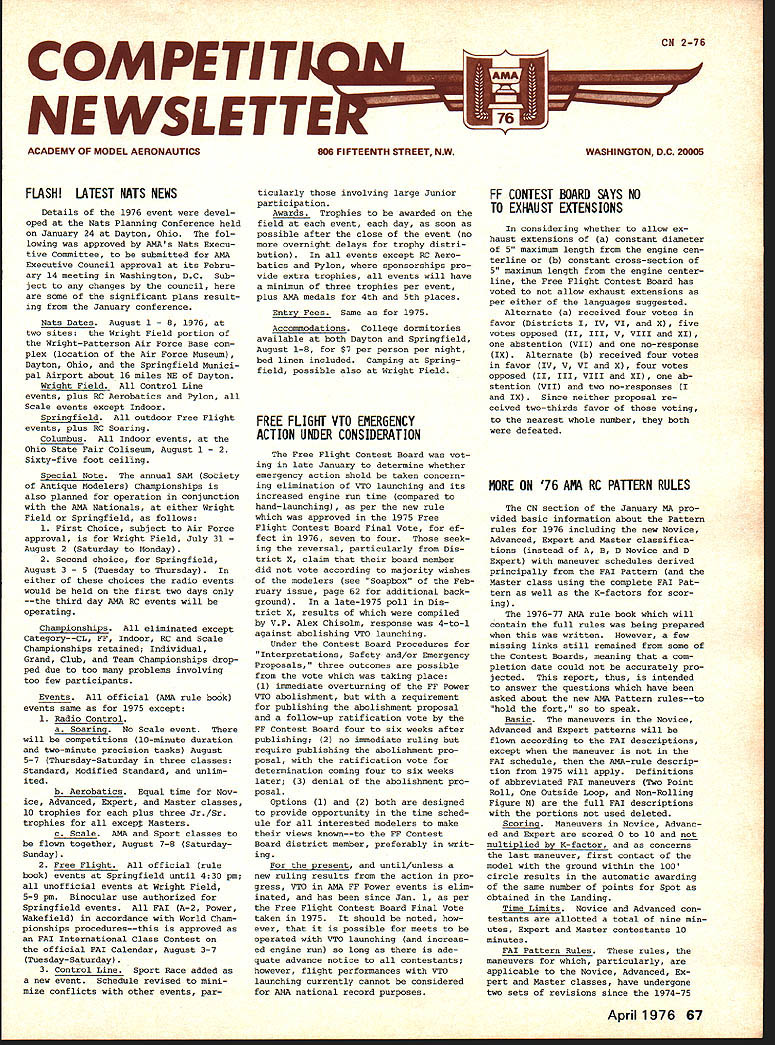
FLASH! LATEST NATS NEWS
Details of the 1976 event were developed at the Nats Planning Conference held January 24 at Dayton, Ohio. The following was approved by AMA's Nats Executive Committee to be submitted for AMA Executive Council approval at its February 14 meeting, Washington, D.C. Subsequent to any changes by the Council, here are some of the significant plans resulting from the January conference.
Nats Dates. August 1-8, 1976, at two sites: the Wright Field portion of the Wright-Patterson Air Force Base complex (location of the Air Force Museum), Dayton, Ohio, and the Springfield Municipal Airport about 16 miles NE of Dayton.
Wright Field. All Control Line events, plus RC Aerobatics and Pylon, all Scale events except Indoor.
Springfield. All outdoor Free Flight events, plus RC Soaring.
Columbus. All indoor events, at the Ohio State Fair Coliseum, August 1-2. Sixty-five foot ceiling.
Special Note. The annual SAM (Society of Antique Modelers) Championships is also planned for operation in conjunction with the AMA Nationals, at either Wright Field or Springfield, as follows:
- First choice, subject to Air Force approval, is Wright Field, July 31-August 2 (Saturday-Monday).
- Second choice, Springfield, August 3-5 (Tuesday-Thursday). In either of these choices the radio events would be held on the first two days only — the third day AMA RC events will be operating.
Championships. All eliminated except category—CL, FF, Indoor, RC and Scale Championships retained; Individual, Grand, Club and Team Championships dropped due to problems involving too few participants.
Events. All official (AMA rule book) events same as for 1975 except:
- Radio Control.
- Soaring. No Scale event. There will be competitions (10-minute duration and two-minute precision tasks) August 5-7 (Thursday-Saturday) in three classes: Standard, Modified Standard, and Unlimited.
- Aerobatics. Equal time for Novice, Advanced, Expert and Master classes. Ten trophies for each plus three Jr./Sr. trophies except Masters.
- Scale. AMA and Sport classes flown together, August 7-8 (Saturday-Sunday).
- Free Flight. All official (rule book) events at Springfield until 4:30 p.m.; all unofficial events at Wright Field, 5-9 p.m. Binocular use authorized for Springfield events. All FAI (A/2, Power, Wakefield) in accordance with World Championships procedures—this is approved as an FAI International Class Contest on the official FAI Calendar, August 3-7 (Tuesday-Saturday).
- Control Line. Sport Race added as a new event. Schedule revised to minimize conflicts with other events, particularly those involving large Junior participation.
Awards. Trophies to be awarded on the field at each event, each day, as soon as possible after the close of the event; no more overnight delays for trophy distribution. In all events except RC Aerobatics and Pylon, where sponsorships provide extra trophies, events will have a minimum of three trophies per event plus AMA medals for 4th and 5th places.
Entry Fees. Same as for 1975.
Accommodations. College dormitories available at both Dayton and Springfield, August 1-8, for $7 per person per night, bed linen included. Camping at Springfield possible; also at Wright Field.
FREE FLIGHT VTO EMERGENCY ACTION UNDER CONSIDERATION
The Free Flight Contest Board was voting in late January to determine whether emergency action should be taken concerning elimination of VTO launching because of its increased engine run time compared with hand-launching, per a new rule approved in 1975. The Free Flight Contest Board final vote, effective 1976, was seven to four, those seeking reversal. Particularly in District X it was claimed that a board member did not vote according to majority wishes of the modelers (see "Soapbox" in the February issue, page 62 for additional background). In a late-1975 poll in District X, Alex Chisholm's response was 4-to-1 against abolishing VTO launching.
Under the Contest Board Procedures "Interpretations, Safety and/or Emergency Proposals," three outcomes were possible from the vote which was taking place: (1) immediate overturning of the FF Power VTO abolishment, with a requirement for publishing the abolishment proposal and a followup ratification vote by the FF Contest Board four to six weeks after publishing; (2) no immediate ruling but requiring publication of the abolishment proposal with the ratification vote determination coming four to six weeks later; or (3) denial of the abolishment proposal. Options (1) and (2) are both designed to provide opportunity in the time schedule for all interested modelers to make their views known to the FF Contest Board district member, preferably in writing, until/unless a new ruling results. As of press time it was not known whether the FF Contest Board action would result in elimination of VTO AMA FF Power events.
FF CONTEST BOARD SAYS NO TO EXHAUST EXTENSIONS
In considering whether to allow exhaust extensions (a) of constant diameter of 5/16" maximum length from the engine carburetor or (b) constant cross-section of 5/16" maximum length from the engine centerline, the Free Flight Contest Board voted to not allow exhaust extensions as either of the languages suggested.
Alternate (a) received four votes in favor (Districts I, IV, VI and X), five votes opposed (II, III, V, VII and VIII), one abstention, and one non-response. Alternate (b) received four votes in favor (IV, V, VI and XI), five votes opposed, and two non-responses. Since neither proposal received two-thirds favor of those voting, to the nearest whole number, they were defeated.
MORE ON '76 AMA RC PATTERN RULES
The RC section of the January MA provided basic information about the Pattern rules for 1976 including the new Novice, Advanced, Expert and Master classifications. The Pattern rules announcement was not entirely complete and several additional clarifications and minor revisions have been made since that publication.
The 1976-77 AMA rule book, which will contain the full rules, was being prepared when this was written. However, the major points of interest are that the maneuvers for Novice, Advanced and Expert remain substantially the same as described earlier but have been reworded in several cases for clarity; a K-factor system will be used for scoring maneuvers; and Master class procedures will be defined for national competition. Full maneuver descriptions, K-factor values and judging details will appear in the new rule book.
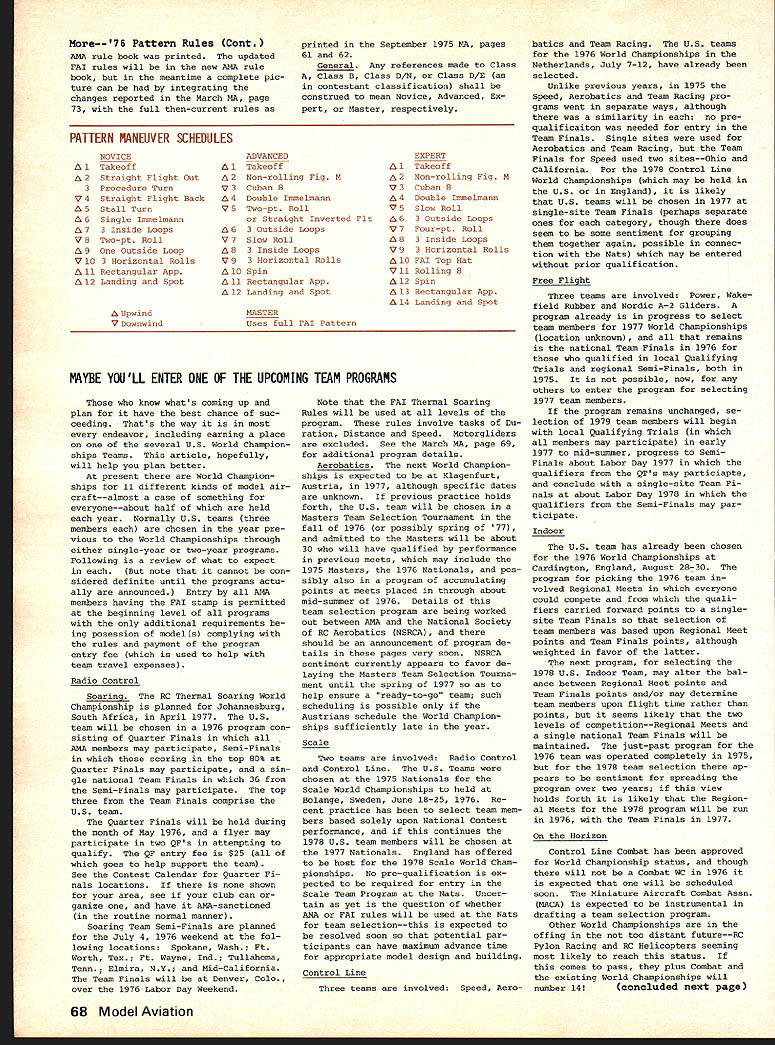
PATTERN MANEUVER SCHEDULES
NOVICE
- Δ1 Takeoff
- Δ2 Straight Flight Out
- Δ3 Procedure Turn
- Δ4 Straight Flight Back
- Δ5 Stall Turn
- Δ6 Single Immelmann
- Δ7 3 Inside Loops
- Δ8 Two-pt. Roll
- Δ9 One Outside Loop
- Δ10 3 Horizontal Rolls
- Δ11 Rectangular App.
- Δ12 Landing and Spot
ADVANCED
- A1 Takeoff
- A2 Non-rolling Fig. M
- A3 Cuban 8
- A4 Double Immelmann
- A5 Two-pt. Roll or Straight Inverted Flt.
- A6 3 Outside Loops
- A7 Slow Roll
- A8 3 Inside Loops
- A9 3 Horizontal Rolls
- A10 Spin
- A11 Rectangular App.
- A12 Landing and Spot
EXPERT
- Δ1 Takeoff
- Δ2 Non-rolling Fig. M
- Δ3 Cuban 8
- Δ4 Double Immelmann
- Δ5 Slow Roll
- Δ6 3 Outside Loops
- Δ7 3 Inside Loops
- Δ8 3 Horizontal Rolls
- Δ9 Fail/Top Hat
- Δ10 Rolling 8
- Δ11 Spin
- Δ12 Landing and Spot
MASTER
- Uses full FAI Pattern
▲ Upwind ▼ Downwind
MAYBE YOU'LL ENTER ONE OF THE UPCOMING TEAM PROGRAMS
Those who know what's coming up and plan for it have the best chance of succeeding. That's the way it is in most every endeavor, including a place on one of the several U.S. World Championship teams. This article, hopefully, will help you plan better.
At present there are World Championships for 11 different kinds of model aircraft—almost a case of something for everyone—about half of which are held each year. Normally U.S. teams (three members each) are chosen in the year previous to the World Championships through either single-year or two-year programs. Following is a review of what to expect in each. (But note that it cannot be considered definitive until the programs actually are announced.) Entry by all AMA members having the FAI stamp is permitted at the beginning level of all programs with the only additional requirements being possession of model(s) complying with the rules and payment of the program entry fee (which is used to help with team travel expenses).
Radio Control
Soaring. The RC Thermal Soaring World Championship is planned for Johannesburg, South Africa, in April 1977. The U.S. team will be chosen in a 1976 program consisting of Quarter Finals in which all AMA members may participate, and a Final in which those scoring in the top 80% of Quarter Finals may participate. The top three from the Team Finals will comprise the U.S. team. The Quarter Finals will be held during the month of May 1976, and a flyer may participate in two QF's in attempting to qualify. The QF entry fee is $25 (all of which goes to help support the team). See the Contest Calendar for Quarter Finals locations. If there is no team scheduled for your area, see if your club can organize one, and have it AMA-sanctioned in the routine normal manner.
Soaring Team Finals will be held during the July 4, 1976 weekend at the following locations: Tipton, Pa.; Fort Wayne, Ind.; Tallahassee, Fla.; Elmira, N.Y.; and Mid-California. The Team Finals will be at Denver, Colo., over the 1976 Labor Day Weekend.
Note that the FAI Thermal Soaring Rules will be used at all levels of the program. These rules involve tasks of Duration, Distance and Speed. Motor gliders are excluded. See the March MA, page 69, for additional program details.
Aerobatics. The next World Championships is expected to be at Klagenfurt, Austria, in 1977, and although specific dates are unknown, if previous practice holds for the U.S. team, the U.S. team will be chosen in a Masters Team Selection Tournament in the fall of 1976 (or possibly spring of '77), and admitted to the Masters will be about 30 who will have qualified by performance in previous meets, which may include the 1975 Masters, the 1976 Nationals, and possibly also in a program of accumulating points at meets placed in through August mid-summer of 1976. Details of this team selection program are being worked out between AMA and the National Society of Radio Controlled Aerobatics (NSRCA), and there should be an announcement of program details in these pages very soon. NSRCA sentiment currently appears to favor delaying the Master Team Selection tournament until the spring of 1977 so as to help ensure a "ready-to-go" team; such scheduling is possibly only if the Australians schedule the World Championships sufficiently late in the year.
Scale
Two teams are involved: Radio Control and Control Line. The U.S. teams were chosen at the 1975 Nationals for the Scale World Championships to be held at Basle, Sweden, June 18-25, 1976. Recent practice has been to select team members basically on the competitor's national contest performance, and if this continues the 1976 U.S. team members will be chosen at the 1976 Nationals. England has offered to be host for the 1978 World Championships. No pre-qualification is expected to be required for entry in the Scale Team Program at the Nats. Uncertainty as to the question of whether AMA or FAI rules will be used at the Nats for team selection—this is expected to be resolved soon so that potential participants can have maximum advance time for appropriate model design and building.
Control Line
Three teams are involved: Speed, Aerobatics and Team Racing. The U.S. teams for the 1976 World Championships in the Netherlands, July 7-12, have already been selected.
Unlike various years, in 1975 the Speed, Aerobatics and Team Racing programs went in separate ways, although there was a similarity in each: no pre-qualification was needed for entry in the Team Finals. Single sites were used for Aerobatics and Team Racing, but the Team Finals for Speed used two sites—Ohio and California. For the 1978 Control Line World Championships (which may be held in the U.S. or in England) it is likely that the U.S. teams will be chosen in 1977 at single-site Team Finals (perhaps separate ones for each category), which may be entered without prior qualification.
Free Flight
Three teams are involved: Power, Wakefield and Rubber and Nordic A-2 Gliders. A program already is in progress to select team members for 1977 World Championships (location unknown), and all that remains is the national Team Finals in 1976 for those who qualified in local Qualifying Trials and Regional Semi-Finals, both in 1975. It is not possible, now, for any others to enter the program for selecting 1977 team members.
If the program remains unchanged, selection of 1979 team members will begin with local Qualifying Trials (in which all members may participate) in early 1977 to mid-summer, progress to Semi-Finals about Labor Day 1977 in which the qualifiers from the QFs may participate, and conclude with a single-site Team Finals at about July 1978 in which the qualifiers from the Semi-Finals may participate.
Indoor
The U.S. team has already been chosen for the 1976 World Championships at Cardington, England, August 28-30. The program for picking the 1976 team involved Regional Meets in which everyone could compete and from which the qualifiers carried forward points to a single-site Team Finals so that selection of team members was based upon Regional Meet points and Team Finals positions, although weighted in favor of the latter.
The next program, for selection of the 1978 U.S. Indoor Team, may alter the balance between Regional Meet points and Team Finals points and/or may determine team members upon flight the rather than upon points, but it seems likely that the two levels of competition—Regional Meets and a single national Team Finals—will be maintained. The just-past program for the 1976 team was operated completely in 1975, but for the 1978 team selection there appears to be some intent for spreading the program over the next two years; this review holds for the 1976 program in 1977.
On the Horizon
Control Line Combat has been approved and (MAMA) is expected to be included in the 1977 selection program. Radio Control Combat may also be considered in the not too distant future—RC Pylon Racing and RC Helicopters seem most likely to reach that status. If this comes to pass, they plus Combat and the existing World Championships will number many events. (concluded next page)
Competition Newsletter
FLASH — Latest Nats News
Nats planning conference held January 24, Dayton, Ohio. Following approval, AMA's Nats Executive Committee submitted its recommendations to the AMA Executive Council for approval at its February 14 meeting in Washington, D.C. Subject to changes by the Council, some significant plans resulted from the January conference.
Nats dates: August 1–8, 1976. Two sites: Wright Field portion of Wright-Patterson Air Force Base complex (location: Air Force Museum, Dayton, Ohio) and Springfield Municipal Airport, about 16 miles NE of Dayton.
- Wright Field: Control Line events plus RC Aerobatics, Pylon, Scale events except Indoor.
- Springfield (outdoor): Free Flight events plus RC Soaring.
- Columbus indoor events: Ohio State Fair Coliseum, August 1–8 (sixty-five foot ceiling).
Special note: Annual SAM (Society of Antique Modelers) championships also planned in conjunction with AMA Nationals, either Wright Field or Springfield.
Either choice:
- First choice, subject to Air Force approval — Wright Field, July 31–August 2 (Saturday–Monday).
- Second choice — Springfield, August 3–5 (Tuesday–Thursday).
In either choice, radio events would be held the first two days — the third day AMA RC events will be operating. Championships eliminated except Category—CL. FF Indoor and RC Scale championships retained. Individual, Grand, and Club Team championships dropped due to problems involving too few participants.
Events: Official AMA rule book events same as 1975 except:
- Radio Control
- a. Soaring — No Scale event will be competition of 10-minute duration with two-minute precision tasks, August 5–7 (Thursday–Saturday); three classes: Standard, Modified Standard, Unlimited.
- b. Aerobatics — Equal time; Novice, Advanced, Expert, Master classes; 10 trophies plus three Jr./Sr. trophies except Masters.
- c. Scale — AMA Sport classes flown together, August 7–8 (Saturday–Sunday).
- Free Flight — Official rule book events at Springfield until 4:30 p.m.; unofficial events at Wright Field 5–9 p.m. Binocular use authorized for Springfield events. FAI A2 Power, Wakefield in accordance with World Championships procedures — this approved FAI International Class Contest is on the official FAI calendar, August 3–7 (Tuesday–Saturday).
- Control Line Sport Race added as a new event. Schedule revised to minimize conflicts with other events, particularly those involving large junior participation.
Awards: Trophies awarded the field event day as soon as possible after close of event; no overnight delays in trophy distribution except RC Aerobatics. Pylon sponsorships provide extra trophies; events will have a minimum of three trophies per event plus AMA medals for 4th and 5th places.
Entry fees: Same as 1975.
Accommodations: College dormitories available both Dayton and Springfield, August 1–8 — $7 per person per night; bed linen included. Camping at Springfield possible; also at Wright Field.
The Free Flight Contest Board, voting late January, must determine whether emergency action should be taken concerning the elimination of VTO launching. Concern centers on VTO's increased engine run time compared to hand-launching per the new rule approved in 1975. The Free Flight Contest Board's final vote will affect 1976.
The board vote was seven to four seeking reversal, particularly District X. District X claims a board member did vote according to the majority wishes of modelers (see Soapbox, February issue, page 62, for additional background). A late‑1975 poll of District X results was compiled; VP Alex Chisholm's response was 4‑to‑1 against abolishing VTO launching.
Under Contest Board Procedures (Interpretations, Safety and/or Emergency Proposals), three outcomes are possible when a vote is taking place:
- Immediate overturning of FF Power VTO abolishment requirement; publish the overturning and follow with a ratification vote by the FF Contest Board four to six weeks after publishing.
- No immediate ruling; require publishing of the abolishment proposal and hold a ratification vote with determination coming four to six weeks later.
- Denial of the abolishment proposal.
Options 1 and 2 are designed to provide interested modelers time and opportunity to make their views known to the FF Contest Board or district member, preferably in writing, until/unless a new ruling results. Action is in progress regarding VTO and AMA FF Power events.
Competition Newsletter
ACADEMY OF MODEL AERONAUTICS — FLASH — LATEST NATS NEWS
Details — 1976 event developed
Nats Planning Conference held January 24, Dayton, Ohio following approval of AMA's Nats Executive Committee submitted to AMA Executive Council for approval at its February 14 meeting, Washington, D.C. Subjects changed by council; some significant plans resulting from January conference.
Nats Dates: August 1–8, 1976 — two sites. Wright Field portion, Wright‑Patterson Air Force Base complex; location: Air Force Museum, Dayton, Ohio. Springfield Municipal Airport about 16 miles NE of Dayton. Wright Field: Control Line events plus RC Aerobatics, Pylon, Scale events except Indoor. Springfield: Outdoor Free Flight events plus B/C Soaring. Columbus: Indoor events — Ohio State Fair Coliseum, August 1 (sixty‑five foot ceiling).
Special Note: Annual SAM (Society of Antique Modelers) Championships also planned to operate in conjunction with AMA Nationals, either Wright Field or Springfield.
Site follows:
In either choice radio events would be held the first two days — the third day AMA RC events will be held. Operating Championships eliminated except Category‑CL; FF Indoor and RC Scale Championships retained. Individual, Grand, Club Team Championships dropped due to problems involving too few participants. Events: official AMA rule book events same as 1975 except:
- Radio Control
a. Soaring: No‑scale event; will be competition of 10‑minute duration with two‑minute precision tasks. August 5–7 (Thursday–Saturday). Three classes: Standard, Modified, Unlimited. b. Aerobatics: Equal time — Novice, Advanced, Expert, Master classes. Ten trophies plus three Jr./Sr. trophies except Masters. c. Scale: AMA Sport classes flown together. August 7–8 (Saturday–Sunday).
- Free Flight: Official rule book events at Springfield until 4:30 p.m.; unofficial events at Wright Field until 5:00 p.m. Binocular use authorized on Springfield events. FAI A2 Power Wakefield in accordance with World Championships procedures — this approved FAI International Class Contest, official FAI calendar, August 3–7 (Tuesday–Saturday).
- Control Line: Sport Race added as new event. Schedule revised to minimize conflicts with other events, particularly involving large Junior participation.
Awards: Trophies awarded on the field event day as soon as possible after close of event; no overnight delays in trophy distribution for events except B/C Aerobatics. Pylon sponsorships provide extra trophies. Events will have a minimum of three trophies per event plus AMA medals for 4th and 5th places.
Entry Fees: Same as 1975.
Accommodations: College dormitories available both Dayton and Springfield, August 1–8, $7 per person per night; bed linen included. Camping in Springfield possible; also Wright Field.
Free Flight Contest Board voting late January to determine whether emergency action should be taken concerning elimination of VTO launching with its increased engine run time compared to hand‑launching per new rule approved 1975. Free Flight Contest Board final vote affects 1976 — seven to four seeking reversal, particularly District X. District X claims a board member did vote according to the majority wishes of modelers (see Soapbox, February issue, page 62 for additional background). A late‑1975 poll of District X results compiled; VP Alex Chisholm response 4‑to‑1 against abolishing VTO launching.
Under Contest Board Procedures (Interpretations, Safety and/or Emergency Proposals) three outcomes possible when a vote is taking place:
- Immediate overturning of FF Power VTO abolishment requirement; publish overturning and follow with a ratification vote by the FF Contest Board four‑six weeks after publishing.
- No immediate ruling; require publishing of the abolishment proposal and hold a ratification vote with determination coming four‑six weeks later.
- Denial of the abolishment proposal.
Options 1 and 2 both designed to provide interested modelers time and opportunity to make views known — to the FF Contest Board or district member, preferably in writing — until/unless new ruling results. Action in progress regarding VTO; AMA FF Power events elimination possible contingent on final vote.
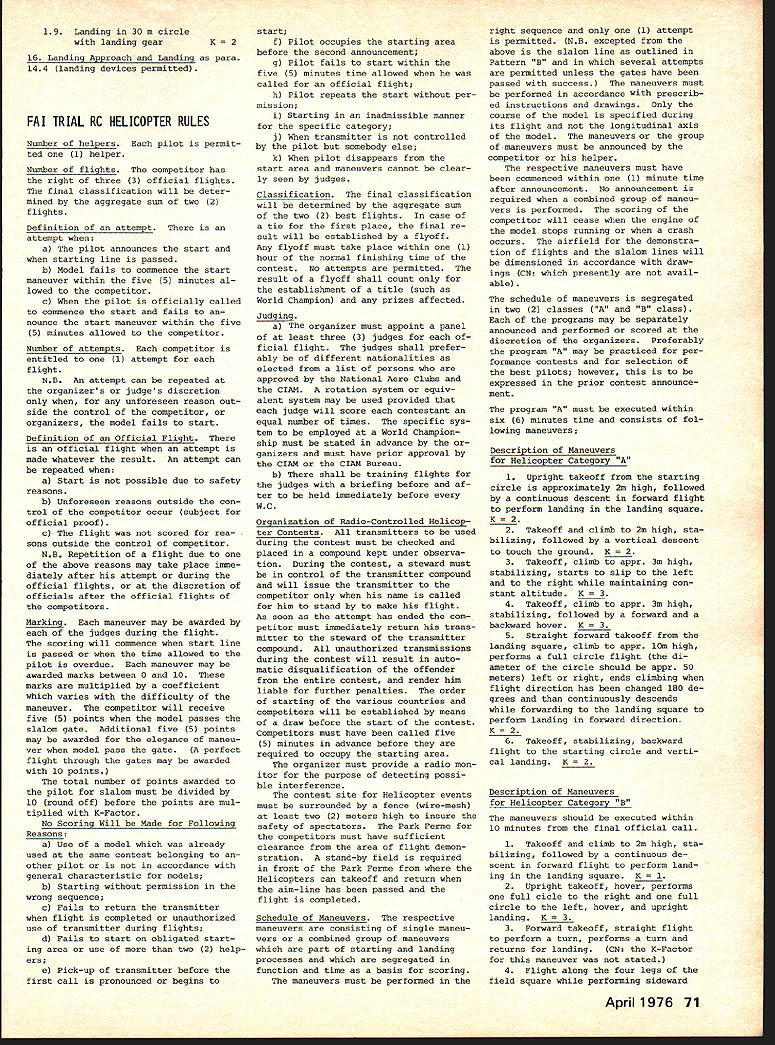
FAI TRIAL RC HELICOPTER RULES
1.9. Landing in 30° circle with landing gear K = 2
- Landing Approach and Landing as para. 14.4 (landing devices permitted).
Number of helpers. — Each pilot is permitted one (1) helper.
Number of flights. — The competitor has the right of three (3) official flights. The final classification will be determined by the aggregate sum of two (2) flights.
Definition of an attempt. There is an attempt when: a) The pilot announces the start and when starting line is passed. b) Model fails to commence the start maneuver within the five (5) minutes allowed to the competitor. c) When the pilot is officially called to commence the start and fails to announce the start maneuver within the five (5) minutes allowed to the competitor.
Number of attempts. Each competitor is entitled to one (1) attempt for each flight.
N.B. An attempt can be repeated at the organizer's or judge's discretion only when, for any unforeseen reason outside the control of the competitor or the organizers, the model fails to start.
Definition of an Official Flight. — An official flight is when an attempt is made whatever the result. An attempt can be repeated when: a) Start is not possible due to safety reasons. b) Unforeseen reasons outside the control of the competitor occur (subject to official proof). c) The flight was not scored for reasons outside the control of the competitor.
N.B. Repetition of a flight due to one of the above reasons may take place immediately after its attempt or during the official flights, or at the discretion of officials after the official flights of the competitors.
Marking. — Each maneuver may be awarded by each of the judges during the flight. The scoring will commence when start line is passed or when the time allowed to the pilot is overdue. Each maneuver may be awarded marks between 0 and 10. These marks are multiplied by a coefficient which varies with the difficulty of the maneuver. The competitor will receive five (5) points when the model passes the landing gate. Additional five (5) points may be awarded for the elegance of maneuver when model passes the gate. A perfect flight through the gates may be awarded with 10 points.
The total number of points awarded to the pilot for slalom must be divided by 10 (round off) before the points are multiplied with K-factor.
No Scoring Will be Made for the Following Reasons a) Use of a model which was already used at the contest belonging to another pilot or is not in accordance with general characteristics for models; b) Starting without permission in the wrong sequence; c) Fails to return the transmitter when flight is completed or unauthorized use of transmitter during flights; d) Fails to start on the official starting area or use of more than two (2) helpers; e) Pick-up of transmitter before the first call is pronounced or begins to start; f) Pilot occupies the starting area before the second announcement; g) Pilot fails to start within the five (5) minutes time allowed when he was called for an official flight; h) Pilot repeats the start without permission; i) Starting in an inadmissible manner for the specific category; j) When transmitter is not controlled by the pilot but somebody else; k) When pilot disappears from the start area and maneuvers cannot be clearly seen by judges.
Classification. — The final classification will be determined by the aggregate sum of the two (2) best flights. In case of a tie for the first place, the final result will be established by a flyoff. Any flyoff must take place within one (1) hour of the normal finishing time of the contest. No attempts are permitted. The result of a flyoff shall count only for the establishment of a title (such as World Champion) and any prizes affected.
Judging. a) The organizer must appoint a panel of at least three (3) judges for each official flight. The judges shall preferably be of different nationalities and be elected from a list of persons who are approved by the National Aero Clubs and the CIAM. A rotation system of equivalent system may be used provided each judge will score each contestant an equal number of times. The specific system to be employed at a World Championship must be stated in advance by the organizers and have prior approval by the CIAM or the CIAM Bureau. b) There shall be training flights for the judges with a briefing before and after to be held immediately before every official flight.
Organization of Radio-Controlled Helicopter Contests. — All transmitters to be used during the contest must be checked and placed in a compound kept under observation. During the contest, a steward must be in control of the transmitter control box and will issue the transmitter to the competitor only when his name is called for him to stand by to make his flight. As soon as the attempt has ended the competitor must immediately return his transmitter to the steward or the transmitter compound. All unauthorized transmissions during the contest will result in automatic disqualification of the offender from the entire contest, and render him liable for further penalties. The order of starting of the various countries and competitors will be established by means of a draw before the start of the contest. Competitors must have been called five (5) minutes in advance before they are required to occupy the starting area.
The organizer must provide a radio monitor for the purpose of detecting possible interference.
The contest site for helicopter events must be surrounded by a fence (wire-mesh) at least two (2) meters high to insure the safety of spectators. The Park Zone for the competitors must have sufficient clearance from the area of flight demonstration. A stand-by field is required in front of the Park Zone from where the helicopters can take off and return when the aim-line has been passed and the flight is completed.
Schedule of Maneuvers. — The respective maneuvers are consisting of single maneuvers or a combined group of maneuvers which are part of starting and landing procedures and which are segregated in function and time as a basis for scoring. The maneuvers must be performed in the right sequence and only one (1) attempt is permitted. (N.B. excepted from the above is the slalom in lines as outlined in Pattern "B" and in which several attempts are permitted unless the gates have been passed with success.) The maneuvers must be performed in accordance with prescribed instructions and drawings. Only the direction of the model is specified during its flight, and not the longitudinal axis of the model. The maneuvers or the group of maneuvers must be announced by the competitor to the timer.
The respective maneuvers must have to be commenced within one (1) minute time after announcement. No announcement is required when a combined group of maneuvers is performed. The scoring of the competitor will cease when the engine of the model stops running or when a crash occurs. The airfield for the demonstration of flights and the slalom lines will be dimensioned in accordance with drawings, (which presently are not available).
The schedule of maneuvers is segregated in two (2) classes ("A" and "B" class). Each of the programs may be separately announced and performed or scored at the discretion of the organizers. Preferably the program "A" may be practiced for performance contests and for selection of the best pilots; however, this is to be expressed in the prize contests announcement.
The program "A" must be executed within six (6) minutes time and consists of following maneuvers:
Description of Maneuvers for Helicopter Category "A"
- Upright takeoff from the starting circle is approximately 2m high, followed by a continuous descent in forward flight to perform landing in the landing square. K = 2
- Takeoff and climb to 2m high, stabilizing, followed by a vertical descent to touch the ground. K = 2
- Takeoff, climb to app. 3m high, stabilizing, starts to slip to the left and to the right while maintaining constant altitude. K = 3
- Takeoff, climb to app. 3m high, stabilizing, followed by a forward and a backward hover. K = 3
- Straight forward takeoff from the landing square, climb to app. 10m high, perform a full circle flight (the diameter of the circle should be app. 50 meters) left or right, ends climbing when flight direction has been changed 180° and then continuously descends while forwarding to the landing square to perform landing in forward direction. K = 2
- Takeoff, stabilizing, backward flight to the starting circle and vertical landing. K = 2
Description of Maneuvers for Helicopter Category "B"
The maneuvers schedule to be executed within 10 minutes from the final official call.
- Takeoff and climb to 2m high, stabilizing, followed by a continuous descent in forward flight to perform landing in the landing square. K = 2
- Upright takeoff, hover, performs one full circle to the right, and one full circle to the left, hover and upright landing. K = 3
- Forward takeoff, straight flight to perform a turn, performs a turn and returns to landing. (K = 2)
- Flight along the four legs of the field square while performing sideward
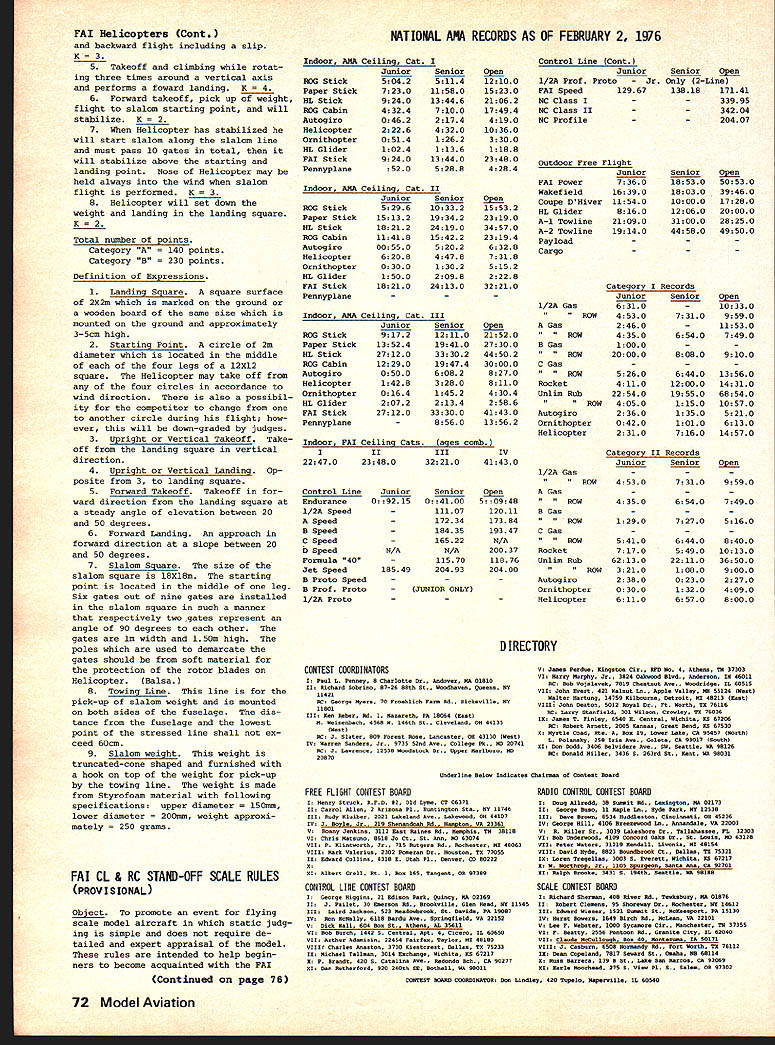
FAI Helicopters (Cont.)
and backward flight including a slip. K = 3.
- Takeoff and climbing while rotating three times around a vertical axis and performs a forward landing. K = 4.
- Forward takeoff, pick up of weight, flight to slalom starting point, and will stabilize. K = 2.
- When Helicopter has stabilized he will start slalom along the slalom line and must pass 10 gates in total, then it will stabilize above the starting and landing point. Nose of Helicopter may be held always into the wind when slalom flight is performed. K = 3.
- Helicopter will set down the weight and landing in the landing square. K = 1.
Total number of points. Category "A" = 140 points. Category "B" = 230 points.
Definition of Expressions.
- Landing Square. A square surface of 2x2m which is marked on the ground or a wooden board of the same size which is mounted on the ground and approximately 3-5cm high.
- Starting Point. A circle of 2m diameter which is located in the middle of each of the four legs of a 12x12m square. The Helicopter may take off from any of the four circles in accordance to wind direction. There is also a possibility for the competitor to change from one to another circle during his flight; however, this will be down-graded by judges.
- Upright or Vertical Takeoff. Take-off from the landing square in vertical direction.
- Upright or Vertical Landing. Opposite from 3, to landing square.
- Forward Takeoff. Takeoff in forward direction from the landing square at a steady angle of elevation between 20 and 50 degrees.
- Forward Landing. An approach in forward direction at a slope between 20 and 50 degrees.
- Slalom Square. The size of the slalom square is 10x10m. The starting point is located in the middle of one leg. Six gates out of nine gates are installed in the slalom square in such a manner that respectively two gates represent an angle of 90 degrees to each other. The gates are 1m width and 1.50m high. The poles which are used to demarcate the gates should be from the soft material for the protection of the rotor blades on the Helicopter. (Balsa.)
- Towing Line. This line is for the pick-up of a balloon weight and is mounted on both sides of the fuselage. The distance from the fuselage and the lowest point of the stressed line shall not exceed 60cm.
- Slalom weight. This weight is truncated-cone shaped and furnished with a hook on top of the weight for pick-up by the towing line. The weight is made from Styrofoam material with following specifications: upper diameter = 15cm, lower diameter = 20mm, weight approximately = 250 grams.
Competition Newsletter
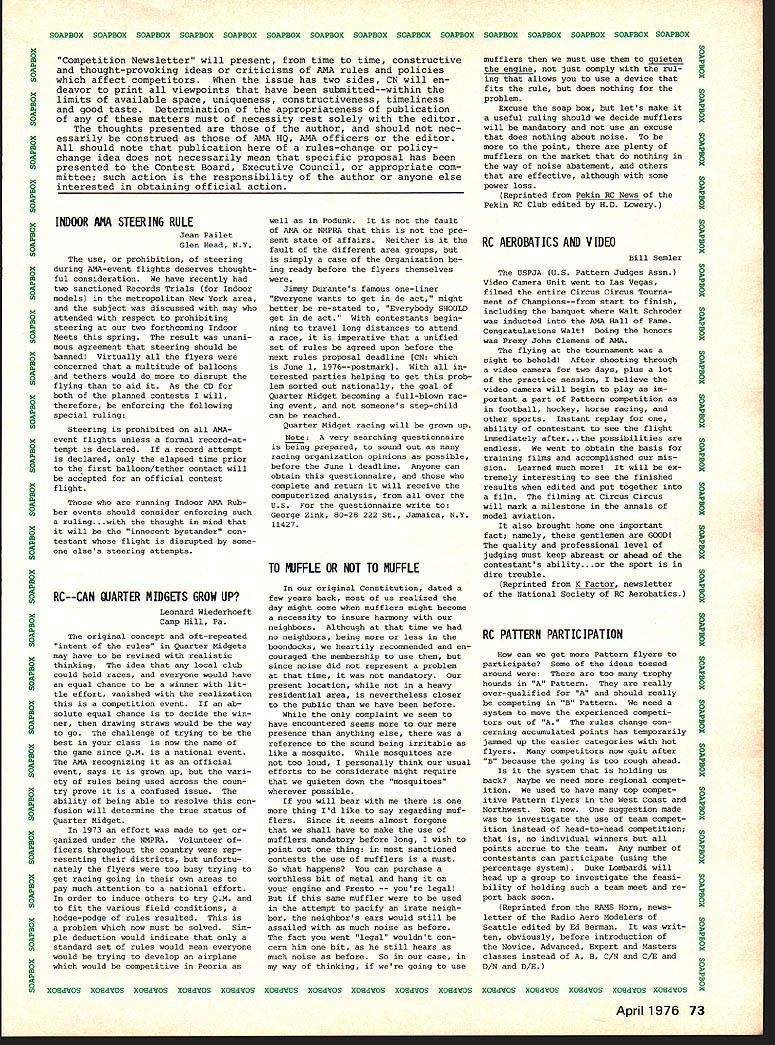
"Competition Newsletter" will present, from time to time, constructive and thought-provoking ideas or criticisms of AMA rules and policies which affect competitors. When the issue has two sides, CN will endeavor to print all viewpoints that have been submitted—within the limits of available space, uniqueness, constructiveness, timeliness and good taste. Determination of the appropriateness of publication of any of these matters must of necessity rest solely with the editor. The thoughts presented are those of the author, and should not necessarily be construed as those of AMA HQ, AMA officers or the editor. All should note that publication here at a rules-change or policy-change idea does not necessarily mean that a specific proposal has been presented to the Contest Board, Executive Council, or appropriate committee; such action is the responsibility of the author or anyone else interested in obtaining official action.
INDOOR AMA STEERING RULE
Jean Paillet Glen Head, N.Y.
The use, or prohibition, of steering during AMA-event flights deserves thoughtful consideration. We have recently had two sanctioned Records Trials (for Indoor models) in the metropolitan New York area, and the subject was discussed with my father and the BMRC participants steering at our two forthcoming Indoor Meets this spring. The result was unanimous agreement that steering should be banned! Virtually all the flyers were concerned that a multitude of balloons and tethers would do more to disrupt the flying than to add to it. As the CD for both of the planned contests I will, therefore, be enforcing the following special ruling:
Steering is prohibited on all AMA-event flights unless a formal, recorded-attempt is declared. If a recorded attempt is declared, only the elapsed time prior to the first balloon/other contact will be accepted for an official contest flight.
Those who are running Indoor AMA Rubber events should consider enforcing such a ruling, with the thought in mind that it will be the "innocent bystander" contestant whose flight is improved by someone else's steering attempts.
RC—CAN QUARTER MIDGETS GROW UP?
Leonard Weidenhofer Camp Hill, Pa.
The original concept and oft-repeated "intent of the founders" in Quarter Midgets may have to be revised with realistic thinking. The idea that only those who could afford classes, and everyone would have an equal chance to be a winner, with little effort, vanished with the realization this is a competition event. If an absolute equal chance is to decide the winner, then drawing straws would be the way to go. The challenge of trying to be the best in your class is now the name of the game since Q.M. is a national event. The AMA recognizing it as an official event, says it is grown up, but the variety of rules being used across the country prove it is a confused issue. The ability of being able to resolve this confusion will determine the true status of Quarter Midgets.
In 1973 an effort was made to get organized under the NMPRA. Volunteer officers throughout the country were representing their districts, but unfortunately the flyers were too busy trying to get racing going in their own areas to pay much attention to a national effort. In order to induce others to try Q.M. and to fit the various field conditions, a hodge-podge of rules resulted. This is a problem which now must be solved. Simple deduction would indicate that only a standard set of rules would mean everyone would be trying to develop an airplane which would be competitive in Peoria as well as in Podunk. It is not the fault of AMA or NMPRA that this is not the present state of affairs. Neither is it the fault of the different areas; but it simply is a case of the organizations being ready before the flyers themselves were.
"Everyone wants to get in on the act," might better be re-stated to, "Everybody SHOULD get in on the act." With contestants beginning to travel long distances to attend a race, it is imperative that a uniform set of rules be agreed upon before the next rules proposal deadline (which is June 1, 1976—postmark). With all interested parties helping to get this program sorted out nationally, the goal of Quarter Midget becoming a full-blown racing event, and not someone's step-child can be reached. Quarter Midget racing will be grown up.
Note: A very searching questionnaire is being prepared to sound out as many racing organizations' opinions as possible, before the June 1 deadline. Anyone can obtain this questionnaire, and those who complete and return it will receive the computerized analysis, from all over the country. For the questionnaire write to George Zink, 80-26 228 St., Jamaica, N.Y. 11427.
TO MUFFLE OR NOT TO MUFFLE
In our original Constitution, dated a few years back, most of us realized the day might come when mufflers might become a necessity to insure harmony with our neighbors. Although at that time we had no neighborhoods, being more or less in the boondocks, we heartily recommended and encouraged the membership to use them, but since noise did not represent a problem at that time, it was not mandatory. At present location, while not in a heavy residential area, it is nevertheless closer to the public than we have been before. While the only complaint we seem to have encountered seems to be our more precise than anything else, there was a reference to the sound being as irritable as a mosquito. While mosquitoes are not too loud, I personally think our usual efforts to be considerate might require that we quieten down the "mosquitoes" wherever possible.
If you will bear with me the idea is one more thing I'll like to say regarding mufflers. Since it seems almost forgone that we shall have to make the use of mufflers mandatory before long, I wish to point out one thing: in most sanctioned contests the use of mufflers is a must. What happens? You can purchase a so-called muffler at the swap meets and hang it on your engine and presto — you're legal! The point is that if the same muffler were to be used in the attempt to pacify an irate neighbor, the neighbor's ears would still be assaulted with as much noise as before. The fact you went "legal" wouldn't concern him one bit, as he still hears as much noise as before. So in our case, in my way of thinking, if we're going to use mufflers then we must use them to quieten the engine, not just comply with the ruling that allows you to use a device that fits the rule, but does nothing for the problem.
Excuse the soapbox, but let's make it useful and realize that when we decide mufflers will be mandatory and not use an excuse that does nothing about noise. To be more on the point, there are plenty of mufflers on the market that do nothing in the way of noise abatement, and others that are effective, although with some power loss.
(Reprinted from Pekin RC News of the Pekin RC Club edited by H.D. Lowery.)
RC AEROBATICS AND VIDEO
Bill Semler
The USPA (U.S. Pattern Judges Assn.) Video Camera Unit went to Las Vegas, filmed the entire Cirrus Circus Tournament of Champions—from start to finish, including the banquet where Walt Schroeder was inducted into the Hall of Fame. Congratulations Walt! Doing the honors was Perry Glick Clemens of AMA.
The flying at the four tournaments was a sight to behold! After shooting through a video camera for two days, plus a lot of practice sessions, I believe the video camera will begin to play as important a part of Pattern competition as in football, hockey, horse racing, and other sports. Instant replay, for the ability of contestant to see the flight immediately after...the possibilities are endless. We were able to obtain the basics for training films and accomplished our mission. Learned much more! It will be extremely interesting to see the finished results when edited and put together into films. One film will be the Cirrus Circus will mark a milestone in the annals of the model aviation world.
It also brought home one important fact; namely, these gentlemen are GOOD! The quality and professional level of judging must keep abreast or ahead of the contestants' ability...or the sport is in trouble.
(Reprinted from X Factor, newsletter of the National Society of RC Aerobatics.)
RC PATTERN PARTICIPATION
How can we get more Pattern flyers to participate? Some of the ideas tossed around were: There are too many trophy hounds in "A" pattern. They are really overqualified for "A" and should really be competing for "B" or "C" spots. The judges move the experienced competitors out of the other classes which has temporarily thinned some categories. Many competitors now qualify for "B" because the going is too rough ahead. Is it the system that is holding us back? Maybe we need more regional competitions. We need to be able to induce more top competitors to attend these contests. In the West Coast and Northwest, not so. One suggestion made was to investigate the feasibility of holding such a team meet and report back soon.
(Reprinted from the RAMS Horn, newsletter of the Radio Aero Modelers of Seattle edited by Ed Derman.)
Transcribed from original scans by AI. Minor OCR errors may remain.

