
COMPETITION NEWSLETTER
'83 SAM Champs
The Denver SAM (Society of Antique Modelers) club—SAM 1—will host the 1983 SAM Championships, to be held July 19–21, 1983 at La Junta, CO. The contest site is a dead-flat former WWII B-25 base about 150 miles east of Denver. The chase area for free flight extends for several miles in all directions—there are no trees. Practice flying is available at the site on July 17–18.
For further information, correspond with SAM leadership (not AMA HQ): Jim Thomas, Vice-President for SAM’s Rocky Mountain Area, 1050 Clarkson, Denver, CO 80218.
'83 RC Aerobatics Team Progress: Finals Qualifiers
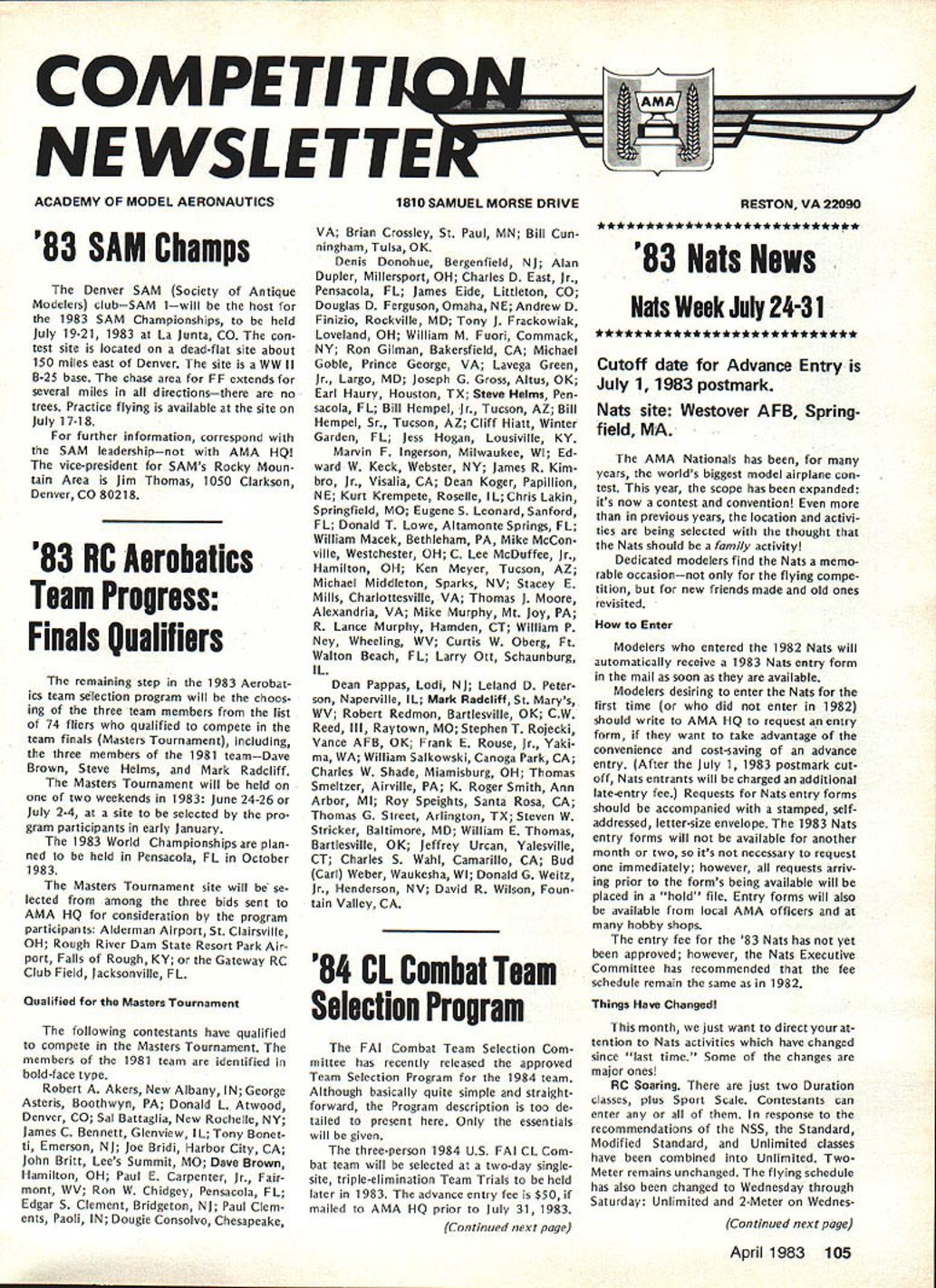
The remaining step in the 1983 Aerobatics team selection program will be choosing three team members from the 74 fliers who qualified to compete in the team finals (Masters Tournament), including the three members of the 1981 team: Dave Brown, Steve Helms, and Mark Radcliff.
- The Masters Tournament will be held on one of two weekends in 1983: June 24–26 or July 2–4. The site will be selected by program participants in early January.
- The 1983 World Championships are planned for Pensacola, FL in October 1983.
- The Masters Tournament site will be selected from three bids submitted to AMA HQ: Alderman Airport, St. Clairsville, OH; Rough River Dam State Resort Park Airport, Falls of Rough, KY; or the Gateway RC Club Field, Jacksonville, FL.
Qualified for the Masters Tournament
- Robert A. Akers, New Albany, IN
- George Asteris, Boothwyn, PA
- Donald L. Atwood, Denver, CO
- Sal Battaglia, New Rochelle, NY
- James C. Bennett, Glenview, IL
- Tony Bonetti, Emerson, NJ
- Joe Bridi, Harbor City, CA
- John Britt, Lees Summit, MO
- Dave Brown, Hamilton, OH (1981 team member)
- Paul E. Carpenter, Jr., Fairmont, WV
- Ron W. Chidgey, Pensacola, FL
- Edgar S. Clement, Bridgeton, NJ
- Paul Clements, Paoli, IN
- Dougie Consolvo, Chesapeake, VA
- Brian Crossley, St. Paul, MN
- Bill Cunningham, Tulsa, OK
- Denis Donohue, Bergenfield, NJ
- Alan Dupler, Millersport, OH
- Charles D. East, Jr., Pensacola, FL
- James Eide, Littleton, CO
- Douglas D. Ferguson, Omaha, NE
- Andrew D. Finizio, Rockville, MD
- Tony J. Frackowiak, Loveland, OH
- William M. Fuori, Commack, NY
- Ron Gilman, Bakersfield, CA
- Michael Goble, Prince George, VA
- LaVega Green, Jr., Largo, MD
- Joseph G. Gross, Altus, OK
- Earl Haury, Houston, TX
- Steve Helms, Pensacola, FL (1981 team member)
- Bill Hempel, Jr., Tucson, AZ
- Bill Hempel, Sr., Tucson, AZ
- Cliff Hiatt, Winter Garden, FL
- Jess Hogan, Louisville, KY
- Marvin F. Ingerson, Milwaukee, WI
- Edward W. Keck, Webster, NY
- James R. Kimbro, Jr., Visalia, CA
- Dean Koger, Papillion, NE
- Kurt Krempete, Roselle, IL
- Chris Lakin, Springfield, MO
- Eugene S. Leonard, Sanford, FL
- Donald T. Lowe, Altamonte Springs, FL
- William Macek, Bethlehem, PA
- Mike McConville, Westchester, OH
- C. Lee McDuffee, Jr., Hamilton, OH
- Ken Meyer, Tucson, AZ
- Michael Middleton, Sparks, NV
- Stacey E. Mills, Charlottesville, VA
- Thomas J. Moore, Alexandria, VA
- Mike Murphy, Mt. Joy, PA
- R. Lance Murphy, Hamden, CT
- William P. Ney, Wheeling, WV
- Curtis W. Oberg, Ft. Walton Beach, FL
- Larry Ott, Schaumburg, IL
- Dean Pappas, Lodi, NJ
- Leland D. Peterson, Naperville, IL
- Mark Radcliff, St. Marys, WV (1981 team member)
- Robert Redmon, Bartlesville, OK
- C. W. Reed III, Raytown, MO
- Stephen T. Rojecki, Vance AFB, OK
- Frank E. Rouse, Jr., Yakima, WA
- William Salkowski, Canoga Park, CA
- Charles W. Shade, Miamisburg, OH
- Thomas Smeltzer, Airville, PA
- K. Roger Smith, Ann Arbor, MI
- Roy Speights, Santa Rosa, CA
- Thomas G. Street, Arlington, TX
- Steven W. Stricker, Baltimore, MD
- William E. Thomas, Bartlesville, OK
- Jeffrey Urcan, Yalesville, CT
- Charles S. Wahl, Camarillo, CA
- Bud Carl Weber, Waukesha, WI
- Donald G. Weitz, Jr., Henderson, NV
- David R. Wilson, Fountain Valley, CA
'84 CL Combat Team Selection Program
The FAI Combat Team Selection Committee has released the approved Team Selection Program for the 1984 team. Only the essentials are given here.
- The three-person 1984 U.S. FAI CL Combat team will be selected at a two-day, single-site, triple-elimination Team Trials to be held later in 1983.
- Advance entry fee: $50 if mailed to AMA HQ prior to July 31, 1983.
After July 31 and up until one week before the Team Trials, a $75 late entry fee will be accepted at AMA HQ. A down payment of $10 toward either the advance or late entry fees will enroll any interested AMA Combat flier in the program and permit voting in the next team selection program. This down payment also entitles the payer to receive all program information flyers, including a copy of the 1984 team selection program document.
- Program participants (who have paid their entry fee) may withdraw before the Team Trials matches are drawn (the evening before the Trials) and request a $25 refund.
- Modelers desiring to participate in the team selection program must be U.S. citizens holding valid AMA licenses with the $10 FAI stamp affixed.
- The Team Selection Committee reviews all proposed FAI rules changes submitted by AMA members. August 31 is the deadline for submitting proposed FAI Combat rules proposals to AMA HQ for consideration that year.
'83 Nats News
Nats Week: July 24–31
- Cutoff date for advance entry: July 1, 1983 postmark.
- Nats site: Westover AFB, Springfield, MA.
The AMA Nationals has long been the world's biggest model airplane contest. In 1983 the scope was expanded; it is a contest and convention, with emphasis on making the Nats a family activity. Dedicated modelers find the Nats memorable for flying competition and for meeting friends.
How to Enter
- Modelers who entered the 1982 Nats will automatically receive a 1983 Nats entry form in the mail as soon as available.
- New entrants (or those who did not enter in 1982) should write to AMA HQ to request an entry form if they want the convenience and cost-saving of an advance entry. After the July 1 postmark cutoff, a late-entry fee will be charged.
- Requests for entry forms should include a stamped, self-addressed, business-size envelope. Entry forms will also be available from local AMA officers and many hobby shops.
- The entry fee for the '83 Nats had not yet been approved at time of printing; the Nats Executive Committee recommended keeping the 1982 fee schedule.
Things Have Changed!
Note the Nats activities that changed since last time—some are major.
RC Soaring
- There are just two Duration classes, plus Sport Scale. Contests can enter any or all of them.
- In response to NSS recommendations, the Modified Standard and Unlimited classes have been combined into Unlimited. The 2-meter class remains unchanged.
- The soaring flying schedule was changed to Wednesday through Saturday: Unlimited and 2-Meter on Wednesday.
Nats (continued)
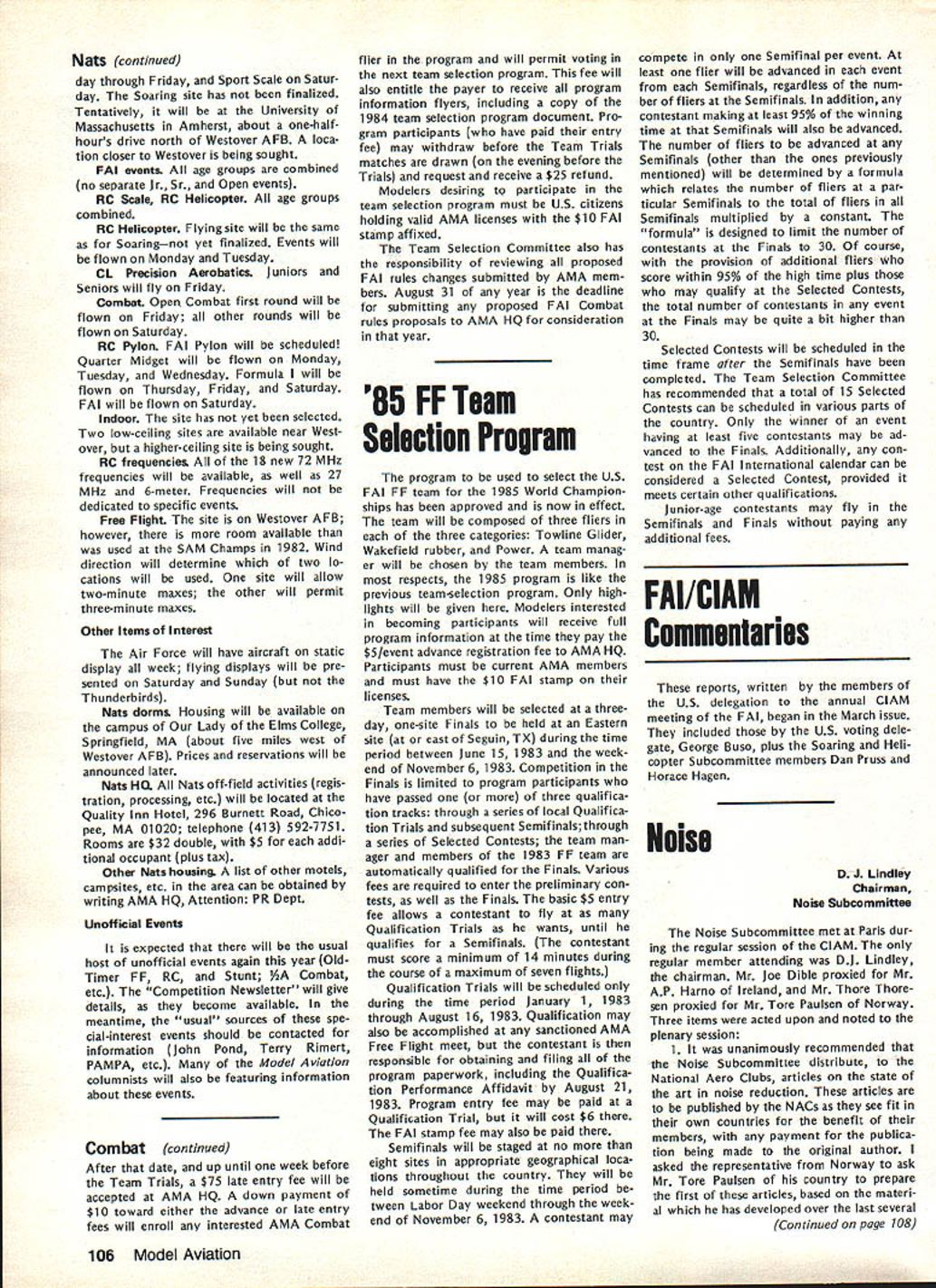
- Soaring site: not yet finalized. Tentatively at the University of Massachusetts in Amherst (about 30 minutes north of Westover AFB). A closer location is being sought.
- FAI events: all age groups combined (no separate Jr., Sr., and Open events).
- RC Scale and RC Helicopter: all age groups combined.
- RC Helicopter: flying site will be the same as Soaring (not yet finalized). Events flown Monday and Tuesday.
- CL Precision Aerobatics: Juniors and Seniors fly on Friday.
- Combat: Open Combat first round on Friday; all other rounds on Saturday.
- RC Pylon:
- FAI Pylon flown Monday.
- Quarter Midget flown Monday, Tuesday, and Wednesday.
- Formula I flown Thursday, Friday, and Saturday.
- FAI Pylon flown Saturday.
- Indoor: site not yet selected. Two low-ceiling sites are available near Westover, but a higher-ceiling site is being sought.
- RC frequencies: all 18 new 72 MHz frequencies will be available, as well as 27 MHz and 6-meter. Frequencies will not be dedicated to specific events.
- Free Flight: site is on Westover AFB; more room is available than used at the 1982 SAM Champs. Wind direction will determine which of two locations is used; one site will allow two-minute maxes, the other three-minute maxes.
Other Items of Interest
- The Air Force will have aircraft on static display all week; flying displays will be presented on Saturday and Sunday (but not the Thunderbirds).
- Nats dorms: housing will be available on the campus of Our Lady of the Elms College, Springfield, MA (about five miles west of Westover AFB). Prices and reservations to be announced later.
- Nats HQ: all off-field activities (registration, processing, etc.) will be located at the Quality Inn Hotel, 296 Burnett Road, Chicopee, MA 01020; telephone (413) 592-7751. Rooms: $32 double, with $5 for each additional occupant (plus tax).
- Other Nats housing: list of motels, campsites, etc. in the area available by writing AMA HQ, Attention: PR Dept.
Unofficial Events
It is expected that the usual host of unofficial events will appear again (Old-Timer FF, RC, and Stunt; X-2 Combat, etc.). The Competition Newsletter will give details as they become available. In the meantime, contact the usual sources of special-interest events (John Pond, Terry Rimert, PAMPA, etc.). Many Model Aviation columnists will also feature information about these events.
Combat (continued)
- After the advance-entry deadline, a $75 late entry fee will be accepted at AMA HQ up until one week before the Team Trials.
- A $10 down payment enrolls a participant, permits voting in team selection, and entitles the payer to all program flyers.
- Program participants may withdraw before the matches are drawn and request a $25 refund.
- Participants must be U.S. citizens with valid AMA licenses and the $10 FAI stamp.
- The Team Selection Committee reviews proposed FAI rules changes submitted by AMA members; deadline for submission is August 31.
Noise (continued)
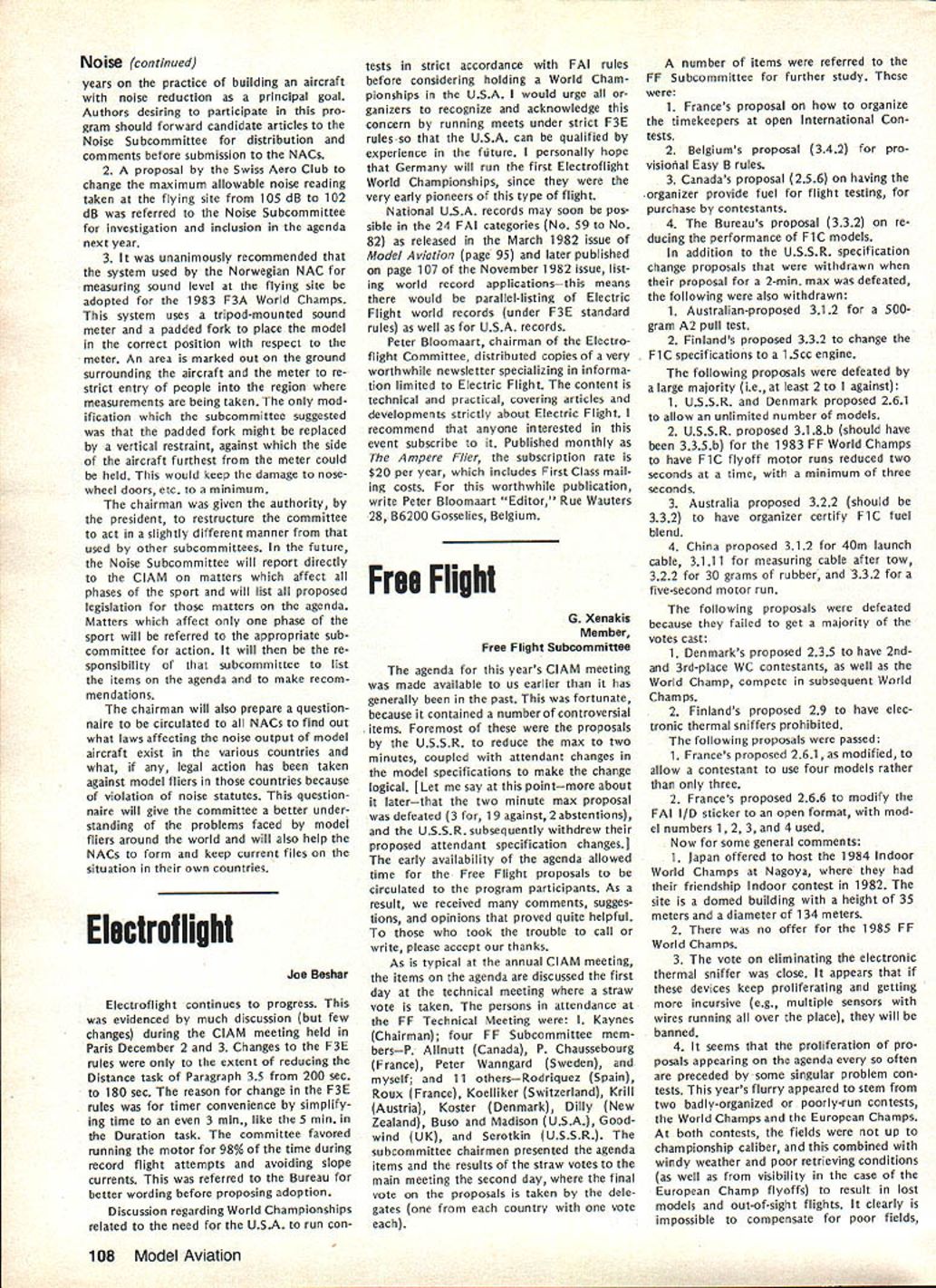
- Authors desiring to contribute articles on noise reduction should forward candidate articles to the Noise Subcommittee for distribution and comment before submission to the NACs.
- A Swiss Aero Club proposal to change the maximum allowable noise measured at the flying site from 105 dB to 102 dB was referred to the Noise Subcommittee for investigation.
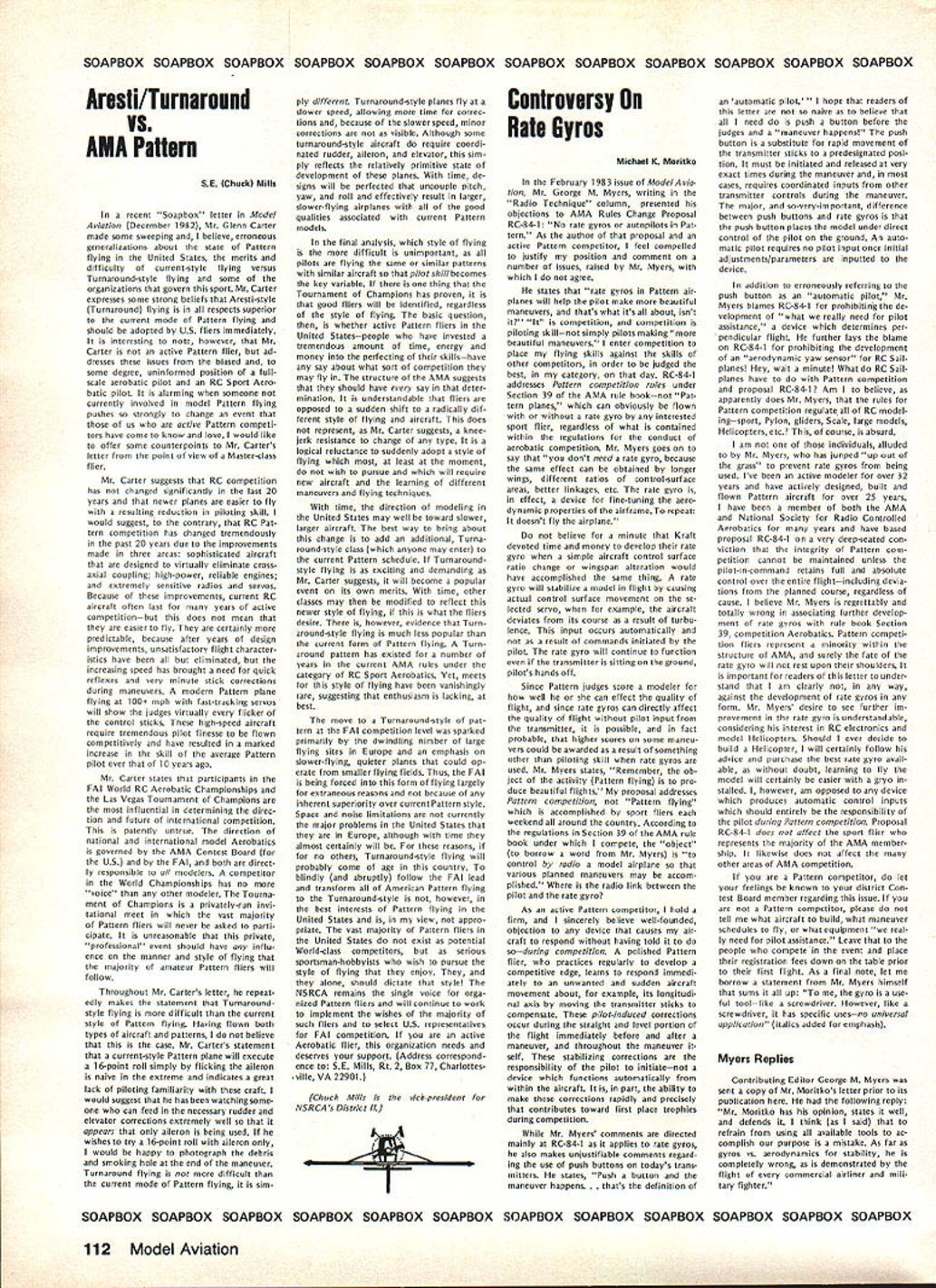
- The subcommittee recommended adopting the Norwegian NAC system for measuring sound level at flying sites for the 1983 F3A World Championships. The system uses a tripod-mounted sound meter and a padded fork to place the model in the correct position relative to the meter, with a marked area to restrict entry while measurements are taken. The subcommittee suggested replacing the padded fork with a vertical restraint to minimize damage to nose-wheel doors.
- The committee chairman was authorized to restructure the Noise Subcommittee to report directly to CIAM on matters affecting all phases of the sport; matters affecting a single phase will be referred to the appropriate subcommittee.
- The chairman will prepare a questionnaire for all NACs to determine national laws affecting model aircraft noise and any legal actions taken against model fliers for noise violations. This will help the committee and NACs keep current files on national situations.
Electroflight
Electroflight progress was evident at the CIAM meeting in Paris (December 2–3). Changes to F3E rules were minor: reducing the Distance task timing in Paragraph 3.5 from 200 sec to 180 sec for timing convenience and to ease the 3-min timing like the 5-min Duration task. The committee favored running the motor for 98% of the time during record flight attempts and avoiding slope attempts; wording was referred to the Bureau.
Discussion of World Championships emphasized that the U.S. should run contests strictly under FAI rules before hosting an Electroflight World Championship. Organizers are urged to run meets under strict F3E rules to build appropriate experience. Germany was suggested as a likely host for the first Electroflight World Championships.
National U.S. records may soon be possible in the 24 FAI categories (No. 59 to No. 82). Peter Bloomaart, chairman of the Electroflight Committee, distributes a newsletter specializing in Electric Flight, The Ampere Flier, published monthly. Subscription: $20/year (First Class mailing). Write: Peter Bloomaart, "Editor," Rue Wauters 28, B6200 Gosselies, Belgium.
Free Flight
G. Xenakis, Member, Free Flight Subcommittee
The CIAM agenda was made available earlier than usual, which helped address several controversial items, notably the U.S.S.R. proposal to reduce the max to two minutes (defeated: 3 for, 19 against, 2 abstentions). The early agenda allowed Free Flight proposals to be circulated to program participants and resulted in many helpful comments.
Attendees at the FF Technical Meeting included the subcommittee chairman J. Kaynes; subcommittee members P. Alfinutt (Canada), P. Chaussebourg (France), Peter Wannagard (Sweden), and G. Xenakis; plus representatives from Spain, France, Switzerland, Austria, Denmark, New Zealand, the U.S.A., the U.K., and the U.S.S.R.
Items referred to the FF Subcommittee for further study:
- France's proposal on organizing timekeepers at open International Contests.
- Belgium's proposal (3.4.2) for provisional Easy B rules.
- Canada's proposal (2.5.6) on organizers providing fuel for flight testing, for purchase by contestants.
- The Bureau's proposal (3.3.2) on reducing F1C model performance.
Withdrawn proposals (in addition to the U.S.S.R. specification changes tied to the 2-minute max):
- Australia: proposed 3.1.2 for a 500-gram A2 pull test.
- Finland: proposed 3.3.2 to change F1C specifications to a 1.5cc engine.
Defeated proposals (large majority against):
- U.S.S.R. and Denmark: proposed 2.6.1 to allow unlimited number of models.
- U.S.S.R.: proposed 3.1.8b (should have been 3.3.5.b) for 1983 FF World Champs to reduce F1C flyoff motor runs in two-second steps to a minimum of three seconds.
- Australia: proposed 3.2.2 (should be 3.3.2) to have organizer certify F1C fuel blend.
- China: proposals for launch cable, tow-measuring, rubber weight, and five-second motor run changes.
Defeated due to lack of majority:
- Denmark: proposed 2.3.5 to require 2nd- and 3rd-place WC contestants to compete in subsequent World Champs.
- Finland: proposed 2.9 to prohibit electronic thermal sniffers.
Passed proposals:
- France: proposed 2.6.1 (modified) to allow a contestant to use four models rather than only three.
- France: proposed 2.6.6 to modify the FAI I/D sticker to an open format with model numbers 1–4.
Other notes and general comments:
- Japan offered to host the 1984 Indoor World Champs at Nagoya (a domed building, height 35 m, diameter 134 m).
- No offer was made for the 1985 FF World Champs.
- The vote on eliminating electronic thermal sniffers was close; proliferation and intrusiveness of these devices may lead to a ban in future.
- Many proposals arise from isolated problems at specific contests; better contest organization is often the real remedy.
- Consensus: F1A and F1B are well balanced; F1C has too much performance potential and may need reduction, but a sensible non-destructive solution has not been agreed upon.
- The FF Subcommittee encourages organizers to improve fields and retrieval procedures.
Control Line
Laird Jackson, Chairman, CL Subcommittee
At the CIAM Plenary Meeting in Paris, the Control Line Subcommittee reviewed proposals and made recommendations. A major proposal considered was reducing engine displacement in all CL categories (except Stunt) to 1.5cc to reduce available power and overall performance potential.
Rationale for 1.5cc proposal:
- Reduction of displacement is a single, inescapable change that reduces performance potential across categories.
- Competitors and manufacturers could adapt; recent tests show 1.5cc engines in F2C Team Race can return to competition levels achieved about four years prior with relatively modest engine modifications.
- The goal is to reduce extreme performance, improve safety, lower noise, and slow contest pace to manageable limits. A plan to require 1.5cc engines by 1986 was discussed.
Other rule proposals and outcomes:
- Several general-rule proposals had little effect on CL (e.g., Giant Scale maximum weight, number of models for Free Flight).
- French wording change treating World and Continental Championships the same for some official roles was approved.
- Danish proposal to require 2nd- and 3rd-place winners to return to defend was not passed.
- Canadian proposal to have the organizer provide all practice fuel was defeated.
- Finland's suggestion to require the Stunt circle to be level within 1% was approved for the organizers' guide.
- French proposal to make the Assistant Team Manager in Control Line an official team member was accepted; the Assistant Team Manager may deliver protests but not discuss them—the Team Manager handles discussion with organizers or the Jury.
- Sweden's suggestion to require hand-starting in Stunt was accepted.
- Proposal to stop carrying the qualifying score in Stunt over to the final score was defeated; it may pass if presented again with clearer wording.
- In Team Race, fuel tank size was reduced for the kilometer event to affect pit stops and passing.
General conclusions:
- Performance in several events (Free Flight Power, Control Line speed, Team Race, Combat) has reached high levels; action is needed to reduce performance potentials to manageable and safe limits.
- Interim safety procedures and a plan for a displacement reduction were considered necessary.
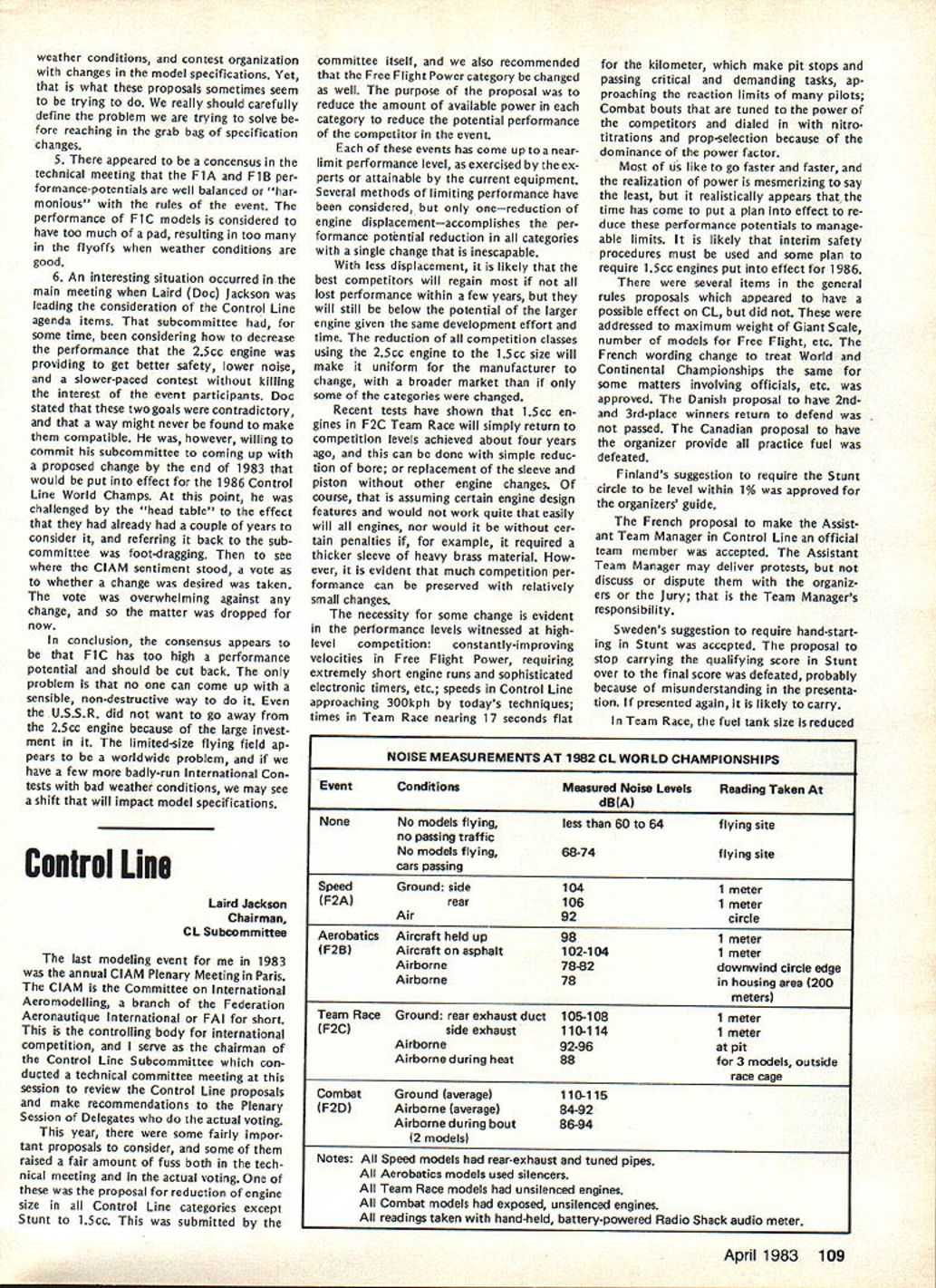
Noise Measurements at 1982 CL World Championships
Measurements taken at the 1982 World Control Line Championships (Oxelosund, Sweden). Readings were taken with a battery-powered Tandy/Radio Shack audio meter calibrated in dB(A). All engine noise measurements were taken at 1 meter during warmup or ground running unless otherwise noted. Values represent ranges recorded from at least 10 aircraft of each type; instrument accuracy ±3 dB.
- Event: None
- Conditions: No models flying, no passing traffic
- Measured Noise Levels dB(A): less than 60 to 64
- Reading Taken At: flying site
- Event: None
- Conditions: No models flying, cars passing
- Measured Noise Levels dB(A): 68–74
- Reading Taken At: flying site
- Event: Speed (F2A)
- Conditions: Ground — side
- Measured Noise Levels dB(A): 104
- Reading Taken At: 1 meter
- Event: Speed (F2A)
- Conditions: Ground — rear
- Measured Noise Levels dB(A): 106
- Reading Taken At: 1 meter
- Event: Speed (F2A)
- Conditions: Air
- Measured Noise Levels dB(A): 92
- Reading Taken At: circle
- Event: Aerobatics (F2B)
- Conditions: Aircraft held up
- Measured Noise Levels dB(A): 98
- Reading Taken At: 1 meter
- Event: Aerobatics (F2B)
- Conditions: Aircraft on asphalt
- Measured Noise Levels dB(A): 102–104
- Reading Taken At: 1 meter
- Event: Aerobatics (F2B)
- Conditions: Airborne
- Measured Noise Levels dB(A): 78–82
- Reading Taken At: downwind circle edge
- Event: Aerobatics (F2B)
- Conditions: Airborne
- Measured Noise Levels dB(A): 78
- Reading Taken At: in housing area (200 meters)
- Event: Team Race (F2C)
- Conditions: Ground — rear exhaust duct
- Measured Noise Levels dB(A): 105–108
- Reading Taken At: 1 meter
- Event: Team Race (F2C)
- Conditions: Ground — side exhaust
- Measured Noise Levels dB(A): 110–114
- Reading Taken At: 1 meter
- Event: Team Race (F2C)
- Conditions: Airborne
- Measured Noise Levels dB(A): 92–96
- Reading Taken At: at pit
- Event: Team Race (F2C)
- Conditions: Airborne during heat (3 models)
- Measured Noise Levels dB(A): 88
- Reading Taken At: outside race cage
- Event: Combat (F2D)
- Conditions: Ground (average)
- Measured Noise Levels dB(A): 110–115
- Reading Taken At: 1 meter
- Event: Combat (F2D)
- Conditions: Airborne (average)
- Measured Noise Levels dB(A): 84–92
- Reading Taken At: 1 meter
- Event: Combat (F2D)
- Conditions: Airborne during bout (2 models)
- Measured Noise Levels dB(A): 86–94
- Reading Taken At: 1 meter
Notes:
- All Speed models had rear-exhaust and tuned pipes.
- All Aerobatics models used silencers.
- All Team Race models had unsilenced engines.
- All Combat models had exposed, unsilenced engines.
- All readings taken with a hand-held, battery-powered Radio Shack audio meter.
The survey suggests current competition practices do not produce sound levels significantly in excess of background noise at distances of 250–500 meters or greater, but the duration and character of the sound make it frequently perceived as annoying by local residents.
DON'T FLY CL MODELS NEAR POWER LINES
Competition Newsletter — Control Line Safety and Rules
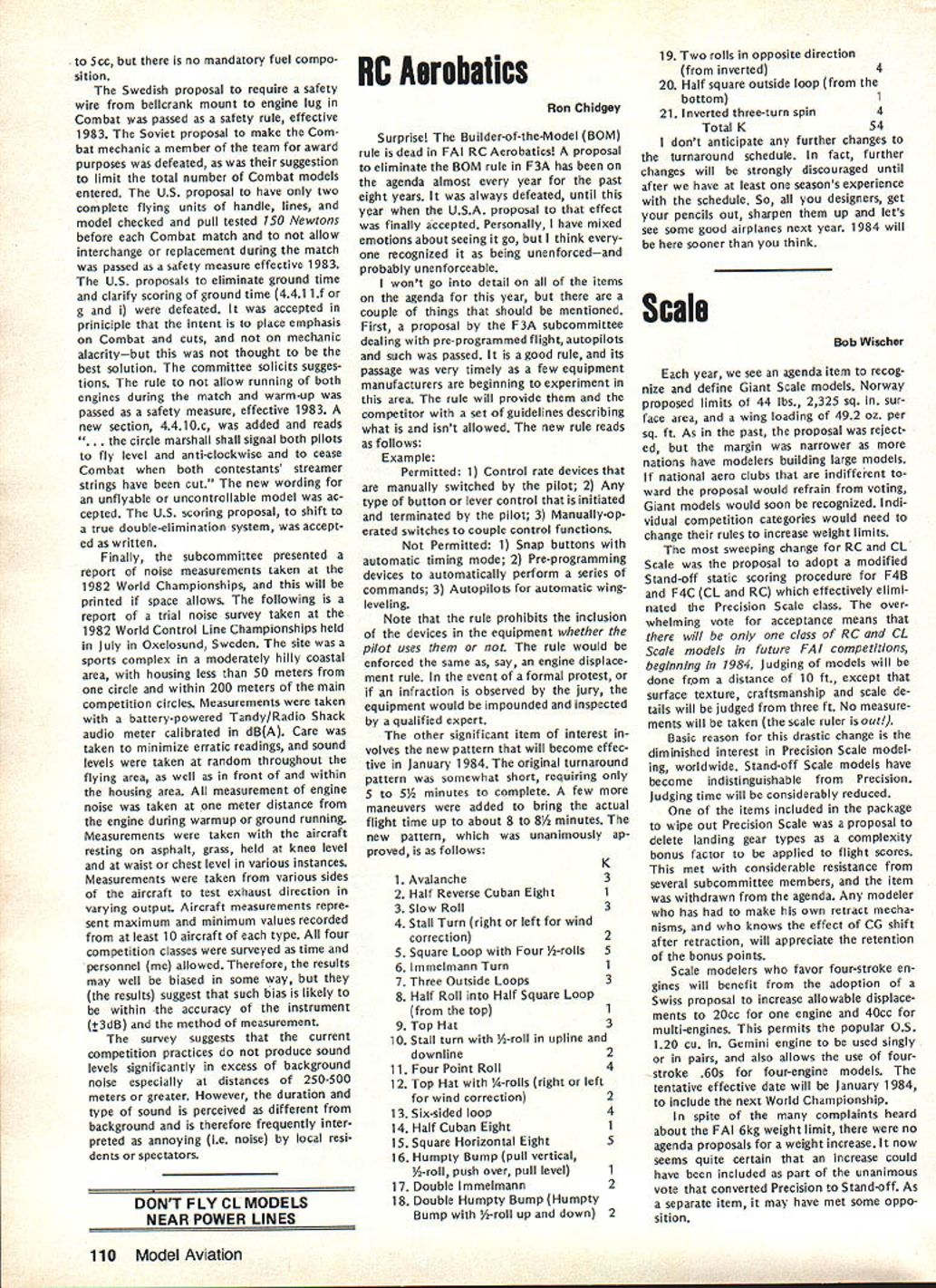
- The Swedish proposal to require a safety wire from bellcrank mount to engine lug in Combat was passed as a safety rule, effective 1983.
- The Soviet proposal to make the Combat mechanic a member of the team for award purposes was defeated, as was their suggestion to limit the total number of Combat models entered.
- The U.S. proposal to require only two complete flying units (handle, lines, and model) to be checked and pull-tested to 150 Newtons before each Combat match, with no interchange or replacement during the match, was passed as a safety measure effective 1983.
- The U.S. proposals to eliminate ground time and to clarify scoring of ground time were defeated. It was accepted in principle that emphasis should be on Combat and cuts rather than mechanical alacrity; the committee solicits suggestions.
- A rule not allowing both engines to be run during the match and warm-up was passed as a safety measure, effective 1983.
- A new section (4.4.10.c) was added: "The circle marshall shall signal both pilots to fly level and anti-clockwise and to cease Combat when both contestants' streamer strings have been cut."
- New wording for handling unflyable or uncontrollable models was accepted.
- The U.S. scoring proposal to shift to a true double-elimination system was accepted as written.
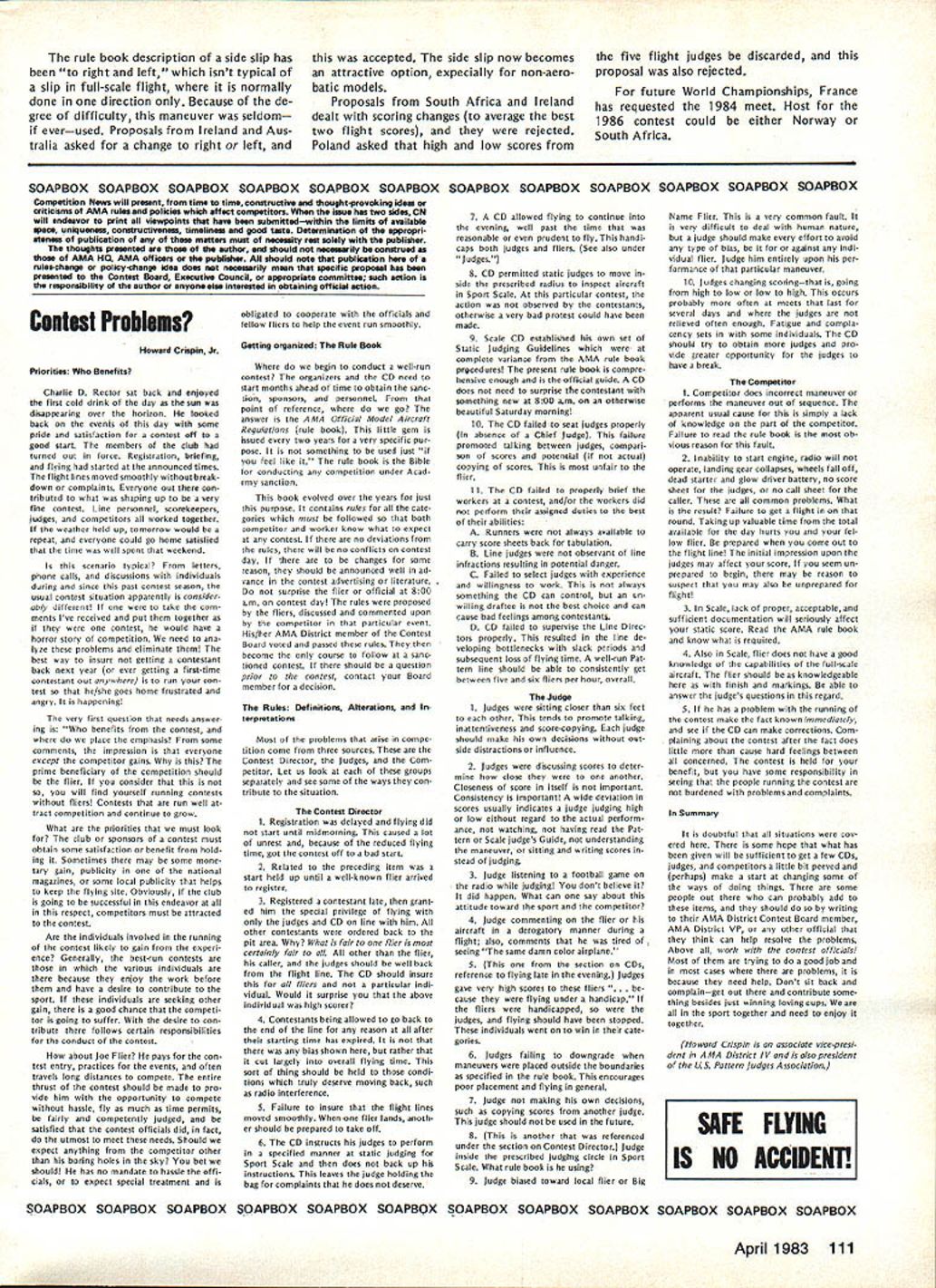
Contest Problems? — Howard Crispin, Jr.
Priorities: Who Benefits?
Charlie D. Recot sat back with the first cold drink of the day as the sun disappeared over the horizon, satisfied with a contest that had gone well: club turnout, timely registration and briefings, smooth flight lines, competent judges and line personnel. But many contests do not run so well. From letters, phone calls, and discussions, the typical contest scene often includes disorganization, unfair treatment of contestants, and loss of future entrants.
The prime beneficiary of a contest should be the flier. Well-run contests attract competitors and continue to grow. Clubs and sponsors may gain publicity or financial benefit, but without competitors, contests cannot succeed.
Where to begin: The Rule Book
- Organizers and the Contest Director (CD) should start months in advance to obtain sanction, sponsors, and personnel.
- The AMA Official Model Aircraft Regulations (rule book) is the reference for conducting sanctioned contests. Deviations must be announced in contest advertising; do not surprise competitors on contest day.
- If questions arise prior to contest day, contact your AMA District Contest Board member for decisions.
Problems source: Contest Director, Judges, Competitors
The Contest Director
- Delayed registration and late start, reducing flying time and causing unrest.
- Holding start until a well-known flier arrives; unfair favoritism.
- Granting late entrants special privileges (e.g., flying with judges and CD on line); all contestants should be treated equally.
- Allowing contestants to rejoin the line after start time without valid reason; this cuts into overall flying time.
- Failing to ensure flight lines move smoothly—landings should be followed by ready-to-go takeoffs.
- Instructing judges to perform in a specified manner at static judging, then not backing them up.
- Allowing flying to continue too late in the evening, handicapping judges and fliers.
- Permitting static judges to move inside prescribed radii during Sport Scale inspections.
- Establishing local judging guidelines that conflict with the AMA rule book.
- Failing to seat judges properly, encouraging talking and score comparison.
- Failing to brief workers properly or workers not performing assigned duties.
- Not providing runners to carry score sheets for tabulation.
- Line judges not observant of infractions creating potential danger.
- Selecting inexperienced or unwilling judges.
- Failing to supervise Line Directors, causing bottlenecks and loss of flying time. A well-run Pattern time should average five to six flight runs per hour per flight line in most conditions.
The Judge
- Sitting closer than six feet to each other, encouraging talking and score copying.
- Discussing scores during judging to align scores—consistency, not closeness, matters.
- Inappropriate distractions (e.g., listening to a radio game) while judging.
- Making derogatory comments about fliers or aircraft during flights.
- Fatigue causing poor judgment late in the evening.
- Failing to downgrade maneuvers placed outside prescribed boundaries.
- Copying scores from other judges instead of making independent decisions.
The Competitor
- Performing incorrect maneuvers or out-of-sequence due to not reading the rule book.
- Equipment or preparation failures (engine, radio, gear, starter, batteries, missing score or call sheets) that waste flight time—be prepared.
- In Scale, inadequate documentation seriously affects static score—know AMA requirements.
- Lack of knowledge of aircraft capabilities affects flying and answers to judges.
- If you have problems with contest running, raise them immediately with the CD—complaining after the fact causes hard feelings.
In Summary
- Many problems are correctable with better preparation and cooperation between CDs, judges, and competitors.
- If you see shortcomings, write to your AMA District Contest Board member, AMA District VP, or other officials who can help.
- Above all, work with contest officials—most are trying to do a good job. Don’t just complain; contribute to make the sport better. We are all in this together.
ACADEMY OF MODEL AERONAUTICS — Final Notices
1983 SAM Champs — La Junta, CO
(Repeated notice)
- SAM will host the 1983 SAM Championships July 19–21, 1983 at La Junta, CO. Practice flying available July 17–18.
- For information contact Jim Thomas, 1050 Clarkson, Denver, CO 80218.
1983 RC Aerobatics Team / Masters Tournament Qualifiers
(Repeated summary)
- Finals qualifiers listed above; Masters Tournament dates and site selection process reiterated. Advance planning and bids were submitted to AMA HQ.
Transcribed from original scans by AI. Minor OCR errors may remain.

