
COMPETITION NEWSLETTER
RC Aerobatics World Champs
The AMA, in association with the Northwest Florida RC Modelers, will host the 1983 RC Aerobatics World Championships from Monday, October 10, 1983 through Saturday, October 15, 1983 at Bronson Field, Pensacola, FL. The flying site is a relatively inactive U.S. Navy airfield having a 4,000-ft runway. It is at an elevation of 17 m (50 ft) above sea level and is about a 15-minute drive from the center of Pensacola.
New RC Channels Official
The RC frequency listing appearing on page 43 of the 1982–83 AMA rule book is now outdated. The new, official version conforms to the chart published in the center fold (pp. 82–83) of the February issue of Model Aviation.
Effective immediately, only these RC channels (plus the 6-meter, Ham-license-required frequencies) will be accepted for use in AMA-sanctioned events.
RC, CL Scale Team Selection Program
The selection of the U.S. Control Line and Radio Control Scale teams for the 1984 World Championships will be accomplished this summer at a special team selection event in Louisville, KY. Unlike other team selection programs, Scale has, during its lifetime, utilized the AMA Nats as its selection vehicle. Within the past year, a movement started by the National Association of Scale Aeromodellers (NASA) has separated this important selection process from the Nats. A survey of NASA members, Nats entrants, and former team members indicated an overwhelming preference for using a separate event to select the team.
The weekend of August 12–14, 1983 is the date chosen for selecting the 1984 teams. (Some adjustments had to be made to earlier plans due to the fact that the Nats will be held a week sooner than is typical.)
The site is the excellent area at E.P. "Tom" Sawyer State Park in Louisville, KY. The facilities consist of a large arena/auditorium which can be used for the static judging, which will occur on Friday, August 12, 1983 beginning at 9:00 a.m. The flying areas to be used include an excellent RC field with a paved asphalt runway and beautiful grassy areas. The Control Line site will be directly in front of the arena on an asphalt parking lot. Bleachers for spectators will be provided at both areas.
Overnight camping at the site is available; however, there are no water or electric hookups. Showers, a swimming pool, and recreation facilities are available in the park building. A headquarters motel will be announced at a later date.
Registration for the event must be accomplished two weeks prior to the starting date (that is, by July 29, 1983). Forms may be obtained by contacting Micheline Madison at AMA Headquarters.
Competitors must have a current AMA license with a $10 FAI competition stamp affixed. The entry fee has been designated as $50, which will be divided equally between event expenses and the 1984 FAI Scale Team Fund. All models must meet the FAI specifications which will be in effect for 1984. All pertinent FAI rules and regulations can be determined by reading the FAI section of your AMA rule book and by obtaining the current update from Micheline Madison at AMA Headquarters. (Note: The current amendment to the rules appears elsewhere in this edition of the Competition Newsletter.)
Some recent changes in FAI competition rules which will affect this event include the fact that Precision Scale (F4C) has ceased to exist as previously defined; that is, models will no longer be measured for scale accuracy in the old way. All judging will be done from a distance of three meters for the following categories:
- Scale accuracy K Factor
- Side view 10
- End view 10
- Plan view 10
- Color 6
- Markings 6
The following categories will be judged from a distance of one meter:
- Surface texture 6
- Craftsmanship 10
- Scale detail 7
Total 65
It is significant to note that engine size requirements have been increased—if you are using four-cycle engines (for example, single-engined models may use a 1.2 ci four-cycle). For exact information, contact AMA Headquarters as soon as possible.
The team selection event is being conducted by NASA under authority granted by the AMA. Local support will be provided by the Southern Indiana RC Modelers. Judges and officials are being arranged for by NASA and the Co-CDs, Monty Groves (California) and Dale Arvin (Indiana). Judges are being selected on the basis of past FAI and Nats experience as well as geographic background.
Interest to date concerning the event has been most encouraging. Many persons never before involved in the team selection process have indicated that they intend to participate. Additional information can be obtained from:
- Monty Groves, 791 Nisqually Dr., Sunnyvale, CA 94087
- Dale Arvin, 3428 Charlestown Pike, Jeffersonville, IN 47130
- AMA Headquarters, 1810 Samuel Morse Dr., Reston, VA 22090, Attn: Micheline Madison
- NASA, John Preston, 7012 Elvira Ct., Falls Church, VA 22042
'83 Nats News
#### Nats Week July 24–31
##### Indoor FF Site
The search is on. At present, negotiations are underway to obtain one of two different indoor sites for the Nats. Each site has an 80-ft ceiling. Another site is also available, provided that the ceiling lights can be raised out of the way.
##### Unofficial Events
The Garden State Circle Burners of New Jersey will sponsor and run the Old-Time Stunt event at the 1983 Nats. The CD will be John Miske. He advises that there will be two classes of competition, Ignition and Glow, and that there will be awards through 5th place in Glow and through 3rd place in Ignition. Two special awards will be made: in Ignition, there will be a "Spirit of Spark" award for the entry that best exemplifies the essence of Old-Time Stunt; the Glow event's "Spirit of '52" award will be similar.
Late news: O-T FF on Friday; RC-assist O-T on Saturday at East Long Meadow, CT. More details later.
##### Things & Stuff
There will be more to the Nats this year than ever before. The first really new activity will be the National Static Show. You don't have to be a Nats entrant to enter this one! It will be a contestants-vote-the-winner event. There will be several categories of models, with a trophy awarded in each category (details on categories will be published later). To enter, bring your model and a $2 entry fee to the Nats HQ at the Quality Inn Hotel in Chicopee, MA on Friday evening or Saturday morning (July 29 or 30) — you may enter more than one category.
There will be a Swap Shop operating on Saturday and Sunday (July 30–31), as well as industry displays and modeling seminars. There will be a MECA Collectogether on Sunday.
Bring the family — there's something for everyone.
Nats RC, CL Scale Rules
A new event has been added to the '83 Nats schedule: CL FAI Scale. This will be flown without age groupings (as will all other Nats FAI events).
The RC Precision Scale event (which uses FAI rules) and the CL FAI Scale event will use the newest FAI rules, including the amendments from the last (December 1982) CIAM meeting. The new rules amendments are not effective for International or World Championship competitions until January 1, 1984; however, the Nats Executive Committee has decided to use them in this year's Nats. Modelers should note that, with the exception of the engine displacement increases for RC, nothing affecting the models has been changed. Only items affecting the judging, and (to a certain degree) the flight Scale Options, have been amended. The main change is in the procedures to be used in static judging: a scale ruler is no longer used; models are first judged from a distance of three meters for scale accuracy, color, and markings; then at a distance of one meter for surface texture, craftsmanship, and scale detail.
The New FAI RC and CL Scale Rules Amendments
As a service to interested modelers, the following is a complete list of the latest FAI Scale rules amendments. These are applicable to FAI classes F4B and F4C (CL and RC). For purposes of international competition, they become effective January 1, 1984.
- Static Judging Schedule
The current static judging schedules for F4B (CL Scale), F4C (RC Scale) and for Stand-Off Scale are all to be replaced by the following:
- 1. Scale Accuracy K Factor
- Side view 10
- End views 10
- Plan views 10
- 2. Color 6
- 3. Markings 6
- 4. Surface texture 6
- 5. Craftsmanship 10
- 6. Scale detail 7
Total (unchanged) 65
Items 1–3 to be judged first at a minimum distance of 3 m from the model. Items 4–6 to be judged afterwards at a minimum distance of 1 m.
(This means that the present F4C and International Stand-Off classes are now merged into one class.)
- Proof of Scale
The requirements under this heading have been simplified and now consist of the following:
a) An accurate 3-view scale drawing or color drawing of the full-size aeroplane having a minimum scale of 1/72, or a minimum span of 150 mm, and a maximum scale of 1/24. A selection of photographs can replace the 3-view drawing for early aircraft for which no drawings may exist.
b) Color drawings from authentic sources, e.g., "Profile" publications (including 3-views) are acceptable for proof of color and markings. An authenticated written or printed description is also acceptable. Homemade drawings by the contestant or other draftsman are not acceptable unless they are certified as accurate in advance by an authoritative source, such as the National Scale Committee, builder of original aircraft, or other competent authority. Proof of the cruising speed must be given.
c) At least three photos or printed reproductions of the full-scale aircraft, including at least one of the actual subject aircraft being modeled.
d) The competitor should supply a declaration listing all components he did not make himself, and should sign a declaration that he is the builder of the model.
(Note: A scale ruler is no longer required.)
- Multi-Motors
This can no longer be nominated as a flight option (6.3.8.a) but is still eligible for complexity flight bonus.
- Motive Power for RC Scale Models
The maximum permissible power is now as follows:
a) Piston motor:
- 2-stroke single engine 10 cc
- Two engines 15 cc
- Three or more 20 cc
- 4-stroke single engine 20 cc
- Two or more 40 cc
b) Jet reaction motors: Neither jet nor rocket motor may be used.
- Models Equipped with Ducted Fan Engines
Under para 6.1.6.c in the Sporting Code, the following should be added: Additional air entries are permitted, provided that they are covered by movable hatches for static judging; these hatches may be covered or opened prior to flight, or opened in flight by means of radio control. The appearance of the model in flight must not be affected.
(Note: this is also applicable to models equipped with piston engines.)
- CL Scale Flight Options
Not more than two drop options may be nominated.
Flap Option: If the full-size used flaps for takeoff, the model must also. For full marks to be awarded, a separate demonstration should be made during which flaps are lowered, and at least one lap must be completed before flaps are raised. The model should reduce speed before flaps are lowered during the demonstration, and a change of attitude of the model must be observed and further reduction of speed must also be observed.
- RC Scale Flight
- 6.3.7.2. Straight Flight. Model to make a straight flight upwind for approximately 10 seconds with the line of flight to pass over the landing circle. The figure starts approximately five seconds before reaching the landing circle.
- Side-slip. Instead of the present requirement to side-slip to left and right, the maneuver may be to left or right.
Judges' Guide for Scale Static Judging
Scale Accuracy
Firstly, have the model positioned in a pose similar to that in the best photograph and check for any obvious discrepancies; also assess the "character" and realism of the model. Repeat this procedure with other suitable photographs. Then, using photographs and drawings, check:
a) The side view, including the fuselage outline, cabin or canopy shape, cockpit aperture, engine cowling and spinner shape, outline of fin and rudder, wing and tailplane sections, wing stagger and struts on biplanes; shape, angle and position of undercarriage legs and tailwheel or skid; size of wheels and tires.
b) End views, for dihedral, wing thickness and taper; wing struts, bracing and gap on biplanes; thickness of fin, rudder and tailplane; cross sections of fuselage and engine cowling; cowling shape and cutouts; dummy propeller size and shape; shape of cockpit canopy or windshields; size, shape, position and angle of undercarriage; wheel track; tire thickness.
c) Plan views (above and below) for wing outline and fairings, aileron size, flaps; tailplane size and outline; elevator size, shape and cutouts, trim tabs; fuselage shape and taper; cockpit or canopy shape; engine cowling shape.
Note: Photographs must take precedence over drawings when there is any doubt concerning any item of scale accuracy.
6.1.10.2 Color
Correct color may be established from color photographs, from accepted published descriptions, from samples of original paint, or from accepted published color drawings. Also check colors of national markings, lettering and insignia. Camouflage color schemes should show the correct degree of merging of the shades.
6.1.10.3 Markings
Check the size and position of all markings and lettering. Check that the style and thickness of all letters and figures are correct. Check that any trim strips are of correct dimensions and are correctly positioned.
6.1.10.4 Surface Texture
The texture and appearance of the surface of the model should reflect that of the full-size aircraft. Fabric-covered types should be covered in the correct material, and the outline of stringers and wing ribs should be visible. Ply-covered or wooden monocoque types should be correctly simulated, and any gaps between ribs and formers should be apparent. Metal stressed-skin types should show simulation of panels and rivets.
In all instances, the appropriate gloss, eggshell or matte finish should be correctly reproduced.
6.1.10.5 Craftsmanship
Model should be checked for quality of workmanship, with particular reference to filling of grain; clean, sharp edges, especially trailing edges of wings and tail surfaces; correct gaps at hinge line of control surfaces; close fit where wings are attached to fuselage; and general finesse. Check for any components which have not been made by the contestant (see 6.1.9.4.d) and adjust the mark awarded accordingly. A complex subject should be awarded slightly higher marks than a simple subject.
6.1.10.6 Scale Detail
Check that items such as those listed below are present on the model where applicable, and that they are accurately reproduced and correctly positioned:
- Hatches
- Handles
- Footsteps
- Doors
- Armament
- Bomb racks
- Control cables
- Control horns
- Fairings
- Bracing
- Turnbuckles
- Struts
- Lacing or stitching
- Aerials
- Venturis
- Brake lines
- Undercarriage springing
- Tire treads
- Wing slots
- Navigation and landing lights
- Pitot head
- Walkways
- Tanks
- Radiators
- Filler caps
- Louvers
- Cooling gills
- Mass balances
- Instrument panel
- Cockpit or cabin interior detail
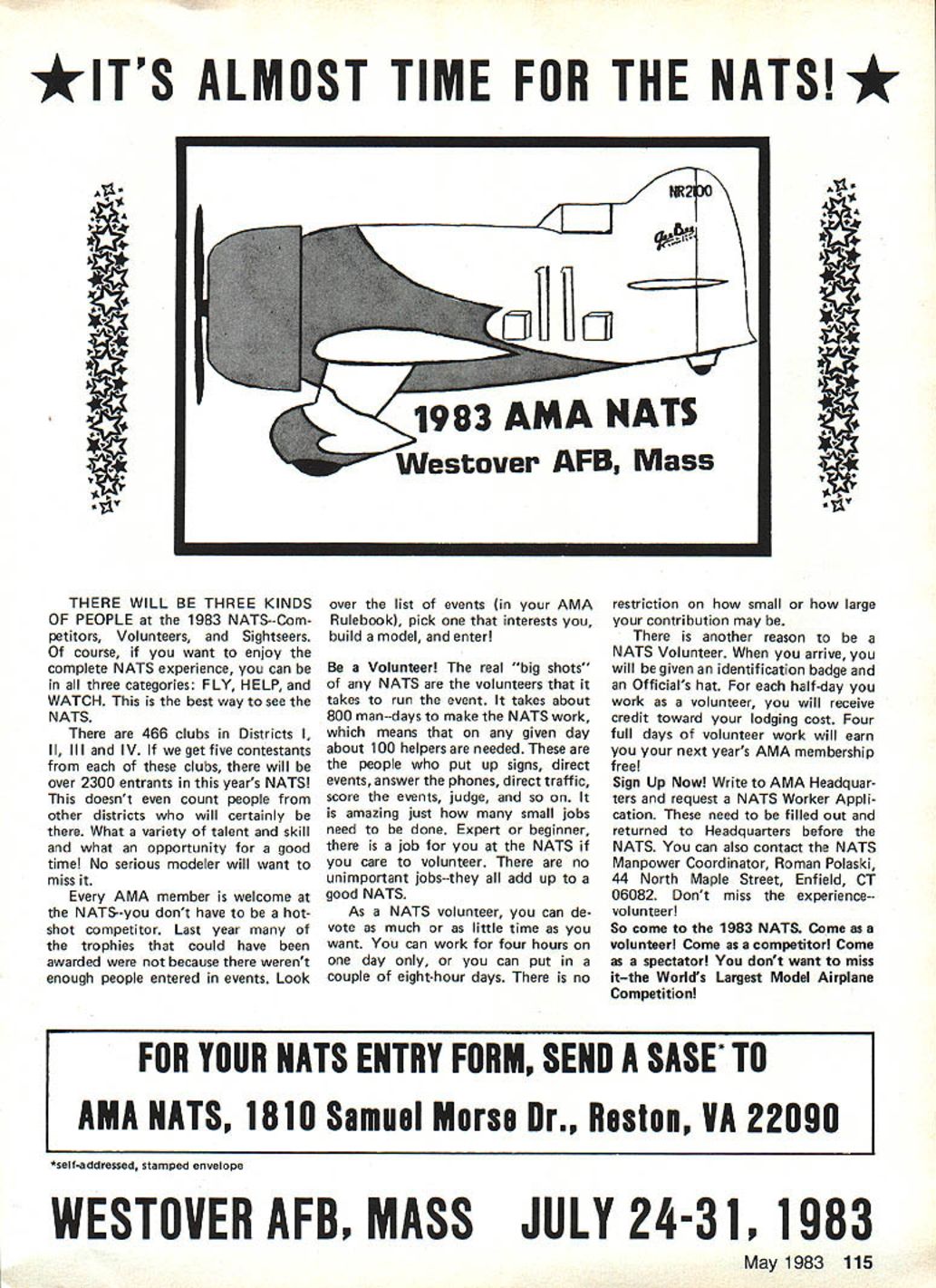
IT'S ALMOST TIME FOR THE NATS!
1983 AMA NATS
Westover AFB, Mass
There will be three kinds of people at the 1983 NATS—competitors, volunteers, and sightseers. Of course, if you want to enjoy the complete NATS experience, you can be in all three categories: FLY, HELP, and WATCH. This is the best way to see the NATS.
There are 466 clubs in Districts I, II, III and IV. If we get five contestants from each of these clubs, there will be over 2,300 entrants in this year's NATS! This doesn't even count people from other districts who will certainly be there. What a variety of talent and skill and what an opportunity for a good time! No serious modeler will want to miss it.
Every AMA member is welcome at the NATS—you don't have to be a hot-shot competitor. Last year many of the trophies that could have been awarded were not because there weren't enough people entered in events. Look over the list of events (in your AMA Rulebook), pick one that interests you, build a model, and enter!
Be a Volunteer! The real "big shots" of any NATS are the volunteers that it takes to run the event. It takes about 800 man-days to make the NATS work, which means that on any given day about 100 helpers are needed. These are the people who put up signs, direct events, answer the phones, direct traffic, score the events, judge, and so on. It is amazing just how many small jobs need to be done. Expert or beginner, there is a job for you at the NATS if you care to volunteer. There are no unimportant jobs—they all add up to a good NATS.
As a NATS volunteer, you can devote as much or as little time as you want. You can work for four hours on one day only, or you can put in a couple of eight-hour days. There is no restriction on how small or how large your contribution may be.
There is another reason to be a NATS volunteer. When you arrive, you will be given an identification badge and an Official's hat. For each half-day you work as a volunteer, you will receive credit toward your lodging cost. Four full days of volunteer work will earn you your next year's AMA membership free!
Sign Up Now! Write to AMA Headquarters and request a NATS Worker Application. These need to be filled out and returned to Headquarters before the NATS. You can also contact the NATS Manpower Coordinator, Roman Polaski, 44 North Maple Street, Enfield, CT 06082. Don't miss the experience—volunteer!
So come to the 1983 NATS. Come as a volunteer! Come as a competitor! Come as a spectator! You don't want to miss it—the World's Largest Model Airplane Competition!
For your NATS entry form, send a SASE* to:
AMA NATS, 1810 Samuel Morse Dr., Reston, VA 22090
*Self-addressed, stamped envelope
WESTOVER AFB, MASS — JULY 24–31, 1983
Transcribed from original scans by AI. Minor OCR errors may remain.

