
COMPETITION NEWSLETTER
First Sullivan Award Winner
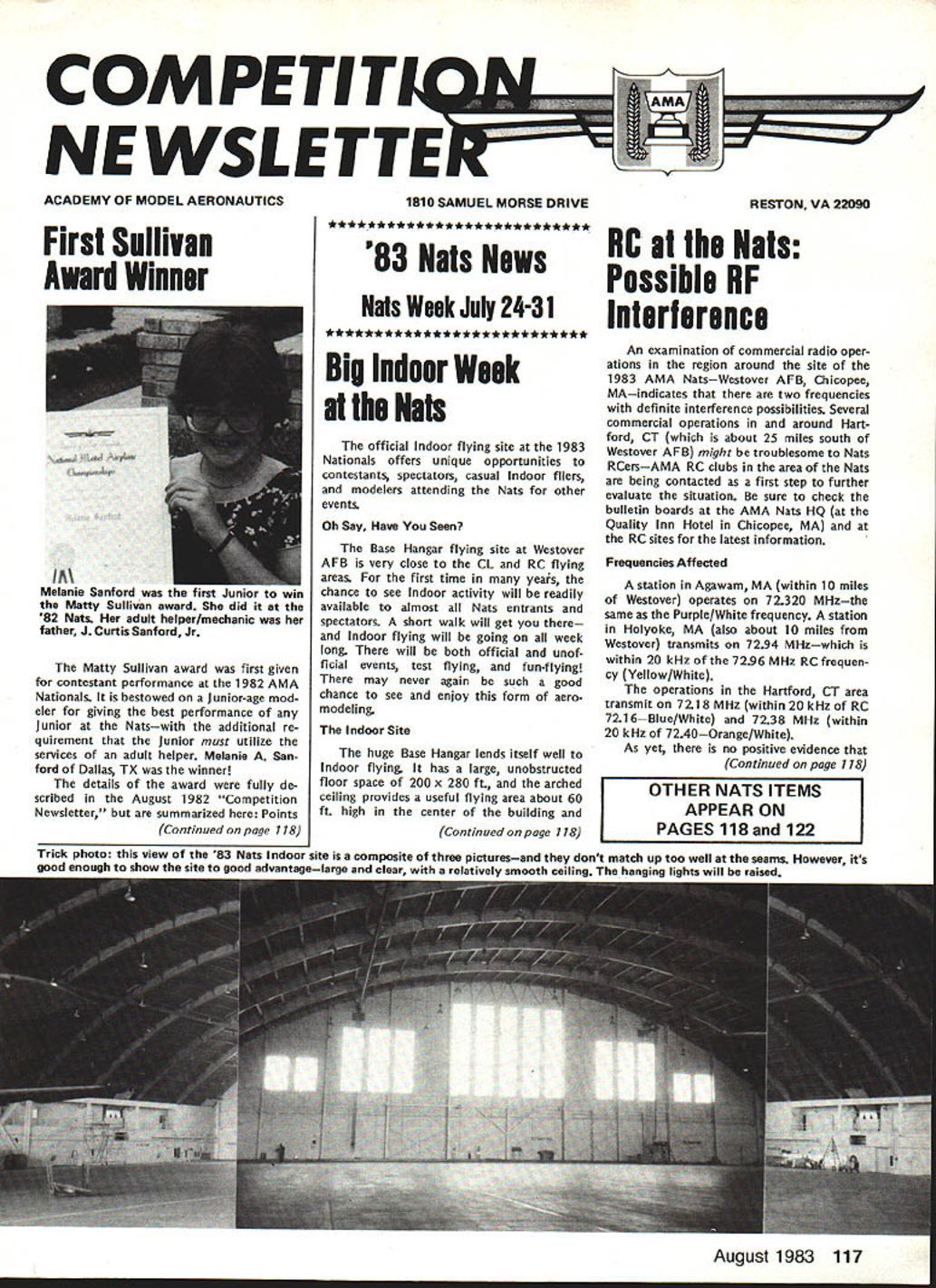
The Matty Sullivan Award was first given for contestant performance at the 1982 AMA Nationals. It is bestowed on a junior-age modeler for giving the best performance of any junior at the Nats — with the additional requirement that the junior must utilize the services of an adult helper. Melanie A. Sanford of Dallas, TX was the winner!
The details of the award were fully described in the August 1982 Competition Newsletter. In summary:
- Points are earned in any official Nats event which has a Junior category.
- The contestant must have the assistance of an adult helper or mechanic.
- Points earned in any event are based on the total number of Junior entrants in that event (placing last will still earn one point).
- There is no limit to the number of events which can be entered in the course of earning points.
- The contestant accumulating the most points wins.
'83 Nats News
- Nats Week: July 24–31
Big Indoor Week at the Nats
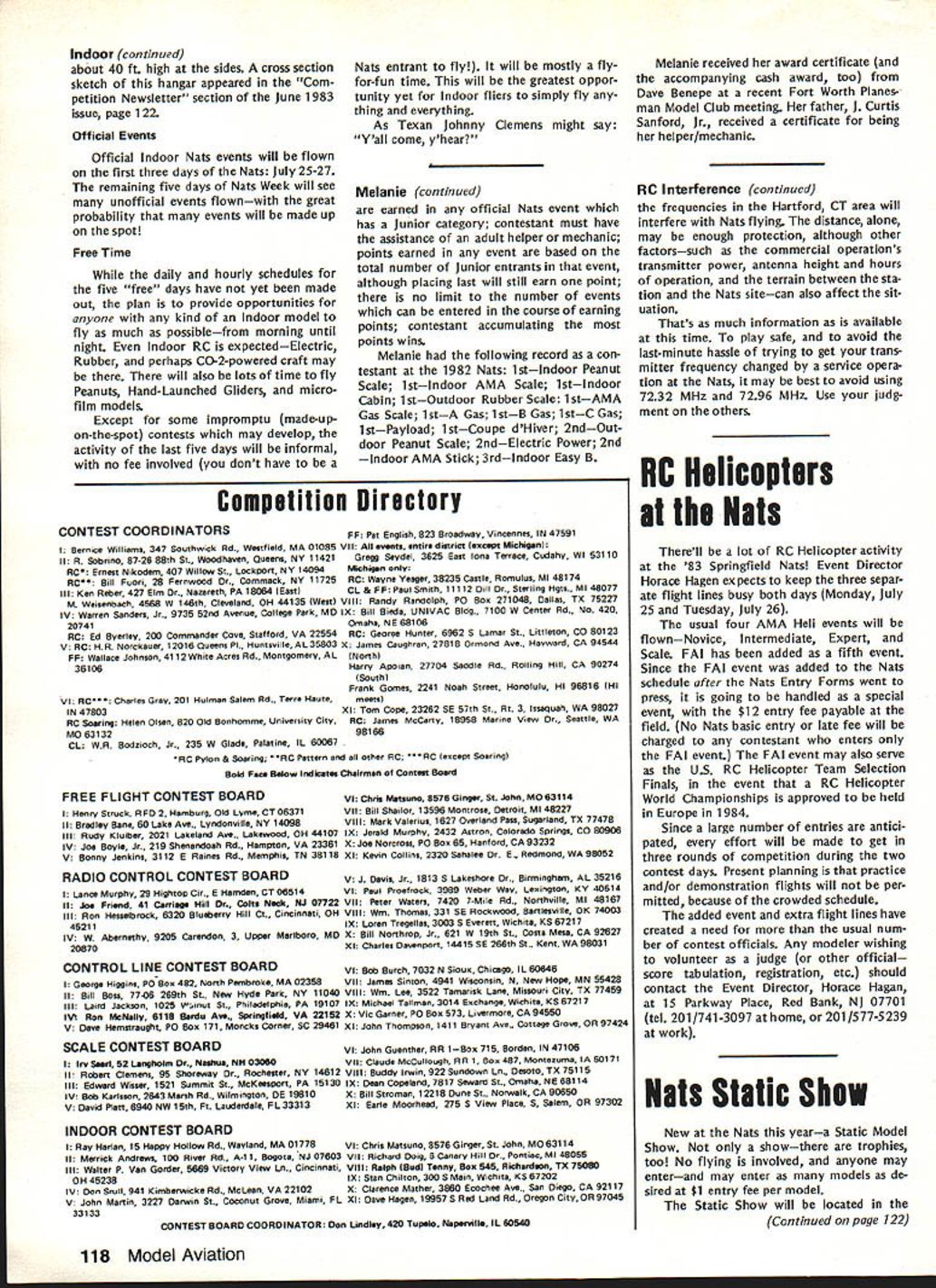
The official indoor flying site at the 1983 Nationals offers unique opportunities to contestants, spectators, casual indoor fliers, and modelers attending the Nats for other events.
#### Oh Say, Have You Seen? The Base Hangar flying site at Westover AFB is very close to the CL and RC flying areas. For the first time in many years, the chance to see indoor activity will be readily available to almost all Nats entrants and spectators. A short walk will get you there — indoor flying will be going on all week long. There will be both official and unofficial events, test flying, and fun-flying. There may never again be such a good chance to see and enjoy this form of aeromodeling.
#### The Indoor Site The huge Base Hangar lends itself well to indoor flying. It has a large, unobstructed floor space of 200 x 280 ft, and the arched ceiling provides a useful flying area about 60 ft high in the center of the building.
RC at the Nats: Possible RF Interference
An examination of commercial radio operations in the region around the site of the 1983 AMA Nats — Westover AFB, Chicopee, MA — indicates that there are two frequencies with definite interference possibilities. Several commercial operations in and around Hartford, CT (about 25 miles south of Westover AFB) might be troublesome to Nats RCers. AMA RC clubs in the area of the Nats are being contacted as a first step to further evaluate the situation. Be sure to check the bulletin boards at the AMA Nats HQ (at the Quality Inn Hotel in Chicopee, MA) and at the RC sites for the latest information.
Frequencies Affected
- A station in Agawam, MA (within 10 miles of Westover) operates on 72.320 MHz — the same as the Purple/White frequency.
- A station in Holyoke, MA (also about 10 miles from Westover) transmits on 72.94 MHz — which is within 20 kHz of the 72.96 MHz RC frequency (Yellow/White).
- Operations in the Hartford, CT area transmit on 72.18 MHz (within 20 kHz of RC 72.16 — Blue/White) and 72.38 MHz (within 20 kHz of 72.40 — Orange/White).
RC Interference (continued)
As yet, there is no positive evidence that the frequencies in the Hartford, CT area will interfere with Nats flying. Distance alone may provide sufficient protection, although other factors — such as the commercial operation's transmitter power, antenna height and hours of operation, and the terrain between the station and the Nats site — can also affect the situation.
To be safe, and to avoid the last-minute hassle of trying to get your transmitter frequency changed by a service operation at the Nats, it may be best to avoid using 72.32 MHz and 72.96 MHz. Use your judgment on the others.
Melanie (continued)
Melanie had the following record as a contestant at the 1982 Nats:
- 1st — Indoor Peanut Scale
- 1st — Indoor AMA Scale
- 1st — Indoor Cabin
- 1st — Outdoor Rubber Scale
- 1st — AMA Gas Scale
- 1st — A Gas
- 1st — B Gas
- 1st — C Gas
- 1st — Payload
- 1st — Coupe d'Hiver
- 2nd — Outdoor Peanut Scale
- 2nd — Electric Power
- 2nd — Indoor AMA Stick
- 3rd — Indoor Easy B
Melanie received her award certificate (and the accompanying cash award) from Dave Benepe at a recent Fort Worth Planesman Model Club meeting. Her father, J. Curtis Sanford, Jr., received a certificate for being her helper/mechanic.
RC Helicopters at the Nats
There will be a lot of RC helicopter activity at the '83 Springfield Nats! Event Director Horace Hagen expects to keep the three separate flight lines busy both days (Monday, July 25 and Tuesday, July 26).
The usual four AMA Heli events will be flown — Novice, Intermediate, Expert, and Scale. FAI has been added as a fifth event. Since the FAI event was added to the Nats schedule after the Nats entry forms went to press, it will be handled as a special event, with the $12 entry fee payable at the field. (No Nats basic entry or late fee will be charged to any contestant who enters only the FAI event.) The FAI event may also serve as the U.S. RC Helicopter Team Selection Finals, should a RC Helicopter World Championships be approved in Europe in 1984.
Because a large number of entries are anticipated, every effort will be made to get in three rounds of competition during the two contest days. Present planning is that practice and/or demonstration flights will not be permitted because of the crowded schedule. The added event and extra flight lines have created a need for more contest officials. Any modeler wishing to volunteer as a judge or other official (score tabulation, registration, etc.) should contact Event Director Horace Hagen at 15 Parkway Place, Red Bank, NJ 07701 (tel. 201/741-3097 at home, or 201/577-5239 at work).
Nats Static Show
New at the Nats this year — a Static Model Show. Not only a show — there are trophies, too! No flying is involved, and anyone may enter. Entrants may enter as many models as desired at $1 entry fee per model.
The Static Show location is not specified on this page; check Nats announcements and the convention schedule for details.
1983 NATS AND NATIONAL CONVENTION
IT'S ALMOST HERE — the 1983 NATS and National Convention. Interest is running at higher levels than we've ever seen; we expect more contestants, more spectators, and more good times than ever before.
Many people are excited about the new National Convention that will be held on Friday, Saturday, and Sunday of Nats Week. The National Convention combines traditional elements that modelers enjoy with some new ideas. It will round out the NATS experience and provide a feature of great interest to the sport flier.
The National Convention's most visible feature will be the Manufacturer Display area. Located on the spacious patio of the Quality Inn in Chicopee, the displays will be a mini hobby show where you can view the latest products from the industry.
The Swap Shop is a great opportunity to pick up someone's uncompleted project and save yourself some bucks and building time. Bring the plane you lost interest in halfway through construction, or the kit you'll never get around to building, so you can wheel and deal.
Lovers of model engines will enjoy the MECA Collectogether during the National Convention. The Model Engine Collectors Association will be displaying their members' collections, trading and swapping, and having a grand time.
Something new to the aeromodeling scene will appear at the National Convention — Seminars. These will be hands-on discussion groups run by experts on specific topics, where you will have a chance to learn and enjoy in a quiet atmosphere. The Academy will run seminars on topics such as Club Administration, How to Be a Contest Director, and Getting and Keeping Flying Sites. Some Special Interest Groups will run seminars in their areas of expertise; for example, the National Association of Scale Aeromodelers will run a seminar on scale research. Manufacturers will offer seminars on building techniques, covering and finishing, and hints for using their products.
A typical seminar is Ace RC's electronic kit-building session, where participants are guided through a project by Ace technicians. Top Flite and Coverite plan to conduct sessions on using their covering and finishing products. Seminars will be scheduled on Friday, Saturday, and Sunday to minimize conflict with competition flying.
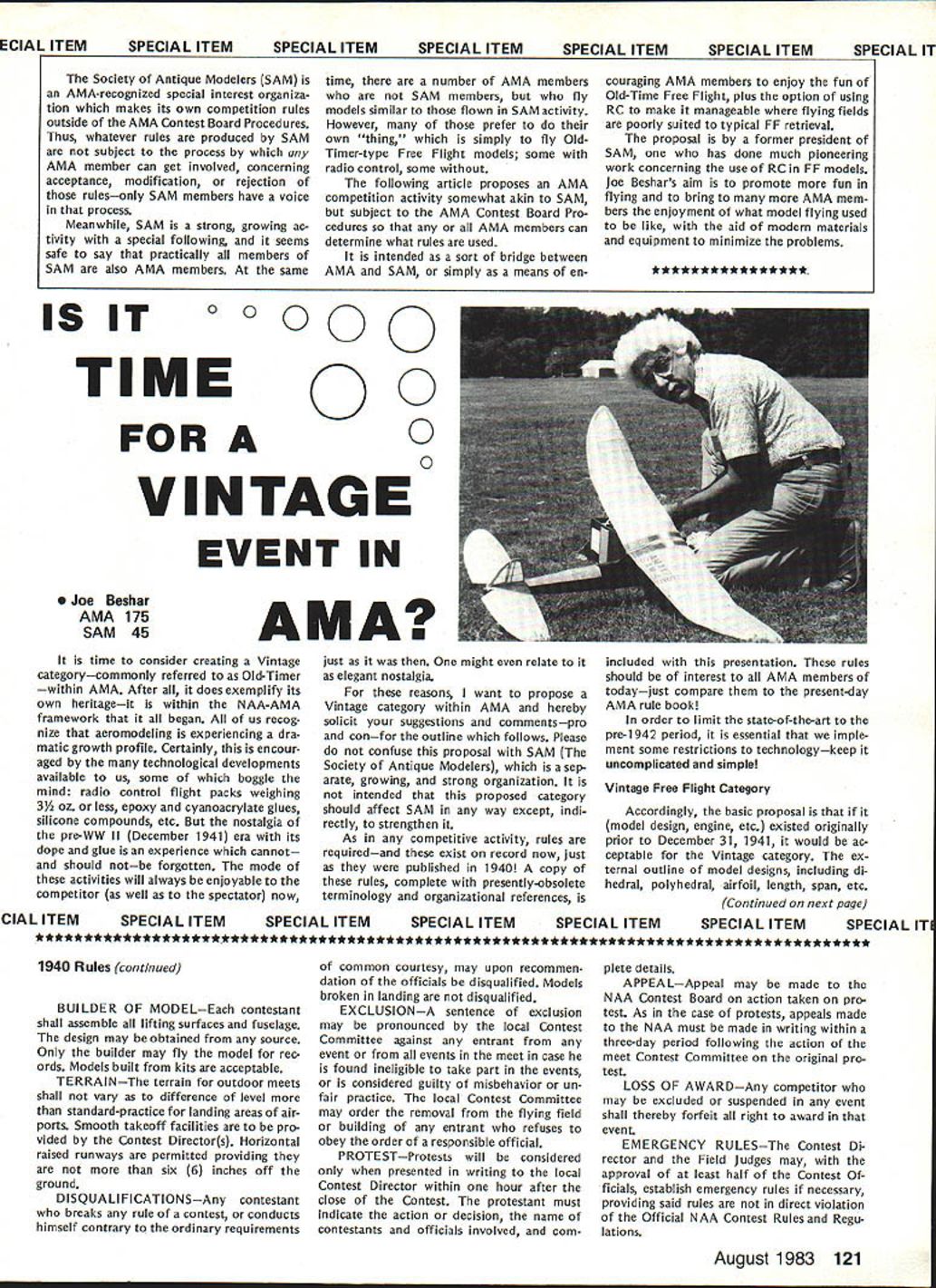
IS IT TIME FOR A VINTAGE EVENT IN AMA?
Joe Beshar AMA 175 SAM 45
The Society of Antique Modelers (SAM) is an AMA-recognized special interest organization which makes its own competition rules outside of the AMA Contest Board Procedures. Thus, SAM members alone have a voice in those rules. SAM is a strong, growing activity with a special following, and many SAM members are also AMA members. There are, however, AMA members who are not SAM members but who fly models similar to SAM activity. Many prefer to do their own thing — flying Old-Timer-type Free Flight models, some with radio control, some without.
This article proposes an AMA competition activity somewhat akin to SAM, but subject to the AMA Contest Board Procedures so that any AMA member can help determine the rules. It is intended as a bridge between AMA and SAM, encouraging AMA members to enjoy the fun of old-time free flight, with the option of using RC to make retrieval manageable where flying fields are poor.
It is time to consider creating a Vintage category — commonly referred to as Old-Timer — within AMA. The key idea is to limit the state-of-the-art to the pre-December 31, 1941 period, keeping designs uncomplicated and simple, while allowing modern materials where appropriate.
Vintage Free Flight Category
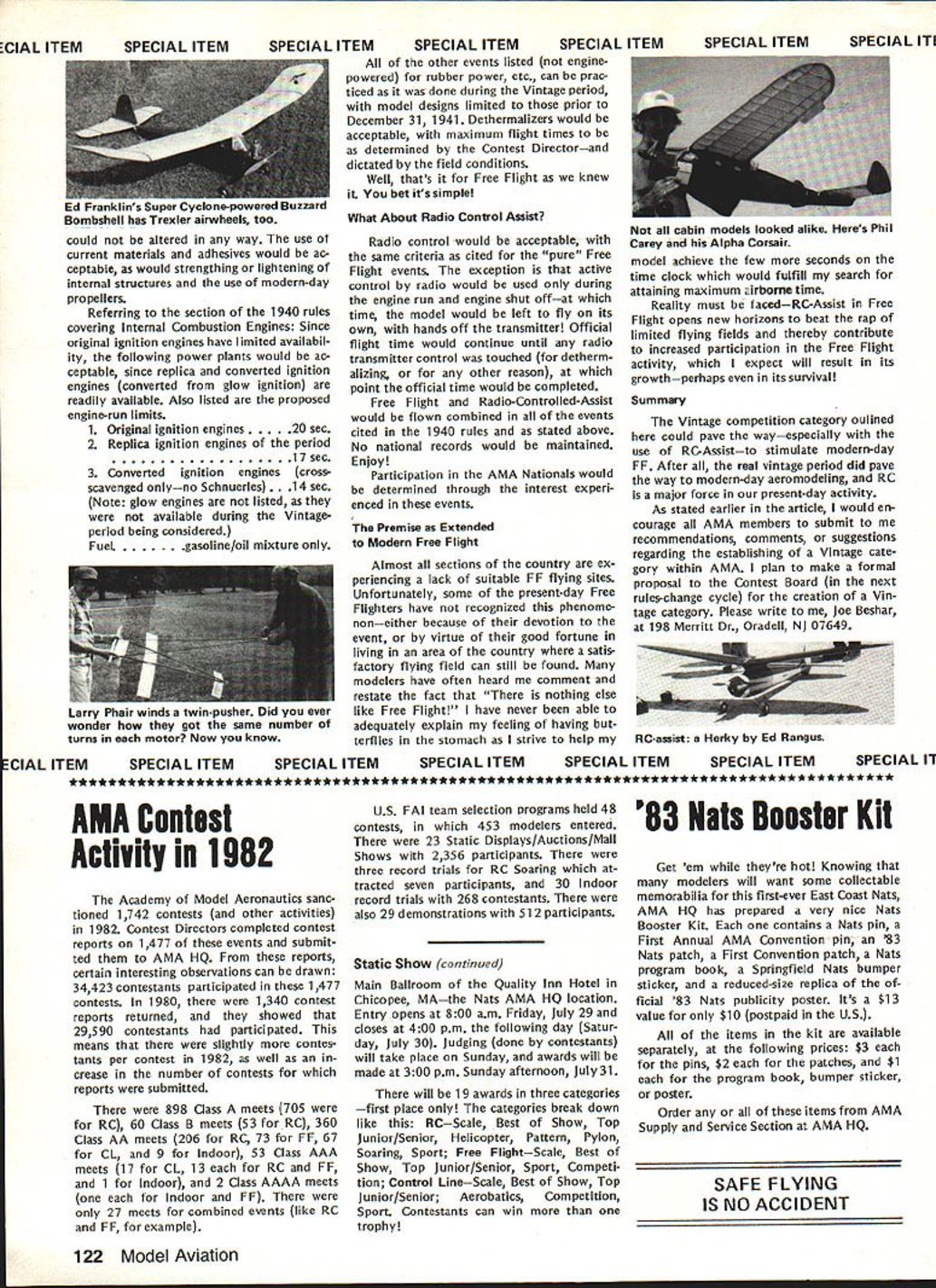
The basic proposal is that if a model design, engine, etc., existed originally prior to December 31, 1941, it would be acceptable for the Vintage category. External outlines of model designs — including dihedral, polyhedral, airfoil, length, span, etc. — could not be altered in any way. The use of current materials and adhesives would be acceptable, as would strengthening or lightening of internal structures and the use of modern-day propellers.
Referring to the 1940 rules covering internal combustion engines, and recognizing limited availability of original ignition engines, the following power plants would be acceptable with the proposed engine-run limits:
- Original ignition engines — 20 sec.
- Replica ignition engines of the period — 17 sec.
- Converted ignition engines (cross-scavenged only — no Schnuerle's) — 14 sec.
Note: Glow engines are not listed, as they were not available during the Vintage period being considered. Fuel: gasoline/oil mixture only.
All other events listed for rubber power, etc., can be practiced as during the Vintage period, with designs limited to those prior to December 31, 1941. Dethermalizers would be acceptable, with maximum flight times to be determined by the Contest Director and dictated by field conditions.
What About Radio Control Assist?
Radio control would be acceptable using the same criteria as for pure free flight events. Active control by radio would be used only during the engine run and engine shutoff — after which the model would be left to fly on its own, with hands off the transmitter. Official flight time would continue until any radio transmitter control was touched (for dethermalizing or any other reason), at which point the official time would be completed.
Free Flight and Radio-Controlled-Assist would be flown combined in all events cited in the 1940 rules and as stated here. No national records would be maintained. Participation in the AMA Nationals would depend on interest in these events.
The Premise as Extended to Modern Free Flight
Many areas are experiencing a lack of suitable free flight flying sites. RC-assist in free flight opens new horizons to address limited flying fields and can contribute to increased participation in the free flight activity, potentially aiding its growth and survival.
Summary
The Vintage competition category outlined here, especially with RC-assist, could stimulate modern-day free flight while preserving the nostalgia and simplicity of the pre-1942 era. Joe Beshar invites AMA members to submit recommendations, comments, or suggestions regarding establishing a Vintage category within AMA. Write to Joe Beshar, 198 Merritt Dr., Oradell, NJ 07649.
Competition Rules Proposals Activity
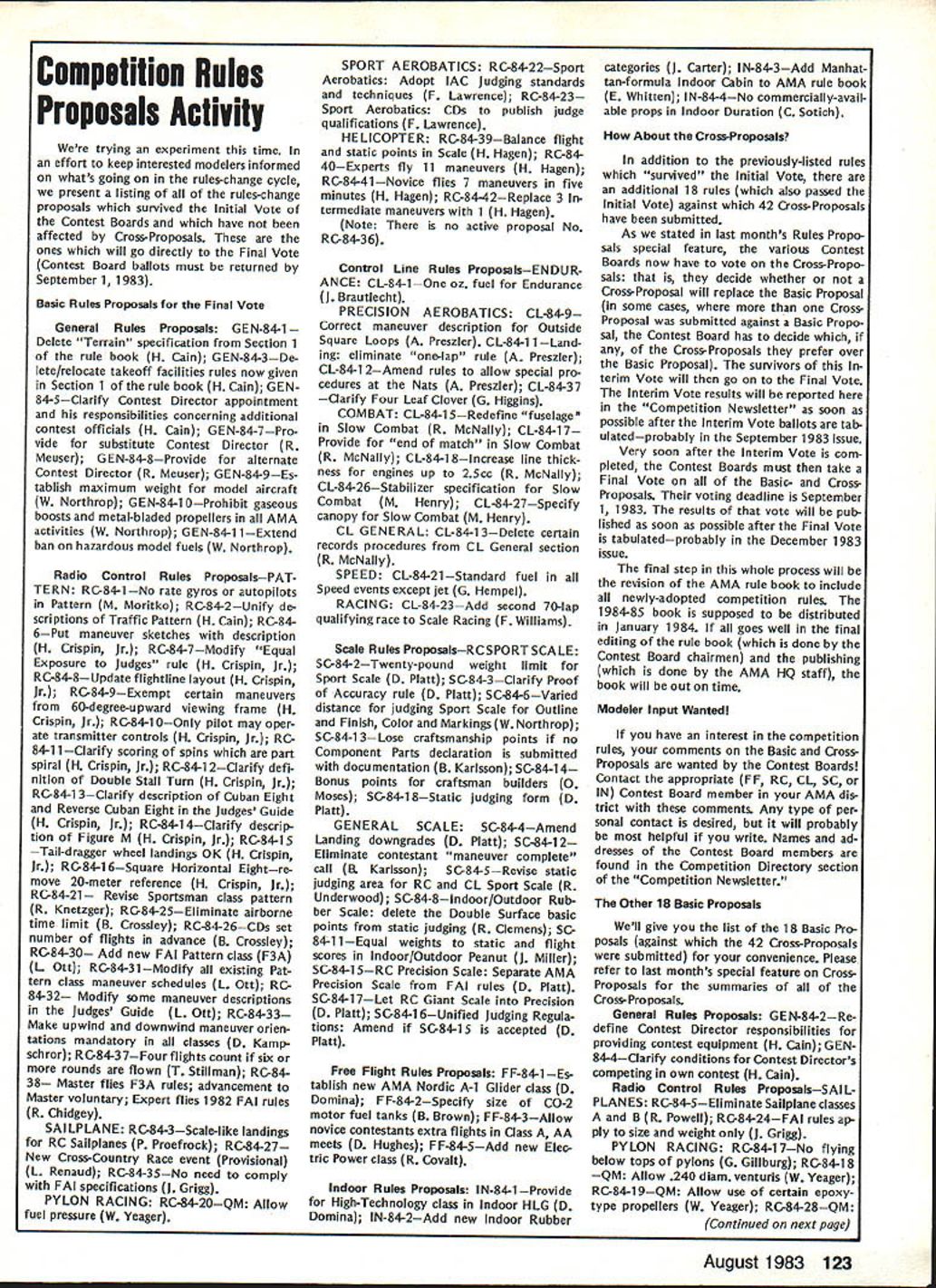
We're trying an experiment to keep interested modelers informed on the rules-change cycle. Below is a listing of all rules-change proposals that survived the Initial Vote of the Contest Boards and which have not been affected by Cross-Proposals. These are the ones that will go directly to the Final Vote. Contest Board ballots must be returned by September 1, 1983.
Basic Rules Proposals for the Final Vote
#### General Rules Proposals
- GEN-84-1 — Delete "Terrain" specification from Section 1 of the rule book (H. Cain)
- GEN-84-3 — Delete/relocate takeoff facilities rules now given in Section 1 of the rule book (H. Cain)
- GEN-84-5 — Clarify Contest Director appointment and his responsibilities concerning additional contest officials (H. Cain)
- GEN-84-7 — Provide for substitute Contest Director (R. Meuser)
- GEN-84-8 — Provide for alternate Contest Director (R. Meuser)
- GEN-84-9 — Establish maximum weight for model aircraft (W. Northrop)
- GEN-84-10 — Prohibit gaseous boosts and metal-bladed propellers in all AMA activities (W. Northrop)
- GEN-84-11 — Extend ban on hazardous model fuels (W. Northrop)
#### Radio Control Rules Proposals — PATTERN
- RC-84-1 — No rate gyros or autopilots in Pattern (M. Moritko)
- RC-84-2 — Unify descriptions of Traffic Pattern (H. Cain)
- RC-84-6 — Put maneuver sketches in description (H. Crispin, Jr.)
- RC-84-7 — Modify "Equal Exposure to Judges" rule (H. Crispin, Jr.)
- RC-84-8 — Update flightline layout (H. Crispin, Jr.)
- RC-84-9 — Exempt certain maneuvers from 60-degree-upward viewing frame (H. Crispin, Jr.)
- RC-84-10 — Only pilot may operate transmitter controls (H. Crispin, Jr.)
- RC-84-11 — Clarify scoring of spins which are partial (H. Crispin, Jr.)
- RC-84-12 — Clarify definition of Double Stall Turn (H. Crispin, Jr.)
- RC-84-13 — Clarify description of Cuban Eight and Reverse Cuban Eight in the Judges' Guide (H. Crispin, Jr.)
- RC-84-14 — Clarify description of Figure M (H. Crispin, Jr.)
- RC-84-15 — Tail-dragger wheel landings OK (H. Crispin, Jr.)
- RC-84-16 — Square Horizontal Eight — remove 20-meter reference (H. Crispin, Jr.)
- RC-84-21 — Revise Sportsman class pattern (R. Knetzger)
- RC-84-25 — Eliminate airborne time limit (B. Crossley)
- RC-84-26 — CDs set number of flights in advance (B. Crossley)
- RC-84-30 — Add new FAI Pattern class (F3A) (L. Ott)
- RC-84-31 — Modify all existing Pattern class maneuver schedules (L. Ott)
- RC-84-32 — Modify some maneuver descriptions in the Judges' Guide (L. Ott)
- RC-84-33 — Make upwind and downwind maneuver orientations mandatory in all classes (D. Kamp)
- RC-84-37 — Four flights count if six or more rounds are flown (T. Stillman)
- RC-84-38 — Master flies F3A rules; advancement to Master voluntary; Expert flies 1982 FAI rules (R. Chidgey)
#### Radio Control Rules Proposals — SAILPLANE
- RC-84-32 — Scale-like landings for RC sailplanes (P. Proefrock)
- RC-84-27 — New Country Race event (provisional) (L. Renaud)
- RC-84-35 — No need to comply with FAI specifications (U. Grieg)
#### PYLON RACING
- RC-84-20 — QM: Allow fuel pressure (W. Yeager)
#### SPORT AEROBATICS
- RC-84-22 — Sport Aerobatics: Adopt IAC judging standards and techniques (F. Lawrence)
- RC-84-23 — Sport Aerobatics: CDs to publish judge qualifications (F. Lawrence)
#### HELICOPTER
- RC-84-39 — Balance flight and static points in Scale (H. Hagen)
- RC-84-40 — Experts fly 11 maneuvers (H. Hagen)
- RC-84-41 — Novice flies 7 maneuvers in five minutes (H. Hagen)
- RC-84-42 — Replace 3 Intermediate maneuvers with 1 (H. Hagen)
(Note: There is no active proposal No. RC-84-36.)
#### Control Line Rules Proposals — ENDURANCE
- CL-84-1 — One oz. fuel for Endurance (J. Braultrecht)
#### PRECISION AEROBATICS
- CL-84-9 — Correct maneuver description for Outside Square Loops (A. Preszler)
- CL-84-11 — Landing: eliminate "one-loop" rule (A. Preszler)
- CL-84-12 — Amend rules to allow special procedures at the Nats (A. Preszler)
- CL-84-37 — Clarify Four Leaf Clover (G. Higgins)
#### COMBAT
- CL-84-15 — Redefine "fuselage" in Slow Combat (R. McNally)
- CL-84-17 — Provide for "end of match" in Slow Combat (R. McNally)
- CL-84-18 — Increase line thickness for engines up to 2.5 cc (R. McNally)
- CL-84-26 — Stabilizer specification for Slow Combat (M. Henry)
- CL-84-27 — Specify canopy for Slow Combat (M. Henry)
#### CL GENERAL
- CL-84-13 — Delete certain records procedures from CL General section (R. McNally)
#### SPEED
- CL-84-21 — Standard fuel in all Speed events except jet (G. Hempel)
#### RACING
- CL-84-23 — Add second 70-lap qualifying race to Scale Racing (F. Williams)
#### Scale Rules Proposals — RC/SPORT SCALE
- SC-84-2 — Twenty-pound weight limit for Sport Scale (D. Platt)
- SC-84-3 — Clarify Proof of Accuracy rule (D. Platt)
- SC-84-5 — Clarify Proof of Accuracy rule (D. Platt)
- SC-84-6 — Varied distance for judging Sport Scale for Outline and Finish, Color and Markings (W. Northrop)
- SC-84-13 — Lose craftsmanship points if no Component Parts declaration is submitted with documentation (B. Karlsson)
- SC-84-14 — Bonus points for craftsman builders (O. Moses)
- SC-84-18 — Static judging form (D. Platt)
#### GENERAL SCALE
- SC-84-4 — Amend landing downgrades (D. Platt)
- SC-84-12 — Eliminate contestant "maneuver complete" call (B. Karlsson)
- SC-84-5 — Revise static judging for RC and CL Sport Scale (R. Underwood)
- SC-84-8 — Indoor/Outdoor Rubber Scale: delete the Double Surface basic points from static judging (R. Clemens)
- SC-84-11 — Equal weights to static and flight scores in Indoor/Outdoor Peanut (J. Miller)
- SC-84-15 — RC Precision Scale: Separate AMA Precision Scale from FAI rules (D. Platt)
- SC-84-17 — Let RC Giant Scale into Precision (D. Platt)
- SC-84-16 — Unified Judging Regulations: Amend if SC-84-15 is accepted (D. Platt)
#### Free Flight Rules Proposals
- FF-84-1 — Establish new AMA Nordic A-1 Glider class (D. Domina)
- FF-84-2 — Specify size of CO-2 motor fuel tanks (B. Brown)
- FF-84-3 — Allow novice contestants extra flights in Class A, AA meets (D. Hughes)
- FF-84-5 — Add new Electric Power class (R. Covalt)
#### Indoor Rules Proposals
- IN-84-1 — Provide for High-Technology class in Indoor HLG (D. Domina)
- IN-84-2 — Add new Indoor Rubber categories (J. Carter)
- IN-84-3 — Add Manhattan-formula Indoor Cabin to AMA rule book (E. Whitten)
- IN-84-4 — No commercially-available props in Indoor Duration (C. Sotich)
How About the Cross-Proposals?
In addition to the previously listed rules which survived the Initial Vote, there are an additional 18 Basic Proposals (which also passed the Initial Vote) against which 42 Cross-Proposals have been submitted.
The Contest Boards now must vote on the Cross-Proposals: they decide whether a Cross-Proposal will replace the Basic Proposal. Where more than one Cross-Proposal was submitted against a Basic Proposal, the Contest Board must decide which, if any, Cross-Proposal they prefer over the Basic Proposal. The survivors of this Interim Vote will then go on to the Final Vote. Interim Vote results will be reported in the Competition Newsletter as soon as they are tabulated — probably in the September 1983 issue.
Soon after the Interim Vote is completed, the Contest Boards must take a Final Vote on all Basic and Cross-Proposals. The voting deadline is September 1, 1983. Final Vote results will be published as soon as possible after tabulation — probably in the December 1983 issue.
The final step is revision of the AMA rule book to include all newly adopted competition rules. The 1984–85 book is supposed to be distributed in January 1984. If final editing (by the Contest Board chairmen) and publishing (by AMA HQ staff) proceed on schedule, the book will be out on time.
Modeler Input Wanted!
If you have an interest in the competition rules, your comments on the Basic and Cross-Proposals are wanted by the Contest Boards. Contact the appropriate (FF, RC, CL, SC, or IN) Contest Board member in your AMA district with comments. Personal contact is desired, but written comments will be most helpful. Names and addresses of Contest Board members are found in the Competition Directory section of the Competition Newsletter.
The Other 18 Basic Proposals
For convenience, here are the 18 Basic Proposals against which 42 Cross-Proposals were submitted.
#### General Rules Proposals
- GEN-84-2 — Redefine Contest Director responsibilities for providing contest equipment (H. Cain)
- GEN-84-4 — Clarify conditions for Contest Director's competing in own contest (H. Cain)
#### Radio Control Rules Proposals — SAILPLANES
- RC-84-5 — Eliminate Sailplane classes A and B (R. Powell)
- RC-84-24 — FAI rules apply to size and weight only (J. Grigg)
#### PYLON RACING
- RC-84-17 — No flying below tops of pylons (G. Gillburg)
- RC-84-18 — QM: Allow .240 diam. venturis (W. Yeager)
- RC-84-19 — QM: Allow use of certain epoxy-type propellers (W. Yeager)
- RC-84-29 — Require mufflers or muffled tuned pipes (R. Wilson)
#### Control Line Rules Proposals — PRECISION AEROBATICS
- CL-84-2 — Maneuver diagrams from pilot's viewpoint (B. Zimmer)
#### CARRIER
- CL-84-6 — Delete "Builder of the Model" rule (L. Cordes)
- CL-84-7 — Increase Profile Carrier wingspan to 50 in. (L. Cordes)
- CL-84-8 — Delete 60-degree nose-high rule; substitute maximum low speed flight time of 150 sec. (L. Cordes)
- CL-84-32 — Re-line landing description (P. Mazur)
- CL-84-33 — Only three 60-degree nose-high warnings permitted or low speed is DQ'd (P. Mazur)
#### RACING
- CL-84-22 — Revise Slow Rat (F. Williams)
#### Scale Rules Proposals
- SC-84-1 — Revise static scoring of Sport Scale Sailplanes (K. Ruth)
#### Free Flight Rules Proposals
- FF-84-4 — Delete Rocket Power event (H. Murphy)
Transcribed from original scans by AI. Minor OCR errors may remain.

