
Congratulate Yourself!
In a slightly different form this article originally appeared in the newsletter of the Joint Military RC Flyers Club of Oceanside, CA. There's a message in it: we all need to be considerate of others and concerned with safe flying practices. ■ Marlin L. Kinning
Illustrations by Robert M. Kalafat
You should congratulate yourself. You perform a difficult task regularly, and you do it well and safely. It's called flying RC model airplanes. It doesn't seem that hard to you, because you do it every weekend without mishap. But flying RC aircraft, whether it's a tuned‑pipe Pattern ship or a high‑wing basic trainer, requires more agility, attention, and skill than almost any other kind of hobby. And because you fly only on weekends, you know that you have to be cognizant of yourself as well as all of the many other fliers and visitors.
Even with all the different airplanes, movements, maneuvers, signs, and verbal signals you have to watch and listen for, you are rarely surprised by anything. Although the maneuvers of another may annoy you, you are not caught off guard by them. You aren't surprised, because you are constantly watching around for the slightest hint of what is to come.
Let's look at a few of the things that separate you—the safe flier—from the not‑so‑safe flier.
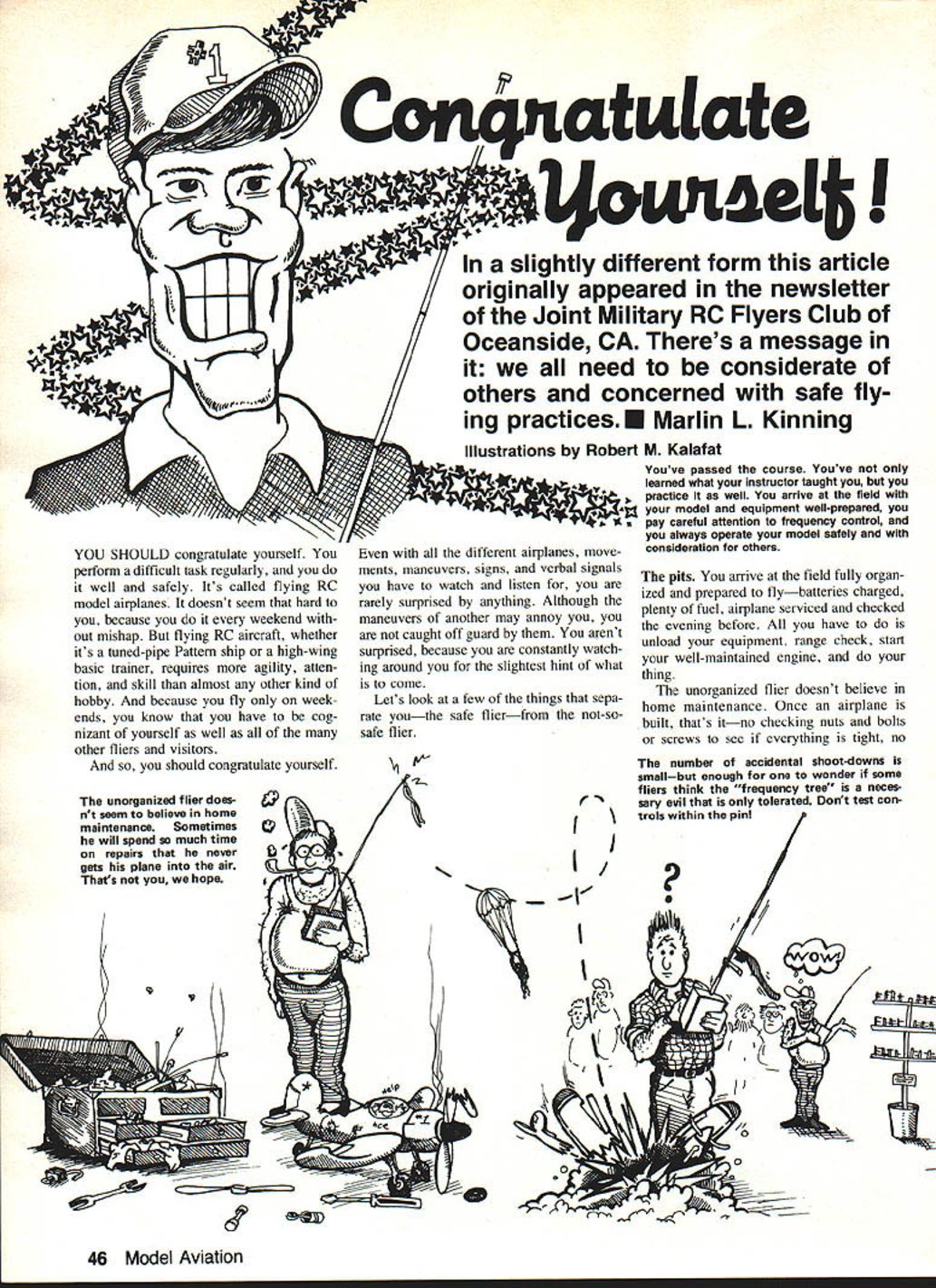
The unorganized flier doesn't seem to believe in home maintenance. Once an airplane is built, that's it—no checking nuts and bolts or screws to see if everything is tight. He neglects servo and engine maintenance, doesn't check clevises, and arrives at the field with no idea of what condition his airplane is in and virtually no tools or materials for field repairs. He goes from flier to flier borrowing items and sometimes literally disassembling an engine. So much time is spent on repairs that he never does get off the ground. He even succeeds in keeping another flier grounded by misuse of the frequency pin.
You've passed the course. You've not only learned what your instructor taught you, but you practice it as well. You arrive at the field with your model and equipment well‑prepared, you pay careful attention to frequency control, and you always operate your model safely and with consideration for others.
The pits. You arrive at the field fully organized and prepared to fly—batteries charged, plenty of fuel, airplane serviced and checked the evening before. All you have to do is unload your equipment, range check, start your well‑maintained engine, and do your thing.
Frequency tree
With the amount of traffic (in the air and on the ground) a frequency tree or similar device is the only thing that can efficiently control all the different frequencies. You know that you are not to turn on your transmitter without the frequency pin. Even when you have the pin, you turn on cautiously as you scan the flight line for anyone you know who is using the same frequency.
To some fliers the frequency tree is a necessary evil that is tolerated at best. They want to turn on at any time to test this or that, and they really hate to wait their turn for the pin. This is the culprit that shoots other fliers down and then says he "forgot" or "I only switched on for a second." Worse yet, if he thinks he can get away with it, he will never admit it was him and will argue the point heatedly.
Use the frequency tree as a positive safety device. It allows fliers to efficiently control different frequencies and know when someone is using a frequency. When you have the transmitter frequency pin, turn it cautiously and scan the flight line to be sure no one is using the same frequency.
Taxiing
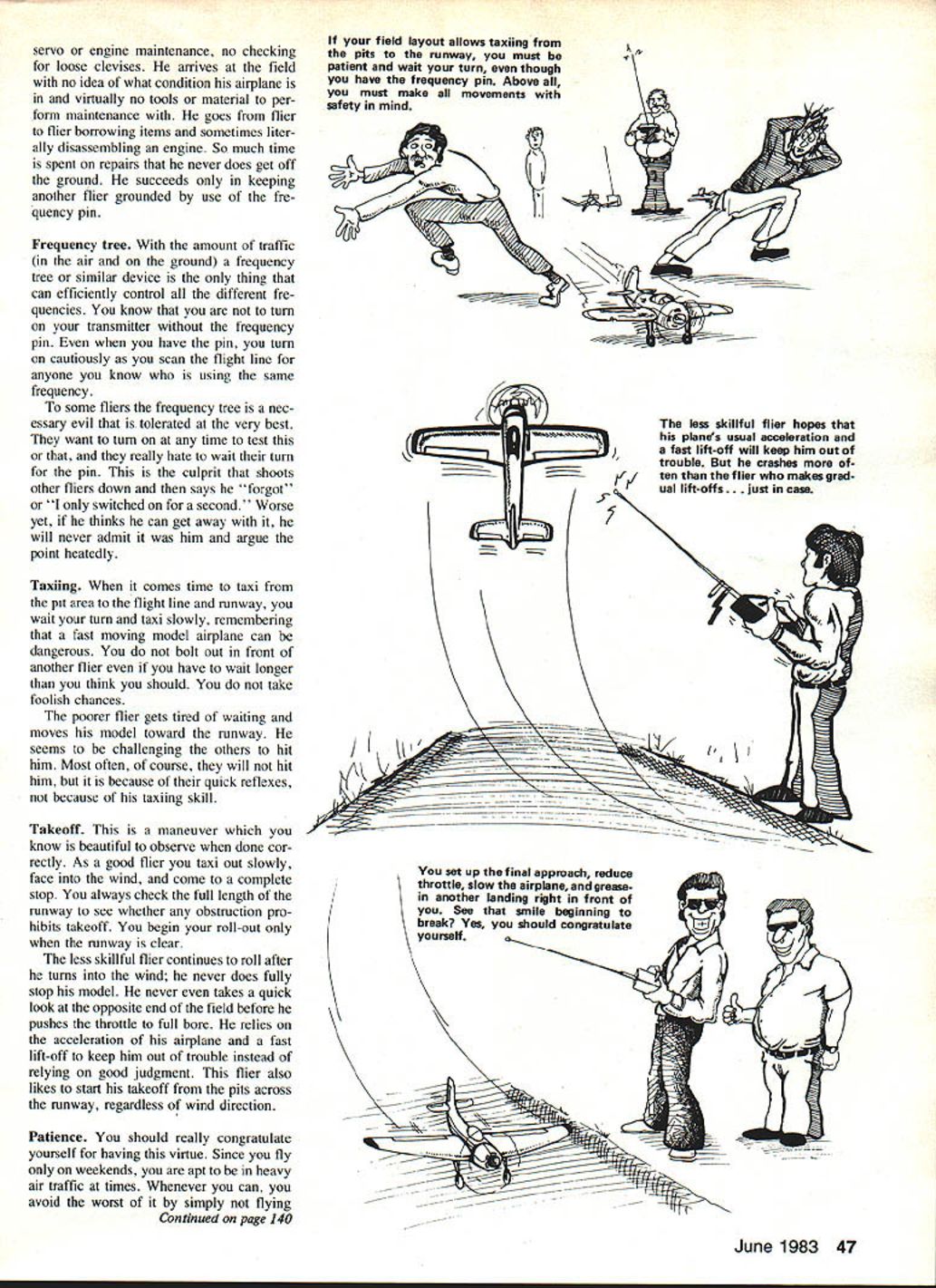
When it comes time to taxi from the pit area to the flight line and runway, you wait your turn and taxi slowly, remembering that a fast‑moving model airplane can be dangerous. You do not bolt out in front of another flier even if you have to wait longer than you think you should. You do not take foolish chances.
The poorer flier gets tired of waiting and moves his model toward the runway as if challenging the others. He will most often be hit (or narrowly missed) because other pilots have quick reflexes and taxiing skill, not because of his prudence.
Takeoff
This is a maneuver which you know is beautiful to observe when done correctly. As a good flier you taxi out slowly, face into the wind, and come to a complete stop. You always check the full length of the runway to see whether any obstruction prohibits takeoff. You begin your roll‑out only when the runway is clear.
The less skillful flier continues to roll after he turns into the wind; he never fully stops his model and never takes a quick look at the opposite end of the field before he pushes the throttle to full bore. He relies on acceleration to get the airplane airborne quickly instead of on good judgment. This flier also likes to start his takeoff from the pits across the runway, regardless of wind direction.
Patience
You should really congratulate yourself for having this virtue. Since you fly only on weekends, you are apt to be in heavy air traffic at times. Whenever you can, you avoid the worst of it by simply not flying until the sky thins out to the number of planes you feel comfortable with.
But when you do fly in heavy air traffic, you remain in control of yourself as well as your airplane. You don't get angry when you almost have a midair, and you don't say ill‑mannered things to other fliers. The lousy flier has no more fun than you do, but he certainly tries—doing loops and snap rolls in, around, and through traffic and then pulling up sharply as he narrowly averts a head‑on because he's flying against the pattern. Worst of all, he gets angry and verbally loses his temper at people who can't do any more about the crowded situation than he can.
Above all, make your movements with safety in mind. On final approach, reduce throttle and slow the airplane for an easy landing rather than a fast, hazardous one.
Landing
When the time comes to finish the flight, you are ready. You have looked to see if the field is clear, and you have signaled to let other fliers know your intentions by announcing in a loud voice, "Landing!" You have checked that the airspace is clear and that there are no other airplanes you will interfere with. You set up your final approach, cut the throttle, slow the airplane, and grease another one right in front of you.
In contrast, the poor flier will do his best to overtake you on final approach—or he'll make a tight circle into the landing pattern, impeding traffic behind him, then sweep down to a fast, hard landing halfway down the field. Every flier must watch him closely, as he doesn't believe in verbal signals. He has a problem: no advance planning; his mind was elsewhere during the flight.
"Congratulations!" you might say. "But this is only ordinary flying—the basic stuff my instructor taught me even before I soloed." There's nothing very remarkable about it. Perhaps you're right. Aren't you glad nobody flies like that bad flier in your club?
The bottom line is this. The next time you're at the flying field and someone does something to annoy you, congratulate yourself on being better than average at an enjoyable hobby that is both complex and challenging. You fully realize that irresponsible behavior and reckless flying is not, and cannot, be tolerated. Safety is a factor for everyone connected with model aviation to be concerned with.
You mustn't rest and pat yourself on the back (certainly not while flying; keep both hands on the transmitter!). Continue to think about what you are doing each time you start your engine. Get completely absorbed in the task of flying your airplane. Plan your moves and execute them smoothly. Do nothing to surprise those around you. You have your experience to get you through the flight at hand, and your experience is a considerable asset.
Congratulate yourself. You've earned it.
Transcribed from original scans by AI. Minor OCR errors may remain.

