
Connecticut: flying field
Bob Gordon
History
Having and retaining a flying field is perhaps the most important aspect of club affairs. Without a field, a club's membership list soon diminishes as fliers look elsewhere for a place to put their super creations into the air.
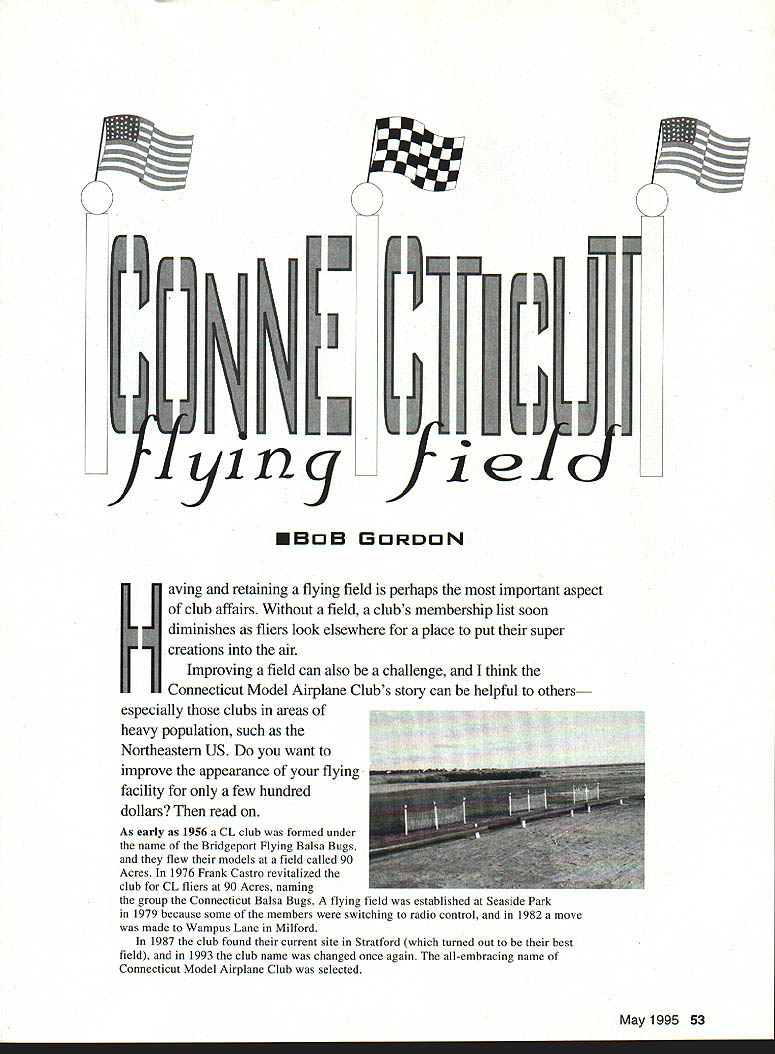
As early as 1956 a CL club was formed under the name Bridgeport Flying Balsa Bugs; they flew at a field called 90 Acres. In 1976 Frank Castro revitalized the club for CL fliers at 90 Acres and named the group the Connecticut Balsa Bugs. A flying field was established at Seaside Park in 1979 because some members were switching to radio control, and in 1982 the club moved to Wampus Lane in Milford.
In 1987 the club found its current site in Stratford (which turned out to be their best field), and in 1993 the club name was changed again to the all-embracing Connecticut Model Airplane Club (CMAC).
Initial improvements
I was new to RC—a member of CMAC for only one year—but I proposed ideas that would allow several dramatic improvements to the Stratford flying site. After discussions with the Club Executive Committee, I was given the okay to initiate those field changes.
The first modification added a pilot-protection fence that separated the pit area from the runway. This change was favorably received by the fliers.
To acquaint members with additional projected field modifications, I prepared a flip-chart presentation, complete with an artist’s concept of "before" and "after" fence extensions so the members could receive full-color impressions of the proposals. The cost for these modifications was indicated so everyone would understand the commitment needed.
There was an excited reception, followed by complete acceptance of the proposals, as indicated by unanimous approval by the membership of the ideas and the $750 of club funds needed for the project.
Fence installation and detailing
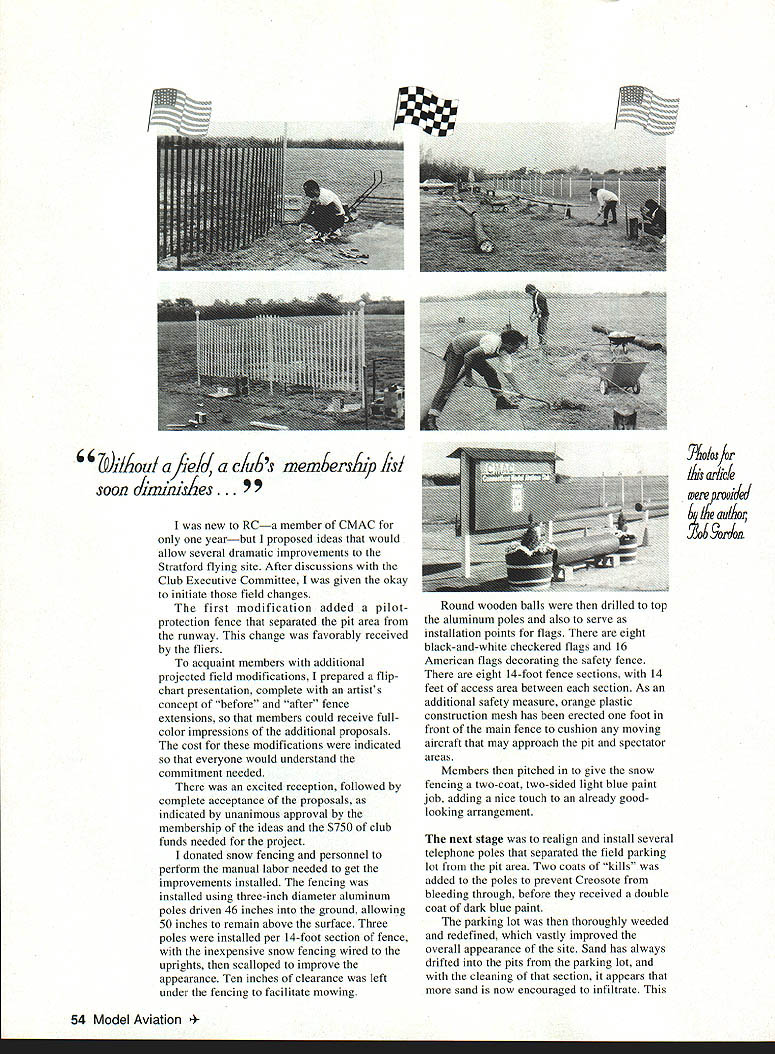
I donated snow fencing and personnel to perform the manual labor needed to get the improvements installed. The fencing was installed using three-inch-diameter aluminum poles driven 46 inches into the ground, leaving 50 inches above the surface. Installation details and features included:
- Three poles were installed per 14-foot section of fence.
- The inexpensive snow fencing was wired to the uprights, then scalloped to improve appearance.
- Ten inches of clearance was left under the fencing to facilitate mowing.
- Round wooden balls were drilled to top the aluminum poles and also to serve as installation points for flags.
- There are eight black-and-white checkered flags and 16 American flags decorating the safety fence.
- There are eight 14-foot fence sections, with 14 feet of access area between each section.
- As an additional safety measure, orange plastic construction mesh was erected one foot in front of the main fence to cushion any moving aircraft that may approach the pit and spectator areas.
Members then pitched in to give the snow fencing a two-coat, two-sided light-blue paint job, adding a nice touch to an already good-looking arrangement.
Parking lot, poles, and landscaping
The next stage was to realign and install several telephone poles that separated the field parking lot from the pit area. Two coats of Kilz were applied to the poles to prevent creosote from bleeding through, before they received a double coat of dark-blue paint.
The parking lot was thoroughly weeded and redefined, which vastly improved the overall appearance of the site. Sand has always drifted into the pits from the parking lot; with the cleaning of that section, the situation has improved.
Trailer, signage, and finishing touches
The field, already equipped with a 40 x 12-foot trailer, was mounted on blocks above ground level, creating a storage area underneath the unit. Adding a wooden lattice skirt improved the appearance and effectively concealed equipment stored below.
The frequency board was painted blue and white and a new sign added on the reverse side: "Connecticut Model Airplane Club / Home Balsa Bugs." The sign was covered with Plexiglas to seal it from the elements and possible defacing. A finishing touch was the placement of two whiskey half-barrels flanking the frequency board, each containing a small pine tree surrounded by a garden planted with summer flowers.
Completion and reception
It's a tribute to the many volunteers that the entire project was completed in 30 days—in time for the club's annual Giant Fly-In, June 11–12, 1994. Spectators and visitors enjoyed the new scalloped fencing, the 24 flags, the decorated parking-lot dividers, and the colorful frequency board/club sign augmented by the flower garden and potted trees. Many club members were so proud of their efforts they brought their families to the field just to show it off—quite a compliment for the workers.
Transcribed from original scans by AI. Minor OCR errors may remain.

