
Bill Hannan
Contests by Proxy
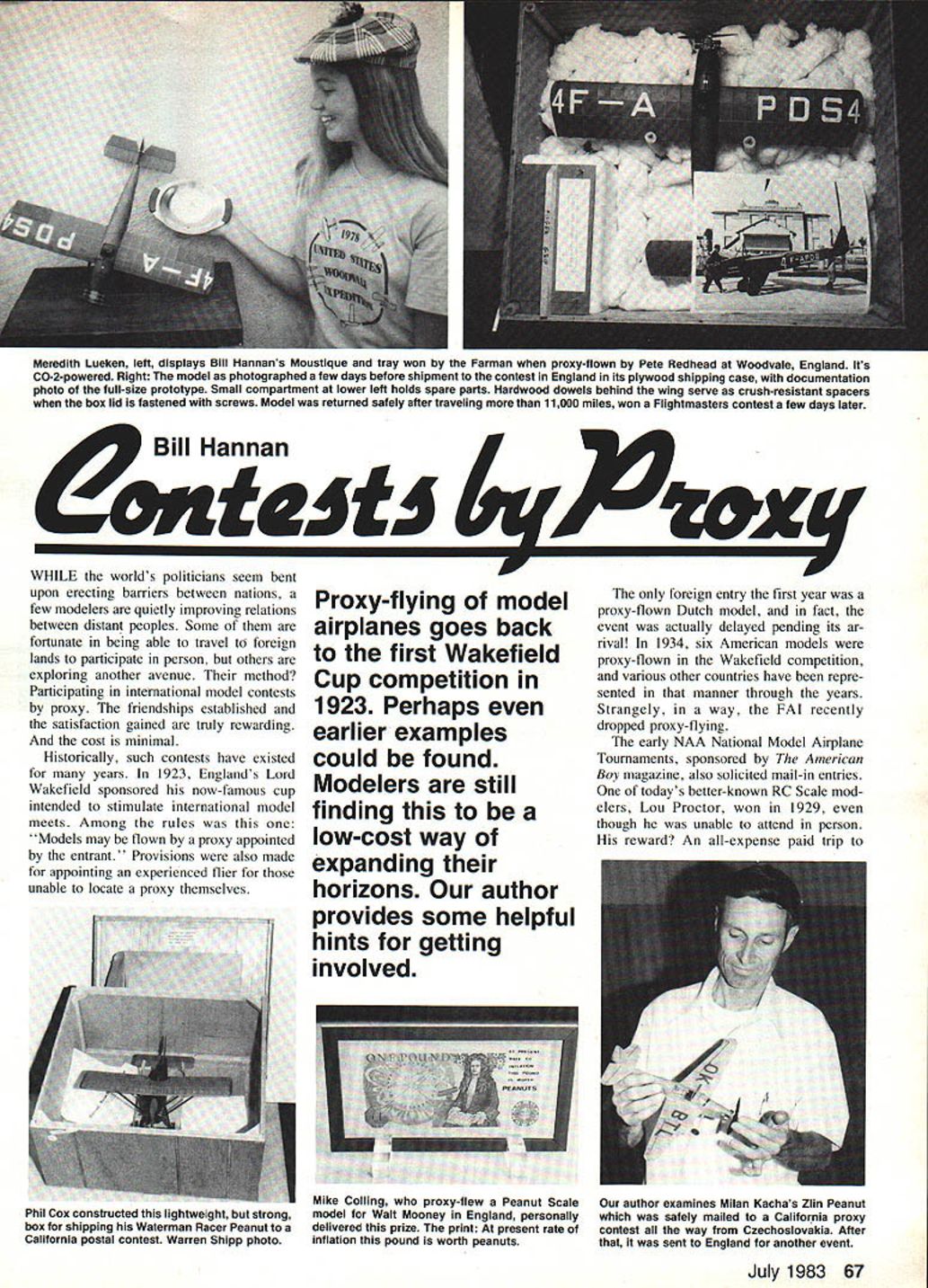
While the world's politicians seem bent upon erecting barriers between nations, a few modelers are quietly improving relations between distant peoples. Some are fortunate enough to travel to foreign lands and participate in person; others are exploring another avenue — proxy entry. Participating in international model contests by proxy establishes friendships, and the satisfaction gained can be truly rewarding at minimal cost.
History
Historically, proxy contests have existed for many years. In 1923 England's Lord Wakefield sponsored his now-famous Wakefield Cup to stimulate international model meets. Among the rules was this one: "Models may be flown by a proxy appointed by the entrant." Provisions were also made for appointing an experienced flier for those unable to locate a proxy themselves. Proxy flying of model airplanes thus goes back to the first Wakefield Cup competition in 1923, and perhaps even earlier examples could be found.
The early NAA National Model Airplane Tournaments, sponsored by The American Boy magazine, also solicited mail-in entries. One notable example: Lou Proctor, now a well-known RC scale modeler, won in 1929 though he was unable to attend in person. His reward was an all-expense-paid trip to England.
Strangely, the FAI recently dropped proxy-flying from some of its rules, but proxy contests remain popular among hobbyists as a low-cost way of expanding horizons.
Notable proxy entries and travel stories
- The only foreign entry the first Wakefield Cup year was a proxy-flown Dutch model; the event was actually delayed pending its arrival. In 1934, six American models were proxy-flown in the Wakefield competition, and various other countries have been represented that way through the years.
- Milan Kacha's Zlin Peanut was mailed from Czechoslovakia to California for a proxy contest; after being sent to England for another event, it continued to travel to additional competitions.
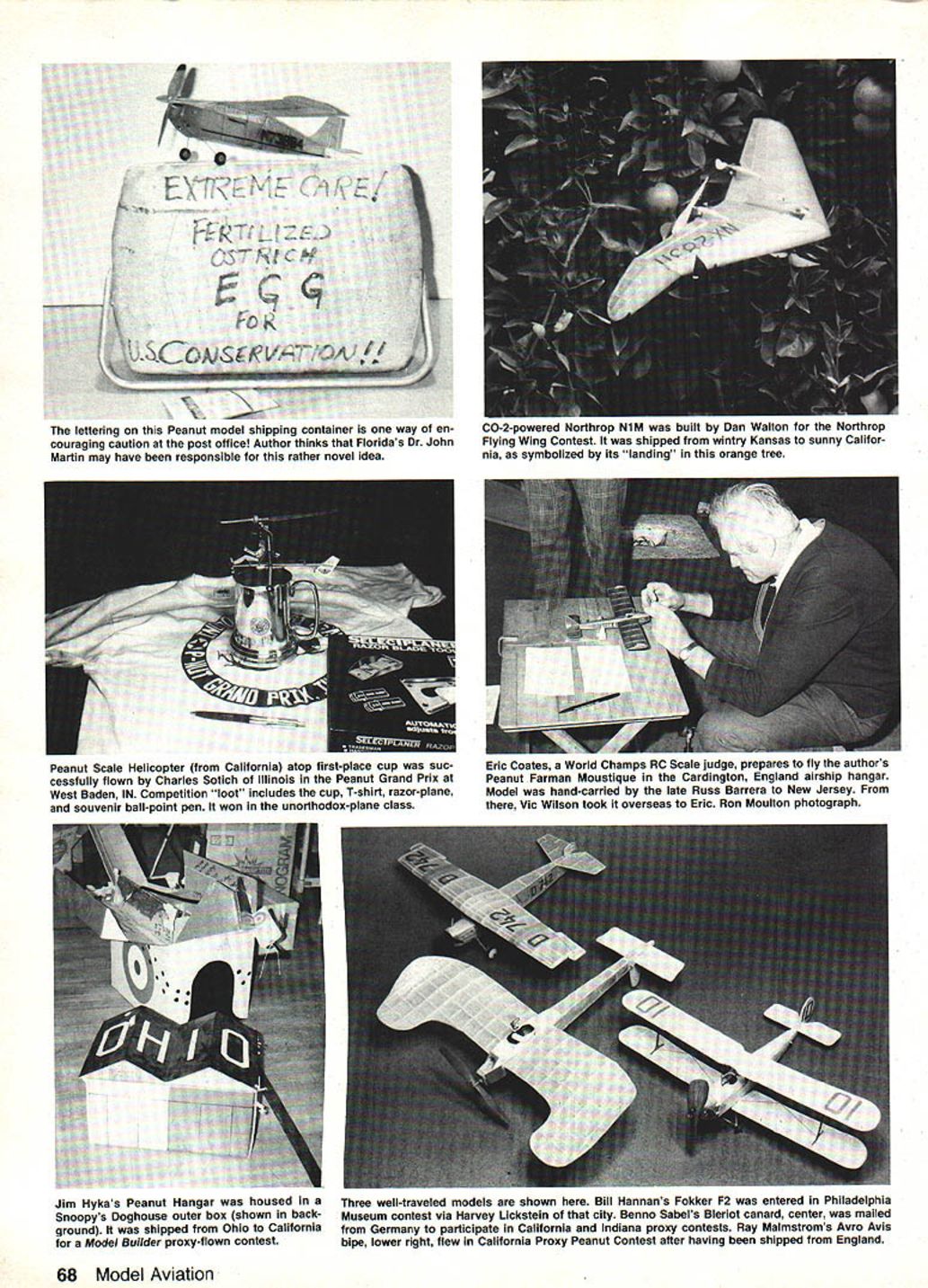
- A Peanut Scale helicopter from California, atop the first-place cup, was successfully flown by Charles Sotich of Illinois in the Peanut Grand Prix at West Baden, IN. Competition prizes included the cup, a T-shirt, a razor plane, and a souvenir ballpoint pen; it won in the unorthodox-plane class.
- Eric Coates, a World Champs RC Scale judge, prepared to fly the author's Peanut Farman Moustique in the Cardington, England airship hangar. The model was hand-carried by the late Russ Barrera to New Jersey; from there Vic Wilson took it overseas to Eric.
- Several well-traveled models have been proxy-entered in various contests:
- Jim Hykas's Peanut Hangar was housed in a Snoopy's Doghouse outer box and shipped from Ohio to California for a Model Builder proxy-flown contest.
- Bill Hannan's Fokker F2 was entered in the Philadelphia Museum contest via Harvey Lickstein of that city.
- Benno Sabel's Bleriot canard was mailed from Germany to participate in California and Indiana proxy contests.
- Ray Malmstrom's Avro Avis biplane flew in the California Proxy Peanut Contest after having been shipped from England.
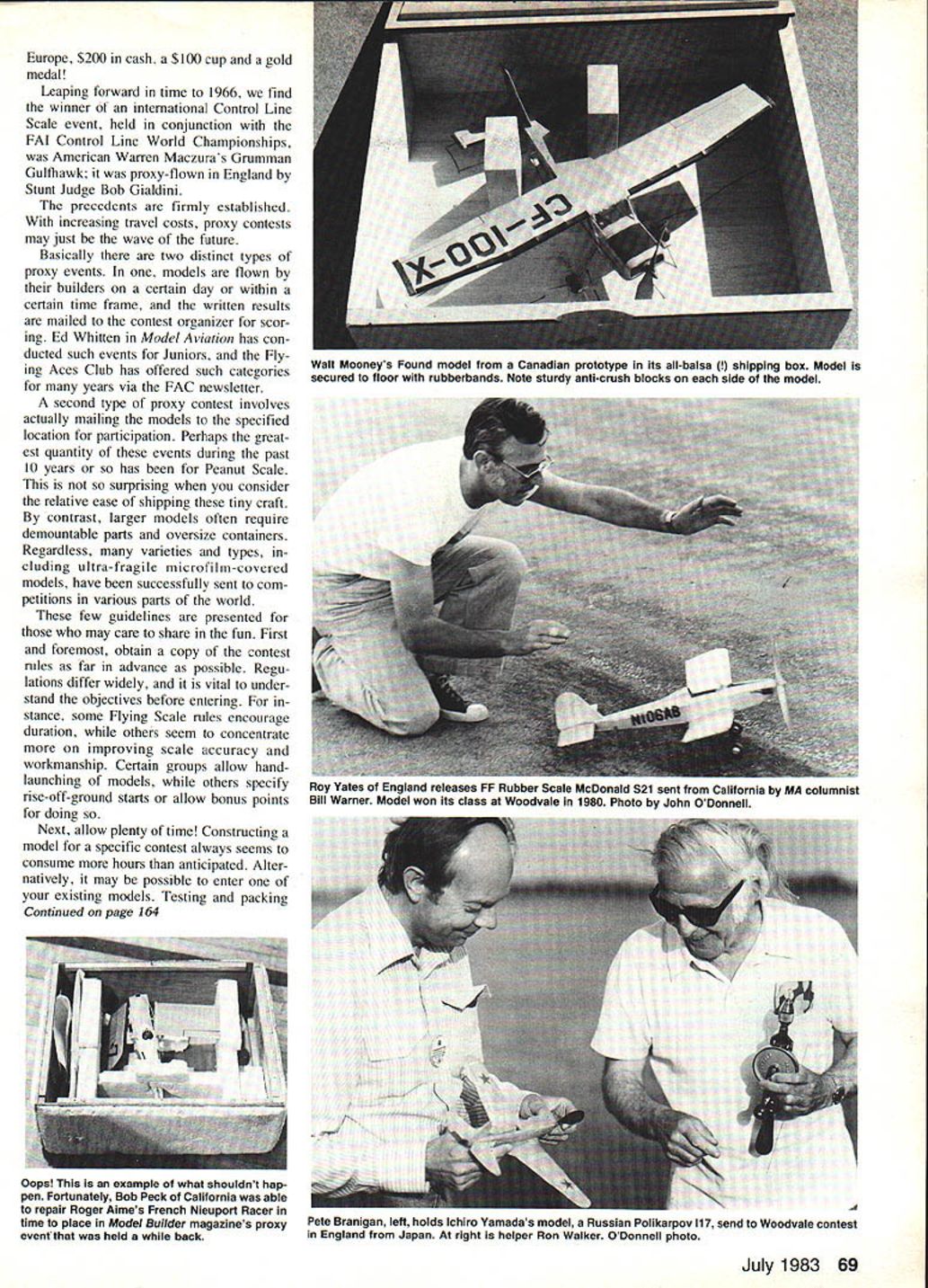
- In 1966, the winner of the international Control Line Scale event held in conjunction with the FAI Control Line World Championships was the American entry, Warren Maczura's Grumman Gulfhawk, proxy-flown in England.
Precedents firmly established and increasing travel costs suggest that proxy contests may well remain a viable option for those wishing to compete internationally.
Types of proxy events
Basically there are two distinct types of proxy events:
- Mail-in results: Models are flown by their builders on a certain day or within a certain time frame, and the written results are mailed to the contest organizer for scoring. Ed Whitten in Model Aviation has conducted such events for Juniors, and the Flying Aces Club has offered such categories for many years via the FAC newsletter.
- Mailed models: Models are actually mailed to the specified location for participation. The greatest quantity of these events during the past decade or so has been for Peanut Scale, due to the relative ease of shipping these tiny craft. Larger models often require demountable parts and oversize containers, but many varieties — including ultra-fragile microfilm-covered models — have been successfully sent to competitions worldwide.
Guidelines for entering by proxy
These guidelines are presented for those who may care to share in the fun:
- Obtain a copy of the contest rules as far in advance as possible. Regulations differ widely, and it is vital to understand the objectives before entering. For example, some Flying Scale rules encourage duration, while others emphasize scale accuracy and workmanship. Some groups allow hand-launching, others specify rise-off-ground starts or allow bonus points for doing so.
- Allow plenty of time. Constructing a model for a specific contest usually takes more hours than anticipated. Testing and packing can also soak up time.
- Allow adequate time for shipping. Even with air mail, delays can occur; models have missed contests by as little as one day. Postal strikes and customs delays have caused additional hang-ups, though such incidents are infrequent.
- Communicate clearly with the contest organizer and with your proxy (if one is to fly the model). Arrange who will provide fuel, props, or any special handling instructions.
Packing and shipping tips
Careful packing is a must if models are to be transported safely. It is unrealistic to expect Fragile or This Side Up notices to do much to protect delicate models. Strive to "bullet-proof" the container to withstand anticipated stresses.
- Containers that have been used successfully:
- Small suitcases
- Metal boxes
- Wooden boxes
- Reinforced cardboard cartons
- Techniques to consider:
- Box-within-a-box concept to isolate contents from outside pressure and shocks
- Internal bracing and foam padding around delicate parts
- Removing or reinforcing vulnerable appendages (propellers, landing gear, antennae)
- Marking contents clearly and including contact information and return instructions
Conclusion
Proxy contests offer a low-cost, rewarding way to participate in international modeling without traveling. With proper planning, careful construction, and robust packing, your models can travel the world, make new friends, and bring home honors — all by proxy.
Transcribed from original scans by AI. Minor OCR errors may remain.

