
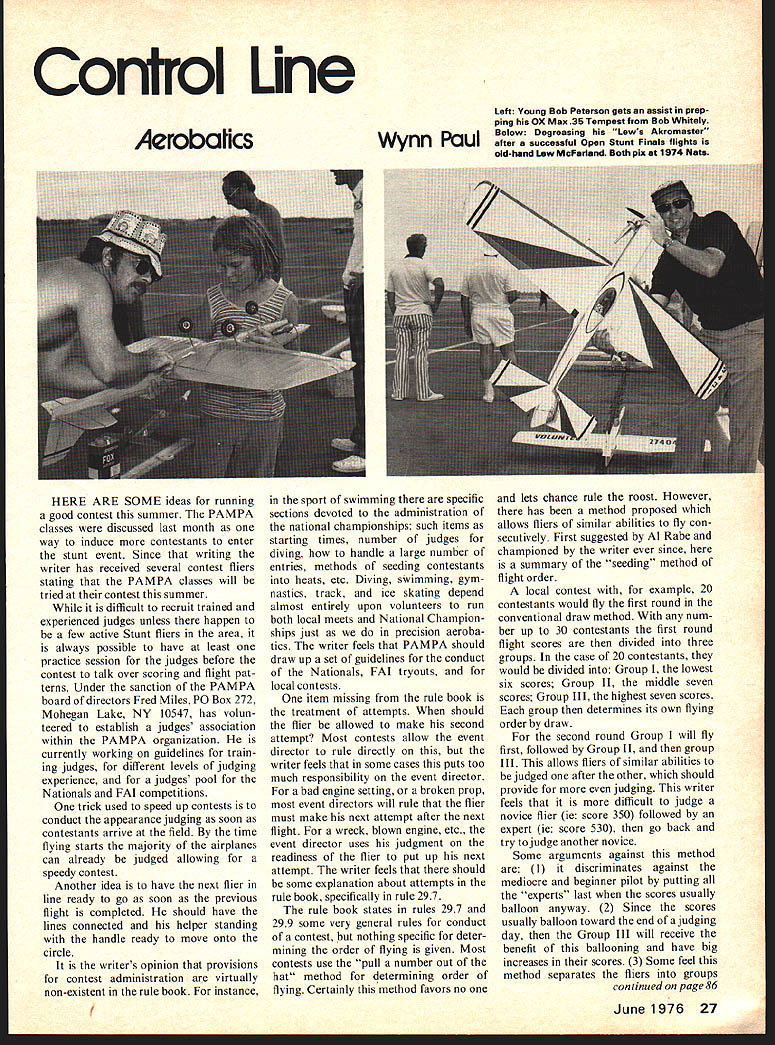
Control Line: Aerobatics
Wynn Paul
HERE ARE SOME ideas for running a good contest this summer. The PAMPA classes were discussed last month as one way to induce more contestants to enter the stunt event. Since that writing the writer has received several contest fliers stating that the PAMPA classes will be tried at contests this summer.
While it is difficult to recruit trained and experienced judges unless there happen to be a few active Stunt fliers in the area, it is always possible to have at least one practice session for the judges before the contest to talk over scoring and flight patterns. Under the sanction of the PAMPA board of directors Fred Miles, P.O. Box 272, Mohegan Lake, NY 10547, has volunteered to establish a judges' association within the PAMPA organization. He is currently working on guidelines for training judges, for different levels of judging experience, and for a judges' pool for the Nationals and FAI competitions.
One trick used to speed up contests is to conduct the appearance judging as soon as contestants arrive at the field. By the time flying starts the majority of the airplanes can already be judged allowing for a speedy contest.
Another idea is to have the next flier in line ready to go as soon as the previous flight is completed. He should have the lines connected and his helper standing with the handle ready to move onto the circle.
It is the writer's opinion that provisions for contest administration are virtually non-existent in the rule book. For instance in the sport of swimming there are specific sections devoted to the administration of the national championships: such items as starting times, number of judges for diving, how to handle a large number of entries, methods of seeding contestants into heats, etc. Diving, swimming, gymnastics, track, and ice skating depend almost entirely upon volunteers to run both local meets and National Championships just as we do in precision aerobatics. The writer feels that PAMPA should draw up a set of guidelines for the conduct of the Nationals, FAI tryouts, and for local contests.
One item missing from the rule book is the treatment of attempts. When should the flier be allowed to make his second attempt? Most contests allow the event director to rule directly on this, but the writer feels that in some cases this puts too much responsibility on the event director. For a bad engine setting, or a broken prop, most event directors will rule that the flier must make his next attempt after the next flight. For a wreck, blown engine, etc., the event director uses his judgment on the readiness of the flier to put up his next attempt. The writer feels that there should be some explanation about attempts in the rule book, specifically in rule 297.
The rule book states in rules 29.7 and 29.9 some very general rules for conduct of a contest, but nothing specific for determining the order of flying is given. Most contests use the "pull a number out of the hat" method for determining order of flying. Certainly this method favors no one and lets chance rule the roost. However, there has been a method proposed which allows fliers of similar abilities to fly consecutively. First suggested by Al Rabe and championed by the writer ever since, here is a summary of the "seeding" method of flight order.
A local contest with, for example, 20 contestants would fly the first round in the conventional draw method. With any number up to 30 contestants the first round flight scores are then divided into three groups. In the case of 20 contestants, they would be divided into: Group I, the lowest six scores; Group II, the middle seven scores; Group III, the highest seven scores. Each group then determines its own flying order by draw.
For the second round Group I will fly first, followed by Group II, and then Group III. This allows fliers of similar abilities to be judged one after the other which should provide for more even judging. The writer feels that it is more difficult to judge a novice flier (i.e. score 350) followed by an expert (i.e. score 530), then go back and try to judge another novice.
Some arguments against this method are: (1) It discriminates against the mediocre and beginner pilots by putting all the "experts" last when the scores usually balloon anyway. (2) Since the scores usually balloon toward the end of a judging day, the Group III will receive the benefit of this ballooning and have big increases in their scores. (3) Some feel this method separates the fliers into groups. from which they cannot break out. (4) People with overruns, engine failures, etc., in the first round will be discriminated against having to fly in Group I in the finals. (5) The best flier will win anyway so why make things so complicated.
As stated earlier it seems a good deal more fair to judge all of the novice or beginner fliers at the same time so that a comparison of like abilities can be used. Also, the chance method of flight order allows someone who gets a lucky draw when the wind is just right to put up a good flight and then sit back while the others have to fight the wind later in the round. Or, the opposite can happen with the wind being up at the start of the round and dying down at the end of the 20 flights. By selective grouping or seeding the groups of similar ability will have somewhat similar atmospheric conditions.
This method of seeding was tried at the 1975 Nationals in England and according to PAMPA correspondent Glen Alison it worked out quite well. They had three groups of fliers for the second and third round of flights. (England uses the FAI scoring with theoretical flights.)
Al Rabe's original proposal was directed toward seeding at the Nationals where the best five to seven fliers are taken off each qualifying circle. Briefly, his idea was that with three qualifying circles and six qualifiers from each circle, the number six qualifiers flew first in the finals, followed by the number five qualifiers from each circle, then the number four men, etc. He suggested that the number one qualifiers from each circle would draw for positions within their group. His proposal kept the same flying order for the second round of the finals.
What the writer has proposed is a slight modification of Al's basic proposal fitted to the local contest. For Nationals' competition, the writer feels that the draw should be used for the first round of the finals. The seeding method should be used for the second round. However, the writer strongly desires a change in the Nationals format so that the winner is determined from the best two of three official flights.
Picking a National Champion from one flight is chancy, and not entirely fair, especially when using a blind draw since there have been national champions determined by early or late draws with ideal or poor wind conditions.
How about trying this method of determining flight order this summer at your contest. It will be used at the Mid-America Championships in Lexington, KY. Instruction sheets showing how to utilize the seeding method, as well as PAMPA classes for competition will be mailed out to CD's for contests in the AMA calendar as well as being sent to anyone who writes the author at: 1640 Maywick Drive, Lexington, KY 40504.
Transcribed from original scans by AI. Minor OCR errors may remain.

