
Control Line: Aerobatics
Ted Fancher
WOW! I knew we "contributing editors" gained enormous influence as a result of our monthly blatherings, but I never would have guessed that we could bring the dead back to life! Al Rabe, no less, and in mid-season form. (See "On CL Stunt Design," MA January 1985.) It seems that my toss-off column on P-factor has become almost a cause célèbre amongst Stunt aficionados who are proving themselves to be much more sophisticated and "into" the aerodynamic puzzles of our adult divertissements (grown-ups' toys) than I ever would have guessed. Very pleasing and encouraging to me, as it opens the door to future subject matter which is much more interesting to me.
Although I was very much tempted to rebut Al's article item by item, common sense finally prevailed. As I stated in my own column in January, this controversy is assuming proportions far beyond its importance. Al and I obviously disagree, and I doubt very much that either of us is going to convince the other of the error of his ways.
However, I do want to use some of the points of disagreement to lead into two new areas which are significant in Stunt design and flying: pitching moment in design, and the reasons for the "apparent" reduced tension in outsides for which Al is seeking remedies in flight. (Boy, I can feel the howls of protest from about 50% of you already starting to fill my mailbox!)
In support of his theories, Al submitted two drawings of propeller and wing sections, both wings at the same "aerodynamic" angle of attack; i.e., the angle of the relative wind to the chord line of the wing. One wing achieved this angle through deflection of the flaps and the other through pitching the unflapped wing nose-high. His point was that the flapped wing achieved this angle of attack without pitching the aircraft, and thus the aircraft would "turn" without ever changing its "geometric" angle of attack (i.e., the angle at which the aircraft itself strikes the relative wind). The consequence of this would be that P-factor influences would never be generated. (Curiously, he never addresses the unflapped wing, which is obviously in a nose-high attitude and thus generating P-effects... perhaps the rudder should work one way on flapped Stunters and the other way on unflapped ones? Sorry, cheap shot.)
The apparent conclusion we are supposed to draw is that this lift causes the aircraft body angle to change. Well, if anyone really feels that any aircraft, flapped or unflapped, can make an abrupt pitch change of 90° or more without achieving a positive geometric angle of attack (body angle) to the relative wind, I can certainly understand how he came into possession of all that beachfront property he's trying to palm off on me.
Pitching Moment in Design
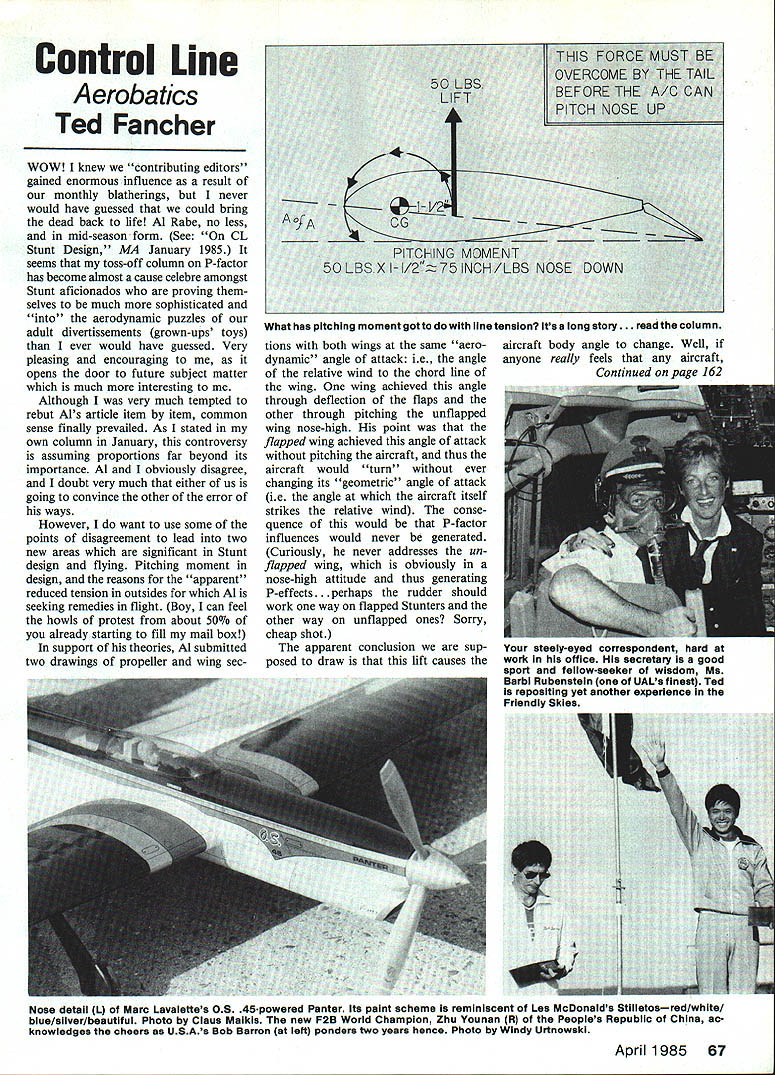
Take a look at my drawing, which is similar to Al's with the addition of two pieces of information. These two items, a lift vector and the center of gravity (CG), are the major factors in the phenomenon known as "pitching moment." For your Stunt glossary: a "moment" is the product of a force applied over a given distance from a fulcrum. On a Stunt ship the CG is the fulcrum, and all forces applied will cause the ship to react about the CG. Ergo, 50 pounds of lift applied 1½ inches aft of the CG will produce 75 inch‑pounds of torque about the CG.
Weight acts upon the airframe at the center of gravity. The CG of most competitive Stunters (with the gas tank empty) is located approximately 16% aft of the leading edge at the mean chord. (You can either take my word for it or go measure some plans, as I did. To reassure myself, I measured Al's models and found them to be 16‑percenters, as well.)
As you can see, the net result of these lift and weight vectors is a nose-down force. In level flight, the pitching moment is small—but still exists. This is where the stabilizing function of the tail surfaces comes into play. The tail must supply a slight download to overcome the negative pitching moment. When the wing's angle of attack is increased so that the lift produced exactly equals the weight of the aircraft plus the download on the tail, stable level flight will be maintained. This answers the recurring question as to how a symmetrical, "non-lifting" airfoil can fly straight and level. If the CG is moved aft of the center of lift, this moment will become destabilizing, and the ship will not fly level... the tail-heavy experience to which we can all relate.
Back to the drawing. If we suddenly deflect the flaps, as in a square-cornered maneuver, we instantly (and dramatically!) increase the lift vector. In addition, since the point at which the lift is centered moves aft on a cambered surface, we have also increased the distance between the CG and the center of lift. The result of these changes is a dramatically increased pitching moment which, despite the generally vertical component, acts behind the CG and will thus result in the aircraft pitching nose-down. If you doubt this, disconnect your elevator and "turn" your ship with flaps. (Hint: Use an old airplane.)
In practice, this adverse pitching moment on a Stunt ship is overcome by very powerful horizontal tail surfaces, coupled to the flaps, which rotate the ship about the center of gravity to the desired body angle—coincidentally achieving a positive body angle to the relative wind, thus introducing the necessary prerequisites for P-effects to become a factor. (Heh, heh, who'd a thunk it, didn't I?)
Flaps and Turning
Let's make some general statements on flaps with the foregoing in mind.
- Flaps increase lift; they do not "turn" the airplane. In fact, they retard the rate of turn on a ship which is stable in the pitch axis, i.e., CG ahead of the center of lift.
- Since they increase lift, their primary advantage in a Stunter is to allow us to fly a heavier airplane at high G-loads without exceeding the lift capability of the wing.
Note that it is entirely possible to generate more lift than is required, if the flaps are larger than necessary or deflected more than needed. In this case, you suffer all the consequences of lots of negative pitching moment while gaining nothing of value.
Therefore, if our purpose is to make tighter cornering possible, the ideal flap should be no larger than necessary to provide the lift required by the radius of the corner desired. You have, thereby, kept the adverse pitching moment to a minimum. This, in turn, will reduce the force required from the tail to produce the desired rapid change in pitch. Got that?
Why Outsides Sometimes Seem Light
At the very root of my difference of opinion with Al and some others about P-factor, gyroscopic precession, and so forth, is the conviction on their part that Stunters have less tension in outsides than insides. Not so, I say, and I submit P-factor as evidence of the reverse. I will admit that, at times, in a Stunt pattern the ship seems light on outsides but I still maintain my position with respect to the controversy. How come?
I think three areas distort our perception of line tension:
- Body (human) asymmetry
- Stunt-pattern asymmetry
- Maneuver placement relative to the wind
We maneuver our Stunters primarily through the manipulation of the flying hand, wrist, elbow, shoulder, and fingers. Of these five components, four are essentially uniform in their ability to input Up and Down control. Only the elbow is unidirectional, aiding only the inside maneuvers. Watch most good Stunt fliers, and you will see the following:
- The hand, wrist, and fingers provide the lion's share of control inputs.
- The shoulder joint will change only a little.
- The elbow will provide control input exclusively on insides. In addition, the movement of the elbow effectively pulls the model toward us, thus increasing perceived line tension.
Neither of these forms of aid—in control or tension—is available in outsides. Experiment doing Inside and Outside Loops, Squares, etc., using wrist action only, and see if you don't agree.
Stunt-pattern asymmetry is a more subtle problem. Due to the rules, we don't accomplish similar—but reversed—maneuvers in the same manner or form or from the same starting point. Only the Outside Loops are a mirror-image of the Insides, and I think you will agree that outside tension is generally greater. Inside Square Loops start from level flight with a turn up and away from this already good-tension entry. Outside Square Loops are entered from a position of poor tension—45° flight elevation—and start with a dive, wherein gravity further reduces line tension. We don't do Outside Triangles at all—give them a try, and I think you'll be amazed at the improved line tension in comparison to the insides. The Vertical Eight is obviously discriminatory; the outsides are done above 45° and the insides below. Worst of all is the Hourglass, wherein the toughest corners of the whole pattern are outsides done at the least advantageous of all positions, directly overhead! Finally, consider what is the most flown-out-of-maneuver of the pattern, bar none. That's right, the first loop of the Four Leaf Clover—the only time in the entire pattern that the ship is rotated to an inside maneuver above 45° (except the overheads). Where's precision when you really need it?
Finally, for most fliers, maneuver placement relative to the wind has a serious effect on the outside portions of the Figure Eights and the Four Leaf Clover. The rule book requires that the inside portion of all Figure Eights and the first inside of the Clover be performed first. The flier's natural inclination is to ensure safe entry into the maneuvers, and as a result most will bias the entry to the left side of the inside (sometimes essential with the Four Leaf) but this puts successful completion of the outside portions at jeopardy, as they will be performed entirely to the left of downwind, if the intersections are held. Again, don't take my word for it. Watch some Stunt patterns flown in a breeze without letting your purpose be known and see if it ain't true.
Okay, I've got my armor on. Let me have it!
I haven't plugged PAMPA lately. If you fly Stunt and haven't joined the Precision Aerobatic Model Pilots Association, you're missing half the fun. Contact Doug Figgs at 329 Lincoln Place, Brooklyn, NY 11238. Dues are $15.00 annually and worth it!
Fly Stunt.
Ted Fancher 158 Flying Cloud Isle Foster City, CA 94404
Transcribed from original scans by AI. Minor OCR errors may remain.

