

Control Line: Aerobatics
Editor's Note
If you think you're seeing double this month, you're almost right. Why two Control Line Aerobatics columns this time? It's because Ted Fancher (our regular contributing editor on this subject) has been expounding on things which are dear to the heart of Al Rabe, our special contributor this month. Both of these modelers are acknowledged experts on this subject—and they both cling to certain beliefs about the aerodynamic facts of life in this specialized type of model, which are not in agreement! Who's right? The MA editorial staff doesn't know, so we have agreed to publish Al Rabe's thoughts, which follow, so that any interested modeler can read and judge for himself/herself. Also, Al has something to say about tail-first designs, which may set you to thinking.
Al Rabe
This column is being written because Ted Fancher has been talking about P-factor and (gyroscopic) precession. I want to lay these topics to rest. I'm addressing this issue one more time because Ted misquoted me in one of his columns. Now, I feel that this is important only insofar as any readers of Ted's column (or this one) actually incorporate some of these ideas into the design and/or construction of their airplanes in the hope of having nicer-flying craft and greater competitive success.
For example, a few Stunt fliers have tried such things as shock-absorbing landing gears, significant dihedral, and movable rudders on their airplanes. Many have installed their bellcranks upside down, and nearly everyone uses "sliding-block/slot-tied-wing-tip" adjustable lead-out guides, an idea which I originated in 1968 and which was first published in my Bearcat construction article in 1970.
To decide which features you are going to incorporate into your new Stunt ship, you have a right to evaluate the best available information, accurately presented. It isn't important whether you agree with Ted or with me in our differences over P-factor and precession, so long as those of you who are interested receive a fair presentation.
I tried to present my ideas in the article "On CL Stunt Design" in the January 1985 issue of Model Aviation. I tried to present them clearly and accurately. I think that most Stunt fliers understood my ideas—until Ted paraphrased them and substituted the expression "turn," where I obviously meant "lift." I certainly had no intention of suggesting that "... an airplane would 'turn' without ever changing its 'geometric' angle of attack." Neither did I suggest that "... lift causes the aircraft body angle to change." Quite the contrary!
I simply said that it was not necessary to change the body angle to create lift.
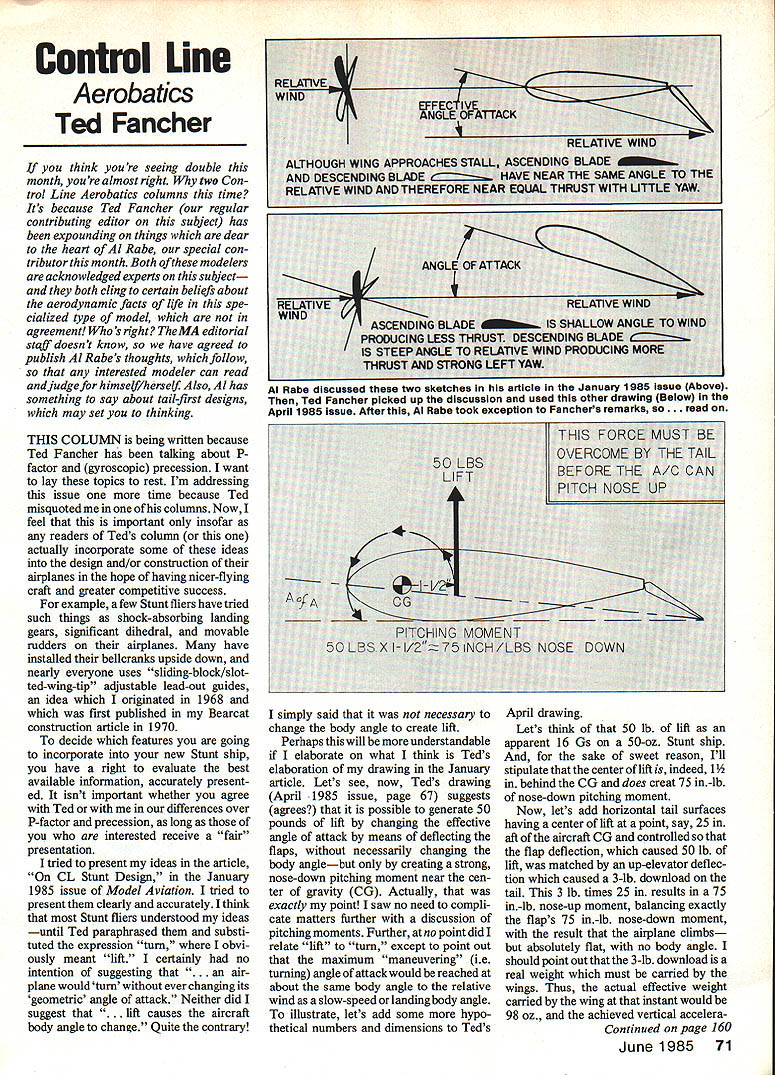
Perhaps this will be more understandable if I elaborate on what I think is Ted's elaboration of my drawing in the January article. Let's see, now, Ted's drawing (April 1985 issue, page 67) suggests (agrees?) that it is possible to generate 50 pounds of lift by changing the effective angle of attack by means of deflecting the flaps, without necessarily changing the body angle—but only by creating a strong nose-down pitching moment near the center of gravity (CG). Actually, that was exactly my point! I saw no need to complicate matters further with a discussion of pitching moments. Further, at no point did I relate "lift" to "turn," except to point out that the maximum "maneuvering" (i.e., turning) angle of attack would be reached at about the same body angle to the relative wind as in a slow-speed or landing body angle.
To illustrate, let's add some more hypothetical numbers and dimensions to Ted's April drawing.
Let's think of that 50 lb. of lift as an apparent 16 Gs on a 50-oz. Stunt ship. And, for the sake of sweet reason, I'll stipulate that the center of lift is, indeed, 1-1/2 in. behind the CG and does create 75 in.-lb. of nose-down pitching moment.
Now, let's add horizontal tail surfaces having a center of lift at a point, say, 25 in. aft of the aircraft CG and controlled so that the flap deflection, which caused 50 lb. of lift, was matched by an up-elevator deflection which caused a 3-lb. download on the tail. This 3 lb. times 25 in. results in a 75 in.-lb. nose-up moment, balancing exactly the flaps' 75 in.-lb. nose-down moment, with the result that the airplane climbs—but absolutely flat, with no body angle change. I should point out that the 3-lb. download is a real weight which must be carried by the wing. Thus, the actual effective weight carried by the wing at that instant would be 98 oz., and the achieved vertical acceleration would be closer to 8 Gs.
While such an airplane configuration is possible, I'd be the first to admit that its performance would be more akin to that of an elevator than to a Stunt ship. An airplane would be incapable of a Stunt pattern without positive (and negative) body angle. Does this mean I surrender? Not quite.
As Ted correctly pointed out, ineffective tail surfaces (elevator pushrod disconnected) will cause a violent nose-down response to up-elevator (down-flap) control (reversed control, with a vengeance). But, why be so extreme? If, when the deflected flaps create 75 in.-lb. of nose-down moment, the tail surfaces produce only 2.8 lb. of download (70 in.-lb. of nose-up moment) because the elevators are too small in size or with too little deflection, the result will still be reversed controls, but not so violently. If that same flap deflection and "stronger" tail surfaces produced a 3.2-lb. download (80 in.-lb. of nose-up moment), the result would be a positive, nose-up rotation in response to up-control application.
Let's put it together. Here we have a Stunt ship with a wing-bending load of 50 lb. and a 3-oz. change in the tail load that causes it to turn. It's my opinion that the real work in this situation is the high lift required to oppose the high G-loads of a tight corner. Relatively little effort is required to change the body angle, and that relatively little change in body angle is required to produce the desired up- or down-rotation necessary to turn sharply.
Once again, the maneuvering body angle at maximum loads should approximate the body angle of a slow-speed stall. In the case of a full-flap Stunt ship, we observe the body angle, in such a case, to be a slight one; thus, insignificant pitch—insignificant "P-factor."
That statement does not (and did not) read: "No pitch—no 'P'." It simply assigns to the real effects of "P" (which I recognized and addressed) less importance than the effect of precession in the application to the full-flap Stunt ships.
To summarize, I do not suggest that "...an aircraft ... can make an abrupt pitch change ... without achieving a positive geometrical angle of attack..." I did add sufficient proper and accurate modifiers to my various statements, such as, "...dramatically reduced the body angle to the relative wind..." and "Stunt ships usually have small body angles to land;" and "they stall with little nose-up pitch." All of my statements flatly suggest that, while the need for positive pitch is minimal on a full-flap Stunt ship, in each case, some is appropriate. In short, having studied Ted's rebuttal and answered it, I am not persuaded that changing one word of my article is either necessary or appropriate.
Finally, Ted correctly said that I am convinced that most conventional Stunt ships have less tension flying outside maneuvers than flying inside ones. I didn't arrive at this conviction while assuming "break dancing" body positions while doing mythical "Outside Triangles." It was a simple observation that anyone can make. If the airplane was directly downwind and climbing vertically below 45° (center of traditional Square Eight), it would pull harder if I applied up-control at the "45" than if I applied down-control. This simple test will divide Stunt fliers into "Precessers" and "P-ers."
Ted and I have both pointed out, now, that conventionally-configured airplanes (stab brings up the rear) require a download on the tail for stability. Full-size airplanes are carefully designed to be safe and stable with a minimum of payload-destroying download. Since jet fuel costs went out of sight, we don't just load our 727s within the approved CG range any longer—now, we try to load within the "economy" range of the CG, which is roughly the rear half of the approved range. I'd guess that full-size, conventional aircraft probably carry 3%–5% less payload than, say, a flying wing of the same gross weight and wing area.
Efficiency-wise, Stunt ships are in another class, entirely. First, we build super-stable airplanes to "grooooove" by placing the CG (balance point) much farther forward than necessary for normal, stable flight. Then, we use large, full-span flaps to obtain high lift and sharp corners. These coupled flaps create both high lift and strong negative pitching moments. Without quite knowing why, we all build airplanes with super-effective stabs and powerful elevators as the most practical way to lever our Stunt ships out of their grooves into sharp turns and to overcome the terrific negative pitching moment of full-span flaps. The arbitrary numbers that Ted and I have bandied about probably overstate the case. However, without doubt, we pay a large penalty in lost payload capability (which corresponds to a reduction of G-pulling capacity) with our Stunt ships. I guess the loss to be in the 20%–25% range for airplanes with high wing loadings and big, stiff flaps — and somewhat less for lightly-loaded "classics" with smaller flaps or less flap travel.
If we all suffer this real loss of potential performance more or less equally, no one is at a competitive disadvantage until some "sharpie" comes along with a canard (stab in front), well-enough designed and "pretty" enough to overcome a judge's natural bias against non-conforming airplanes. That guy just might blow our doors off. You see, unlike conventional airplanes, the stab on a stable canard actually carries part of the weight in level or high-G maneuvering flight. The canard doesn't suffer a penalty for a downloaded stab: it gains bonus performance for an uploaded stab. As a result, the canard can carry more weight, or have a smaller wing, or turn tighter.
Look around, guys. We are still flying all the old "classics." The latest bomber (the "Stealth") is reported to be a flying wing. Lockheed has proposed a super-efficient canard airliner for the Nineties. In business aviation, the Beech Starship, Avtec 400, and Omac's Laser 300 are flying now, and all are canards. In military aviation, the Northrop X-29 is not only a canard, but it has swept-forward wings, as well. In general aviation, Burt Rutan's popular homebuilt Vari-Eze and his around-the-world Voyager are both canards. The signs are there: canards will come to Stunt.
This is inevitable as radical new configurations are developed, we can already see some problems associated with their practical development—and maybe a solution here or there.
First, let's look at flying wings for Precision Aerobatics. Flapless, Combat-style airplanes can never do slow, accurate, precision maneuvers. When the elevators on a flying wing are deflected upward, the effective downwash is the same as raising the flaps on a conventional Stunt ship: negative (downward) lift—and lots of it. Next, the elevons change the pitch attitude of the wing. When the overall increased lift of the pitched-up wing offsets the down force of the elevons, the sink stops (though pitch will continue to change as long as the elevons are deflected). When the desired pitch attitude is reached and the elevator is neutralized, there will be a sort of an upward bounce in the airplane from elimination of the downward lift. In short, corners flown by a flapped flying wing can never approximate a smooth radius. They will always have funny little "sinks" and "bounces."
Another unusual characteristic of the flapless flying wing was demonstrated by one of my early designs, a semiscale Me 163B that would not take off with up-elevator. When up-elevator was applied on the ground, it couldn't rotate the airplane upward, and the negative lift created sure pushed that sucker to the ground. To fly it, I had to raise the flaps (or in this case, lower the elevon) to get it clear of the ground and then follow with up-elevator for subsequent airborne trimmed flight.
Trailing edge flaps obviously won't work on a flying wing, either. I think a Precision Stunt flying wing would be possible only if it had sets of flush-mounted flaps on the upper and lower wing surfaces located near the spar. The bottom flap would operate with up-elevator to provide enough lift to balance the sinking tendency as the pitch attitude changed, and vice versa. When the desired pitch attitude was obtained, the flap would retract as the elevators centered. Positive and negative lift would disappear simultaneously without "bouncing" the wing. While spar-mounted flaps wouldn't be as efficient lift-producers as trailing edge flaps, they should, nevertheless, work.
Actually, canards will be easier to design and fly. The CG will still be conventionally located at or just ahead of the spar. Wing design and lead-out position will remain unchanged. The stab will be moved to the front and can probably be reduced in size. To keep a normal, near-spar balance point, the engine will probably have to be moved to the rear and installed in a "pusher" configuration. Even this has aerodynamic advantages, as the rear engine of push/pull twins (like the Cessna Skymaster) usually has greater thrust from improved airflow into and out of the prop. Aerodynamics will also be improved by removing propswash from the airframe. The biggest problem with pusher canards will probably be engine heat. We have troubles enough cooling our Stunt engines when they are directly in "prop-blasted" flow. Without that blast of cooling air, supplementary cooling (probably liquid cooling) will be required. It will be tough, but it can be done—and the rewards of canard performance improvement could be rich.
When will my canard fly? Welllll, my retract-equipped, twin-engined Hornet has its lines. My molded-balsa P-47N fuselage is finished, as is my molded-balsa P-51B fuselage. Also, I have some of the molds finished for my all-glass Ultimate Spitfire. I guess what I'm trying to say is that I, personally, will have trouble replacing those WWII fighters with strange, new shapes, however well they may fly.
With innovation, creativity, experimentation, and a ridiculous amount of effort, I finally managed to make my semiscale Stunters fully competitive with the rest of today's conventional Stunt ships. As I survey the situation, I don't believe there is enough unrealized performance potential left in my semiscale Stunters to compete fully against the improved aerodynamics of radically new ships. What the heck, when that day comes, I'll just fly my Sea Fury in Old-Time Stunt.
Al Rabe, 1904 Valley Oaks Ct., Irving, TX 75061.
Ted Fancher
Still my own opinion, here. The flaps have a strong effect on tracking. Particularly influential is their spanwise distribution. As flaps get shorter, tracking suffers. Flaps should be long in span and narrow in chord.
A rule of thumb from Fancher:
- Flaps should be full-span, or nearly so, and their chord should range from 15% to 20% of the wing chord, depending on aircraft weight.
- Their hingeline should be straight. Since a Stunter flies in a constant left skid, a straight hingeline assures that the airflow across the airfoil is as consistent as possible for the entire span.
- The final design objective is uniformity of turn (pitch). The prime design factor here is decalage. Decalage is a fancy term for alignment of the wing and tail. To be blunt, there should be no decalage in a Stunter. The centerlines of the wing and tail, and for that matter the thrust line, must all be parallel. Any misalignment of any of these in either design or construction will result in a plane which turns differently inside versus outside. Don't do it.
Secondarily, be aware of where you locate large draggy parts of the airplane. Uneven vertical distribution of the drag relative to the CG will result in unequal turns. No rules of thumb for this one. You must eyeball the side view and make an educated guess on drag distribution. The same goes for drag's opposite number, thrust. Don't mount your engine on a pylon above the tail and expect your ship to turn well inside!
This about winds up the design phase. Next month, we'll do a preflight and get started flying.
Ted Fancher, 158 Flying Cloud Isle, Foster City, CA 94404.
Transcribed from original scans by AI. Minor OCR errors may remain.

