
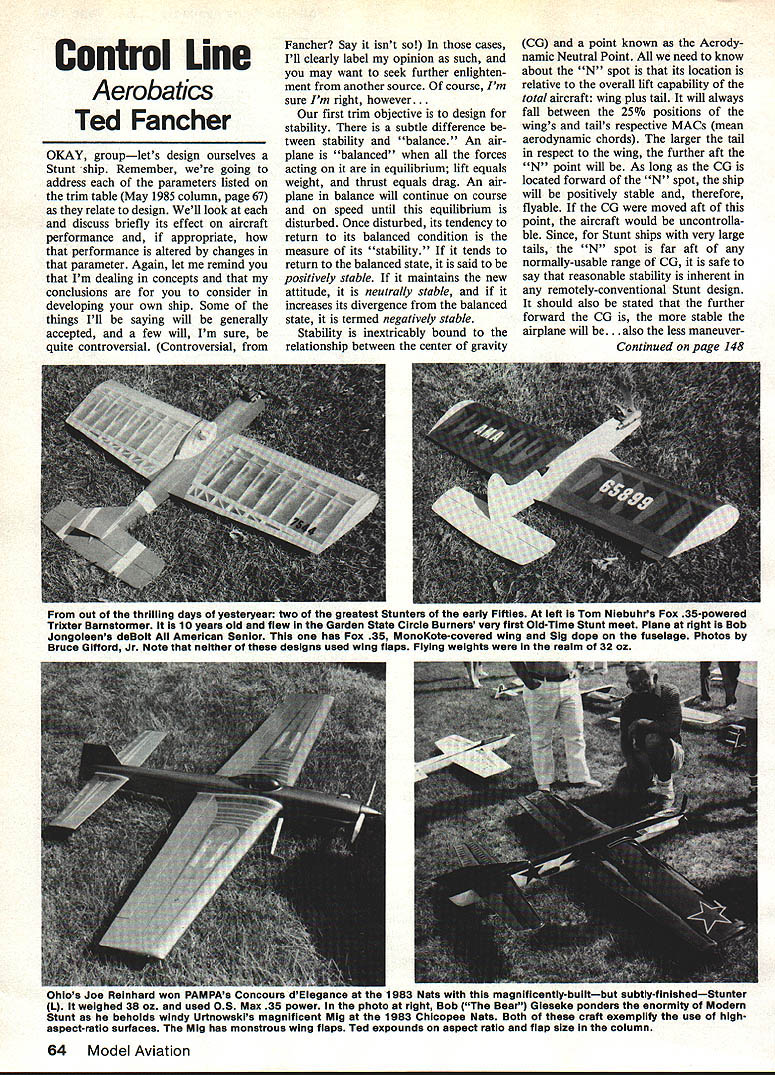
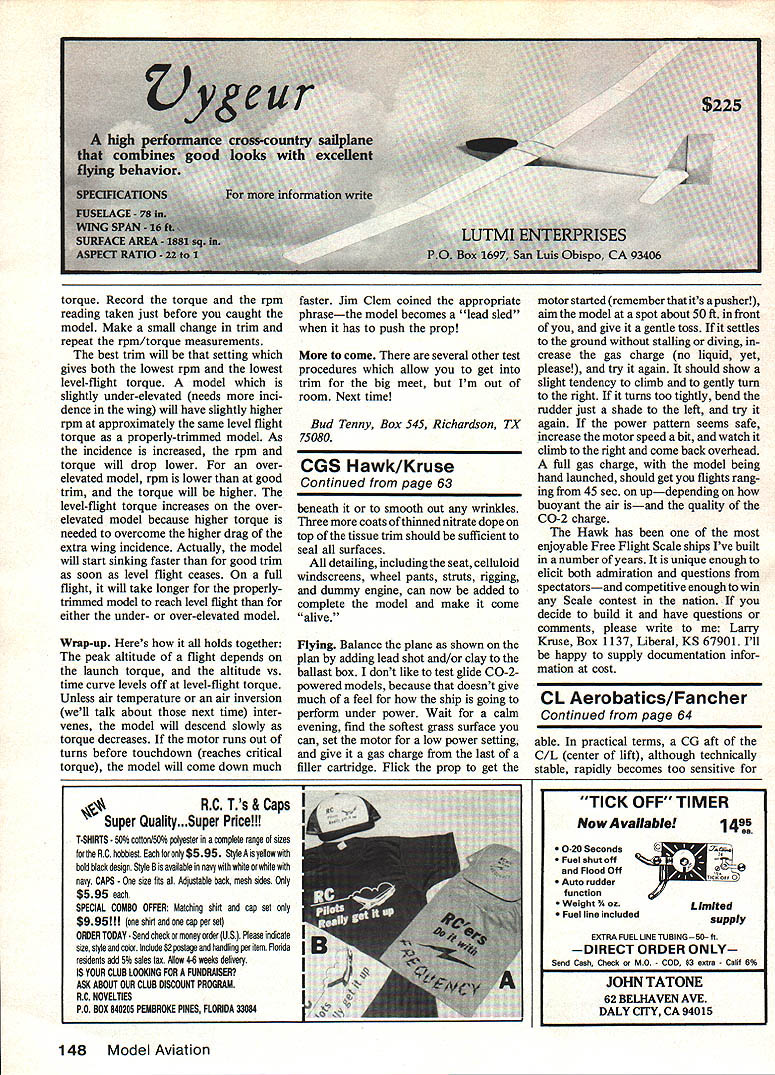
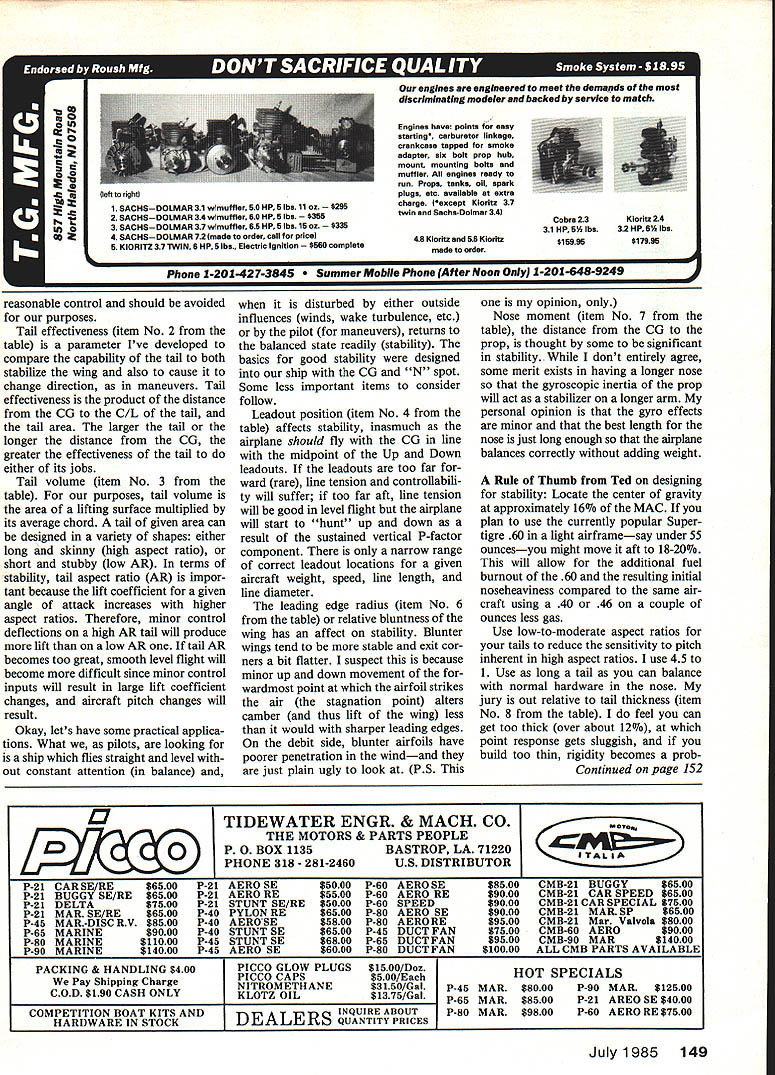
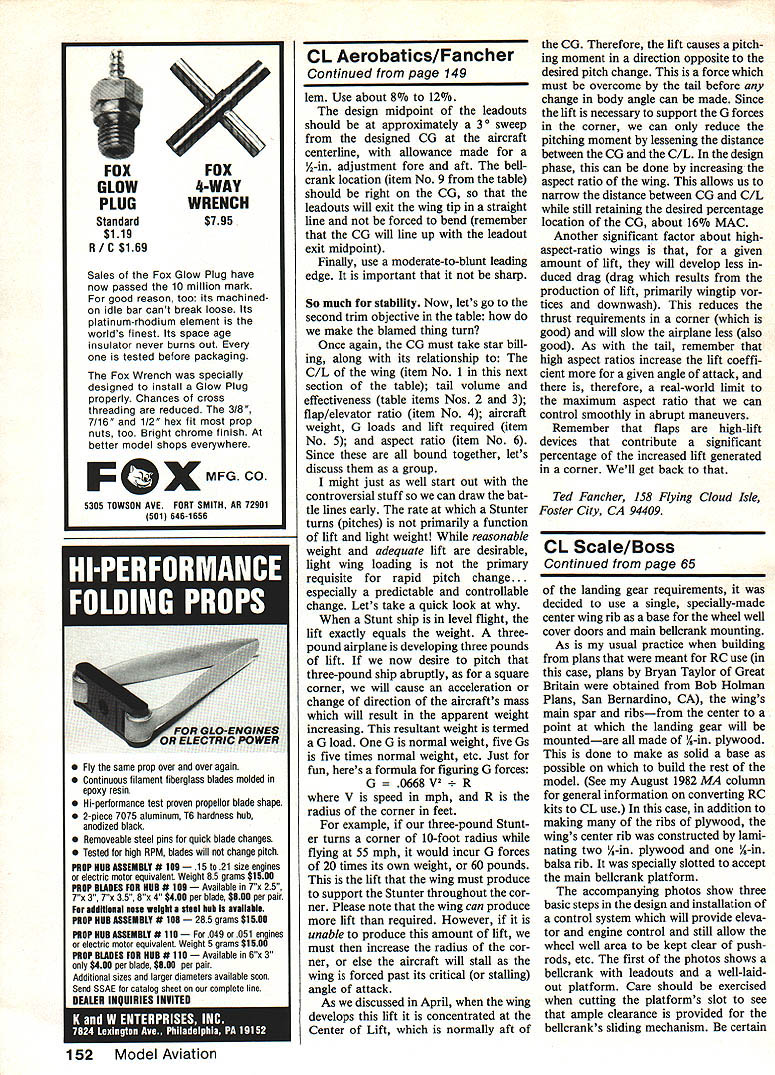
Control Line: Aerobatics
Ted Fancher
Stability
There is a subtle difference between stability and "balance." An airplane is "balanced" when all the forces acting on it are in equilibrium: lift equals weight, and thrust equals drag. An airplane in balance will continue on course and speed until this equilibrium is disturbed. Once disturbed, its tendency to return to its balanced condition is the measure of its "stability." If it tends to return to the balanced state, it is positively stable. If it maintains the new attitude, it is neutrally stable. If it increases its divergence from the balanced state, it is negatively stable.
Aerodynamic Neutral Point (N)
Stability is inextricably bound to the relationship between the center of gravity (CG) and a point known as the Aerodynamic Neutral Point (N). The "N" spot's location is relative to the overall lift capability of the total aircraft: wing plus tail. It will always fall between the 25% positions of the wing's and tail's respective mean aerodynamic chords (MACs). The larger the tail relative to the wing, the farther aft the "N" point will be. As long as the CG is located forward of the "N" spot, the ship will be positively stable and therefore flyable. If the CG is aft of this point, the aircraft would be uncontrollable.
For Stunt ships with very large tails, the "N" spot is far aft of any normally usable CG range, so reasonable stability is inherent in most conventional Stunt designs. It should also be stated that the further forward the CG is, the more stable the airplane will be — and also the less maneuverable. Excessive forward CG that results in reduced control should be avoided for our purposes.
Tail effectiveness (Item No. 2)
Tail effectiveness is a parameter to compare the tail's capability to both stabilize the wing and to cause it to change direction (as in maneuvers). Tail effectiveness is the product of the distance from the CG to the centerline of the tail and the tail area. The larger the tail or the longer the distance from the CG, the greater the effectiveness of the tail to do either job.
Tail volume (Item No. 3)
For our purposes, tail volume is the area of a lifting surface multiplied by its average chord. A tail of a given area can be designed in various shapes: long and skinny (high aspect ratio) or short and stubby (low AR). In terms of stability, tail aspect ratio is important because the lift coefficient for a given angle of attack increases with higher aspect ratios. Therefore, minor control deflections on a high-AR tail will produce more lift than on a low-AR tail. If tail AR becomes too great, smooth level flight will become more difficult since minor control inputs will result in large lift-coefficient changes and large pitch changes.
Leadout position (Item No. 4)
Leadout position affects stability because the airplane should fly with the CG in line with the midpoint of the up and down leadouts. If the leadouts are too far forward (rare), line tension and controllability suffer; if too far aft, line tension will be excellent in level flight but the airplane will "hunt" up and down due to a sustained vertical P-factor component. There is only a narrow correct range of leadout locations for a given aircraft weight, speed, line length, and line diameter.
Leading edge radius (Item No. 6)
The leading edge radius, or relative bluntness of the wing, affects stability. Blunter wings tend to be more stable and exit corners a bit flatter. This may be because minor up-and-down movement of the forwardmost stagnation point alters camber (and thus lift) less than with sharper leading edges. On the downside, blunter airfoils have poorer penetration in wind — and are less attractive visually. (This is the author's opinion.)
Nose moment (Item No. 7)
Nose moment is the distance from the CG to the prop. Some believe it is significant in stability because the prop's gyroscopic inertia on a longer arm can act as a stabilizer. The author feels the gyroscopic effects are minor and that the best nose length is just long enough so the airplane balances correctly without adding unnecessary weight.
Rule of Thumb (design for stability)
- Locate the center of gravity at approximately 16% of the MAC. If you plan to use the popular Super-Stripe .60 in a light airframe (under about 55 ounces), you might move it aft to 18–20% to allow for fuel burn-out and the resulting initial nose-heaviness compared with a .40 or .46 engine or less fuel.
- Use low-to-moderate aspect ratios for tails to reduce pitch sensitivity; 4.5–5 AR is suggested.
- Use as long a tail as you can balance with normal nose hardware.
- Tail thickness: avoid too thick (over about 12%) where response gets sluggish; too thin risks lack of rigidity. Use about 8% to 12%.
- The design midpoint of the leadouts should be at approximately a 3° sweep from the designed CG at the aircraft centerline, with allowance for a 1/2-inch fore-and-aft adjustment.
- Bellcrank location (Item No. 9) should be right on the CG so the leadouts exit the wingtip in a straight line and are not forced to bend.
- Use a moderate-to-blunt leading edge; avoid a sharp edge.
Turning (making the airplane pitch)
To make the airplane turn (pitch), the CG again takes star billing along with:
- the center of lift (C/L) of the wing (item No. 1),
- tail volume and effectiveness (items Nos. 2 and 3),
- flap/elevator ratio (item No. 4),
- aircraft weight, CG loads and lift required (item No. 5),
- and aspect ratio (item No. 6).
These factors are interrelated.
A controversial point: the rate at which a Stunter turns (pitches) is not primarily a function of light weight and lift. While reasonable weight and adequate lift are desirable, light wing loading is not the primary requisite for rapid, predictable, and controllable pitch change.
When a Stunt ship is in level flight, lift equals weight. If we wish to pitch that ship abruptly (e.g., a square corner), the maneuver causes an acceleration of the mass, producing an apparent weight increase — a G load. One G is normal weight; five Gs is five times normal weight. A formula for G forces is:
G = 0.0686 × V^2 / R
where V is speed in mph and R is the radius of the corner in feet.
Example: a three-pound Stunter turning a 10-foot-radius corner at 55 mph would incur roughly 20 Gs, or about 60 pounds of lift demand. The wing must produce this lift throughout the corner. If the wing cannot produce the required lift, you must increase the corner radius or the wing will stall as it is driven past its critical angle of attack.
When the wing develops the needed lift, the lift is concentrated at the Center of Lift, normally aft of the CG. Therefore, the lift produces a pitching moment opposite the desired pitch change, which must be overcome by the tail before the body angle changes. Since lift is necessary to support the G load in the corner, the pitching moment can only be reduced by lessening the distance between the CG and the C/L. In the design phase, this can be achieved by increasing the wing's aspect ratio. This allows narrowing the distance between the CG and C/L while retaining the desired CG percentage location (about 16% MAC).
High-aspect-ratio wings also develop less induced drag for a given amount of lift (induced drag results from wingtip vortices and downwash). This reduces thrust requirement in a corner and slows the airplane less. As with tails, remember that high aspect ratios increase lift coefficient more for a given angle of attack, so there is a practical limit to the maximum AR that can be smoothly controlled in abrupt maneuvers.
Remember that flaps are high-lift devices that contribute a significant percentage of the increased lift generated in a corner.
Ted Fancher 158 Flying Cloud Isle Foster City, CA 94409
Transcribed from original scans by AI. Minor OCR errors may remain.

