
Control Line: Aerobatics
Ted Fancher
WELL, I suspect that since reading last month's windup on the design phase of Stunt model trim, you have all spent the last 30 days designing, building, and painting a brand new Stunter. You are, at this very moment, standing at your mailbox with the new ship in one hand and the car keys in the other, awaiting this month's column on preflight trim and finally flying the thing. Well, here it is, so jump in the car, and let's go.
Preflight inspection — general
Let's begin with a careful examination of the ship to ensure that it not only conforms to our design criteria, but also that all the bits and pieces are ready for flight.
- Double-check that all screws and keepers are secure.
- Frequently-forgotten items to verify:
- Spinner and prop nuts
- Engine mount bolts
- Fuel line
- Tank hold-downs
- Leadouts and line connectors
- Wheel keepers
- Hinge joints (secure, not just glued)
- Controls secure and hinges free and lubricated
- Tail wheel secure
- Pushrod keepers (if accessible)
Center of gravity (CG) and balance
- Locate the MAC (mean aerodynamic chord) on both wing panels.
- Check that the CG (center of gravity) is located per your specs (see Item No. 1 under the "Stability" objective in the Trim table — May 1985 issue, page 67).
- Mark the design CG on the bottom of each wing panel. Place an index finger at each mark, cross your other fingers beneath, and lift. If the model does not balance, add weight until the design CG is achieved.
- To locate leadout midpoint: pick up the airplane by the wingtips so it balances fore and aft (you might need a friend for large spans). Measure inboard from the wing tip to the CG position, then measure aft to the design location of the midpoint of the Up and Down leadouts. That spot should lie on a line angled about 3° aft of the center of the aircraft — roughly 1 to 1-1/4 inches aft of the wingtip CG for most conventional Stunters. Adjust the leadout to spec (a movable leadout guide is recommended).
Control setup and response rate
- Flap/Elevator ratio: Start with a 1:1 flap/elevator ratio and remain with it until you have a reason to change. It's the closest thing to a universal setup.
- Ensure flap and elevator neutral positions coincide.
- Control deflection: Provide 40°–45° of travel available for elevator (you may not use it all, but have it).
- Control handle: Adjust line spacing so a comfortable, full wrist motion results in full elevator deflection. The handle should be vertical at neutral. Double-check that Up is up and Down is down.
Line tension — causes and checks
Line tension problems often show as the airplane rolling toward the pilot. Common causes:
- Wing warps (Item No. 15 under Line Tension Trim)
- Misaligned flaps (Item No. 10)
- Inadequate tip weight (Item No. 3) — can allow the plane to roll toward the pilot in both upright and inverted flight.
Checks and corrections:
- To check for misaligned flaps: View the aircraft from the rear with the trailing edge of the flap exactly centered on the wing. If flaps are aligned, each should bisect its respective wing. Twist the flaps as necessary to align them.
- To check for wing warps: With flaps centered, view the trailing edge and slowly lift the aircraft's rear end away from you while watching the trailing edge relative to the top of the wing. The trailing edges should obscure the wing equally; if one does so faster, that wing is warped — locate and remove the warp.
- Tip weight estimation: Support the airplane by the crankshaft and tail. Add weight to the outboard wing until it drops easily but not rapidly. For equal-span wings, you may need an additional 1/2 to 3/4 ounce; full-fuselage types often have built-in tip weight and may require less.
Offset and rudder
- Offset (item No. 6): For profile ships, ensure washers under the front engine lugs to provide offset. Rule of thumb: about 1-1/2° offset for .40–.46-size ships and up to 3° for .19–.35-size ships. Some good planes fly with zero offset, but a small offset is often more comfortable.
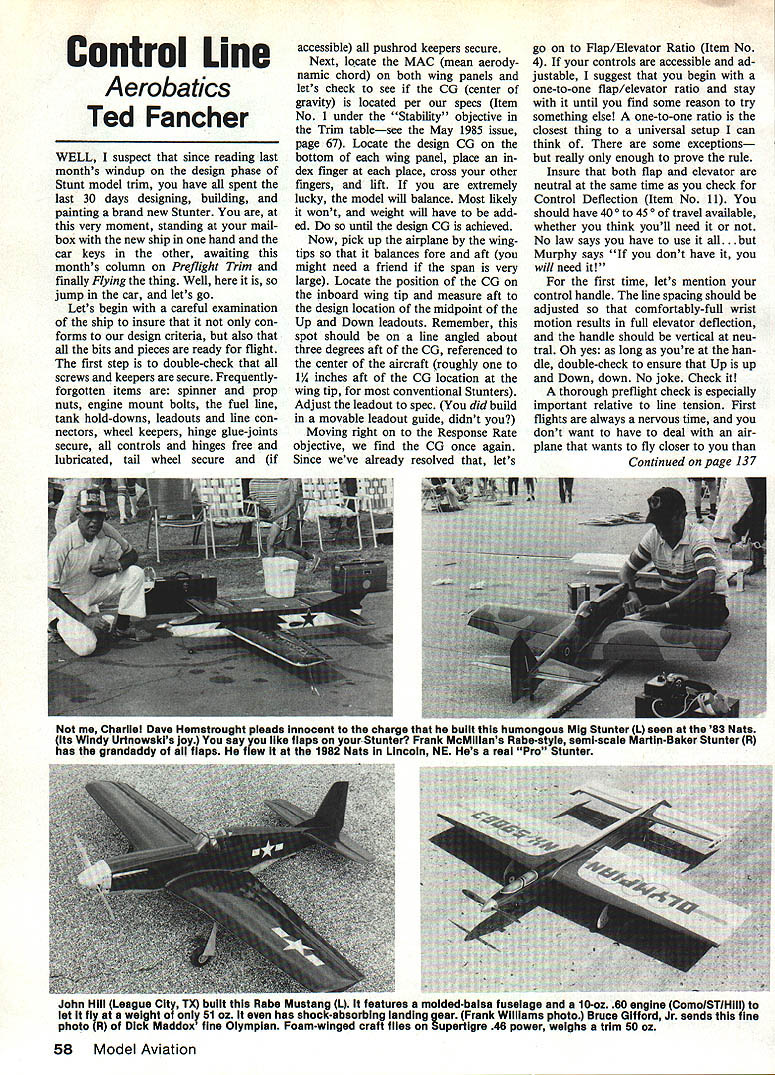
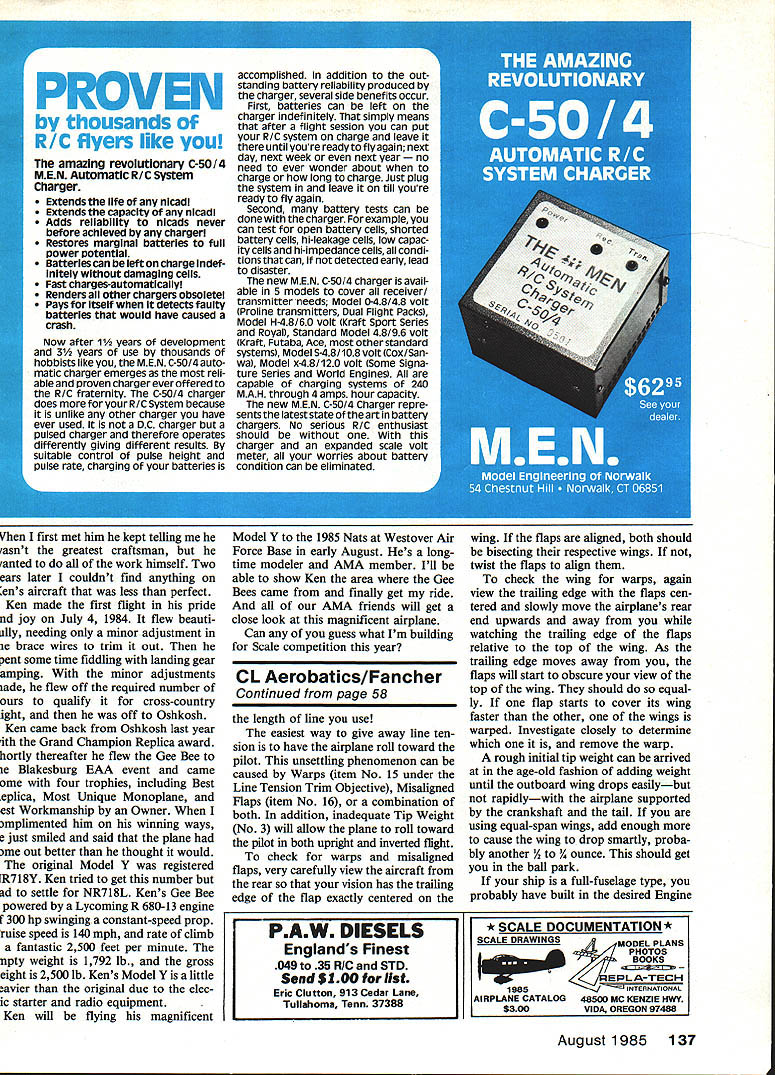
- Rudder configuration (item No. 8): Opinions vary widely. Some winning airplanes have Rabe-style rudders; others have none. Decide based on personal preference and testing.
Prop selection and speed control
- Prop selection affects line tension. For first flights, choose a prop with a bit more pitch or slightly less diameter than you expect to use. I prefer less diameter if using a new engine — it reduces engine load while allowing a bit more power for extra line tension.
- Speed control (Trim Option IV): Aside from prop choice, line length determines apparent speed to the pilot. Pick lines of moderate length so lap times are slightly faster than eventual desired speed; this improves line tension.
Tracking, flap relationships, and decallage
- Tracking (Trim Option V): Most aircraft parameters are built in at this stage. CG and flap relationships have been set; further tracking trim must wait for inflight evaluation.
- Uniformity of turn (Trim Option VI): Also largely determined in flight. Before flying, ensure flaps and elevators are neutral together and visually confirm that wing and stabilizer installation produced zero decalage (both installed with zero incidence).
Final preflight checks and first-flight procedure
- Double-check lines for kinks.
- Give the control system a reasonable pull test.
- If possible, fly the first flights with less than a full tank of fuel. This is primarily to protect the engine: initial flights can expose cooling issues, impurities in new tanks, kinks in fuel tubing, etc. A helper can hold the airplane in an attitude that ensures fuel to the pickup until launch. If the engine overheats, it's better to run out of fuel than to risk a long overheating run with a full tank.
- First flights typically check only a few trim parameters and allow you to spot loose components, tank location, cowling fit, etc., quickly.
Initial flight indications and decision points
- Takeoff and climb: If the airplane lifts off smoothly, climbs gradually, and flies level without excessive aileron (even if it droops a little higher or lower), CG, response rate, and handle neutral are likely in the ballpark.
- If the engine runs rough or other serious issues appear on takeoff, abort and check the airplane on the ground.
Good luck — double-check everything and have a helper for the first flights.
Transcribed from original scans by AI. Minor OCR errors may remain.

