
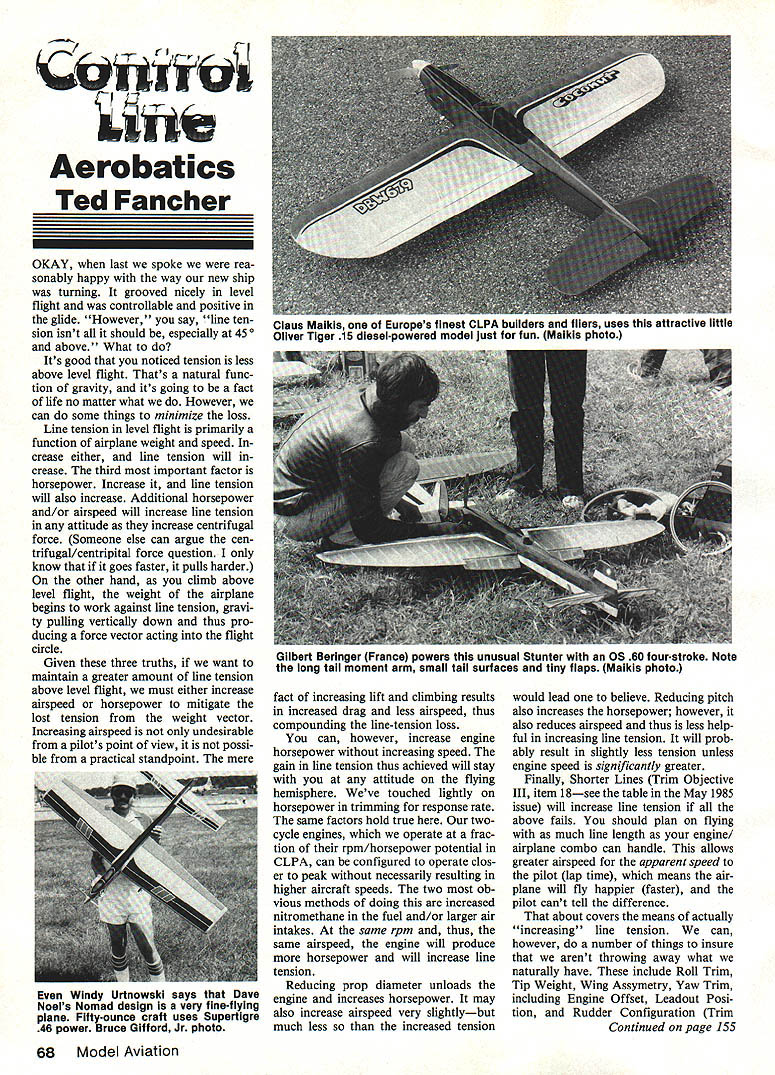
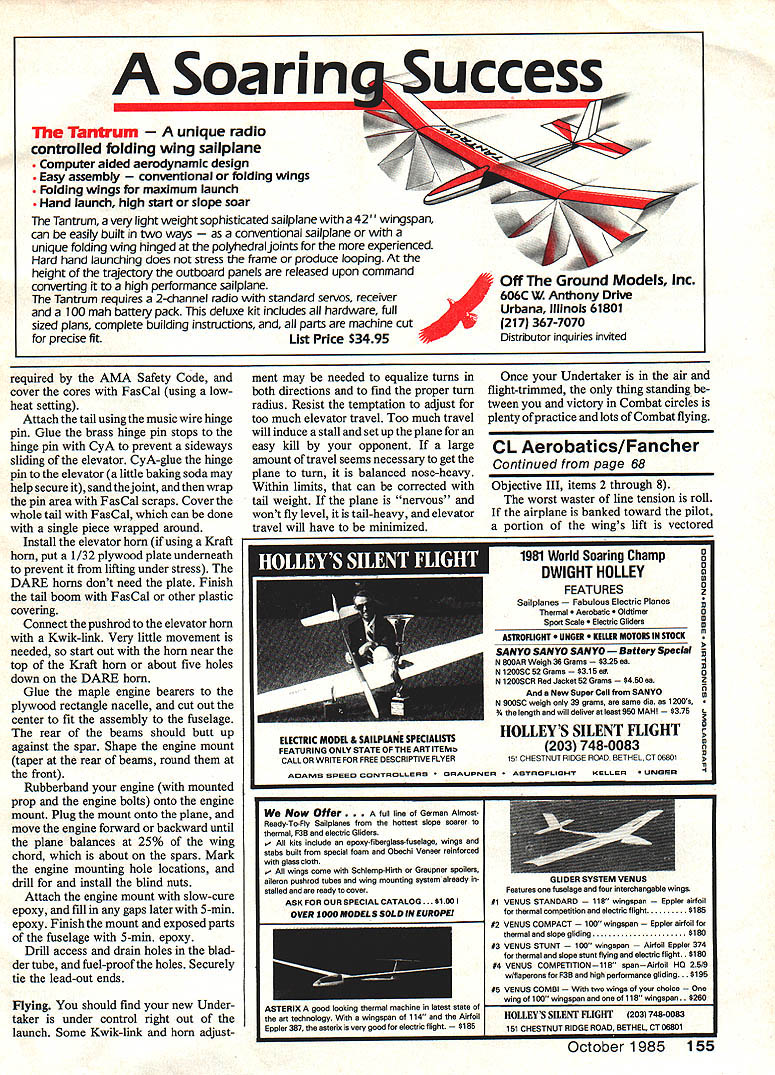
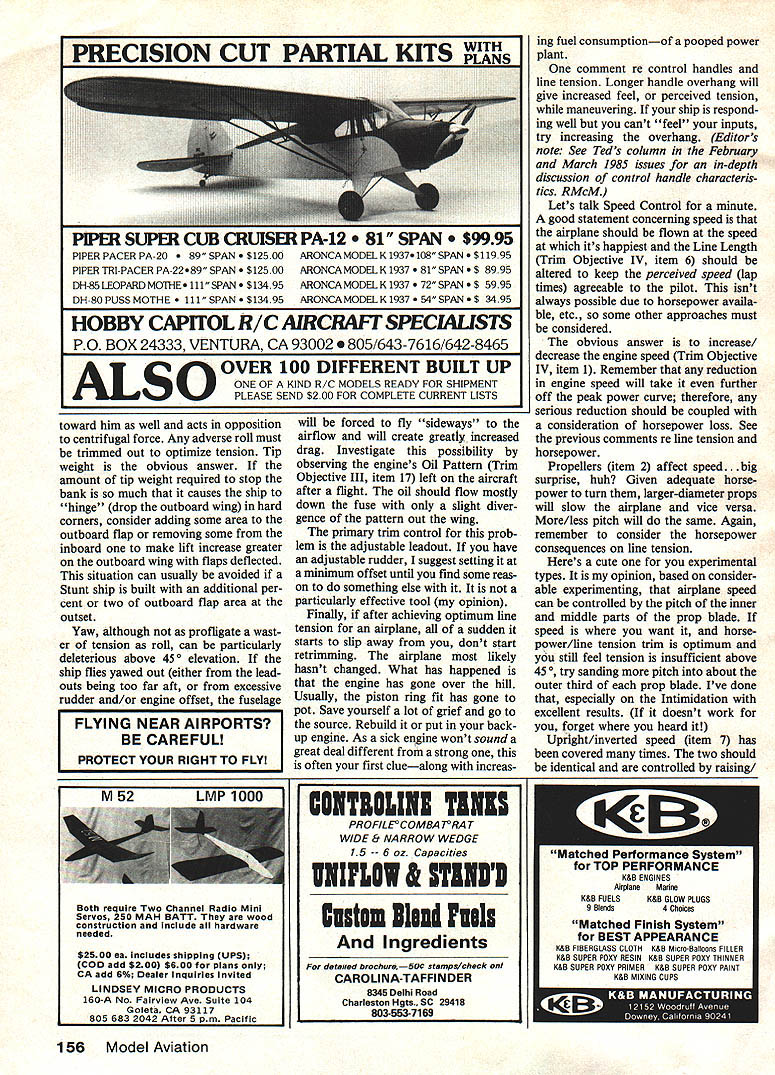
Control Line: Aerobatics
Ted Fancher
Introduction
OKAY, when last we spoke we were reasonably happy with the way our new ship was turning. It grooved nicely in level flight and was controllable and positive in the glide. However, line tension isn't all it should be, especially at 45° and above. What to do?
Line tension — fundamentals
Line tension in level flight is primarily a function of:
- Airplane weight
- Airspeed
- Horsepower
Notes:
- Increasing weight or speed increases line tension.
- Increasing horsepower also increases line tension.
- As you climb above level flight, gravity works against line tension: the weight vector acts vertically down and reduces the component available for centripetal force. That’s why tension is naturally less above level flight.
How to increase or retain line tension
Given the above, to maintain greater line tension above level flight you must either increase airspeed or increase horsepower. Increasing airspeed during a climb is impractical (more lift → more drag → less airspeed), so increasing engine horsepower is the preferred approach.
Ways to increase engine horsepower without increasing cruise speed:
- Increase nitromethane in the fuel.
- Provide larger air intakes.
- Reduce prop diameter — this unloads the engine and can increase horsepower (it may slightly increase airspeed, but the tension gain is the primary effect).
- Reduce prop pitch — this increases horsepower but usually reduces airspeed, so it may not help line tension unless engine rpm increases significantly.
If the above fails, shorten the lines (see Trim Objective III, item 18). Use as much line length as your engine/airplane combo can handle; that lets you keep lap times and perceived speed acceptable to the pilot.
Preventing wasted tension (trimming and setup)
You can also avoid throwing away tension by proper trimming and setup. Key items:
- Roll trim: The worst waster of line tension is roll. If the airplane is banked toward the pilot, some lift is vectored out of the plane of the circle and is unavailable for centripetal force. Keep the wings level.
- Tip weight and roll damping: Add tip weight or increase roll inertia to smooth rapid rolling. A lightly damped wing is "nervous" and requires more pilot correction.
- Wing asymmetry: Design with a bit more outboard flap area (a percent or two) to prevent the outboard wing from hinging (dropping) in hard corners when tip weight is high.
- Yaw trim (rudder and engine offset): If the airplane is yawed off heading, the lift vector is misdirected and tension is lost. Proper rudder trim and engine offset keep the nose pointed into the relative wind.
- Leadout position: Position leadouts tangent to the wing at the attachment point so lines do not introduce unwanted rolling or yawing moments. Small changes in leadout geometry can make large handling differences.
- Rudder configuration: Adjustable rudders can help, but set rudder offset minimal unless needed.
- Oil pattern check (Trim Objective III, item 17): Inspect engine oil spray after flight. The oil should flow mostly down the fuselage with only slight divergence onto the wing. Excessive lateral oil suggests yaw/sideways drag issues.
Engine health
If optimum trim suddenly deteriorates, don’t immediately retrim. Often the engine has lost power (rings worn, etc.). Rebuild or replace the engine rather than continually adjusting trim. Signs include increased fuel consumption and diminished power; sound alone may not reveal the problem.
Control handle feel
Longer handle overhang increases feel or perceived tension while maneuvering. If the ship responds well but you can’t “feel” inputs, try increasing the handle overhang.
Speed control
General principle
Fly the airplane at the speed at which it’s happiest. Adjust line length (Trim Objective IV, item 6) to keep perceived speed (lap times) agreeable to the pilot. If horsepower limits speed choices, consider other adjustments.
Engine rpm
- Increasing or decreasing engine speed changes airplane speed (Trim Objective IV, item 1).
- Reducing engine rpm moves it further off peak power; consider horsepower loss when lowering rpm.
Propellers
- Prop diameter and pitch affect speed: larger diameter slows the airplane; more pitch increases speed (given horsepower).
- Consider horsepower consequences on line tension when changing props.
Experimental tip:
- Sanding additional pitch into the outer third of each prop blade can sometimes improve line tension above 45° without changing overall speed. (Author’s experience on the Intimidator — results may vary.)
Upright/inverted speed
- Upright and inverted speeds should be identical.
- Control these by raising/lowering thrust line or changing wing incidence — do so cautiously because thrust-line changes affect climb/line tension.
Turn uniformity and tracking
If turns are unequal or tracking is poor:
- Try biasing the elevator in the direction of the poorer turn. If airborne controls aren’t adjustable, bias the handle or increase line spacing for the poorer-turn direction.
- Usually, trimming for stability, response rate, and turn uniformity will yield acceptable tracking.
Other remedies:
- Try different props — props from different manufacturers, or even different batches, can behave differently.
- Props with washed-out tips (less pitch at tip) tend to track better, though sometimes at a small loss of line tension above 45°.
- Increase flap per degree of elevator to help tracking. If you have partial-span flaps and severe tracking problems, increasing flap span usually improves tracking.
Conclusion
Most of the above will get your stunt ship trimmed for line tension, speed, and tracking. Some points are conventional wisdom, some are the author’s opinions and experiments. Use them as a guide and adjust for your particular airplane and engine combination.
A future article will cover the wind’s effects on flying the pattern in detail.
Ted Fancher 158 Flying Cloud Isle Foster City, CA 94404
Transcribed from original scans by AI. Minor OCR errors may remain.

