
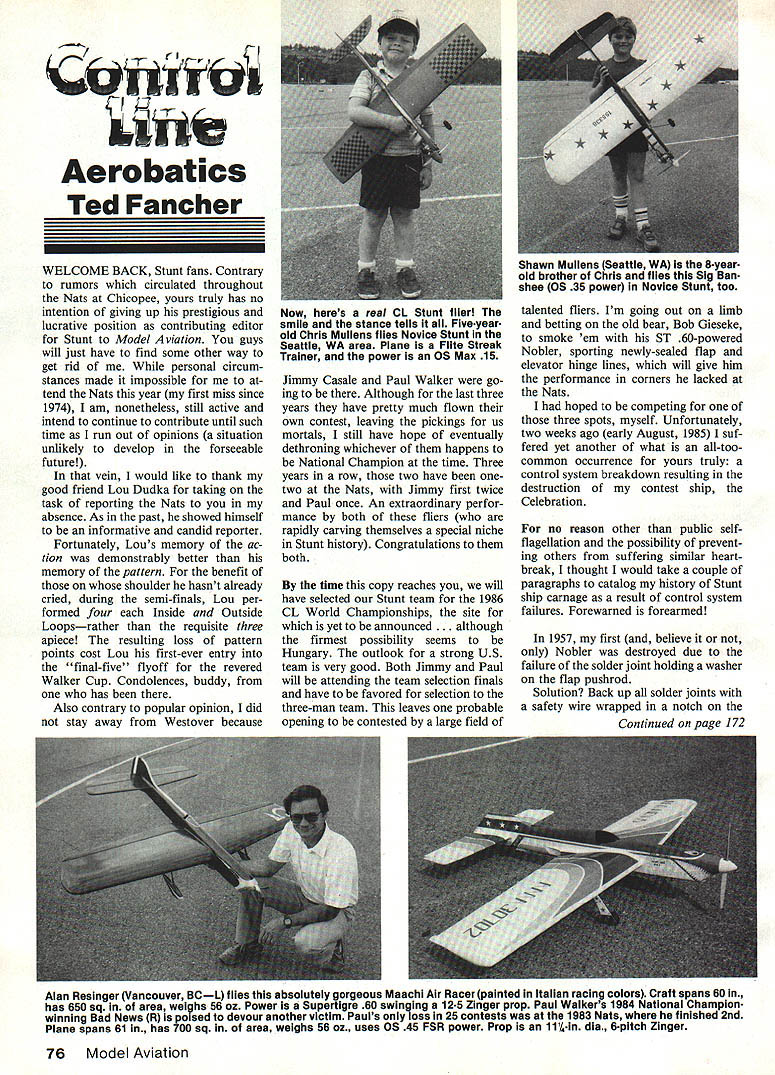
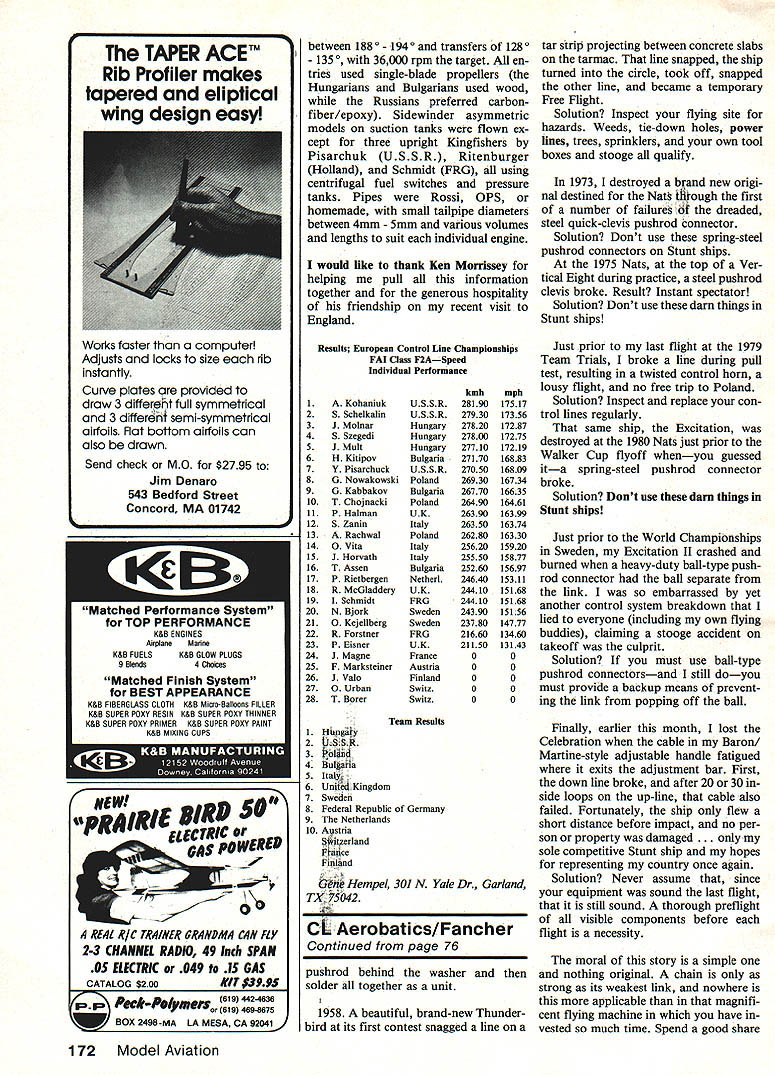
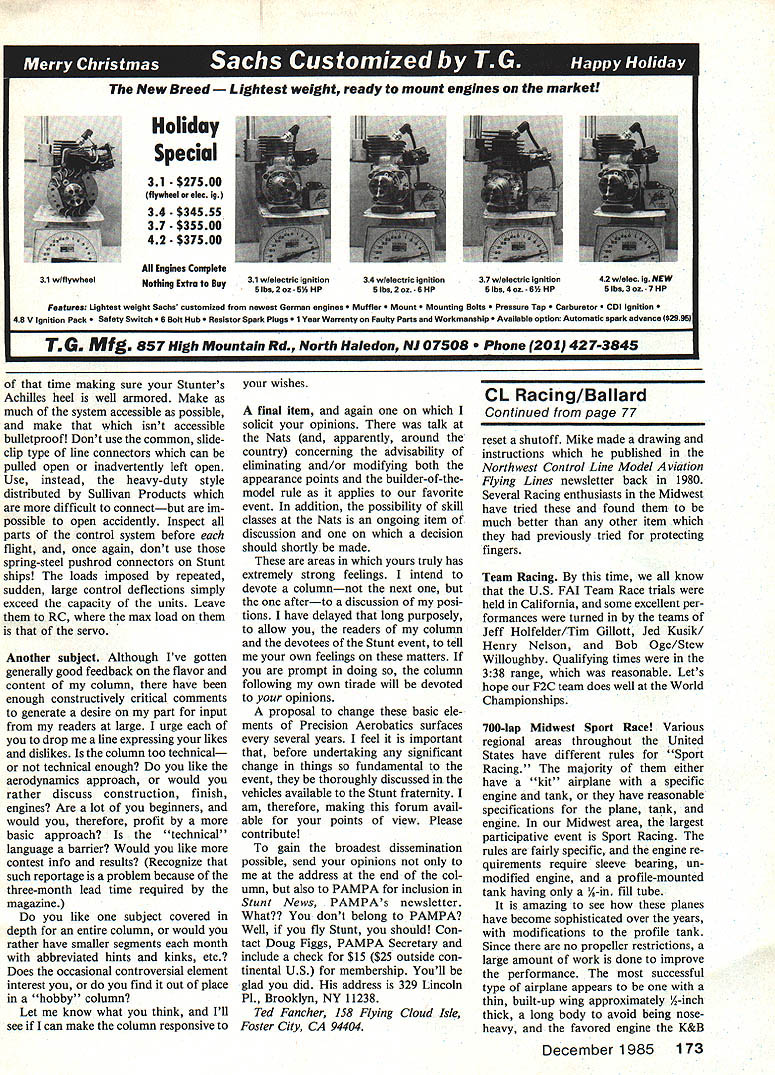
Control Line: Aerobatics
Ted Fancher
WELCOME BACK, stunt fans. Contrary to rumors that circulated throughout the Nats at Chicopee, I have no intention of giving up my position as contributing editor for Stunt to Model Aviation. You guys will just have to find some other way to get rid of me. While personal circumstances made it impossible for me to attend the Nats this year (my first miss since 1974), I am nonetheless still active and intend to continue to contribute until such time as I run out of opinions (a situation unlikely to develop for the foreseeable future!).
In that vein, I would like to thank my good friend Lou Dudka for taking on the task of reporting the Nats to you in my absence. As in the past, he showed himself to be an informative and candid reporter.
Fortunately, Lou's memory of the action was demonstrably better than his memory of the pattern. For the benefit of those on whose shoulder he hasn't already cried: during the semi-finals Lou performed four Inside Loops and four Outside Loops—rather than the requisite three apiece. The resulting loss of pattern points cost Lou his first-ever entry into the "final five" flyoff for the revered Walker Cup. Condolences, buddy, from one who has been there.
Also contrary to popular opinion, I did not stay away from Westover because Jimmy Casale and Paul Walker were going to be there. Although for the last three years they have pretty much flown their own contest, leaving the pickings for us mortals, I still have hope of eventually dethroning whichever of them happens to be National Champion at the time. Three years in a row, those two have been one-two at the Nats, with Jimmy first twice and Paul once. An extraordinary performance by both of these fliers (who are rapidly carving themselves a special niche in Stunt history). Congratulations to them both.
By the time this copy reaches you, we will have selected our Stunt team for the 1986 CL World Championships, the site for which is yet to be announced, although the firmest possibility seems to be Hungary. The outlook for a strong U.S. team is very good. Both Jimmy and Paul will be attending the team selection finals and have to be favored for selection to the three-man team. This leaves one probable opening to be contested by a large field of talented fliers. I'm going out on a limb and betting on the old bear, Bob Gieseke, to smoke 'em with his ST-60-powered Nobler, sporting newly sealed flap and elevator hinge lines, which will give him the performance in corners he lacked at the Nats.
I had hoped to be competing for one of those three spots myself. Unfortunately, two weeks ago (early August, 1985) I suffered yet another of what is an all-too-common occurrence for yours truly: a control system breakdown resulting in the destruction of my contest ship, the Celebration.
Control-system failures — a personal catalog
For no reason other than public self-flagellation and the possibility of preventing others from suffering similar heartbreak, I will catalog my history of Stunt ship carnage due to control system failures. Forewarned is forearmed.
- 1957: My first (and, believe it or not, only) Nobler was destroyed due to the failure of the solder joint holding a washer on the flap pushrod.
- Solution: Back up all solder joints with a safety wire wrapped in a notch on the pushrod behind the washer and solder all together as a unit.
- 1958: A beautiful, brand-new Thunderbird at its first contest snagged a line on a tar strip projecting between concrete slabs on the tarmac. That line snapped, the ship turned into the circle, took off, snapped the other line, and became a temporary free flight.
- Solution: Inspect your flying site for hazards. Weeds, tie-down holes, power lines, trees, sprinklers, your own tool boxes and storage all qualify.
- 1973: I destroyed a brand-new original destined for the Nats through the first of a number of failures of the dreaded steel quick-clevis pushrod connector.
- Solution: Don't use these spring-steel pushrod connectors on Stunt ships!
- 1975 Nats: At the top of a Vertical Eight during practice, a steel pushrod clevis broke. Result? Instant spectator.
- Solution: Don't use these darn things in Stunt ships!
- 1979 Team Trials: Just prior to my last flight, I broke a line during pull-test, resulting in a twisted control horn, a lousy flight, and no free trip to Poland.
- Solution: Inspect and replace your control lines regularly.
- 1980 Nats: The Excitation was destroyed just prior to the Walker Cup flyoff when — you guessed it — a spring-steel pushrod connector broke.
- Prior to the World Championships in Sweden: My Excitation II crashed and burned when a heavy-duty ball-type pushrod connector had the ball separate from the link. I was so embarrassed by my own comical system breakdown that I lied to everyone (including my flying buddies), claiming a stooge accident on takeoff was the culprit.
- Solution: If you must use ball-type pushrod connectors — and I still do — provide a backup means of preventing the link from popping off the ball.
- Early August 1985 (earlier this month): I lost the Celebration when the cable in my Baron/Martin-style adjustable handle fatigued where it exits the adjustment bar. First, the down line broke, and after 20–30 inside loops on the up line that cable also failed. Fortunately, the ship only flew a short distance before impact, and no person or property was damaged — only my sole competitive Stunt ship and my hopes for representing my country once again.
- Solution: Never assume that, since your equipment was sound on the last flight, it is still sound. A thorough preflight check of all visible components before each flight is a necessity.
The moral of this story is a simple one and nothing original: a chain is only as strong as its weakest link, and nowhere is this more applicable than in that magnificent flying machine in which you have invested so much time. Spend a good share of that time making sure your own Stunter's Achilles heel is well armored. Make as much of the system accessible as possible, and make that which isn't accessible bulletproof!
- Don't use the common slide-clip type of line connectors which can be pulled open or inadvertently left open.
- Use, instead, the heavy-duty style distributed by Sullivan Products; they are more difficult to connect but are virtually impossible to open accidentally.
- Inspect all parts of the control system before each flight.
- And, once again: don't use those spring-steel pushrod connectors on Stunt ships! The loads imposed by repeated, sudden, large control deflections simply exceed the capacity of those units. Leave them to RC, where the maximum load on them is that of the servo.
Reader input requested
Although I've gotten generally good feedback on the flavor and content of my column, there have been enough constructively critical comments to generate a desire on my part for input from my readers at large. I urge each of you to drop me a line expressing your likes and dislikes. Here are some specific items I'd like feedback on:
- Is the column too technical — or not technical enough?
- Do you like the aerodynamics approach, or would you rather discuss construction, finish, engines?
- Are many of you beginners, and would you therefore profit by a more basic approach?
- Is the "technical" language a barrier?
- Would you like more contest info and results? (Recognize that such reportage is a problem because of the three-month lead time required by the magazine.)
- Do you prefer one subject covered in depth for an entire column, or smaller segments each month with abbreviated hints and kinks?
- Does the occasional controversial element interest you, or do you find it out of place in a "hobby" column?
Let me know what you think, and I'll see if I can make the column more responsive to your wishes.
A final item, and again one on which I solicit your opinions: there was talk at the Nats and, apparently, around the country concerning the advisability of eliminating and/or modifying both the appearance points and the builder-of-the-model rule as it applies to our favorite event. In addition, the possibility of skill classes at the Nats is an ongoing item of discussion and one on which a decision should shortly be made.
These are areas in which I have extremely strong feelings. I intend to devote a column — not the next one, but the one after — to a discussion of my positions. I have delayed that long purposely, to allow you, the readers of my column and the devotees of the Stunt event, to tell me your own feelings on these matters. If you are prompt in doing so, the column following my own tirade will be devoted to your opinions.
A proposal to change these basic elements of Precision Aerobatics surfaces every several years. I feel it is important that, before undertaking any significant change in things so fundamental to the event, they be thoroughly discussed in the vehicles available to the Stunt fraternity. I am, therefore, making this forum available for your points of view. Please contribute!
To gain the broadest dissemination possible, send your opinions not only to me at the address below, but also to PAMPA for inclusion in Stunt News, PAMPA's newsletter. What? You don't belong to PAMPA? Well, if you fly Stunt, you should! Contact Doug Biggs, PAMPA Secretary, and include a check for $15 ($25 outside continental U.S.) for membership. You'll be glad you did. His address is:
- Doug Biggs, PAMPA Secretary
329 Lincoln Pl. Brooklyn, NY 11238
Ted Fancher 158 Flying Cloud Isle Foster City, CA 94404
Transcribed from original scans by AI. Minor OCR errors may remain.

