
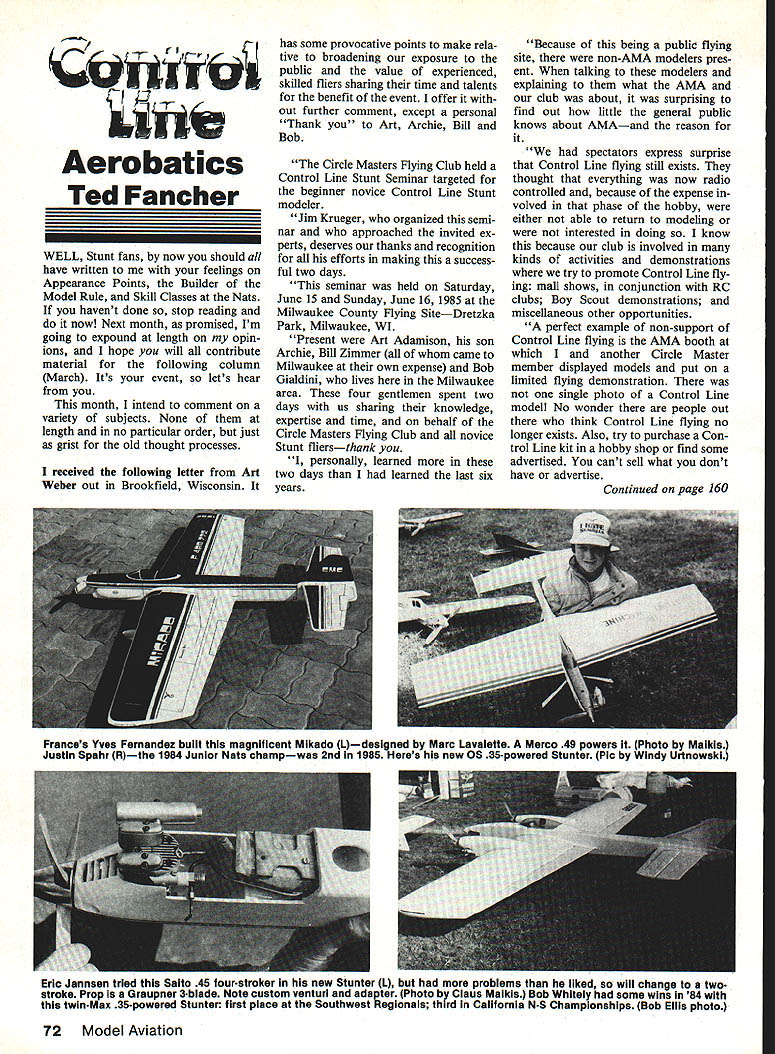
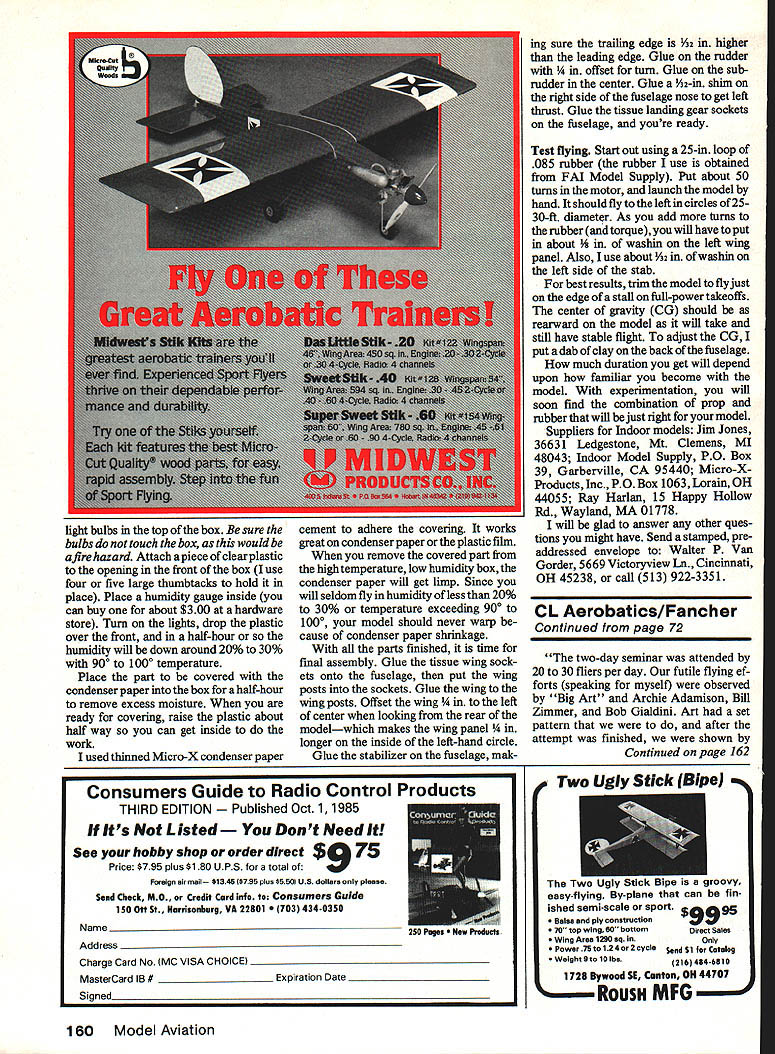
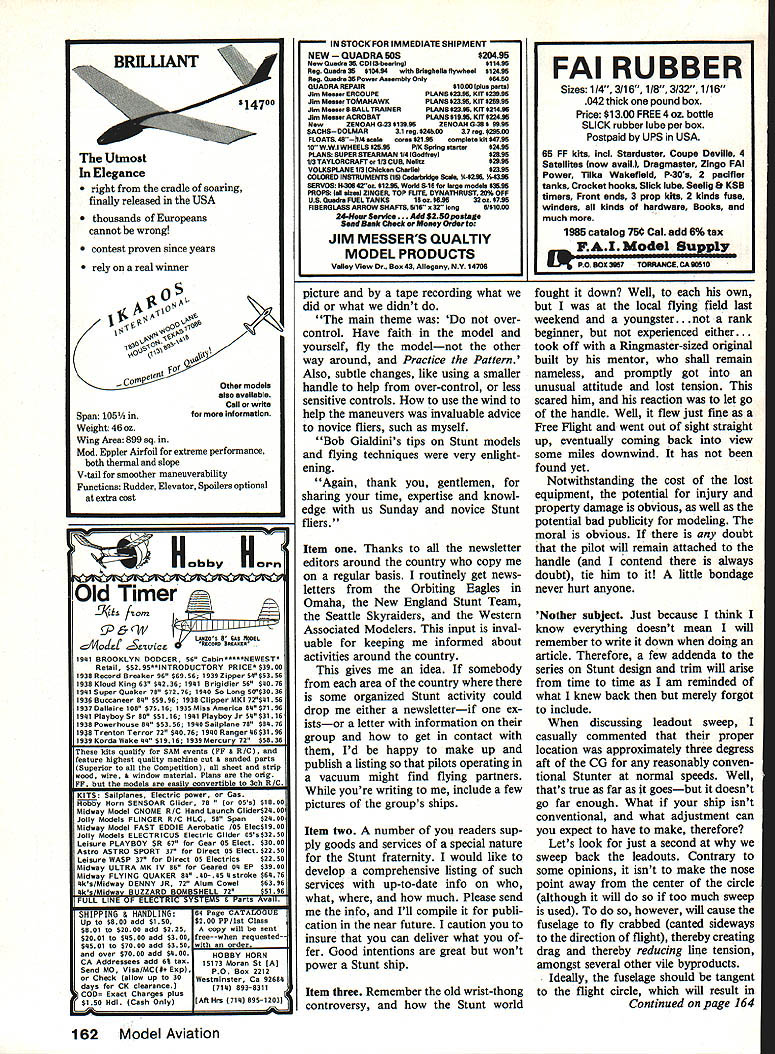
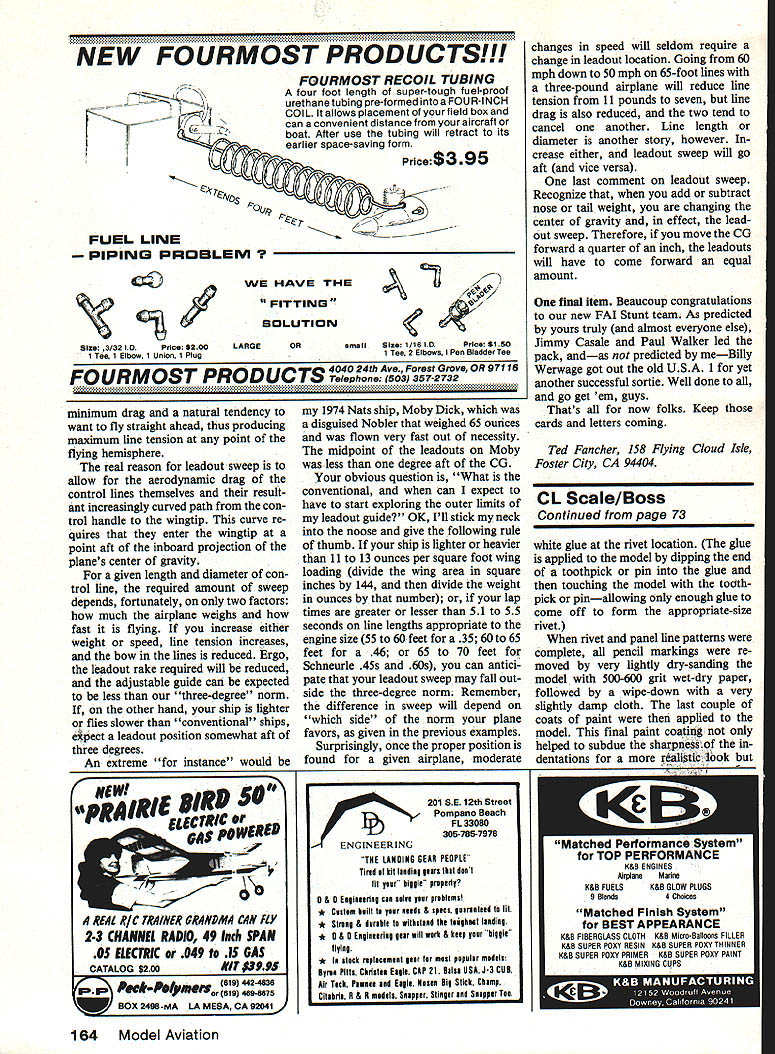
Control Line: Aerobatics
Ted Fancher
WELL, Stunt fans, by now you should all have written to me with your feelings on Appearance Points, the Builder of the Model Rule, and Skill Classes at the Nats. If you haven't done so, stop reading and do it now! Next month, as promised, I'm going to expound at length on my opinions, and I hope you will all contribute material for the following column (March). It's your column, so let's hear from you.
This month, I intend to comment on a variety of subjects. None of them at length and in no particular order, but just as grist for the old thought processes.
Letter from Art Weber (Circle Masters Flying Club)
"The Circle Masters Flying Club held a Control Line Stunt Seminar targeted for the beginner/novice Control Line Stunt modeler.
"Jim Krueger, who organized this seminar and who approached the invited experts, deserves our thanks and recognition for all his efforts in making this a successful two days.
"This seminar was held on Saturday, June 15 and Sunday, June 16, 1985 at the Milwaukee County Flying Site—Dretzka Park, Milwaukee, WI.
"Present were Art Adamison, his son Archie, Bill Zimmer (all of whom came to Milwaukee at their own expense) and Bob Gialdini, who lives here in the Milwaukee area. These four gentlemen spent two days with us sharing their knowledge, expertise and time, and on behalf of the Circle Masters Flying Club and all novice Stunt fliers—thank you.
"I, personally, learned more in these two days than I had learned the last six years.
"Because of this being a public flying site, there were non-AMA modelers present. When talking to these modelers and explaining to them what the AMA and our club was about, it was surprising to find out how little the general public knows about AMA—and the reason for it.
"We had spectators express surprise that Control Line flying still exists. They thought that everything was now radio controlled, and, because of the expense involved in that phase of the hobby, were either not able to return to modeling or were not interested in doing so. I know this because our club is involved in many kinds of activities and demonstrations where we try to promote Control Line flying: mall shows, in conjunction with RC clubs; Boy Scout demonstrations; and miscellaneous other opportunities.
"A perfect example of non-support of Control Line flying is the AMA booth at which I and another Circle Master member displayed models and put on a limited flying demonstration. There was not one single photo of a Control Line model on the booth models. No wonder there are people out there who think Control Line flying no longer exists. Also, try to purchase a Control Line kit in a hobby shop or find some advertised—you can't sell what you don't have or advertise.
"The two-day seminar was attended by 20 to 30 fliers per day. Our little flying efforts (speaking for myself) were observed by 'Big Art' and Archie Adamison, Bill Zimmer, and Bob Gialdini. Art had a set pattern that we were to do, and after the attempt was finished, we were shown by picture and by a tape recording what we did or what we didn't do.
"The main theme was: Do not over-control. Have faith in the model and yourself, fly the model—not the other way around, and Practice the Pattern. Also, subtle changes, like using a smaller handle to help prevent over-control, or less sensitive controls. How to use the wind to help the maneuvers was invaluable to the novice fliers, such as myself.
"Bob Gialdini's tips on Stunt models and flying techniques were very enlightening.
"Again, thank you, gentlemen, for sharing your time, expertise and knowledge with us Sunday and novice Stunt fliers."
Indoor covering: High-temperature, low-humidity box
(From: Walter P. Van Gorder)
Install light bulbs in the top of the box. Be sure the bulbs do not touch the box, as this would be a fire hazard. Attach a piece of clear plastic to the opening in the front of the box (I use four or five large thumbtacks to hold it in place). Place a humidity gauge inside (you can buy one for about $3.00 at a hardware store). Turn on the lights, drop the plastic over the front, and in a half-hour or so the humidity will be down around 20% to 30% with 90° to 100° temperature.
Place the part to be covered with condenser paper into the box for a half-hour to remove excess moisture. When you are ready for covering, raise the plastic about half way so you can get inside to do the work.
I used thinned Micro-X condenser paper cement to adhere the covering. It works great on condenser paper or the plastic film. When you remove the covered part from the high-temperature, low-humidity box, the condenser paper will get limp. Since you will seldom fly in humidity of less than 20% to 30% or temperatures exceeding 90° to 100°, your model should never warp because of condenser paper shrinkage.
With all the parts finished, it is time for final assembly. Glue the tissue wing sockets onto the fuselage, then put the wing posts into the sockets. Glue the wing to the wing posts. Offset the wing 1/4 in. to the left center when looking from the rear of the model—which makes the wing panel 1/4 in. longer on the inside of the left-hand circle.
Glue the stabilizer on the fuselage, making sure the trailing edge is 1/32 in. higher than the leading edge. Glue on the rudder with 1/4 in. offset for turn. Glue on the sub-rudder in the center. Glue a 1/32-in. shim on the right side of the fuselage nose to get left thrust. Glue the tissue landing gear sockets on the fuselage, and you're ready.
Test flying. Start out using a 25-in. loop of .085 rubber (the rubber I use is obtained from FAI Model Supply). Put about 50 turns in the motor, and launch the model by hand. It should fly to the left in circles of 25–30 ft. diameter. As you add more turns to the rubber (and torque), you will have to put in about 1/8 in. of wash-in on the left wing panel. Also, I use about 3/32 in. of wash-in on the left side of the stab.
For best results, trim the model to fly just on the edge of a stall on full-power takeoffs. The center of gravity (CG) should be rearward on the model as it will take and still have stable flight. To adjust the CG, I put a dab of clay on the back of the fuselage.
How much duration you get will depend upon how familiar you become with the model. With experimentation, you will soon find the combination of prop and rubber that will be just right for your model.
Suppliers for indoor models:
- Jim Jones, 36631 Ledgestone, Mt. Clemens, MI 48043
- Indoor Model Supply, P.O. Box 39, Garberville, CA 95440
- Micro-X Products, Inc., P.O. Box 1063, Lorain, OH 44055
- Ray Harlan, 15 Happy Hollow Rd., Wayland, MA 01778
I will be glad to answer any other questions you might have. Send a stamped, pre-addressed envelope to: Walter P. Van Gorder, 5669 Victoryview Ln., Cincinnati, OH 45238, or call (513) 922-3351.
Ted Fancher — Items and Commentary
Item one. Thanks to all the newsletter editors around the country who copy me on a regular basis. I routinely get newsletters from the Orbiting Eagles in Omaha, the New England Stunt Team, the Seattle Skyraiders, and the Western Associated Modelers. This input is invaluable for keeping me informed about activities around the country.
This gives me an idea. If somebody from each area of the country where there is some organized Stunt activity could drop me either a newsletter—if one exists—or a letter with information on their group and how to get in contact with them, I'd be happy to make up and publish a listing so that pilots operating in a vacuum might find flying partners. While you're writing to me, include a few pictures of the group's ships.
Item two. A number of you readers supply goods and services of a special nature for the Stunt fraternity. I would like to develop a comprehensive listing of such services with up-to-date info on who, what, where, and how much. Please send me the info, and I'll compile it for publication in the near future. I caution you to ensure that you can deliver what you offer. Good intentions are great but won't power a Stunt ship.
Item three. Remember the old wrist-thong controversy, and how the Stunt world fought it down? Well, to each his own, but I was at the local flying field last weekend and a youngster—not a rank beginner, but not experienced either—took off with a Ringmaster-sized original built by his mentor, who shall remain nameless, and promptly got into an unusual attitude and lost tension. This scared him, and his reaction was to let go of the handle. Well, it flew just fine as a Free Flight and went out of sight straight up, eventually coming back into view some miles downwind. It has not been found yet.
Notwithstanding the cost of the lost equipment, the potential for injury and property damage is obvious, as well as the potential bad publicity for modeling. The moral is obvious. If there is any doubt that the pilot will remain attached to the handle (and I contend there is always doubt), tie him to it! A little bondage never hurt anyone.
Another subject. Just because I think I know everything doesn't mean I will remember to write it down when doing an article. Therefore, a few addenda to the series on Stunt design and trim will arise from time to time as I am reminded of what I knew back then but merely forgot to include.
When discussing leadout sweep, I casually commented that their proper location was approximately three degrees aft of the CG for any reasonably conventional Stunter at normal speeds. Well, that's true as far as it goes—but it doesn't go far enough. What if your ship isn't conventional, and what adjustment can you expect to have to make, therefore?
Let's look for just a second at why we sweep back the leadouts. Contrary to some opinions, it isn't to make the nose point away from the center of the circle (although it will do so in too much sweep; I used to do so, however, will cause the fuselage to fly crabbed—canted sideways to the direction of flight), thereby creating drag and thereby reducing line tension, amongst several other vile byproducts.
Ideally, the fuselage should be tangent to the flight circle, which will result in minimum drag and a natural tendency to want to fly straight ahead, thus producing maximum line tension at any point of the flying hemisphere.
The real reason for leadout sweep is to allow for the aerodynamic drag of the control lines themselves and their resultant increasingly curved path from the control handle to the wingtip. This curve requires that they enter the wingtip at a point aft of the inboard projection of the plane's center of gravity.
For a given length and diameter of control line, the required amount of sweep depends, fortunately, on only two factors: how much the airplane weighs and how fast it is flying. If you increase either weight or speed, line tension increases, and the bow in the lines is reduced. Ergo, the leadout rake required will be reduced, and the adjustable guide can be expected to be less than our "three-degree" norm. If, on the other hand, your ship is lighter or flies slower than "conventional" ships, expect a leadout position somewhat aft of three degrees.
An extreme example would be my 1974 Nats ship, Moby Dick, which was a disguised Nobler that weighed 65 ounces and was flown very fast out of necessity. The midpoint of the leadouts of Moby was less than one degree aft of the CG.
Your obvious question is, "What is the conventional, and when can I expect to have to start exploring the outer limits of my leadout guide?" OK, I'll stick my neck into the noose and give the following rule of thumb. If your ship is lighter or heavier than 11 to 13 ounces per square foot wing loading (divide the wing area in square inches by 144, and then divide the weight in ounces by that number); or, if your lap times are greater or lesser than 5.1 to 3.5 seconds on line lengths appropriate to the engine size (55 to 60 feet for a .35; 60 to 65 feet for a .46; or 65 to 70 feet for Schnuerle .45s and .60s), you can anticipate that your leadout sweep may fall outside the three-degree norm. Remember, the difference in sweep will depend on "which side" of the norm your plane favors, as given in the previous examples.
Surprisingly, once the proper position is found for a given airplane, moderate changes in speed will seldom require a change in leadout location. Going from 60 mph down to 50 mph on 65-foot lines with a three-pound airplane will reduce line tension from 11 pounds to seven, but line drag is also reduced, and the two tend to cancel one another. Line length or diameter is another story, however. Increase either, and leadout sweep will go aft (and vice versa).
One last comment on leadout sweep. Recognize that, when you add or subtract nose or tail weight, you are changing the center of gravity and, in effect, the leadout sweep. Therefore, if you move the CG forward a quarter of an inch, the leadouts will have to come forward an equal amount.
One final item. Beaucoup congratulations to our new FAI Stunt team. As predicted by yours truly (and almost everyone else), Jimmy Casale and Paul Walker led the pack, and—as not predicted by me—Billy Werwage got out the old U.S.A.1 for yet another successful sortie. Well done to all, and go get 'em, guys.
That's all for now folks. Keep those cards and letters coming.
Ted Fancher 158 Flying Cloud Isle Foster City, CA 94404.
Transcribed from original scans by AI. Minor OCR errors may remain.

