
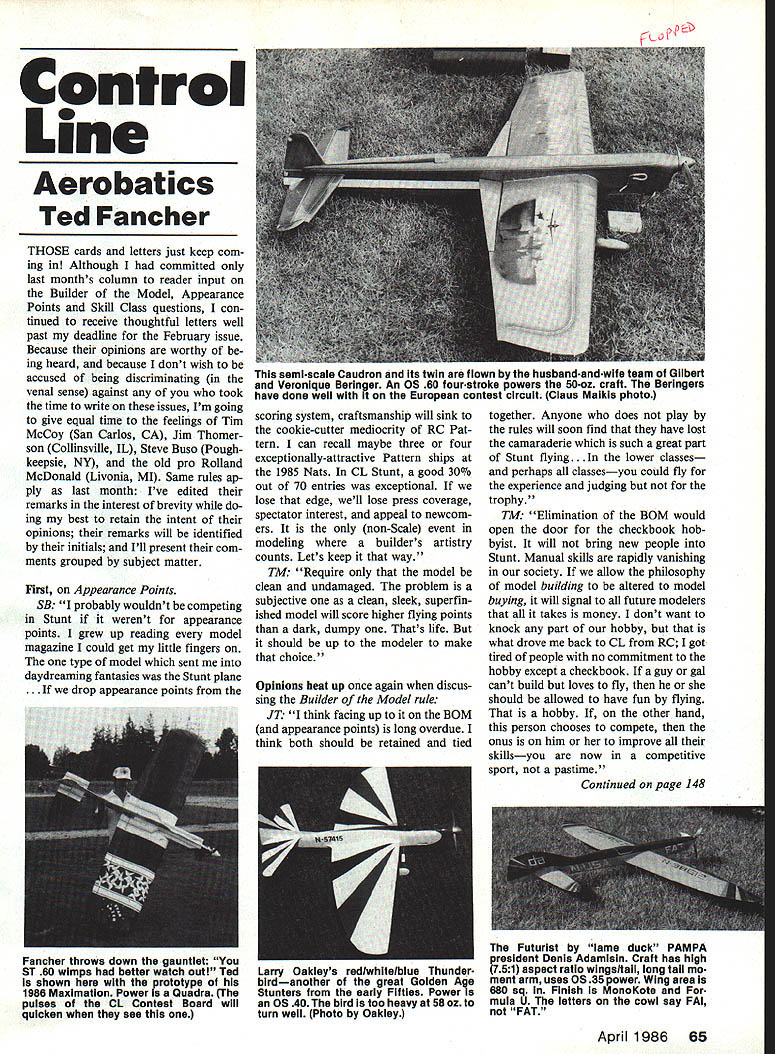
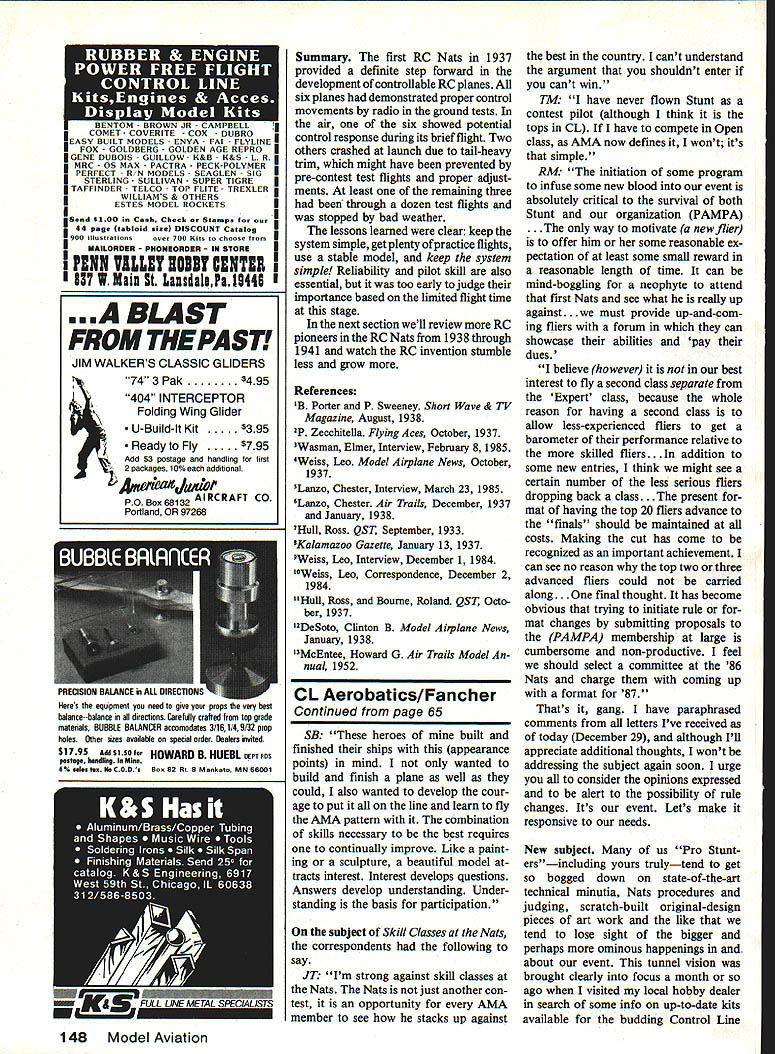
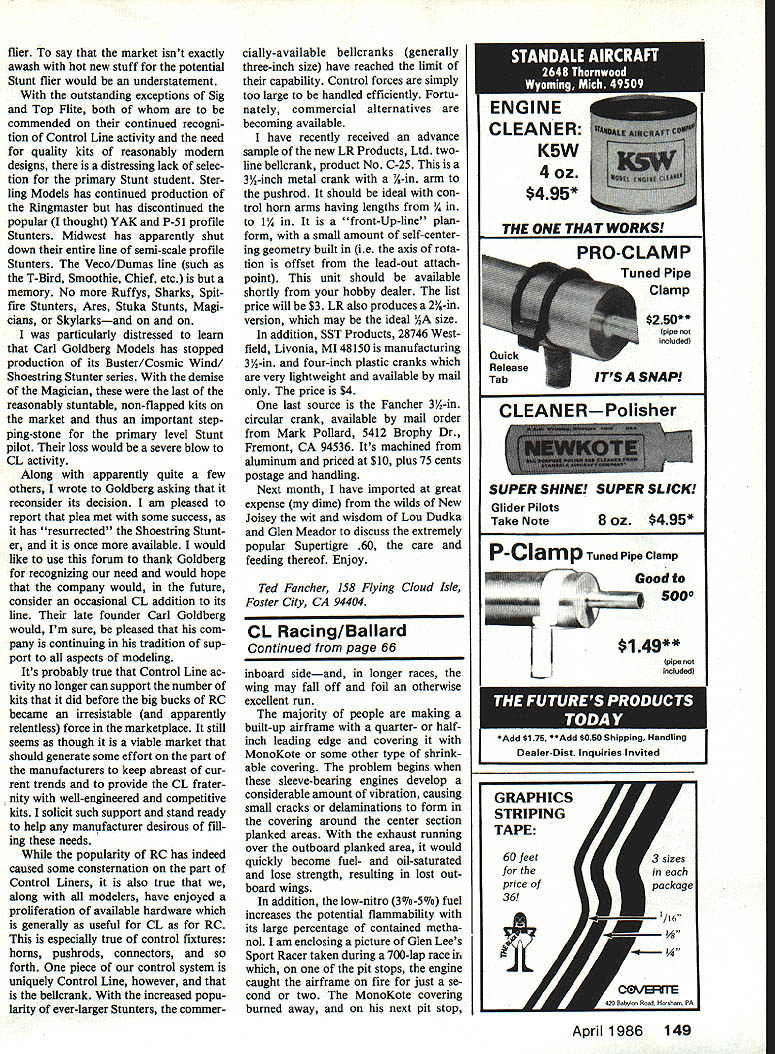
Control Line: Aerobatics
Ted Fancher
Those cards and letters just keep coming in! Although I had committed only last month's column to reader input on the Builder of the Model, Appearance Points and Skill Class questions, I continued to receive thoughtful letters well past my deadline for the February issue. Because their opinions are worthy of being heard, and because I don't wish to be accused of being discriminating (in the venal sense) against any of you who took the time to write on these issues, I'm going to give equal time to the feelings of Tim McCoy (San Carlos, CA), Jim Thomerson (Collinsville, IL), Steve Buso (Poughkeepsie, NY) and the old pro Rolland McDonald (Livonia, MI). Same rules apply as last month: I've edited their remarks in the interest of brevity while doing my best to retain the intent of their opinions; their remarks will be identified by their initials; and I'll present their comments grouped by subject matter.
Appearance Points
SB: "I probably wouldn't be competing in Stunt if it weren't for appearance points. I grew up reading every model magazine I could get my little fingers on. The one type of model which sent me into daydreaming fantasies was the Stunt plane. If we drop appearance points from the scoring system, craftsmanship will sink to cookie-cutter mediocrity of RC Pattern. I can recall maybe three or four exceptionally attractive Pattern ships at the 1985 Nats. In CL Stunt, a good 30% out of 70 entries was exceptional. If we lose that edge, we'll lose press coverage, spectator interest, and appeal to newcomers. It is the only (non-Scale) event in modeling where a builder's artistry counts. Let's keep it that way."
TM: "Require only that the model be clean and undamaged. The problem is a subjective one: a clean, sleek, superfinished model will score higher flying points than a dark, dumpy one. That's life. But it should be up to the modeler to make that choice."
SB: "These heroes of mine built and finished their ships with this (appearance points) in mind. I not only wanted to build and finish a plane as well as they could, but I also wanted to develop the courage to put it all on the line and learn to fly the AMA pattern with it. The combination of skills necessary to be the best requires one to continually improve. Like a painter or a sculptor, a beautiful model attracts interest. Interest develops questions. Answers develop understanding. Understanding is the basis for participation."
Builder of the Model (BOM)
JT: "I think facing up to it on the BOM (and appearance points) is long overdue. I think both should be retained and tied together. Anyone who does not play by the rules will soon find that they have lost the camaraderie which is such a great part of Stunt flying. ... In the lower classes — and perhaps all classes — you could fly for the experience and judging but not for the trophy."
TM: "Elimination of the BOM would open the door for the checkbook hobbyist. It will not bring new people into Stunt. Materials are rapidly vanishing in our society. If we allow the philosophy of model building to be altered to model buying, it will signal to all future modelers that all it takes is money. I don't want to knock any part of our hobby, but that is what drove me back to CL from RC; I got tired of people with no commitment to the hobby except a checkbook. If a guy or gal can't build but loves to fly, then he or she should be allowed to have fun by flying. That is a hobby. If, on the other hand, this person chooses to compete, then the onus is on him or her to improve all their skills — you are now in a competitive sport, not a pastime."
CL Aerobatics — Continued from page 65
Skill Classes at the Nats
JT: "I'm strong against skill classes at the Nats. The Nats is not just another contest; it is an opportunity for every AMA member to see how he stacks up against the best in the country. I can't understand the argument that you shouldn't enter if you can't win."
TM: "I have never flown Stunt as a contest pilot (although I think it is the closest thing to RC). If I have to compete in Open class, as AMA now defines it, I won't; it's that simple."
RM: "The initiation of some program to infuse some new blood into our event is absolutely critical to the survival of both Stunt and our organization (PAMPA) ... The only way to motivate (a new flier) is to offer him or her some reasonable expectation of at least some small reward in a reasonable length of time. It can be mind-boggling for a neophyte to attend that first Nats and see what he is really up against... we must provide up-and-coming fliers with a forum in which they can showcase their abilities and 'pay their dues.'
"I believe (however) it is not in our best interest to fly a second class separate from the 'Expert' class, because the whole reason for having a second class is to allow less-experienced fliers to get a barometer of their performance relative to the more skilled fliers. In addition to some new entries, I think we might see a certain number of the less serious fliers dropping back a class. The present format of having the top 20 fliers advance to the 'finals' should be maintained at all costs. Moving the cut has come to be recognized as an important achievement. I can see no reason why the top two or three advanced fliers could not be carried along.
"One final thought. It has become obvious that trying to initiate rule or format changes by submitting proposals to the (PAMPA) membership at large is cumbersome and non-productive. I feel we should select a committee at the '86 Nats and charge them with coming up with a format for '87.'"
That's it, gang. I have paraphrased comments from all letters I've received as of today (December 29), and, although I'll appreciate additional postscript, I won't be addressing the subject again soon. I urge you all to consider the opinions expressed and to be alert to the possibility of rule changes. It's our event. Let's make it responsive to our needs.
Kits and Manufacturers
Many of us "Pro Stunters" — including yours truly — tend to get so bogged down on state-of-the-art technical minutiae, Nats procedures and judging, scratch-built original-design pieces of artwork and the like that we tend to lose sight of the bigger and perhaps more ominous happenings in and about our event. This tunnel vision was brought clearly into focus a month or so ago when I visited my local hobby dealer in search of some info on up-to-date kits available for the budding Control Line flier.
To my dismay there was very little available. Most "stunt" kits were dreary, cheap, and designed for quick assembly by people who want something to fly and not to build. The few serious kits were expensive or out of production. If we do not encourage manufacturers to produce suitable kits, we will be faced with a dwindling pool of new builders and fliers. The seed that grows champions is planted in the beginner's hands. If there are no decent kits, they will not be gardeners.
To say that the market isn't exactly awash with hot new stuff for the potential Stunt flier would be an understatement. With the outstanding exceptions of Sig and Top Flite, both of whom are to be commended on their continued recognition of Control Line activity and the need for quality kits of reasonably modern designs, there is a distressing lack of selection for the primary Stunt student.
Sterling Models has continued production of the Ringmaster but has discontinued the popular YAK and P-51 profile Stunters. Midwest has apparently shut down their entire line of semi-scale profile Stunters. The Veco/Dumas line (such as the T-Bird, Smoothie, Chief, etc.) is but a memory. No more Ruffys, Sharks, Spitfire Stunters, Ares, Stuka Stunts, Magicians, or Skylarks — and on and on.
I was particularly distressed to learn that Carl Goldberg Models has stopped production of its Buster/Cosmic Wind/Shoestring Stunter series. With the demise of the Magician, these were the last of the reasonably stuntable, non-flapped kits on the market and thus an important stepping-stone for the primary level Stunt pilot. Their loss would be a severe blow to CL activity.
Along with apparently quite a few others, I wrote to Goldberg asking that it reconsider its decision. I am pleased to report that plea met with some success, and that it has "resurrected" the Shoestring Stunter, and it is once more available. I would like to use this forum to thank Goldberg for recognizing our need and would hope that the company would, in the future, consider an occasional CL addition to its line. Their late founder Carl Goldberg would, I'm sure, be pleased that his company is continuing in his tradition of support to all aspects of modeling.
It's probably true that Control Line activity no longer can support the number of kits that it did before the big bucks of RC became an irresistible (and apparently relentless) force in the marketplace. It still seems as though it is a viable market that should generate some effort on the part of the manufacturers to keep abreast of current trends and to provide the CL fraternity with well-engineered and competitive kits. I solicit such support and stand ready to help any manufacturer desirous of filling these needs.
Bellcranks and Hardware
While the popularity of RC has indeed caused some consternation on the part of Control Liners, it is also true that we, along with all modelers, have enjoyed a proliferation of available hardware which is generally as useful for CL as for RC. This is especially true of control fixtures: horns, pushrods, connectors, and so forth. One piece of our control system is uniquely Control Line, however, and that is the bellcrank. With the increased popularity of ever-larger Stunters, the commercially available bellcranks (generally three-inch size) have reached the limit of their capability. Control forces are simply too large to be handled efficiently. Fortunately, commercial alternatives are becoming available.
I have recently received an advance sample of the new LR Products, Ltd., two-line bellcrank, product No. C-25. Details:
- 3½-inch metal crank with a 3/8-inch arm to the pushrod.
- Ideal with control horn arms having lengths from ¾ inch to 1¼ inch.
- "Front-Up-line" planform, with a small amount of self-centering geometry (i.e., the axis of rotation is offset from the lead-out attachment point).
- Expected list price: $3. Available shortly from hobby dealers.
LR also produces a 2½-inch version, which may be the ideal A/2 size.
In addition, SST Products (28746 Westfield, Livonia, MI 48150) is manufacturing 3½-inch and four-inch plastic cranks which are very lightweight and available by mail only. The price is $4.
One last source is the Fancher 3½-inch circular crank, available by mail order from Mark Pollard, 5412 Brophy Dr., Fremont, CA 94536. It's machined from aluminum and priced at $10, plus $0.75 postage and handling.
Next Month
Next month, I have imported at great expense (my dime) from the wilds of New Jersey the wit and wisdom of Lou Dudka and Glen Meador to discuss the extremely popular Super Tigre .60, and the care and feeding thereof. Enjoy.
Ted Fancher 158 Flying Cloud Isle Foster City, CA 94404
Transcribed from original scans by AI. Minor OCR errors may remain.

