
Control Line: Aerobatics
Ted Fancher
Fly Like a Champion: Part I
In the last several months we've talked about designing and trimming a Stunt ship, and last month Lou Duda and Glen Meador discussed the whys and wherefores of the popular Super-Stunter .60. As you read this, the beautiful spring weather should be pushing aside winter's doldrums and you are probably eager to get out to the field and try out all this newfound wisdom.
If you are part of the vast majority of Stunt fans, this means you are probably going to go out and fly pretty much the same way as last year and, predictably, your results on the contest trail will most likely be a repeat of last year. Why, you may well ask, is this so since you're so much smarter than last year? Because, Bunky (as Bill Netzeband used to say), no matter how well-built, designed, and prepared your ship, and despite all the latest state-of-the-art "technology," in the final analysis Stunt is still a flying event and in order to be a champion you've gotta fly like a champion.
Simply stated: flying like a champion means arriving at the contest prepared to fly a properly trimmed, attractive airplane in a professional and entertaining manner and in such a way that you make an impression on the judges. You make that impression in two ways — positively and negatively.
- Negative impression: the easiest to define and the most complex to eliminate. To eliminate the negative... don't make mistakes! How to avoid making mistakes will be the meat of this and the next two columns.
- Positive impression: presentation, appearance, and professionalism that favorably influence judges' perceptions.
Making a Positive Impression
First of all, dress seriously. Clean, comfortable clothes that complement your aircraft are a worthwhile investment. Impression points and showmanship are real and affect the judges' score. Your Stunt performance is a total package, and if the judges perceive a casual attitude it will show up in your score.
Billy Wewarge may be able to show up in a T-shirt and a couple of days' growth of beard and still qualify — but check him out during finals and the Walker Cup flyoff: white pants, clean shirt, and a clean shave! Billy and a handful of others can afford to be casual; 95% of those reading this (plus the guy writing it) can't. Look like you're serious about making Billy dress up for qualifying next year.
If the sun is bright, sacrifice your hairdo and wear a baseball hat. A hat is more effective in keeping the sun out of your eyes than sunglasses.
One exception with respect to neatness: compete in the same shoes you practice in. Comfortable, sure footing is essential to a good flight and shouldn't be part of your conscious thought process.
Make your presentation of the pattern crisp and professional. Be prepared when it is your turn, and don't make the judges wait. When the winds allow it, set up for takeoff in front of the judges and put them and yourself at ease with a pleasant comment about the weather or something equally inane. Judging is a difficult, subjective mental exercise, and a positive disposition toward the pilot will show up in the score. The judge does this with his conscious mind — every judge tries to be as objective as possible, but subconsciously the effect is there.
I can't stress enough the importance of keeping yourself out of controversial situations. Don't make yourself famous for administrative decisions over which you have no control. Stunt is a small fraternity and reputations grow in a hurry. As much as a positive image will help you, a negative reputation will hurt you more.
Don't think of the Stunt pattern as a set of 15 different maneuvers. Ideally, it should be a continuously flowing presentation, every part of which appears purposeful and choreographed.
Presentation and Flight Details
From the moment you signal for the start (or even before that if your personal psychological makeup requires it) you should be giving your total concentration to making the package perfect.
Think of level flight as the "sixteenth maneuver." All level laps should be at rule-book elevation (four to six feet) and your return to level flight upon completion of a given maneuver should be crisp and positive. The two laps between maneuvers are not a time to relax. They are the time to prepare for the next one. Consider the wind and plan maneuver placement. Be aware of the judges' position. If the wind has switched and they are attempting to get into position, give them an extra lap at rule-book level first. Think about any habitual errors you make in the upcoming maneuver and the plan you have to avoid them.
Look pleased with your performance. If the judges see a frown on your face it might just confirm a mistake they're not sure they saw. Without taking the risk of running out of fuel prematurely, keep the number of laps after completing the pattern to a minimum. When you have landed, have your helper promptly remove the ship so that the next flier may attempt to match your professional presentation. If you are really pleased with the flight, a grin and a thank you to the judges wouldn't be out of line. (Maybe they're still trying to decide on the score for your landing!)
On return to the pits, pick up your lines, break them down quickly, and immediately clean up your pit area so that admirers may take pictures. A dirty airplane looks unprofessional, and we want to present a class act all the way to the awards presentation.
Finally, to make the best possible positive impression on the judges: fly no faster, no smaller, and no tighter corners than you are confident of doing smoothly and precisely 99% of the time. Let all the driving-range pros argue the relative importance of five-foot radii, 45° and the currently-popular sub-five-second lap times. You will score your best if you give the judges the fewest possible obvious mistakes to which to deduct points. The secret to doing this is always to fly within your capabilities.
Avoiding Common Mistakes
O.K. All the foregoing we have done to get the judges to pay attention to us, to make us stand out from the pack. Now, if we can impress them we have their attention — maybe we can, in fact, be the champion. To do so, we must get to the tough part: making no mistakes.
Shortly we will begin dissecting the pattern maneuver by maneuver. We'll discuss proper execution in the wind and in calm conditions, some common errors and how to correct them, hints on footwork, arm and body English, etc.
There are, however, some generic mistakes so pervasive in the patterns of most advanced fliers (and almost all beginners) that I'm going to discuss them here so you can get them ironed out before I go into a discussion of individual maneuvers.
- Poor entry into round loops
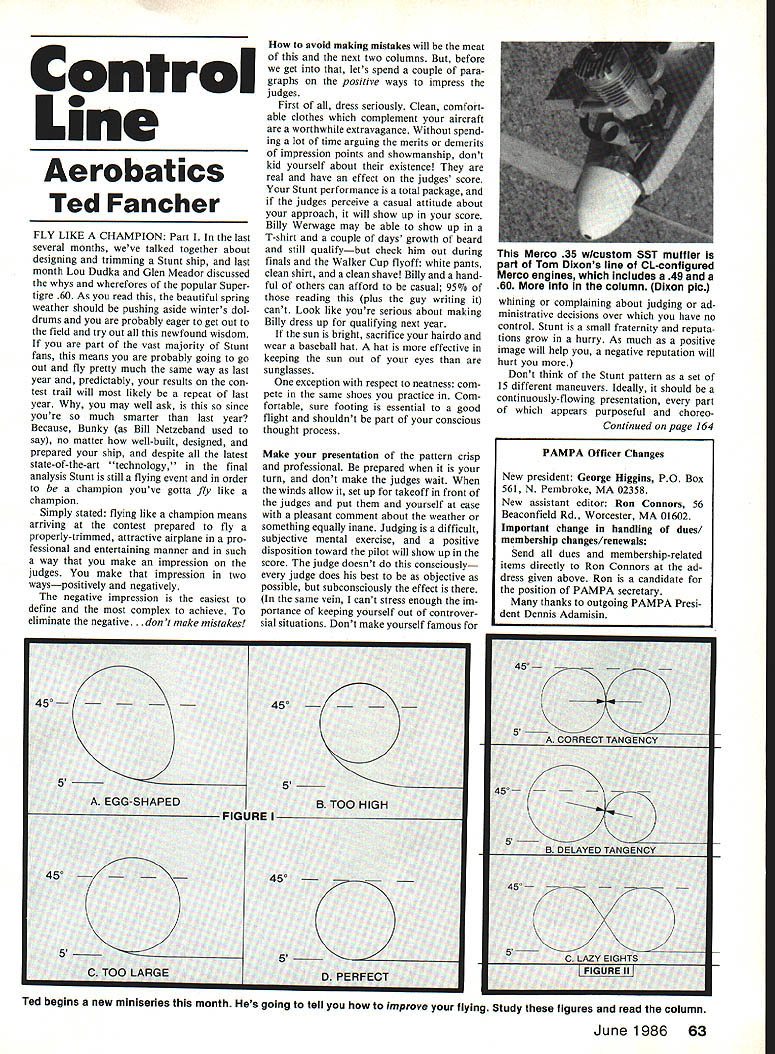
- Because the loop is a "round" maneuver as opposed to a "cornered" one, many feel it should be entered into gradually. This gradual increase in the rate of turn makes a correct series of loops impossible.
- By the time the correct radius is finally established, the plane is often so high that the only options are:
- make all the loops tall and egg-shaped;
- make them round and tight, but well above your rule-book height, both top and bottom; or
- never establish the proper radius and thus make the loops all too large.
- Solution: recognize that although a loop has no abrupt corners, it nonetheless has a constant radius throughout. To fly a correctly shaped and properly sized set of loops, it is necessary to go quickly from zero rate of turn to the proper rate — effectively from level flight to 45° elevation. Work at learning the amount of up-elevator required to rapidly establish the proper rate with your ship. Don't jerk it. What you're looking for is a positive departure from level flight directly into the radius of the loop.
- Poor timing at tangency points in round eights
- The foregoing on round loops applies as well to entry into all of the "round eights." Establish the correct rate of turn as quickly as possible.
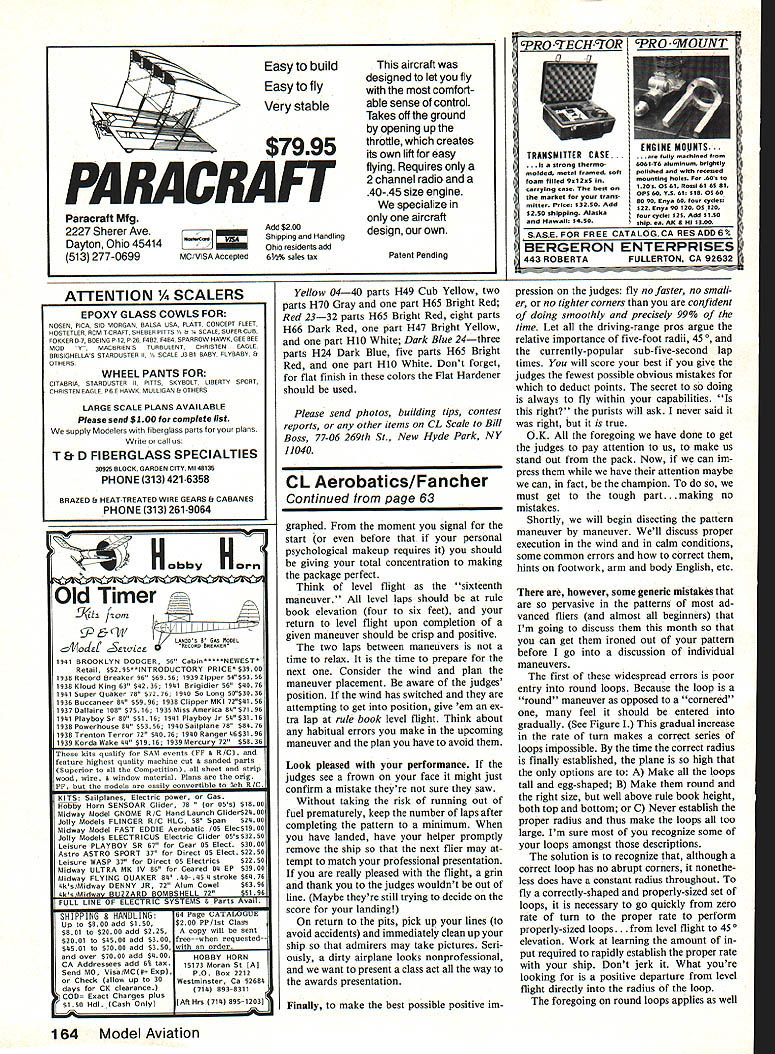
- It is the rule rather than the exception for even some very good fliers to mess up the intersections of all the round eights by flying beyond the proper point of tangency. (See B in Figure II.) What happens is that the pilot waits too long or is too tentative in reversing the direction of turn. As a result, the point of tangency moves up and/or around the first loop so that the second one becomes too large, too high, and/or misshapen. Every set of eights gives us four chances to screw this one up.
- Cure: initiate the change in direction positively just before the point of tangency. If the pilot waits until he sees the ship at the point of tangency to change directions, he is too late.
- Note: if initiated too soon, the result will be a modified lazy eight which must be avoided. (See C in Figure II.)
Several dividends accrue to proper entry and tangent intersection exercises. First, line tension is much better when maneuvers are kept below about 50°, and second, because the maneuvers will be closer to a reference (the ground) and of the proper size, it becomes much easier to keep them really round.
More next month.
Product Note
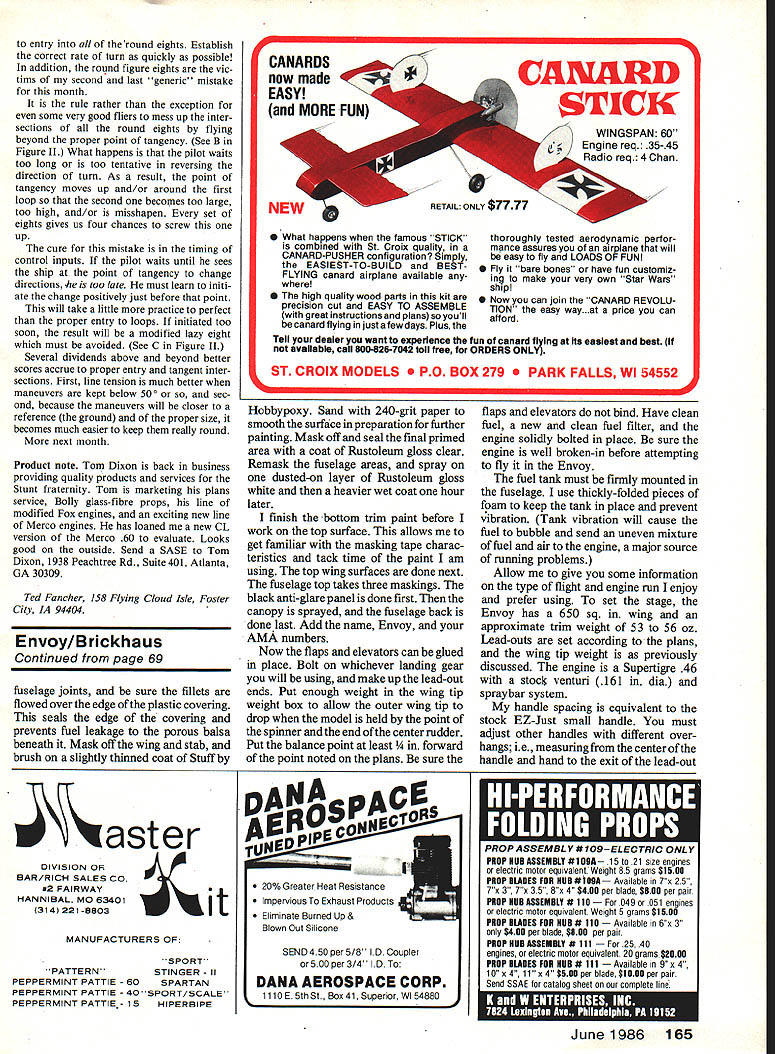
Tom Dixon is back in business providing quality products and services for the stunt fraternity. Tom is marketing his plans service, Bolly glass-fibre props, his line of modified Fox engines, and an exciting new line of Merco engines. He has loaned me a new CL version of the Merco .60 to evaluate. Looks good on the outside.
Send a SASE to: Tom Dixon 1938 Peachtree Rd., Suite 401 Atlanta, GA 30309
Ted Fancher 158 Flying Cloud Isle Foster City, CA 94404
Transcribed from original scans by AI. Minor OCR errors may remain.

