
Control Line Aerobatics
Ted Fancher
Before getting into a maneuver-by-maneuver discussion of the pattern, I think it will be advantageous to discuss three general areas: pilot strategy in windy conditions; in calm air; and an understanding of what I call "horsepower maneuvers."
Windy Conditions
Problems to overcome
- Speed buildup in consecutive downwind maneuvers and the concurrent reduction in responsiveness. Stunters don't turn as well in the wind.
- Poor penetration into the wind.
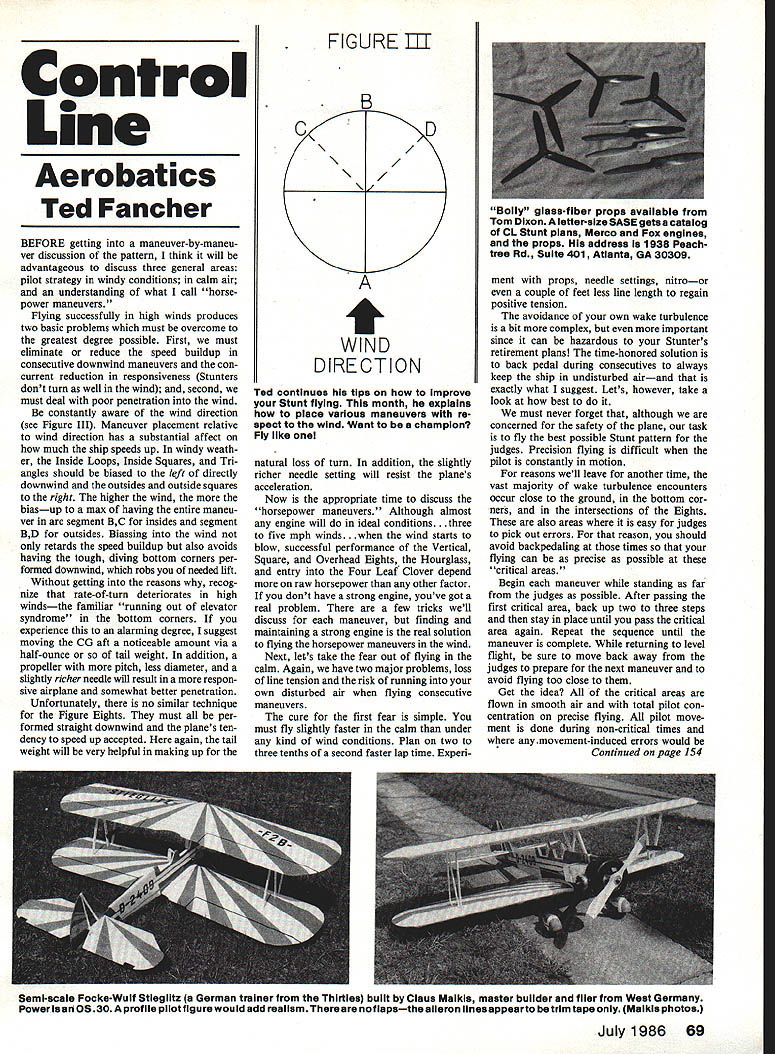
Be constantly aware of the wind direction (see Figure III). Maneuver placement relative to wind direction has a substantial effect on how much the ship speeds up. In windy weather:
- Inside Loops, Inside Squares, and Triangles should be biased to the left of directly downwind (i.e., biased slightly upwind).
- Outsides and Outside Squares should be biased the opposite way so the downwind portions of the maneuver are shortened.
The higher the wind, the more the bias — up to a maximum of having the entire maneuver in arc segment BC for insides and segment BD for outsides. Biasing into the wind retards speed buildup and avoids having tough diving bottom corners performed downwind, which robs you of needed lift.
Recognize that rate-of-turn deteriorates in high winds — the familiar "running out of elevator" syndrome in the bottom corners. If you experience this to an alarming degree:
- Move the CG aft noticeably (for example, add about a half-ounce of tail weight).
- Use a propeller with more pitch and less diameter and set the needle slightly richer; this often results in a more responsive airplane and somewhat better penetration.
Figure Eights are an exception: they must be performed straight downwind and the plane's tendency to speed up must be accepted. Again, a bit of tail weight and a slightly richer needle setting will help compensate for the loss of turn and resist acceleration.
Horsepower maneuvers
Certain maneuvers depend more on raw engine power than anything else when the wind starts to blow (3–5 mph and up):
- Vertical
- Square
- Overhead Eights
- Hourglass
- Entry into the Four-Leaf Clover
If you don't have a strong engine, you'll have real trouble performing these in wind. There are a few tricks for each maneuver, but finding and maintaining a strong engine is the real solution.
Calm Conditions
Problems to overcome
- Loss of line tension.
- Risk of flying into your own disturbed air (wake turbulence) when doing consecutive maneuvers.
Cures and techniques:
- Fly slightly faster in calm than in wind. Plan on two to three-tenths of a second faster lap time.
- Experiment with props, needle settings, nitro, or even shortening the lines by a couple of feet to regain positive tension.
- Use backpedaling during consecutives to keep the ship in undisturbed air. However, avoid backpedaling during "critical areas" where precision matters.
Critical areas (where wake turbulence encounters are most likely and where judges are most observant):
- Close to the ground
- Bottom corners of maneuvers
- Intersections of the Eights
Suggested sequence for consecutives:
- Begin each maneuver standing as far from the judges as possible.
- After passing the first critical area, back up 2–3 steps and remain in place until you pass the critical area again.
- Repeat until the maneuver is complete.
- When returning to level flight, move back away from the judges to prepare for the next maneuver and avoid flying too close.
All critical areas should be flown in smooth air with total pilot concentration on precise flying. All pilot movement should be done during non-critical times where any movement-induced errors will be minimized.
Takeoff and Level Flight
Don't short-shrift the Takeoff — it is worth a possible 40 points. I recommend launching directly in front of the judges:
- Your liftoff point will be difficult for them to establish (they view the rear), and since the judges position themselves upwind, your liftoff will be downwind and less likely to balloon.
- If you plan the climb for one lap from launch to level flight altitude, you can give a small blip of Down elevator as you pass the judges to emphasize completion of the climb and the start of level flight.
Concentrate on two laps of level flight to determine whether the engine run is acceptable. If so, after the two level laps give the judges a signal with your hand held high for a full lap (or until the judges signal back). No signal, no official flight.
If the wind is strong and merely getting airborne is a concern:
- Launch directly into the wind with neutral elevator. The airplane will be airborne almost immediately — make the climb gradual and controlled.
- Avoid downwind or crosswind launches in high winds; those are replete with hazards (weathercocking, flip-overs) and not worth the risk.
The rule book allows a "warm up period" immediately after Takeoff and Level Flight. Forget it — it looks bush-league, and if you haven't warmed the pattern yet, you won't do it between Takeoff and the Wingover.
Wingover
The Wingover is one of the toughest maneuvers to do well and it sets the scene for the whole flight. Major difficulty arises from the lack of a reference as you pass overhead. Technique:
- Use your body as a reference. Just before entering the Wingover, turn your shoulders and feet directly upwind and downwind.
- Fly directly overhead, staring from your upwind foot to your downwind foot, and make a positive inverted pullout at 4–6 feet.
- If you miss the highest point you will likely have to make a directional correction, which is usually fatal to the maneuver.
Common Wingover errors:
- Missing the wind — you must begin directly upwind in any significant breeze.
- Not following the same track on both Wingovers.
Hints:
- In a strong breeze it can be hard to fly a crisp entry directly upwind. Try moving your hand briskly toward your body while giving Up control, effectively shortening the lines.
- On a windy day, enter ever so slightly before directly upwind to ensure you don't pull up too late — a too-late pull up is the most devastating error in wind.
- If your pullouts balloon, you are probably pulling out into the wind rather than directly downwind due to an improper entry or overbanked headings overhead. Check these before adjusting other settings.
When flying the Wingover, establish a target (tree, light pole, etc.) at the pullout point. Upon returning to your upwind foot, pull up directly overhead in the same path as the first pass; as you pass overhead, turn your body one-quarter turn to the left, pick out your aiming point, and nail the upright pullout right at five feet.
Round Loops (Insides and Outsides)
We'll discuss the Insides; Outsides are identical but reversed.
- Make brisk entries to your round maneuvers. That alone solves more than half your problems and makes loops more compact and clearly defined.
- In ideal air, loops should be near perfect from proper entry and practice.
In wind:
- When you cross into the wind, loops will tend to elongate horizontally and walk downwind.
- Correct this by using slightly more up elevator while climbing to penetrate the wind and slightly more down elevator coming down to allow more built-in downwind momentum.
- Done correctly, loops will stay round and concentric and speed will not get out of hand.
Be ruthlessly critical of the shape of all maneuvers. Just because the top is at the bottom at five feet doesn't make it perfect. Avoid flat spots and obvious changes in radius.
In calm air:
- The critical area is the lowest point of each loop. Step back a couple of steps immediately after passing that point to avoid wake turbulence on the next pass.
Stay tuned and keep practicing precision flying.
Ted Fancher 158 Flying Cloud Isle Foster City, CA 94404
Transcribed from original scans by AI. Minor OCR errors may remain.

