
Control Line: Aerobatics
Ted Fancher
FLY LIKE A CHAMPION: Part III — Square Loops and Cornered Maneuvers.
Cornered maneuvers are among the toughest in a pattern. The most frequent and costly mistakes occur at the corner at the end of each vertical dive. To score well you must execute these corners with precision. Anything you can do to simplify the task will reap huge dividends.
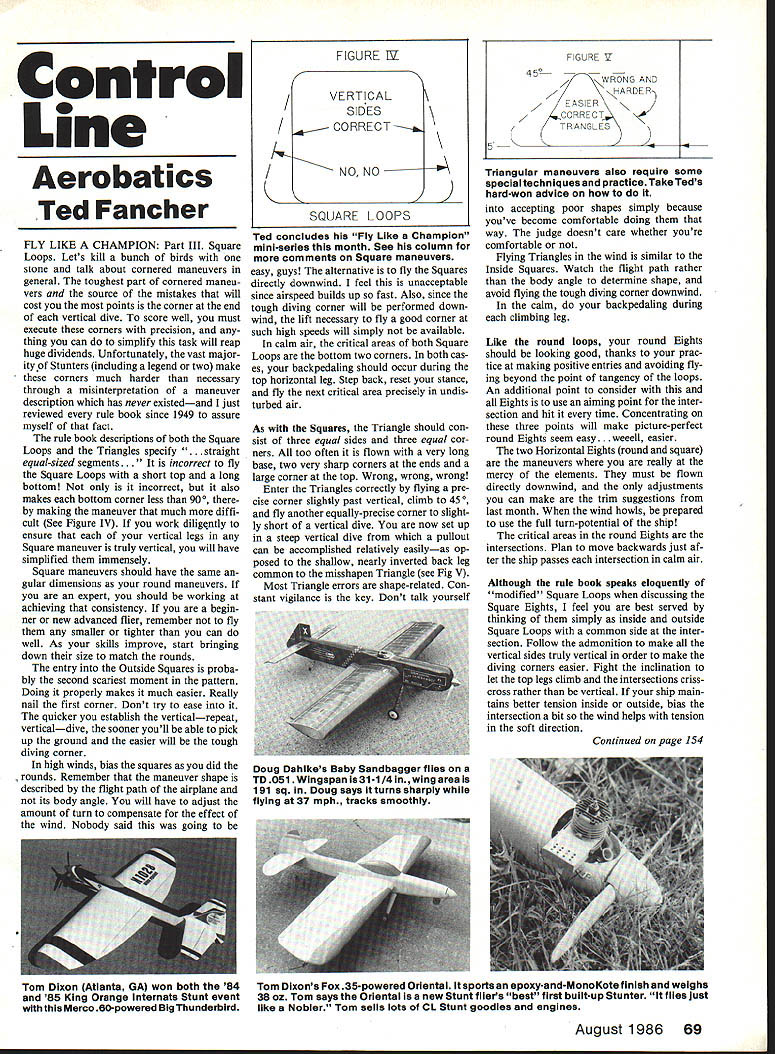
The rule book descriptions for both Square Loops and Triangles specify "straight, equal-sized segments." It is incorrect to fly Square Loops with a short top and a long bottom — this makes each bottom corner less than 90° and makes the maneuver much harder. Ensure each vertical leg in any square maneuver is truly vertical to simplify the corners and improve consistency with your round maneuvers.
Square Loops
The key points for Square Loops:
- Fly straight, equal-sized segments; do not shorten the top or lengthen the bottom.
- Make vertical legs truly vertical to ensure bottom corners are 90° and manageable (see Figure IV).
- Square maneuvers should have the same angular dimensions as your round maneuvers. Experts should work on achieving that consistency; beginners should not fly them any smaller or tighter than they can manage well — shrink them as your skill improves.
- Entry on outside Squares is a critical moment. Nail the first corner — establish the vertical dive quickly rather than easing into it. The sooner the vertical is established, the easier the diving corner.
- In high winds, bias the squares as you do rounds. The maneuver shape is defined by the flight path, not the airplane's body angle. Adjust the amount of turn to compensate for wind effects.
- Avoid performing the tough diving corner downwind: airspeed builds up quickly and required lift for a good corner may not be available.
- In calm air, the bottom two corners are critical. Backpedaling should occur during the top horizontal leg: step back, reset your stance, and fly the next critical area precisely in undisturbed air.
- When dealing with "modified" Square Loops (as in Square Eights), think of them as inside and outside Square Loops with a common side at the intersection. Keep vertical sides truly vertical and avoid letting top legs climb or intersections crisscross rather than remain vertical. If your ship maintains better tension on one side, bias the intersection slightly so the wind helps with the soft direction.
Triangles
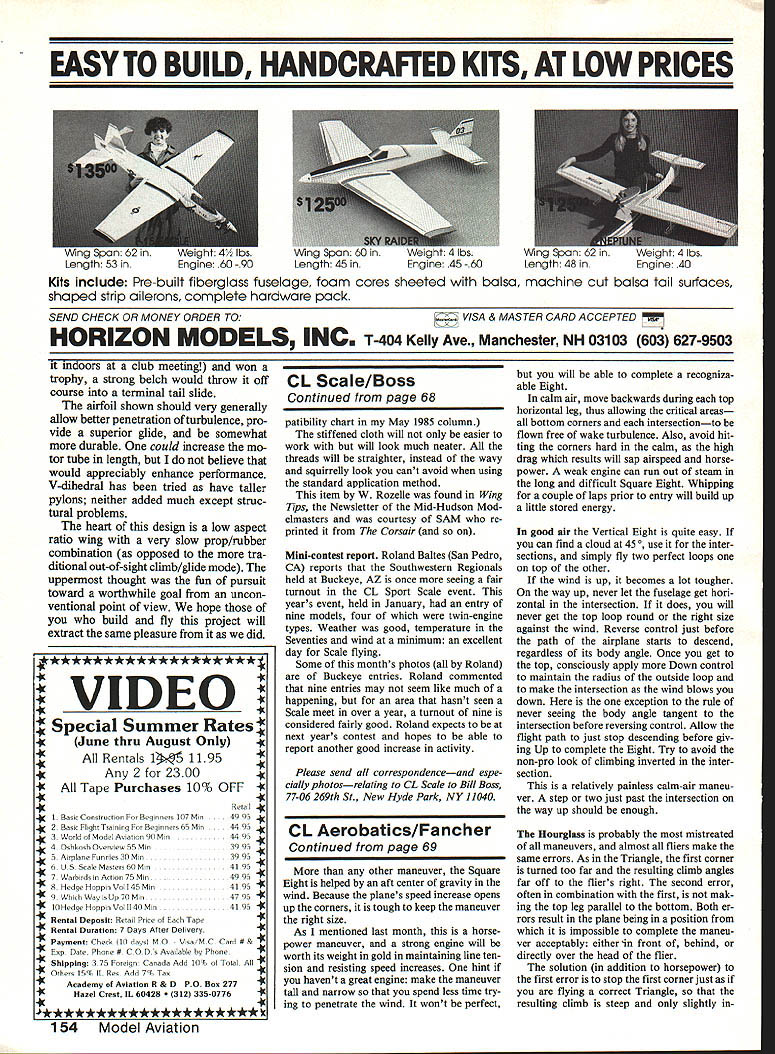
Triangles should be three equal sides with three equal corners. Common faults produce a very long base, two sharp bottom corners, and a large top corner — the wrong shape.
Entry and shape technique:
- Enter by flying a precise corner slightly past vertical, climb to about 45°, then fly another equally precise corner slightly short of vertical.
- From that setup you should be in a steep vertical dive from which a pullout can be accomplished relatively easily — unlike the shallow, nearly inverted back leg of a misshapen triangle (see Figure V).
- Most Triangle errors are shape-related. Constant vigilance is required; do not accept poor shapes just because you are comfortable with them. Judges do not care whether you are comfortable.
- Triangles flown into the wind resemble Inside Squares. Watch the flight path rather than body angle to determine the shape.
- Avoid flying the tough diving corner downwind; in calm air the backpedaling should occur during the climbing leg.
Round Eights and Horizontal Eights
Round Eights:
- Practice positive entries and avoid flying beyond the point of tangency on loops.
- Use an aiming point for the intersection and hit it every time. Concentrating on the three critical points (the two loop centers and the intersection) makes round Eights much easier.
- The critical areas are the intersections. In calm air, plan to move backwards just after the ship passes each intersection.
Horizontal Eights (round and square):
- These maneuvers must be flown directly downwind; they are highly affected by wind.
- Adjust only by trim and by using the full turn potential of the ship in strong winds.
- The round and square Horizontal Eights demand that you plan for wind and engine power; be prepared to use all available turn authority.
Wing Over / Top-Base Alignment
To make the top parallel to the base, use your body as a reference:
- Plant your feet squarely and do the maneuver directly in front of you.
- Start from your left foot, climb to a spot just over your right shoulder, fly a Wing Over path to a point just over your left shoulder, then dive to your right foot.
- Done properly, all the pieces should fall into place.
Hourglass
- The scariest part of the pattern is often the last corner of the Hourglass.
- Avoid the two classic errors: going noticeably inverted at the intersection or allowing the Hourglass to lie on its side. If you must go noticeably inverted to make an intersection, the bottom corner becomes nearly impossible — stand the Hourglass up straight.
Overhead Eight
The Overhead Eight is difficult because of the lack of a visual reference. Use your body as your reference:
- Face into the wind with feet square, climb vertically directly in front of you.
- Bend your back to ensure the Eight is overhead rather than in front of you.
- Fly the Figure Eight with the intersection directly over your nose and the loops over the appropriate shoulders.
- Keep the airplane in view using peripheral vision; if you have to move your head to follow it, the Eight is probably too big. Recover with a half turn of your body to face downwind for a smoother, safer level-flight recovery.
In calm air the Overhead Eight is straightforward; in wind it can open up and be hard to complete. If you lack powerful engine thrust, allow it to open so you can finish rather than blowing out.
Four Leaf Clover
- All four loops should be the same size; the maneuver should start slightly below 45° and appear compact.
- Common errors to avoid:
- Pulling out of the first loop lower than entry level, cramping lower loops.
- Loops overlapping one another.
- Flight paths between segments not being truly horizontal or vertical as appropriate.
- Best performed straight downwind and directly in front of you to help achieve symmetry.
Wind techniques for the Clover if you lack horsepower:
- Delay entry until you are directly downwind so you can complete the first loop, then slowly fudge the maneuvers back to proper position (may cause slight overlap but preferable to blowing out).
- Or fly a shallow Wing Over into the first loop to build some energy as you dive into it.
Landing, Engine Shutdown, and Other Practical Tips
Landing:
- If possible, plan to land downwind to reduce the chance of bouncing noticeably.
- Do not try to touch down at minimum speed; you will lose control effectiveness.
- Use consistent footwork on each flight so you know how many loops it will take to clear low lines for landing, especially when it is wet or humid (sticky lines can reduce control).
Shutting off the engine with a loop:
- It can be helpful in high winds to be able to shut off the engine while in a loop.
- Use a large loop directly downwind and about 20 feet high so you do not bleed off speed prematurely.
- When the engine quits, descend smoothly but promptly, allowing the wind to reduce airspeed so you are ready to touch down downwind.
- Once on the ground, apply down elevator to increase load on the wheels and keep the airplane from becoming airborne if it rolls into the wind.
Ted Fancher 158 Flying Cloud Isle Foster City, CA 94404
Transcribed from original scans by AI. Minor OCR errors may remain.

