
Control Line: Aerobatics
By Ted Fancher
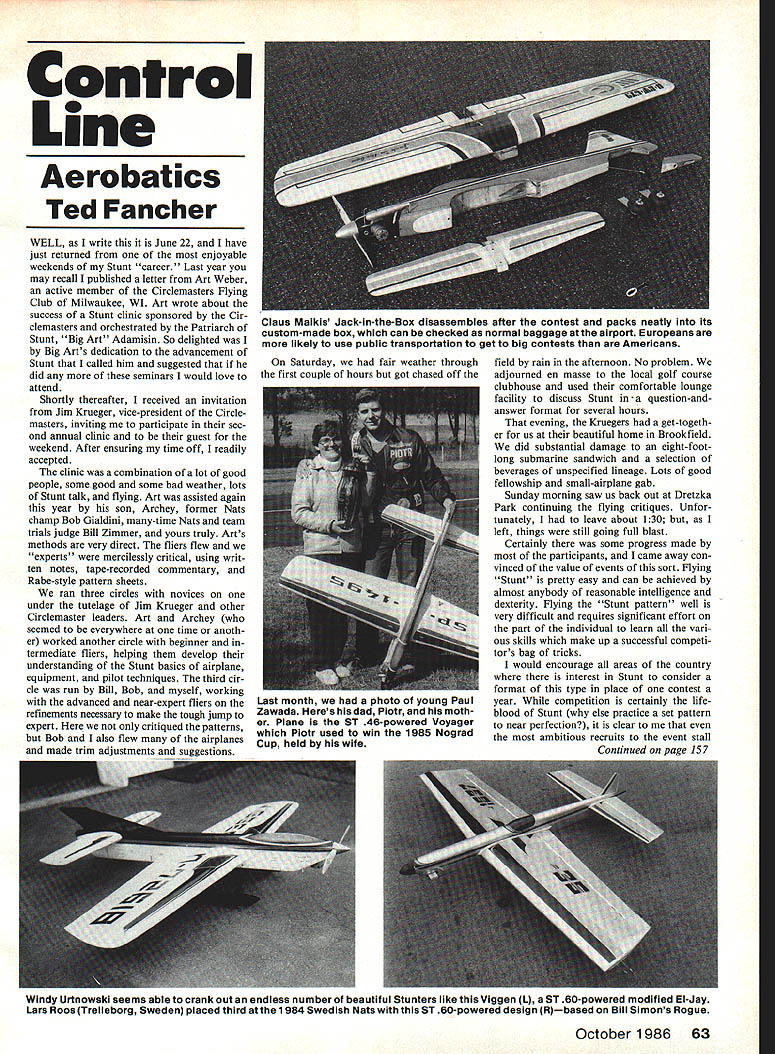
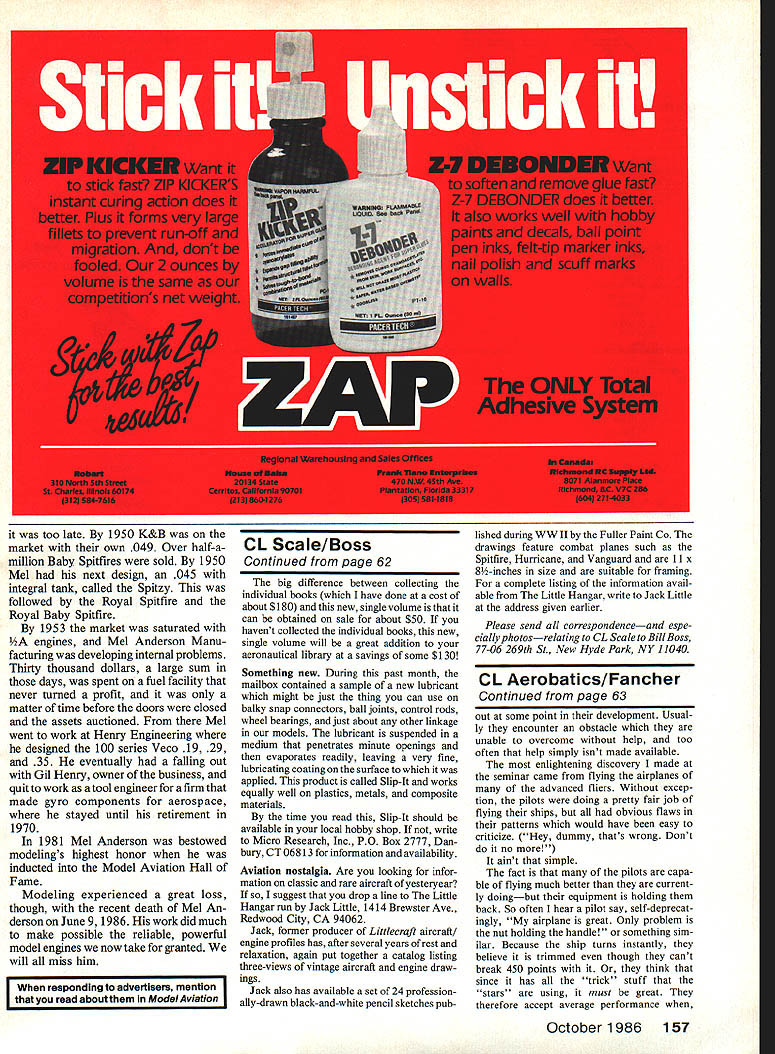
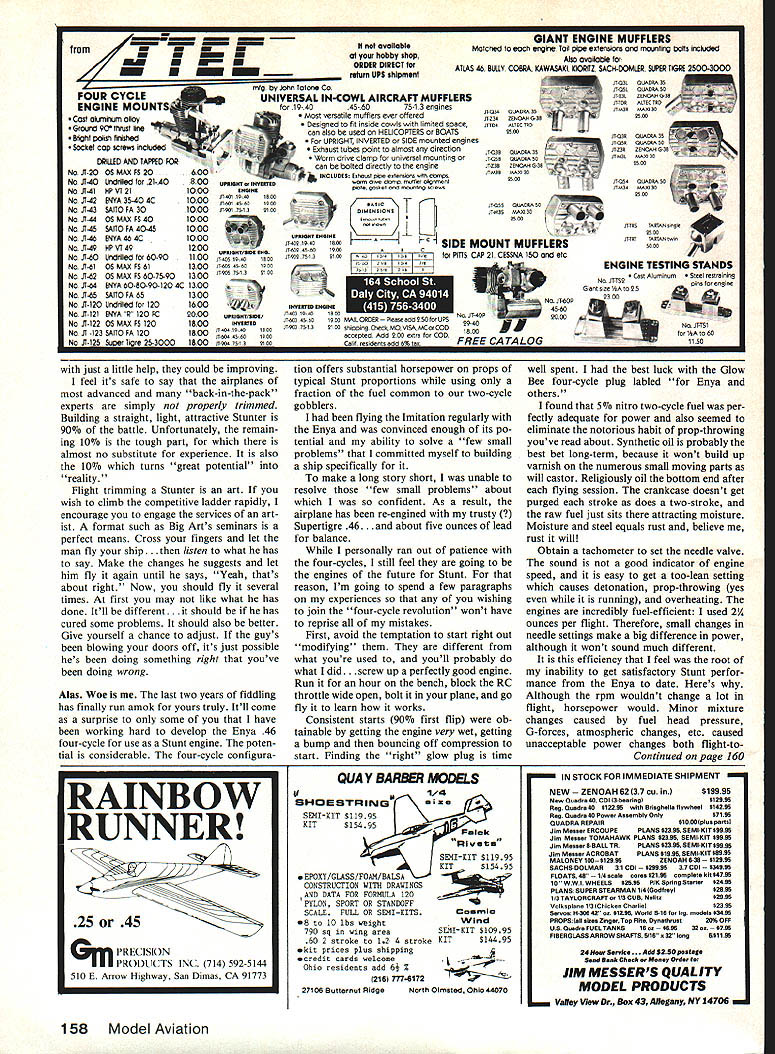
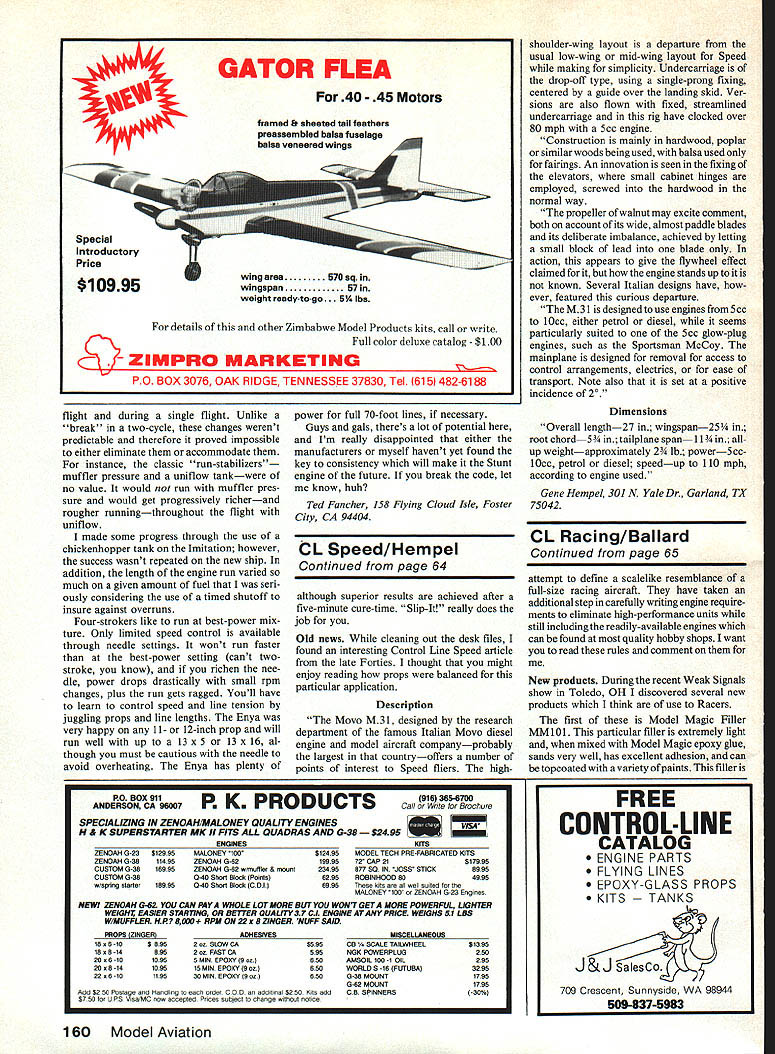
WELL, as I write this it is June 22, and I have just returned from one of the most enjoyable weekends of my Stunt "career." Last year you may recall I published a letter from Art Weber, an active member of the Circlemasters Flying Club of Milwaukee, WI. Art wrote about the success of a Stunt clinic sponsored by the Circlemasters and orchestrated by the Patriarch of Stunt, "Big Art" Adamisin. So delighted was Big Art's dedication to the advancement of Stunt that I called him and suggested that if he did any more of these seminars I would love to attend.
Shortly thereafter, I received an invitation from Jim Krueger, vice-president of the Circlemasters, inviting me to participate in their second annual clinic and to be their guest for the weekend. After ensuring my time off, I readily accepted.
The Clinic
The clinic was a combination of a lot of good people, some good and some bad weather, lots of Stunt talk, and flying. Art was assisted again this year by his son, Archey, former Nats champ Bob Gialdini, many-time Nats and team trials judge Bill Zimmer, and yours truly. Art's methods are very direct. The fliers were mercilessly critical, using written notes, tape-recorded commentary, and Rabe-style pattern sheets.
We ran three circles:
- Novices were on one circle under the tutelage of Jim Krueger and other Circlemaster leaders.
- Art and Archey worked another circle with beginner and intermediate fliers, helping them develop their understanding of the Stunt basics — airplane, equipment, and pilot techniques.
- The third circle was run by Bill, Bob, and myself, working with advanced and near-expert fliers on the refinements necessary to make the jump to expert.
Here we not only critiqued the patterns, but Bob and I also flew many of the airplanes and made trim adjustments and suggestions.
On Saturday we had fair weather through the first couple of hours but got chased off the field by rain in the afternoon. No problem — we adjourned en masse to the local golf course clubhouse and used their comfortable lounge to discuss Stunt in a question-and-answer format for several hours.
That evening the Kruegers had a get-together for us at their beautiful home in Brookfield. We did substantial damage to an eight-foot-long submarine sandwich and a selection of beverages of unspecified lineage. Lots of good fellowship and small-airplane gab.
Sunday morning saw us back out at Dretzka Park continuing the flying critiques. Unfortunately, I had to leave about 1:30, but as I left, things were still going full blast.
Certainly there was progress made by most participants, and I came away convinced of the value of events of this sort. Flying "Stunt" is pretty easy and can be achieved by almost anybody of reasonable intelligence and dexterity. Flying the Stunt pattern well is very difficult and requires significant effort on the part of the individual to learn all the various skills which make up a successful competitor's bag of tricks.
I would encourage all areas of the country where there is interest in Stunt to consider a format of this type in place of one contest a year. While competition is certainly the lifeblood of Stunt (why else practice a set pattern to near perfection?), it is clear to me that even the most ambitious recruits stall out at some point in their development. Usually they encounter an obstacle they are unable to overcome without help, and too often that help simply isn't made available.
Common Faults and Remedies
The most enlightening discovery I made at the seminar came from flying the airplane in many of the advanced flights. Without exception, the pilots were doing a pretty fair job of flying their ships, but all had obvious flaws in their patterns which would have been easy to correct. The most common faults were:
- Poor timing and lack of rhythm in maneuvers.
- A tendency to watch the airplane too closely instead of looking ahead and planning the next move.
- Rushed recoveries, lop-sided loops, and unbalanced figures.
The cures are simple but not always easy:
- Practice slow, deliberate timing. Count aloud if necessary and visualize the airplane's position before starting each maneuver.
- Have someone call counts while you fly or make up a rhythm and stick to it; external cues break the habit of merely reacting to the airplane's current position.
- Work on small, precise control inputs rather than large, last-moment corrections.
Balance and trim are equally important. Many of the pattern problems I saw were aggravated by poorly trimmed ships or inconsistent engine performance. Take the time to trim your airplane so it will fly the desired arc with minimal stick inputs. Check line length and handle centering; small mechanical inconsistencies make it much harder to fly a clean pattern.
Clubs should consider putting on clinics like the one conducted by the Circlemasters. A format that pairs less-experienced pilots with knowledgeable instructors, includes demonstration flights, immediate critique, and hands-on trimming, produces rapid improvement. Flying someone else's well-trimmed ship often reveals bad habits and gives a clearer idea of the timing and control needed.
Finally, be patient and systematic. Keep notes on what corrections help and concentrate on one or two faults at a time. With disciplined practice on timing, rhythm, trim, and small control inputs, most pilots can make significant improvements in their aerobatic flying.
Trimming and the Importance of a Good Ship
I feel it's safe to say that the airplanes of most advanced and many "back-in-the-pack" experts are simply not properly trimmed. Building a straight, light, attractive Stunter is 90% of the battle. Unfortunately the remaining 10% is the tough part, for which there is almost no substitute for experience. It is also the 10% which turns "great potential" into reality.
Flight trimming a Stunter is an art. If you wish to climb the competitive ladder rapidly, I encourage you to engage the services of an artist. A format such as Big Art's seminars is a perfect means. Cross your fingers and let him fly your ship — then listen to what he has to say. Make the changes he suggests and let him fly it again until he says, "Yeah, that's about right." Now you should fly it several times. At first you may not like what he has done. It'll be different — it should be if he has cured some problems. It should also be better. Give yourself a chance to adjust. If the guy's been blowing your doors off, it's just possible he's been doing something right that you've been doing wrong.
Four-Cycle Engine Experience (Enya .46)
Alas. Woe is me. The last two years of fiddling have finally run amok for yours truly. It'll come as a surprise to only some of you that I have been working hard to develop the Enya .46 four-cycle for use as a Stunt engine. The potential is considerable. The four-cycle configuration offers substantial horsepower on props of typical Stunt proportions while using only a fraction of the fuel common to our two-cycle gobblers.
I had been flying the limitation regularly with the Enya and was convinced enough of its potential and my ability to solve a "few small problems" that I committed myself to building a ship specifically for it. To make a long story short, I was unable to resolve those "few small problems" about which I was so confident. As a result, the airplane has been re-engined with my trusty Super Tigre .46 ... and about five ounces of lead for balance.
While I personally ran out of patience with the four-cycles, I still feel they are going to be the engines of the future for Stunt. For that reason, I'm going to spend a few paragraphs on my experiences so that any of you wishing to join the "four-cycle revolution" won't have to repeat all of my mistakes.
Tips and observations from my Enya .46 experience:
- Avoid the temptation to start modifying them right away. They are different from what you're used to, and you may damage a perfectly good engine.
- Run it for an hour on the bench, block the RC throttle wide open, bolt it in your plane, and go fly it to learn how it works.
- Consistent starts (90% first flip) were obtained by getting the engine very wet, getting a bump and then bouncing off compression to start.
- Finding the "right" glow plug is time well spent. I had the best luck with the Glow Bee four-cycle plug labeled "R" for Enya and others.
- I found that 5% nitro two-cycle fuel was perfectly adequate for power and also seemed to eliminate the notorious habit of prop-throwing you've read about.
- Synthetic oil is probably the best bet long-term because it won't build up varnish on the numerous small moving parts as well as castor. Religiously oil the bottom end after each flying session. The crankcase doesn't get caked each stroke as does a two-stroke, and the raw fuel just sits there attracting moisture. Moisture and steel equals rust — and it will rust!
- Obtain a tachometer to set the needle valve. The sound is not a good indicator of engine speed, and it is easy to get a too-lean setting which causes detonation, prop-throwing (yes, even while it is running), and overheating.
- The engine is incredibly fuel-efficient: I used 2½ ounces per hour. Therefore, small changes in needle settings make a big difference in power, although it won't sound much different.
It is this efficiency that I feel was the root of my inability to get satisfactory Stunt performance from the Enya to date. Here's why: although the rpm won't change a lot in flight, horsepower would. Minor mixture changes caused by fuel head pressure, G-forces, atmospheric changes, etc., caused unacceptable power changes both flight-to-flight. Unlike a "break" in a two-cycle, these changes weren't predictable and therefore it proved impossible to either eliminate them or accommodate them.
For instance, the classic "run-stabilizers" — muffler pressure and a uniflow tank — were of no value. It would not run with muffler pressure and would get progressively richer — and rougher running — throughout the flight with uniflow.
I made some progress through the use of a chicken-hopper tank on the imitation; however, the success wasn't repeated on the new ship. In addition, the length of the engine run varied so much on a given amount of fuel that I was seriously considering the use of a timed shutoff to insure against overruns.
Four-strokes like to run at best-power mixture. Only limited speed control is available through needle settings. It won't run faster than at the best-power setting, and if you richen the needle, power drops drastically with small rpm changes, plus the revs get ragged. You'll have to learn to control speed and line tension by juggling props and line lengths. The Enya was very happy on any 11- or 12-inch prop and will run well with up to a 13 x 5 or 13 x 6, although you must be cautious with the needle to avoid overheating. The Enya has plenty of power for full 70-foot lines, if necessary.
Guys and gals, there's a lot of potential here, and I'm really disappointed that either the manufacturers or myself haven't yet found the key to consistency which will make it the Stunt engine of the future. If you break the code, let me know, huh?
Ted Fancher 158 Flying Cloud Isle Foster City, CA 94404
Transcribed from original scans by AI. Minor OCR errors may remain.

