
Control Line: Aerobatics
Wynn Paul
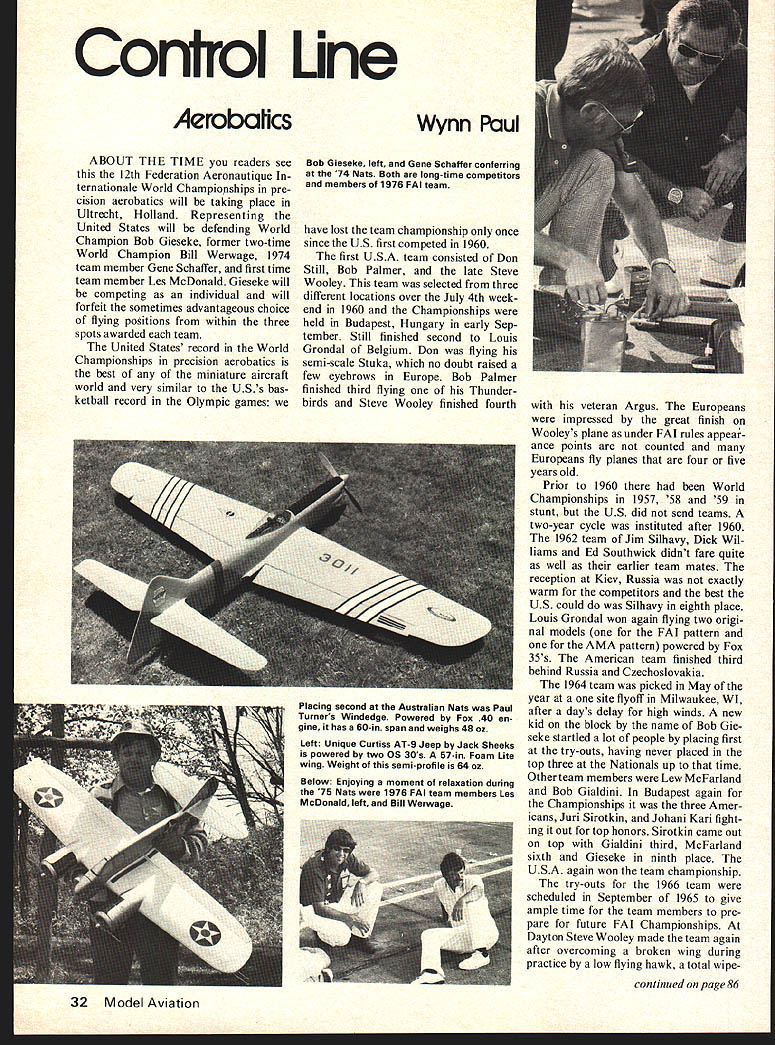
ABOUT THE TIME you readers see this the 12th Federation Aeronautique Internationale World Championships in precision aerobatics will be taking place in Utrecht, Holland. Representing the United States will be defending World Champion Bob Gieseke, former two-time World Champion Bill Werwage, 1974 team member Gene Schaffer, and first time team member Les McDonald. Gieseke will be competing as an individual and will forfeit the sometimes advantageous choice of flying positions within the three spots awarded each team.
The United States' record in the World Championships in precision aerobatics is the best of any of the miniature aircraft world and very similar to the U.S.'s basketball record in the Olympic games: we have lost the team championship only once since the U.S. first competed in 1960.
The first U.S.A. team consisted of Don Still, Bob Palmer, and the late Steve Wooley. This team was selected from three different locations over the July 4th weekend in 1960 and the Championships were held in Budapest, Hungary in early September. Still finished second to Louis Grondal of Belgium. Don was flying his semi-scale Stuka, which no doubt raised a few eyebrows in Europe. Bob Palmer finished third flying one of his Thunderbirds and Steve Wooley finished fourth with his veteran Argus. The Europeans were impressed by the great finish on Wooley's plane as under FAI rules appearance points are not counted and many Europeans fly planes that are four or five years old.
Prior to 1960 there had been World Championships in 1957, '58 and '59 in stunt, but the U.S. did not send teams. A two-year cycle was instituted after 1960. The 1962 team of Jim Silhavy, Dick Williams and Ed Southwick didn't fare quite as well as their earlier teammates. The reception at Kiev, Russia was not exactly warm for the competitors and the best the U.S. could do was Silhavy in eighth place. Louis Grondal won again flying two original models (one for the FAI pattern and one for the AMA pattern) powered by Fox 35s. The American team finished third behind Russia and Czechoslovakia.
The 1964 team was picked in May of the year at a one-site flyoff in Milwaukee, WI after a day's delay for high winds. A new kid on the block by the name of Bob Gieseke startled a lot of people by placing first at the try-outs, having never placed top three at Nationals up to that time. Other team members were Lew McFarland and Bob Gialdini. In Budapest again for the Championships it was the three Americans, Juri Sirotkin, Juhani Kari fighting it out for top honors. Sirotkin came out on top with Gialdini third, McFarland sixth and Gieseke in ninth place. The U.S.A. again won the team championship.
The try-outs for the 1966 team were scheduled in September of 1965 to give ample time for the team members to prepare for future FAI Championships. At Dayton Steve Wooley made the team again after overcoming a broken wing during practice by a low flying hawk, a total wipeout. That team member Bill Werwage flew his USA-1 to first place at Namur, Belgium. Bob Gieseke was very close behind, 1920 points to Bill's 1924. Jerry Phelps, flying clockwise, finished in fourth place as the U.S.A. again won the team championship. Joseph Gabris, flying in his sixth World Championships, was the only European able to split up the Americans as he finished third.
At the 1971 FAI try-outs in Cleveland Bill Werwage presented the Walker Individual World Championship Trophy to Mrs. Wooley, mother of Steve Wooley, who had been killed in an automobile accident. The Walker Cup was replaced by a new award, the Steve Wooley Cup, a Williamson bowl of American silver, which would be the new perpetual trophy for the individual World Champion in control-line precision aerobatics. Selected for the team at Cleveland were Bill Werwage, Gerald Phelps, and Bob Gieseke. Bill won back World Titles as in 1972 in Finland and outclassed the field with the reliable USA-1, this time powered by a ST 46. Gieseke finished sixth and Phelps 14th and the team finished first again.
The 1973 try-outs were a curious mixture of veterans and some new faces. Gieseke was out of retirement; Phelps and Silhavy were in retirement; McFarland, Gieseke and Werwage trying to get back on the team; Gene Schaffer in his second try-outs, and Al Rabe and Les McDonald right up with the leaders. After the wind and heat subsided in St. Louis, Bob Gieseke, Gene Schaffer and Bill Werwage had made the team. And, on his fifth try, the old pipe smoker, Bob Gieseke bested everybody in the world at the 1974 Championships in Czechoslovakia with Bill Werwage taking second place and Gene Schaffer in sixth place. And the U.S.A. team made it in a row for the team championship.
To a lot of stunt fliers the FAI championships is a rather vague concept, both as to team selection, how to enter and once there the time required to get an entry form. Some of the try-outs have had as many as 65 competitors; however, there have been enough great fliers to send outstanding teams to the World Championships. The FAI patches sold by the AMA help to defray the costs of sending the control-line fliers. Perennial team manager Doc Jackson wages a one-man war for more FAI-type competition in the United States, borne out by the poor showings of those who entered team races at the championships. Aerobatics probably has an advantage since the local contest has basically the same stunt pattern as the FAI, while it is rare to see FAI speed or team race on the local scene. It appears to this writer that the number of contestants in precision aerobatics is increasing, so the prospects of a very competitive FAI try-outs every other year, or third year if a three-year cycle is passed, are very good. Write me: Wynn Paul, 1640 Maywick Dr., Lexington, KY 40504.
Transcribed from original scans by AI. Minor OCR errors may remain.

