
Control Line: Aerobatics
Ted Fancher
Thanks and acknowledgements
Many thanks to Lou Dudka for doing the Nats report for last month's issue. This is the third time Lou has filled in for me, and he did his usual fine job. I asked Lou to help out this year partly because having to write the report of your own success takes a lot of ego-gratification out of the event; being as eager as most to avoid that, I was fortunate enough to win and gladly accepted his assistance. Unfortunately, by agreeing to write the column he lost the chance to see his name in lights.
Last year at Chicopee Lou was flying great and in a solid position to qualify for the Walker flyoff. On his second flight in the two-flight finals he inadvertently did four of both the Inside and Outside Loops. That lost him pattern points and caused him to miss—narrowly—the final five. This year there was no denying Lou: he flew beautifully all week long, was the second-highest qualifier for the Walker Flyoff, and placed a strong fifth in the finals. His success is a prime example of the payoff for dedication and hard work.
Special thanks to the many volunteers who make the Nats possible, especially Big Art Adamisin and his ever-active helpmate Betty in their last hurrah administering top-level Stunt competition. Special thanks also to Bev Wisniewski for her long service as Control Line Category Director at the Nats. Bev has stood ten feet tall on our behalf on numerous occasions and received little recognition; attendance at the PAMPA Awards Banquet allowed a token appreciation, for which I add my printed thanks. We all love you, Bev.
Personal thanks as well to:
- Lou Dudka and Glen Meador for whipping up a beautiful foam wing on short notice two years ago (which I only finished this spring).
- Jim Greenaway, whose expertise I greatly admire, for supplying a modified heim-held I used to good advantage on the ST .46 (smoother and more economical than the stock squish-band head with only a slight loss of power).
- Gary McClellan and Don McClellan, both of whom qualified for the finals themselves but who gave unselfishly of their expertise and support as it became clear I would be competing for the top prize.
Finally, thanks to all who called or wrote with congratulations—your thoughtfulness is greatly appreciated.
A few notes from the Nats
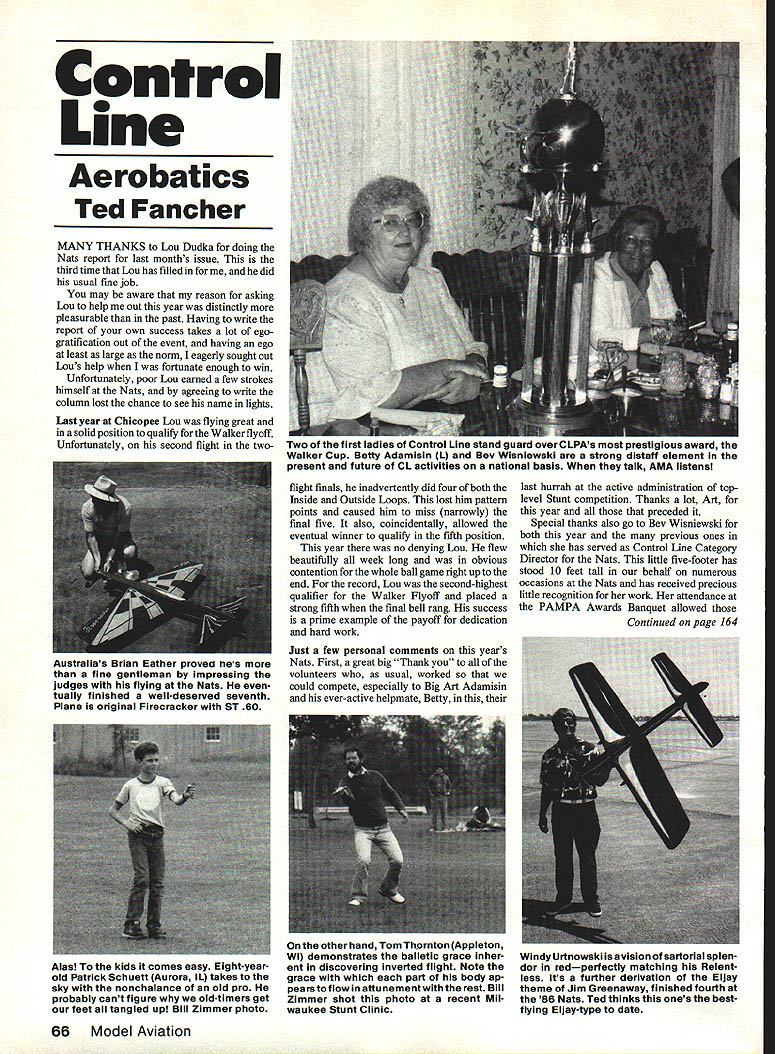
A strong distaff element was present for future CL activities on a national basis. Australia's Brian Eather proved a fine gentleman, impressed the judges with his flying, and finished a well-deserved seventh.
Kids sometimes come easy: eight-year-old Patrick Schuett of Aurora, IL showed up with the nonchalance of an old pro. Jim Greenaway finished fourth. One of the best planes at the recent Milwaukee Stunt Clinic was an Eljay-type, in my opinion.
Wing structure: Criteria of success
Consider what you expect of a wing structure. Decide in advance what constitutes success and what constitutes failure:
- Is a crack acceptable so long as the wing doesn't separate into pieces? (There might be concealed damage.)
- Is crushing acceptable if the dihedral increases? (This is easy to see and measure.)
- Have you designed something into the structure that will yield without breaking and thus reveal an overload? (Lee Renaud put a 1/4‑in.-dia. steel dowel in the wing root of the Aquila; it worked beautifully to show overloads without failing.)
Total failure is easy to recognize; success may be subtle.
Test setup
The test setup can be simple. For a typical balsa-sheeted foam-core Pattern wing, set up two sawhorses with pillows on them to avoid crushing the structure locally, then pile loads on the center section until satisfied. For Old-Timer wings with many skinny spars and ribs, spread the load more carefully. Study pictures of full-scale structures (I mentioned an F-14 example) for ideas on distributing lift loads.
Test loads and design limits
The test loads present a problem: after designing the airplane to meet a specific set of conditions, how can you be sure it meets the most critical conditions it will encounter in service? Simple answer: you can't. Experience helps. If you design, build, fly, and crash many airplanes and keep records, future designs get easier; otherwise you constantly start over and your designs tend to be overweight.
A recollection: our Sun-Fli 4-20 had a large maple block in each wing panel to support the landing gear. The block was supported by thin balsa ribs, thin plywood doublers at the root, and wing sheeting around the block. Those blocks tore out often, and when they didn't the wheels swung back and punched through the lower wing surface. We operated from turf with Du-Bro wheels; the plans didn't specify turf use. The installation might have been satisfactory for pavement, but testing is the only reliable way to know what a structure will withstand.
Crash loads
You should expect to shed some parts in a crash. Ideally, the primary structure should protect the radio system and the engine as much as possible—hence good RC designs have a firewall around the radio compartment (see many Bob Aberle designs). The U.S. Navy says the cockpit must protect the pilot in a crash; if you want to meet similar criteria, push down and forward, or up and back, or both, on the items you want to test.
Typical load expectations:
- Chainsaw engine extension mount (worst-case): about 268 lb (44.7 × 6 lb).
- Mounts for .40–.60-size engines: about 50 lb.
- A radio tray with four servos, switch harness, receiver, and battery: about 35 lb.
- Servo rails: about 5 lb per servo.
Handling and transportation
Handling and transportation include all causes of "hangar rash." Very little attention is paid to these loads until you plan to pack and ship the aircraft. Design and strengthen areas likely to see handling abuse before you have to rely on them.
Tactical approach to competition
Two factors proved instrumental in my victory this year: selecting a tactical approach and learning how to make engines work reliably.
My experiment with a Feya four-stroke left me with a brand-new airplane that was a very good glider but weighed 59 oz.—on the ragged edge of too heavy for my basically-stock ST .46s. The airplane could fly precise maneuvers as long as it wasn't pressed too hard. After practice sessions with Don and Gary we decided the airplane could consistently fly maneuvers scoring in the 32–35 point range, but if pushed to fly very tight or fast maneuvers the motor would be a couple of maneuvers badly. A couple of poor maneuvers in a pattern tend to adversely affect scores on other maneuvers as well.
The night before qualifying we decided to fly conservatively: no smaller, no tighter, and no faster than I was confident of flying well 99% of the time. I only flew a few "wow" maneuvers during the week, and only one "awww." The results speak for themselves.
Moral:
- Take stock of your assets and debits going into a competition.
- Devise a game plan based on your evaluation: size up the competition, your equipment, your physical condition, and the weather.
- Set a realistic goal and fly at a level you can perform honestly; often it's best to fly conservatively.
- If you are an up-and-comer, you have little to lose by letting it hang out within your equipment's honest limits.
- Avoid trying to change your style to please judges mid-event; the chance of successfully changing style in a couple of flights is slim.
Engines: the problem and a practical fix
For about ten years I was known for inconsistent engine runs on my ST .46s. This year they ran like clocks all week. The key fix I discovered may help others.
Symptoms I saw:
- Engines that would not hold the same speed for a full tank, flight after flight.
- Extremely needle-sensitive behavior: tiny adjustments produced large, unpredictable speed changes.
- After a number of flights the engine would break into a two-cycle a couple of laps after takeoff and stay there.
On disassembly I noticed a discoloration on the side of the piston below the ring that matched the blue hue of the fuel I was using—classic "blowby," where the seal between the ring and the cylinder wall is broken and the explosive charge escapes, reducing cylinder pressure and torque. The discoloration on the piston corresponded to polished areas on the cylinder wall.
My theory: the piston ring was effectively hydroplaning on a layer of oil over the highly polished cylinder wall, destroying the seal and causing erratic, needle-sensitive behavior. Full-scale aviation combats hydroplaning by using treaded tires and grooved runways; the grooves allow compressed water to escape. By analogy, tiny scratches in the cylinder wall let oil escape and restore a metal-to-metal seal.
My fix (simple, inexpensive, and so far 100% successful):
- Buy a brake cylinder hone from an automotive parts store.
- Chuck it in a cheap drill press and run at the slowest practical speed.
- Hone the cylinder walls until they are uniformly dull with an approximate crosshatch pattern.
- Reassemble and run the engine; the tiny scratches allow oil to escape and prevent the ring from riding on an oil film.
The tiny scratches act like grooves on a runway: they prevent hydrolapping of the ring, restore sealing, and produce consistent, repeatable runs.
Final thoughts
Test your structures for the likely worst combinations of events and keep records of what works and what doesn't. Fly to your strengths in competition, and take practical measures to make your engines and structures reliable. Thanks again to all who helped, and to the volunteers who make these events possible.
Transcribed from original scans by AI. Minor OCR errors may remain.

