
Control Line: Aerobatics
Ted Fancher
FIRST things first. I owed a guy one and failed to come through. Back in April's column I ran a picture of myself with a mammoth Stunt ship identified as the Maximation and which was touted as my answer to the wimp Stunters who were content to fly the pattern with mere .60s. Because I have yet to "see the light" and switch to the larger Stunters, I have gotten more than my share of flack from the .60 set, and when I saw this ship I couldn't pass up the chance to slip 'em the needle.
In reality, the ship — a twice-scale Sig Banshee — is the handiwork of Joe Pearson, one of the San Francisco area's best scale builders and fliers and also an untiring advocate of Control Line. The ship weighs about 19 pounds and flies on very long anchor chains (just kidding). It is powered by a Quadra and boasts both throttle control and a smoke system to provide exciting demonstration flights. Unfortunately the ship, after nearly a year of active campaigning, suffered a serious in-flight disassembly problem — it shook apart from vibration in the middle of a flight. Fortunately, prior to its demise it delighted many people getting their first exposure to Control Line and (in addition) helped me poke a little fun. Thanks, Joe.
F2B (Control Line Stunt) at the World Championships
Speaking of big, loud, and fast Stunt: by now I'm sure most of you are aware of the results of the F2B event at the CL World Championships held last summer in Pecs, Hungary. Despite the fact that the U.S.A. sent a Stunt team which consisted of two fliers who had pretty much dominated our Nats for the previous three years plus a third member who is nothing short of a Stunt legend (a several-time National and World Champion), our showing was decidedly poorer than we have come to expect in an event where the word domination has taken on an additional dimension as a result of repeated U.S. team and individual successes.
For the first time since the early Sixties the U.S. team failed to win the team championship. We actually placed third behind the teams from the Soviet Union and China. In addition, for the second Championships in a row, an American failed to win the individual championship. The honor this year was also won by a Russian, Anatoly Kolesnikov, and, again, second-place individual was earned by a flier from China, Xiandong Zang. Third-placed Paul Walker was our highest individual finisher.
While there was some hue and cry of Iron Curtain politics rearing its ugly head, it seems to be primarily sour grapes. The consensus seems to be that we just got beat fair and square. In addition, there is a pervasive undercurrent of opinion that the American style of flying Stunt is diverging from that preferred in the rest of the world. In the past there has been an almost automatic acceptance of our style as being trend-setting. It would appear, however, that the automatic following of our lead may be becoming a thing of the past.
The changing American style of Stunt flying
For several years now, but most clearly since Jimmy Casale won his first Nats in Chicopee in 1983, there has been a growing aggressiveness in the "style" of Stunt flying in the United States. There has been an undeniable change in the presentation of winning Stunt patterns. From slow, graceful, probably too big but certainly beautiful patterns, we have transformed the same nominal set of maneuvers into a different animal. In search of maximum performance we are now flying faster — a lot faster, louder and (due to the maximum-length lines and the additional speed) probably just as big with respect to the angular dimensions of the maneuvers and maybe even a bit bigger in the actual dimensions of the maneuvers.
For a clear demonstration of these changes, compare the five-times-Nats-winning Nobler of Bob Gieseke (Fox .35, 40 ounces, 58-foot lines and 5.5-second lap times) to Jimmy Casale's 1985 Nats-winning Spectrum (ST .60, approximately 60 ounces, 70-foot lines, and 4.6-second laps). I won't venture an opinion as to which is better... but they sure are different!
"So what?" you ask. Just this, says I. The recurring theme I hear in discussions of the American fall from grace deals with our adoption of this aggressive style of flying. Here are a few quotes excerpted from a letter I received from Claus Maiks, a member of the West German team and probably the most well-traveled Stunt competitor in the world:
In an informal interview with one of the Pecs judges, Claus recounted the following opinions:
"The Americans flew too big and too fast and too loud... The winning Russian was not impressive, but good, with no big errors... Maybe the results were influenced by some kind of over-reaction? The judges expect the Americans to be top pilots and they are disappointed by the big, loud, fast style. The judges don't see the perfect maneuver which they had expected and they give too low a score — unconsciously, of course."
In addition, Paul Walker reported that in discussions with the judges after the event they expressed the opinion that the higher speeds worked to the disadvantage of the U.S. pilots.
In general, the feeling seems to be that we did in fact get beat at Pecs and that to some degree we may be doing it to ourselves. While there is nothing inherently wrong with developing a style of flying that is particularly American, it might be valuable for us to consider if such an approach is wise in the international arena. Food for thought.
Revival of veteran Stunt fliers
Good heavens! They're back! Via the grapevine (actually a phone call), your fearless correspondent has received word that the local and national Stunt wars are about to be revived by several legends of the past. I'm excited to hear that the siren song of Stunt has become irresistible to such luminaries as:
- Jim "Bearcat" Lynch
- Rich Tower
- Wynn "Pampawagon" Paul
- Bob "Flying Models" Hunt
- Billy "Too Tall" Simmons (maybe)
- Bob "Mr. Clean" Gialdini (maybe)
Don "Skunk" Stull threatened to return "to finally get my name where it belongs" on the Walker Cup when he spoke at the PAMPA banquet in Lake Charles last year. If that weren't frightening enough, there was more than a little trace of determination hidden in the corners of George Aldrich's grin as he flew Dave Cook's Stunter following official flying at last year's Nats... would he come back, too?
These are some of the finest gentlemen and the best fliers our sport has seen, and if any or all of them really do get back into it I think we will all be the better for their return. Welcome back, guys. We've missed you!
Bobby Hunt and Robin's Wings
Good news from Bobby Hunt. Not only is he promising to get back into Stunt and threatening to win the Walker Cup again (I guess R/C Pattern got boring), but he is also putting together a two-page catalog of available kits and parts and instructions for ordering custom items. Send an SASE to Robin's Wings, RFD 1, Box 57, Lafayette, NJ 07848 for details.
At this time Bob is only marketing the cores with a few available options such as spar slots, lite-ply spars, landing-gear supports, and a variety of lightening options. I'm hopeful that someone will be able to offer fully-sheeted wings. Bob is a craftsman of the highest order, and to have someone of his caliber willing to help us again is a real bonus. He has hinted that if proper wood were available and the consumer were willing to pay for the costs associated with high-quality hand craftsmanship, such a product might one day be available again. Let's hope so.
Archie Adamisin's Starship — technical innovation
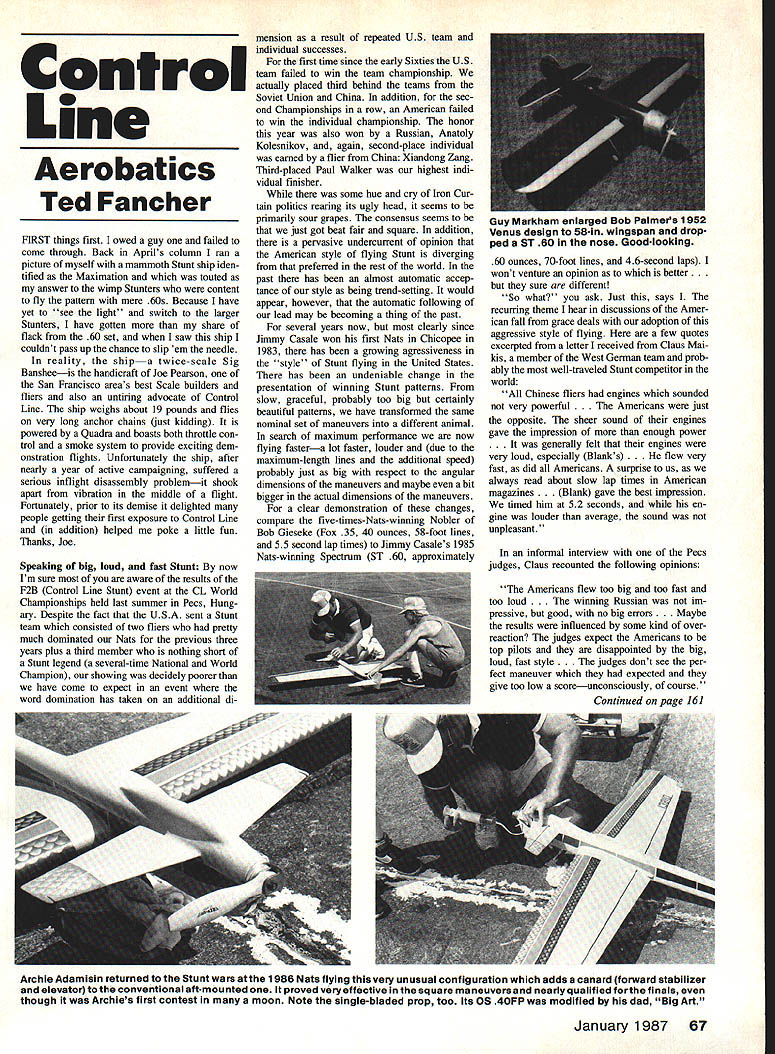
Unfortunately, in the heat of covering as big an event as the National Stunt Championships, it is simply not possible to highlight all of the interesting and valuable innovations that come to light. One such item was Archie Adamisin's award-winning new Stunt ship, the Starship, which won both Jack Sheeks' PAMPA award for technical innovation and the Control Line Aerobatics category award in the AMA-sponsored Top 10 Model Designs at the 1986 Nats.
Archie's design is notable primarily for its innovative planform which includes both a conventional stabilizer/elevator mounted aft and a canard foreplane — both a fixed forward stabilizer and an attached elevator — mounted just aft of the engine. Both forward and aft elevators were coupled to the wing flaps and were articulated as you would expect, i.e., up elevator coupled with down flap and down on the movable forward surface.
Other interesting design features included a single-blade prop and the very high-aspect-ratio wing, very similar to his brother Dennis Adamisin's long-winged, fourth-place finisher at the 1983 Nats. It is also noteworthy that the CG was located forward of the leading edge at the root. This is to be expected, since the aerodynamic center of the entire airplane is moved forward with the addition of the canard surface. If you want to try such a design before you have a chance to publish his findings, be sure that you plan your CG location accordingly. If you balance at the conventional 25% point of the wing it will most likely be too sensitive to fly.
The performance of the airplane was admirable with effortless corners and surprising stability. The proof of the pudding was that Archie very nearly qualified the Starship for the finals notwithstanding that its first flight was the day before qualifying and that Archie himself had almost no recent contest exposure! A truly noteworthy accomplishment. Congratulations.
Final item: Enya four-cycle engines and reader suggestions
Since I owned up to my frustration with the Enya four-cycle a couple of months back, I have received several letters from readers who had suggestions for curing my inconsistency problems. Many thanks to Dave Gierke, Clair Sieversing (when are you guys going to graduate back to CL?), Ronald Clem, and Brian Allen. Unfortunately, I sold all three of my Enyas in a fit of pique one day, and so I have no way of verifying their input. Ergo, I pass it on to you to use as you see fit.
- Two of the four correspondents suggested that a smaller percentage of oil in the fuel results in smoother runs. Dave, a knowledgeable engine man, suggested a figure of 12% oil: 1% castor and 2% Klotz.
- Three of the four praised the use of the Perry oscillating pump as the answer for the inconsistent runs.
I also note that OS is marketing a new version of their .40 four-cycle nicknamed "Surpass," which they advertise at a significantly increased power rating. The OS four-cycles have always seemed more consistent but somewhat lacking in power. This new model may be just the ticket. Hmmmmmm.
Ted Fancher 158 Flying Cloud Isle, Foster City, CA 94404.
Transcribed from original scans by AI. Minor OCR errors may remain.

