
Control Line: Aerobatics
Ted Fancher
The Golden State Championships — a model meet
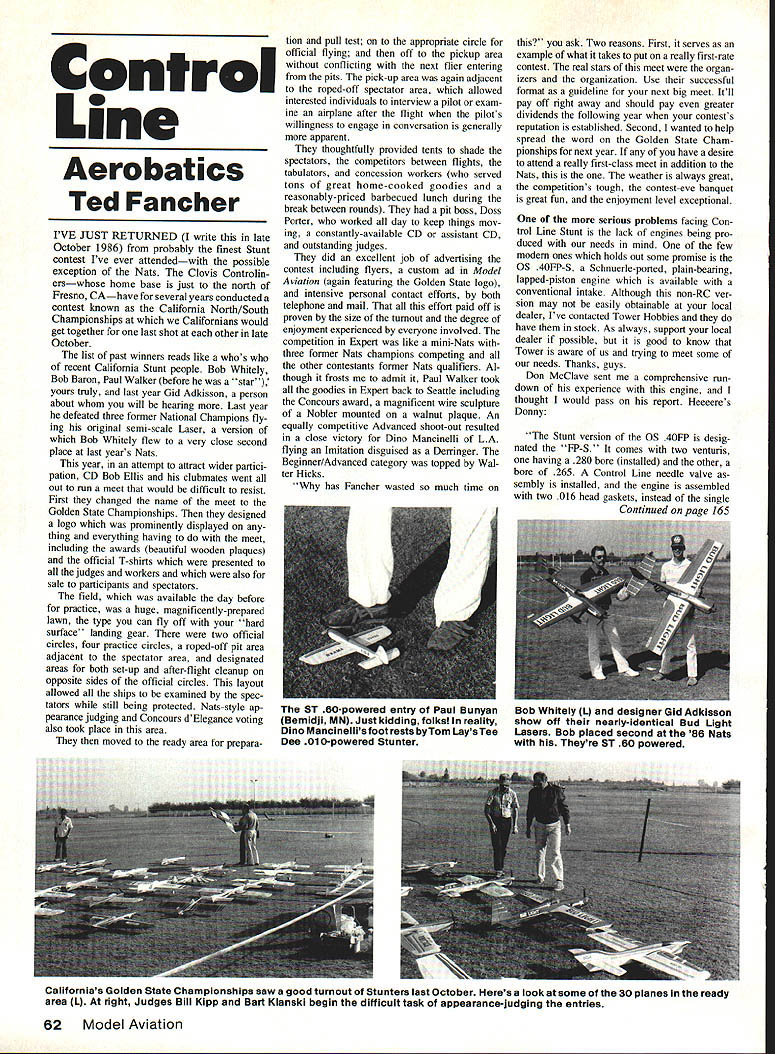
I've just returned (I write this in late October 1986) from probably the finest Stunt contest I've ever attended — with the possible exception of the Nats. The Clovis Controliners, whose home base is just north of Fresno, CA, have for several years conducted a contest known as the California North/South Championships. This year they renamed it the Golden State Championships and went all out to attract wider participation.
The list of past winners reads like a who's who of recent California Stunt people: Bob Whitely, Bob Baron, Paul Walker (before he was a "star"), yours truly, and last year Gid Adkisson, a person about whom you will be hearing more. Last year Gid defeated three former National Champions flying his original semi-scale Laser, a version of which Bob Whitely flew to a very close second place at last year's Nats.
CD Bob Ellis and his clubmates paid attention to every detail. They designed a logo that was prominently displayed on awards (beautiful wooden plaques), official T-shirts presented to judges and workers (and sold to participants and spectators), and on the meet advertising.
The field was available the day before for practice and was a huge, magnificently prepared lawn — the type you can fly off with "hard surface" landing gear. The layout included:
- Two official circles and four practice circles.
- A roped-off pit area adjacent to the spectator area.
- Designated areas for set-up and after-flight cleanup on opposite sides of the official circles.
- A ready area for preparation and pull tests, and a pickup area adjacent to the spectator area.
This arrangement permitted thorough inspection of airplanes by spectators while protecting the ships and allowed smooth traffic flow: pits → ready area → official circle → pickup area without interfering with the next flier. Pilots were easily available after flights for interviews and airplane examination.
They thoughtfully provided tents to shade spectators, competitors between flights, tabulators, and concession workers. Concessions served home-cooked goodies and a reasonably priced barbecue lunch during the break between rounds. A pit boss, Doss Porter, kept things moving; a CD or assistant CD was constantly available, and the judges were outstanding.
Advertising included flyers, a custom ad in Model Aviation featuring the Golden State logo, and intensive personal contact by telephone and mail. The payoff was evident in the size of the turnout and the enjoyment of everyone involved.
Competition highlights:
- Expert: Like a mini-Nats, with three former Nats champions competing and the rest former Nats qualifiers. Paul Walker won Expert and took the Concours award — a magnificent wire sculpture of a Nobler mounted on a walnut plaque.
- Advanced: An equally competitive shoot-out resulted in a close victory for Dino Mancinelli of L.A., flying an imitation (disguised Derringer).
- Beginner/Intermediate: Topped by Walter Hicks.
Why spend so much time describing this? Two reasons. First, the meet serves as an example of what it takes to put on a first-rate contest. The real stars were the organizers and their organization. Use their successful format as a guideline for your next big meet — it will pay off immediately and even more the following year as your contest's reputation is established. Second, I wanted to spread the word about the Golden State Championships for next year. If you want a really first-class meet in addition to the Nats, this is one to attend: great weather, tough competition, a fun contest-eve banquet, and exceptional enjoyment.
Engines — the OS .40FP-S
One of the more serious problems facing Control Line Stunt is the lack of engines being produced with our needs in mind. One of the few modern engines that holds some promise is the OS .40FP-S, a Schnuerle-ported, plain-bearing, lapped-piston engine available with a conventional intake. Although this non-RC version may not be readily available at every local dealer, Tower Hobbies has them in stock. As always, support your local dealer if possible, but it's good to know that Tower is aware of our needs and is trying to meet them.
Don McClave sent a comprehensive rundown of his experience with this engine; here is his report.
Don McClave's report on the OS .40FP-S
- The Stunt version of the OS .40FP is designated the "FP-S." It comes with two venturis: a .280 bore (installed) and a .265 bore (spare). A Control-Line needle valve assembly is installed, and the engine is assembled with two .016 head gaskets instead of the single head gasket found in the RC version. Otherwise, the FP-S is identical to the RC version.
- Weight: 8.1 ounces (without muffler), making the .40FP one of the lightest engines to come along in years — comparable to the old McCoy .35 or K&B Torpedo .35 of the fifties. Overall finish and quality are above average.
- Porting: The FP is Schnuerle-ported, which means easy starting and more power than other porting configurations. In the past Schnuerle ports sometimes led to surging, especially in outside maneuvers, but the FP-S has extremely mild port timing and does not have the tendency to break when you don't want it to.
- Tuning and break-in:
- Use the smaller .265 venturi for starting and warm-up, then switch to the larger .280 venturi for full-power running.
- The factory Control-Line needle-valve assembly is acceptable.
- Don assembled the engine with two .016 head gaskets and used a standard glow plug.
- Break-in consisted of several tanks at a medium-rich setting. After that, the engine settled down to smooth, reliable running.
- Performance: The engine idled well, picked up cleanly, and had a broad usable power band. Don experienced no bearing noise, and the lapped-piston/plain-bearing combination seemed to run in quickly. In flight the FP-S was easy to manage and provided good, consistent power throughout the stunt pattern.
- Availability: Local dealers may be limited, but Tower Hobbies has stocked the unit Don evaluated.
A minor note from Don: If you choose to drill the case for modifications you may want to put tissue in the case before drilling to keep metal particles out — small precautions can save headaches during reassembly.
Thanks, Don — readers will appreciate your investigation.
Quick thought-provokers — engines and wing loading
I'm compiling statistics on the top 20 ships at last year's Nats; they'll be published soon. Preliminary observations:
- Powerplants among the top 20 included three .60s, a 1.8 by Supertiger, and one Merco. There were two ST .46s, two OS .45s, and one OS .35.
- Does this mean Stunt is becoming a one-engine event and that you need a .60 to compete? I don't think so, and a number of competitive fliers don't either. Stay tuned.
Wing loading observations among the top 20:
- The three heaviest wing loadings finished as follows:
- Bob Whitely's Laser — 14.2 oz./sq. ft. — 2nd place.
- Bob Baron's E flier — 13.9 oz./sq. ft. — 3rd place.
- My Citation V — 12.2 oz./sq. ft. — 1st place.
- Windy Urtowski's Relentless was slightly lighter at 12.0 oz./sq. ft.
- Historically, many have advocated an "ideal" wing loading of roughly 11 oz./sq. ft., including me in an earlier article. My Reno special, the Retaliation, was just over 9 oz./sq. ft. and was so mediocre it stayed in the closet while Paul Walker won the '84 Nats with a Bad News whose wing loading was about 13!
Is heavier better than lighter? Good question — opinions follow, and you won't be surprised that there is no simple answer.
Ted Fancher 158 Flying Cloud Isle Foster City, CA 94404
Transcribed from original scans by AI. Minor OCR errors may remain.

