
Control Line: Aerobatics
Ted Fancher
Promoting
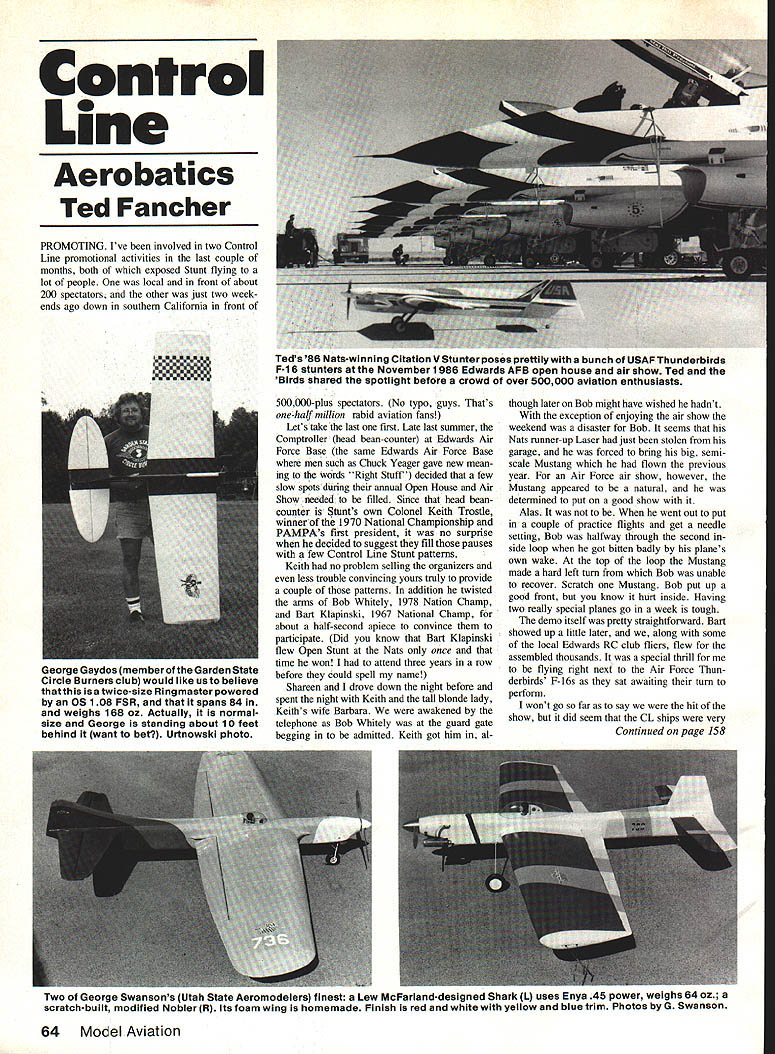
I've been involved in two Control Line promotional activities in the last couple of months, both of which exposed Stunt flying to a lot of people. One was local, in front of about 200 spectators, and the other was just two weekends ago down in southern California in front of 500,000-plus spectators. (No typo — that's one-half million rabid aviation fans.)
Late last summer the Comptroller (head bean-counter) at Edwards Air Force Base — the same Edwards where men such as Chuck Yeager gave new meaning to "Right Stuff" — decided that a few slow spots during their annual Open House and Air Show needed filling. Since that head bean-counter is Stunt's own Colonel Keith Trostle, winner of the 1970 National Championship and PAMPA's first president, it was no surprise when he suggested they fill those pauses with a few Control Line Stunt patterns.
Keith had no problem selling the organizers and even less trouble convincing yours truly to provide a couple patterns. He also twisted the arms of Bob Whitely, 1978 National Champ, and Bart Klapinski, 1967 National Champ, for about a half-second apiece to convince them to participate. (Did you know Bart Klapinski flew Open Stunt at the Nats only once and that time he won? I had to attend three years in a row before I could spell my name!)
Shareen and I drove down the night before and spent the night with Keith and his tall blonde wife, Barbara. We were awakened by the telephone as Bob Whitely was at the guard gate begging to be admitted. Keith got him in, although later on Bob might have wished he hadn't.
With the exception of enjoying the air show, the weekend was a disaster for Bob. It seems his Nats runner-up Laser had just been stolen from his garage, and he was forced to bring his big semiscale Mustang which he had flown the previous year. For an Air Force air show the Mustang appeared natural, and he was determined to put on a good show. Alas, it was not to be. When he went out to put in a couple of practice flights and get needle setting, Bob was halfway through the second side loop when he got bitten badly by his plane's own wake. At the top of the loop the Mustang made a hard left turn and Bob was unable to recover. Scratch one Mustang. Bob put up a good front, but you know it hurt inside. Having two really special planes go in a week is tough.
The demo itself was pretty straightforward. Bart showed up a little later and, along with some of the local Edwards RC club fliers, flew for the assembled thousands. It was a special thrill flying right next to the Air Force Thunderbirds' F-16s as they sat awaiting their turn. I won't go so far as to say we were the hit of the show, but the CL ships seemed very well received. The confined nature of U-Control allowed us to fly close enough to the crowd that they could actually see what was happening. The Wing Over got a big "ooooooh" from the crowd. The Cloverleaf and the B-52 pass behind us. A knife-edge flight about 500 feet off the deck, I think, lost some attention after that. A great big thanks to Keith for setting up this kind exposure of Stunt, especially for asking me to participate. I hope a couple of pix Barbara took will show up in the column.
The second promotional demo was the handiwork of Bill Garrison, a local modeler who has been working hard promoting and publicizing modeling demonstrations in grade schools. Bill has been giving classes in modeling. He credits his success to persistent publicity and sent the following letter which includes good info on both demonstrations and on publicizing in general.
Publicizing demonstrations — Bill Garrison's advice
Much has been written lately about the demise of Control Line flying. You get the feeling publicity is a problem. A common comment is, "People came to watch the demonstration and didn't know anyone still doing it." The first thing to remember about publicity work is be persistent. Everything doesn't get printed the first try; give up after the first try and nothing ever will.
Include the name of your organization, your name, address, and phone number at the top of your publicity release. The text should be written just as you would like it to appear and should be typed (double-spaced) or printed with wide spaces between lines. Information should include:
- WHO you are
- WHAT you will be doing
- WHEN it will be
- WHERE it will be
- HOW to get there
Send a flyer along with your release, but don't send just the flyer. If an editor has to figure out what you want from the typical contest announcement, he normally won't bother with it.
Don't limit yourself to contest announcements. Meeting schedules, contest results, local raffles, swap meets, auctions — all are great for publicity; in fact, all get the attention of editors. Whether they get into print or not, the editors are made aware of you and your existence. This is 95% of the battle. If your name is familiar, the next time you send something you really need printed you stand a much better chance of getting it in.
Send your release to everyone you can think of:
- Local newspapers
- Radio and TV stations (address to the Public Service or Events editor)
- Cable TV outlets
Send two releases to newspapers: one to the Events editor and the other to the Aviation editor.
Lead times:
- Mail publicity to reach the media a minimum of three weeks in advance of the event.
- For magazines such as Model Aviation, lead time increases to three months.
- Hobby shops often carry flyers; they need flyers and info approximately six weeks in advance.
I hope this information will help some of you get Control Line flying back out before the public once again. Good stuff, Bill. Thanks for sharing it with us.
Why aren't there more upright-engine installations in Stunt ships?
I got a letter from Gerald Schamp of Albany, OR asking about the lack of upright-engine installations in Stunt ships. It's an interesting subject, so let's take a look.
From an aerodynamic point of view you might make an esoteric argument that a higher thrust line (from an inverted installation) could offer better stability, but from a practical design standpoint the main reason to avoid upright engines is aesthetic and geometric: the wing incidence must be lowered slightly below the centerline of the wing to keep the cylinder from sticking up and spoiling the appearance of a classically proportioned Stunt ship.
The practical negative result of an upright installation is a lower thrust line which requires the tailplane to be on or very near the ground to achieve a nearly level attitude when sitting. The nose-high attitude makes consistent takeoffs and landings more difficult because the wing is forced back into a higher angle of attack while the tail is lowered. This results in a ship which tends to leap into the air on takeoff and which must be landed either in a full stall — very inelegant and seldom scored well — or in a high-speed "wheel landing," where the plane is touched down on only the main gear and the tail is gradually lowered as speed decreases. Done properly, this type of landing is an automatic 40-pointer (or at least 38). Unfortunately, because it's essentially an all-or-nothing maneuver, most fliers avoid the upright configuration to attain more consistency on takeoff and landing maneuvers which, rightly or wrongly, count for just as much as a Square Eight or an Hourglass.
Very early Stunt patterns did not score takeoff or landing. That, plus the relative difficulty of starting those early engines, led to a historical preference for upright engines — witness designs like the Barnstormer, Zilch, Stutwagon, All American, etc.
Starting inverted engines — the "back-flip" (bump-start) method
What? You still have trouble starting your modern, low-slung, inverted-engined, Belcher .60-powered ship without resorting to the Weaver (holding the ship upside down so the engine is upright)? Try this method, taught to me by Mike Petrie, and used by many who hand-start high-performance engines. It's even easier with docile Stunt engines thanks to the large-prop flywheel and usually a spinner. The method is known as the "back-flip" or "bump-start."
Steps:
- Mount the prop so the flipping blade is at three o'clock rather than the more conventional two o'clock position.
- With the airplane standing on its own wheels and the battery disconnected, choke the engine several times until it sounds somewhat "wetter" than you would ordinarily prefer. (You are choking the engine so you can cowl the engine.)
- Connect the battery and, holding the prop firmly, pull the engine forward through compression until you feel the bump indicating the mixture is proper for starting.
- Signal for your start and bring the blade around to compression once again.
- On the next motion, sharply "flick" the blade backward away from compression. The momentum will carry the blade over and cause the engine to partially compress backwards. If the mixture is correct, ignition will occur and the engine will start running forwards.
Because your finger will never be on the prop when ignition occurs, it is nearly impossible to injure yourself. With practice you'll start engines reliably and safely. Since you are actively attempting to make the engine "back-fire," the historical concern about over-choking inverted engines is eliminated.
I feel this method is even preferable to the use of "chicken sticks" since it eliminates the possibility of shattering props which can become hazardous flying objects.
See ya.
Ted Fancher 158 Flying Cloud Isle, Foster City, CA 94404
Transcribed from original scans by AI. Minor OCR errors may remain.

