
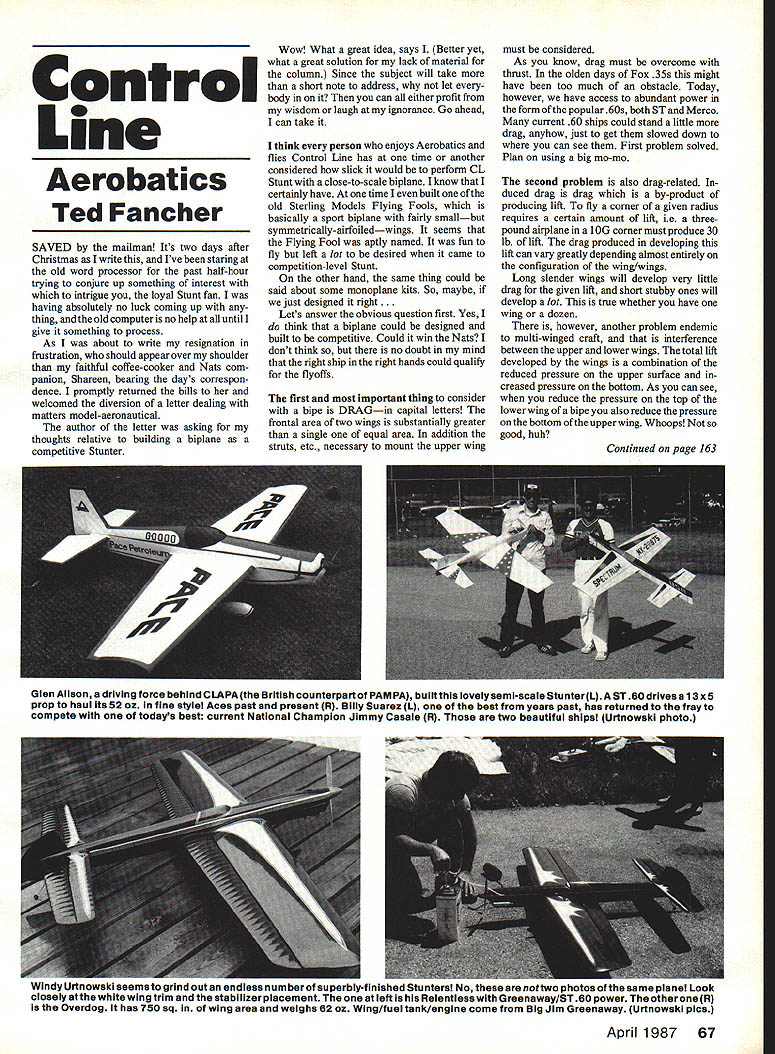

Control Line: Aerobatics
Ted Fancher
Saved by the mailman! It's two days after Christmas as I write this, and I've been staring at the old word processor for the past half-hour trying to conjure up something of interest that will intrigue you, the loyal Stunt fan. I was having absolutely no luck coming up with anything, and the old computer is no help at all until I give it something to process.
As I was about to write my resignation in frustration, who should appear over my shoulder but my faithful coffee‑cooker and Nats companion, Shareen, bearing the day's correspondence. I promptly returned the bills to her and welcomed the diversion of a letter dealing with matters model‑aeronautical.
The author of the letter was asking for my thoughts relative to building a biplane as a competitive Stunter.
Wow! What a great idea, says I. (Better yet, what a great solution for my lack of material for the column.) Since the subject will take more than a short note to address, why not let everybody in on it? Then you can all either profit from my wisdom or laugh at my ignorance. Go ahead, I can take it.
I think every person who enjoys Aerobatics and flies Control Line has, at one time or another, considered how slick it would be to perform CL Stunt with a close‑to‑scale biplane. I know I certainly have. At one time I even built one of the old Sterling Models Flying Fools, which is basically a sport biplane with fairly small—but symmetrically airfoiled—wings. It seems the Flying Fool was aptly named. It was fun to fly but left a lot to be desired when it came to competition‑level Stunt.
On the other hand, the same thing could be said about some monoplane kits. So, maybe, if you just design right.
Can a biplane be competitive?
Yes — I do think a biplane could be designed and built to be competitive. Could it win the Nats? I don't think so, but there is no doubt in my mind that the right ship in the right hands could qualify for the flyoffs.
The first and most important thing to consider with a biplane is DRAG — the frontal area of two wings is substantially greater than a single wing of equal area. In addition, the struts, cabane, and other interplane fittings necessary to mount the upper wing must be considered.
As you know, drag must be overcome with thrust. In the olden days of Fox .35s this might have been too much of an obstacle. Today, however, we have access to abundant power in the form of the popular .60s, both ST and Merco. Many current .60 ships could stand a little more drag, anyhow; just to get them slowed down. Plan on using a big motor. First problem solved.
The second problem is also drag‑related. Induced drag is a by‑product of producing lift. To fly a corner of a given radius requires a certain amount of lift; i.e., a three‑pound airplane in a 10G corner must produce 30 lb. lift. The drag produced developing that lift can vary greatly depending almost entirely on wing configuration. Long, slender wings will develop very little induced drag for a given lift; short, stubby ones will develop a lot, true whether you have one wing or a dozen.
There is, however, another problem endemic to multi‑winged craft, and that is interference between the upper and lower wings. The total lift developed by the wings is a combination of reduced pressure on the upper surfaces and increased pressure on the bottom surfaces. When you reduce the pressure on the top of the lower wing of a biplane you also reduce the pressure on the bottom of the upper wing — not so good.
The usual solution is to space the two wings at least one chord apart vertically and to have the upper wing located somewhat forward of the lower. Because we plan to operate our Stunters at fairly large angles of attack I would consider a one‑ to two‑inch stagger arrangement and might opt for a little extra for good measure.
I think a good planform to combat these problems would be two wings of nearly equal size and of high aspect ratio, i.e., a span of six to seven times the average chord. The upper wing would be about 1.25 times the average chord higher than the lower, and both wings would be approximately equidistant vertically from the thrust line.
The result would be a biplane that has about the same span as a monoplane of the same area and would consequently have much the same induced‑drag characteristics. It would be nearly as efficient in producing lift, with considerably less interference effect than a short‑span biplane, provided you avoid having the drag of the wings affect inside‑versus‑outside turn equality.
Now let's look at the center section. Keeping the interplane gap fairly large will force the center section to carry loads and, therefore, the center section, fuselage top, and struts must be kept as small and faired as possible. The center section is also the place to put dihedral or greater washout to help lateral stability. For a symmetric or semi‑symmetric Stunter you want little wing twist at the tips; let the ailerons do the work.
Rudder and elevator areas should be generous for quick response, but care must be taken to keep hinge moments light so control feel remains crisp. Balanced control surfaces where practical will help reduce pilot fatigue and improve precision.
In short, if you must have a biplane Stunter, design it with long, high‑aspect wings, adequate gap and stagger, careful center‑section aerodynamics, and clean, light structure. With the power available today such a ship can be competitive with monoplanes in the hands of a good pilot, provided you attend to the details above.
I would sweep the upper wing back a little for the sake of appearance and locate it about one‑quarter to one‑third of a chord forward of the lower wing at the average chord.
I would also consider using no more than a 12%‑thick airfoil. There are reasons for this, but they are too lengthy for now. It's no big deal if you want to use more thickness.
Wing area, flaps, and weight
How big should the wings be? Should you use flaps? Area should be based on weight. If you assume an upper limit of 13 ounces per square foot of area as acceptable for competitive flying — and I do — the area should be based on predicted weight. Although I've seen .60 ships as heavy as 80 oz., I'd prefer to limit my biplane to no more than 70 oz. This is again because drag is going to be greater. A 70‑oz. ship at 13 oz./sq. ft. wing loading works out to about 775 sq. in.
I've got a real problem with flaps. Because of the high‑aspect‑ratio wing I don't really think they would be necessary for lift. Since the biplane has more inherent drag I also question the desirability of the increased drag caused by flaps. On the other hand, it would make me nervous to build a Stunter without them.
On balance, I think I would cross my fingers and go without flaps. If you do choose to use them, do so on both wings. Couple the lower flaps as usual to the bellcrank and elevator, and tie the upper flaps to the lower with vertical pushrods at the trailing edge about halfway out.
Fuselage, tail, and moment arm
One of the really distinctive things about full‑scale bipes is their short, stubby fuselages — especially on special aerobatic types such as the Pitts and the Christen Eagle. Unfortunately such a configuration isn't appropriate for our use. The short coupling of full‑size bipes is primarily for enhancing snap rolls. We don't do snap rolls! What we do have are some very abrupt pitch changes which require impressive amounts of tail authority. This requires long tail moments and large tail surfaces.
The stabilizer and elevator together should be roughly 16% to 18% of the total wing area if no flaps are used, and as much as 22% if you do use flaps. That's correct: a bigger tail is necessary with flaps than without them. (See my series on design which ran in the May–October 1985 issues for a discussion of pitching moment induced by flaps.)
The tail moment is tough to define. Since the biplane configuration differs so much from the normal Stunter it becomes impossible to use the accepted hinge‑line‑to‑hinge‑line measurement. This is what I would do:
- Looking directly down on the top of your ship, measure the distance from the leading edge of the upper wing to the trailing edge of the lower. Do this halfway out the span if either wing tapers or if the upper wing is swept. Call this the "average chord" of both wings.
- Take 25% of that number and locate a spot that far aft of the upper leading edge.
- Multiply the first number (the "average chord") by 2.0 if using no flaps, or by 2.2 if using flaps. Plot this distance aft from the 25% location previously noted and locate the hinge line of the stabilizer at that position.
This number was derived from my Nats‑winning Citation V and may or may not be the final word for biplanes. (Never said the first one would be perfect, did I?)
The length of the nose will be one of the toughest problems. Ideally it should be long enough to balance the rest of the airplane without adding any useless weight. The shorter the better, in my estimation, but recognize that the heavier you tend to build the longer it should be.
Again, the classic measurement of leading‑edge‑to‑spinner‑backplate is useless because of the two wings. The tendency will be to make the nose short, again like full‑scale biplanes. Resist that temptation and make it only slightly shorter than for a "normal" Stunter.
Other considerations
- Center of Gravity. Locate conventionally except that you must consider both wings. Based once again on that "average chord" used for figuring tail moments, plan a location of 16% to 20% with flaps and slightly forward of that, say 12% to 15%, if there are no flaps.
- Bellcrank location. To ensure that your biplane flies straight off the lines, the vertical location of the bellcrank must closely approximate the vertical location of the center of gravity. Unfortunately, this means it must be mounted in the fuselage between the upper and lower wings, and the lead‑outs must exit the fuselage and be supported by a guide mounted to the interwing strut on the inboard side of the flight circle. An "eyeball" guess of the mass involved would strongly suggest that the bellcrank be placed on or slightly below the thrust line (assuming the thrust line is located, as suggested, midway between the two wings). Its fore‑and‑aft location is less critical but should be close to the CG for the usual reasons.
The lead‑outs should be conventionally swept about three degrees aft from the CG. Be sure to support them at the interwing strut and allow for the usual adjustment range.
This should about do it. It won't be perfect the first time, but what is?
Final thoughts
You might be wondering why, if all this adds up to a competitive Stunter, I don't think it can win the Nats. Fair question.
Even if you optimize the planform of the wings to reduce interference and induced drag to a minimum, the ratio of drag to lift will still exceed that of a pure monoplane Stunter. In addition, there is no way I know of to build two wings as light as one of the same area. As a result it will take exceptional building skills to achieve competitive wing loadings.
Still and all, I have seen some pretty rudimentary biplanes do a complete Stunt pattern. Who knows? Perhaps it could be done. I have been wrong before. Go for it!
Product news
- Tom Dixon has announced the availability of a special production run of Merco .61 Stunt engines. These engines feature dual piston rings for excellent compression seal and a glow plug located to the rear of the cylinder to ensure smooth ignition. The engines come with the Merco Standard Silencer and CL venturi. Anyone who witnessed how well Tom's .61 ran at the '86 Nats couldn't help but be interested in having a copy for himself. Full parts backup and service are available through Tom on these and other Merco engines. For more information, write to Tom Dixon, Suite 401, 1938 Peachtree Road N.W., Atlanta, GA 30309.
- I received notification from Doc Passner, U.S. representative for Cipolla Model Engines, that they are actively considering production of a lightweight, plain‑bearing CL .35 made for Control Line Stunt. More info as I get it.
Ted Fancher 158 Flying Cloud Isle Foster City, CA 94404
Transcribed from original scans by AI. Minor OCR errors may remain.

