
Control Line: Aerobatics
Ted Fancher
Advanced Class at the Nats
At the end of last month's column I announced the existence of an unofficial Advanced skill-class event to be held at this year's Nats in Lincoln, NE, July 12–18. Although I had no details at the time, I felt it was important that the word get out in a timely fashion.
Shortly after submitting that column I received a letter from Rolland McDonald who, along with Jack Sheeks, is the spark plug behind the endeavor. Although details are not final, he was able to outline the proposed format. Here's Rollie's summary:
Proposed Advanced Division (from Rolland McDonald)
- Any flier who has not finished in the top 10 at a Nationals in the past 10 years may compete in the Advanced Division simply by declaring that he wishes to do so prior to the start of competition flying.
- Advanced fliers will not be segregated or separated from Expert fliers during flying but will be judged as regular Open contestants.
- The scores of Advanced fliers will either be segregated at tabulation and posted separately or indicated on the posted scores as to which division a flier is in.
- Junior and Senior fliers will be invited to enter this division in addition to their regular class to gain experience in a more competitive atmosphere.
- Assuming the Open format of past years—which divides contestants into four qualifying groups—is used, fliers electing to compete Advanced will be divided into four groups and assigned to one of the circles. If the Open format is revised, the format for Advanced will be adjusted accordingly.
- The top two fliers from each of the four groups will advance to the third day of competition and will fly with the traditional top 20 contestants; however, they will be flying for a separate set of awards and will not be eligible to advance to the final day, the Walker Cup Flyoff, regardless of their scores.
- Awards for the Advanced Division will be regular Nationals trophies for first through third places, supplied by Jack Sheeks and Rolland McDonald. Bobby Hunt has offered three custom foam wings, and other awards may be added.
(Editor's note: The proposal was too late to be considered for an official event, thus the decision to run it as a PAMPA-endorsed but unofficial class. It may be necessary to revise the AMA rule book to reflect the skill classes before it could be considered for an official Nats event. A three-year trial as an unofficial event will provide insight into the concept's acceptability to the PAMPA membership and allow time to refine procedures.)
For more information contact Rollie at: 28746 Westfield, Livonia, MI 48150.
As you can see, Rollie clearly has the ball rolling. It's likely that final details will not be known until just before the event begins—but it will begin. There are a variety of pros and cons and lots of strong opinions for and against the proposal. To this observer, the use of unofficial formatting with full PAMPA support and recognition is an ideal way to evaluate whether this is an appropriate direction for the future of our event. I'd like to go on record thanking Rollie and Jack for their efforts.
Team Trials and Scoring
The trials to select the U.S.A.'s F2B (Control Line Stunt, in FAI lingo) team for the 1988 World Championships are apparently set for the 1987 Labor Day weekend in Indianapolis, IN. Jack Sheeks has agreed to orchestrate the competition and has obtained the use of what appears to be an excellent site in Indianapolis. Details will be forthcoming; because of the magazine's lead time, they have already been forwarded. See the "Competition Newsletter" section of the June issue of this magazine, page 125.
When Jack was passing through Indy the other day, we discussed the possibility of selecting the team using AMA scoring rather than FAI scoring (AMA scoring minus appearance, starting, and pattern points using the FAI seven-minute time limit). I am personally strongly in favor of such an action.
There is little or no difference in flying the FAI pattern. The major difference lies in scoring. AMA scoring uses a simple 10-4-0 point score for all maneuvers, with multiple-component maneuvers (for example, Three Consecutive Inside Loops) being given one score. FAI utilizes a 1–10 score for each individual component of consecutive maneuvers, each multiplied by its own difficulty (K) factor. The total score for a maneuver is the sum of each segment's score multiplied by its separate K-factor and then added together.
Given the difficulty of finding competent judges under the best of conditions, I feel we penalize ourselves by insisting that they employ a judging system which most have never used before and likely will never use again. The FAI system places special emphasis on more difficult maneuvers via the difficulty factor, whereas the AMA system ranks all maneuvers equally. Opponents of my suggestion will correctly argue that we should select the team using the same system under which they will be flying at the World Championships. Their argument is logical and well taken.
I feel, however, that the impressions resulting from even very competent judges being forced to use an unfamiliar scoring system—which is both more cumbersome and more apt to magnify any errors on the judges' part—could be more of a disadvantage than any shortcoming caused by use of the AMA system in the team-selection process.
If you feel strongly about this proposal, contact Jack Sheeks, PAMPA President George Higgins, and AMA. There is no requirement that the team be selected in a particular way. The World Championships themselves are specifically regulated, but individual countries can select their teams as they desire.
Biplane Stunters
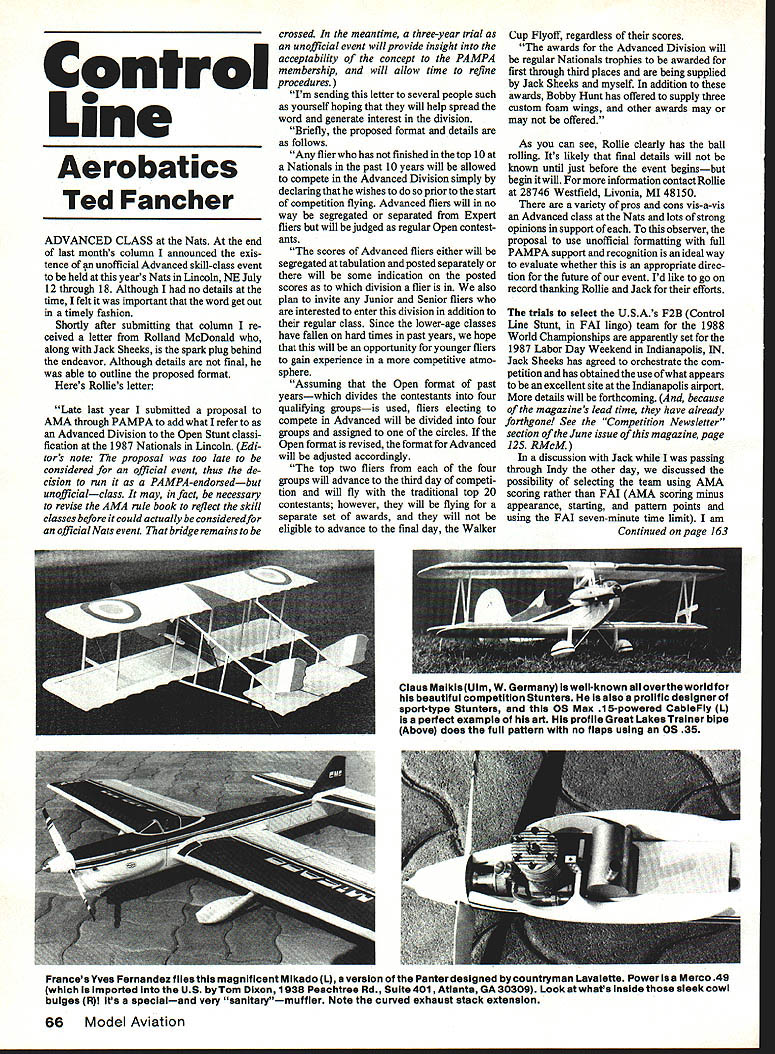
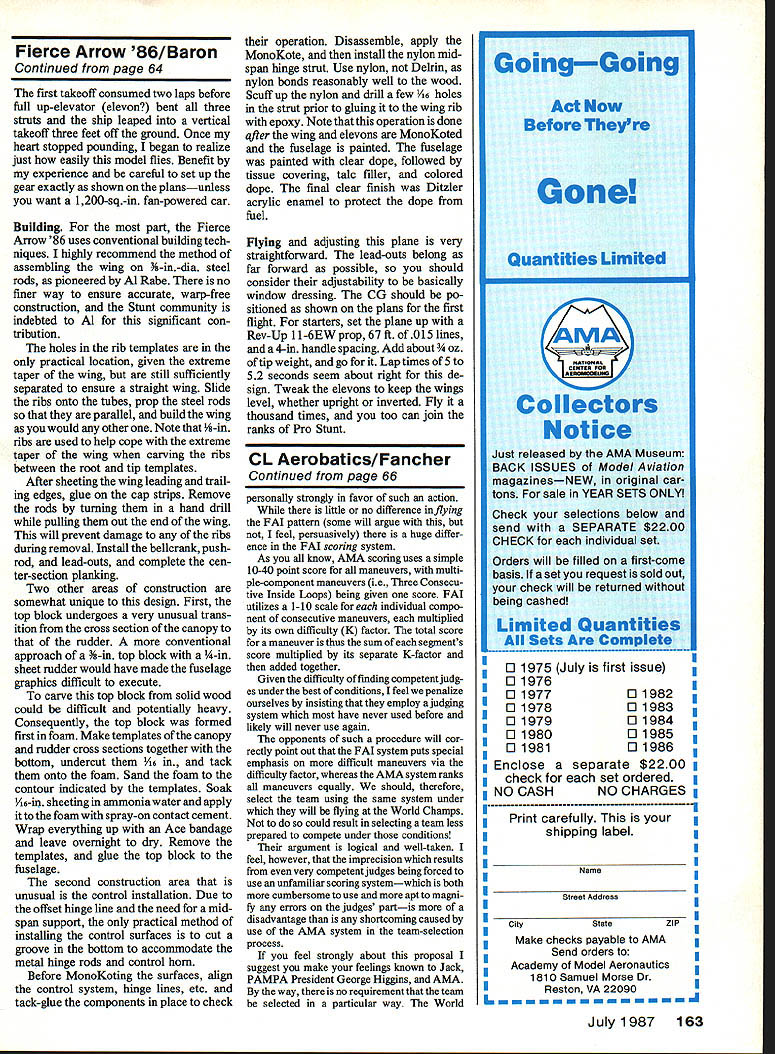
I've been amazed at all the interest shown on the column dealing with biplane Stunters. I've received letters, suggestions, and even plans from all over the States and from Claus Maikis in West Germany. Most comments agreed with my opinions, though there was some disagreement—mostly about my suggestion not to use flaps.
Tom Dixon sent along plans of Don Yearout's Bi-ceps Stunter from 1969. It's a good-looking ship built for a Fox .59. Tom suggests using an ST-60. The plans are available from Tom at 1938 Peachtree Road, Suite 401, Atlanta, GA 30309 ($15 a set).
Tom also had a useful design suggestion applicable to any bipe. Most bipes tend to roll excessively; Claus Maikis commented that all of his bipes roll badly in corners. Tom reminds us that the usual location for the lead-out guide on a bipe is on the interplane strut roughly three-quarters of the way out on the inboard wing.
On a bipe of 700 sq. in. total wing area (350 sq. in. in each wing) with an aspect ratio of 6:1, this would put the lead-out guide just 15 in. from the centerline of the fuselage. A monoplane with comparable area and an aspect ratio of 5.5:1 would place the lead-out guide (in this case the wing tip itself) about 31 in. from the centerline. The positive effect of this additional leverage to control unwanted roll is obvious. Tom suggests developing a means of moving the guide to at least the wing tips, and preferably a few inches beyond. He concedes he can't think of any attractive way to do so—maybe you can.
One other thing I've heard from experienced bipe pilots is that the additional drag is very real. Glide is roughly akin to a highly polished rock. Until you are thoroughly familiar with your ship's power-off characteristics, plan to make either a very steep glide to touchdown or to have the engine quit at a low altitude to avoid the need for an extended glide.
Supplies — Bear Enterprises
If your local hobby emporium thinks control lines are radio antennas or says nobody does that stuff anymore so they won't stock it, there's still hope.
I just received a catalog called Bear Necessities from Bear Enterprises, 2709 Turtlecreek Drive, Hazel Crest, IL 60429. Their catalog boasts the phrase, "Catering to the Controlling Connoisseur," and they back it up. While Bear's primary interest is Combat, they do stock most everything commercially available for the Stunt enthusiast. The one glaring omission at this point is a selection of good Stunt engines.
Of particular interest is the availability of control-line wire in bulk quantities, all of the currently produced control handles, and an intriguing entry for a Bear four-inch aluminum bellcrank. Two bucks gets you a catalog. Give 'em a try.
Beginner and Intermediate Coverage — The Sig Twister Project
By far the biggest complaint I get on the column is that I don't do enough basic stuff useful to beginners and intermediates. I've heard you. Starting next month I hope to rectify that omission.
Over the last couple of months I have been building a Sig Twister, kindly donated by Sig. My intention is to go through the construction and trim stages of the Twister and share the experience with readers. We'll cover most aspects of building and spend extra time on areas that give people trouble.
Most of the information will be usable to both beginners and intermediates. To make it more valuable to intermediates, I'll include some modifications to the basic Twister to bring it up to modern performance standards. Nothing earthshaking, but significant enough that your Twister II should be a much better Precision Aerobatics trainer than the original.
Old-Time Stunt at the Nats and Kits
I just received notification of a couple of special items for this year's Stunt event at the Nats: Model Builder Magazine has graciously offered to sponsor Old-Time Stunt once again as an unofficial event. Model Builder continues to be a strong supporter of traditional modeling endeavors in addition to RC. Many thanks to Bill Northrop and his staff.
If you'd love to fly Old-Timer but haven't the time to scratch-build, contact Russ James at A-J's Free Flight Service, 4840 E. Leisure, Fresno, CA 93727. He now has magnificent kits of the profile P-51 and Yak 9 and also the old All American Senior. Hand-selected wood, precision-sanded (not die-cut) parts, and complete hardware packages make these kits real time-savers.
Merco Award and Closing
Ian Russell, the man behind the Merco engines, has committed to an annual award to the highest-placing user of a Merco engine. (Tom Dixon ain't eligible!) This year's award will be a collector's special Merco .61 built from an original sand-cast case from the early Sixties. I flew a Merco-powered, 800-sq. in. ship this weekend, and it didn't give away a thing to an ST. Go for it!
Ted Fancher 158 Flying Cloud Isle Foster City, CA 94404
Transcribed from original scans by AI. Minor OCR errors may remain.

