
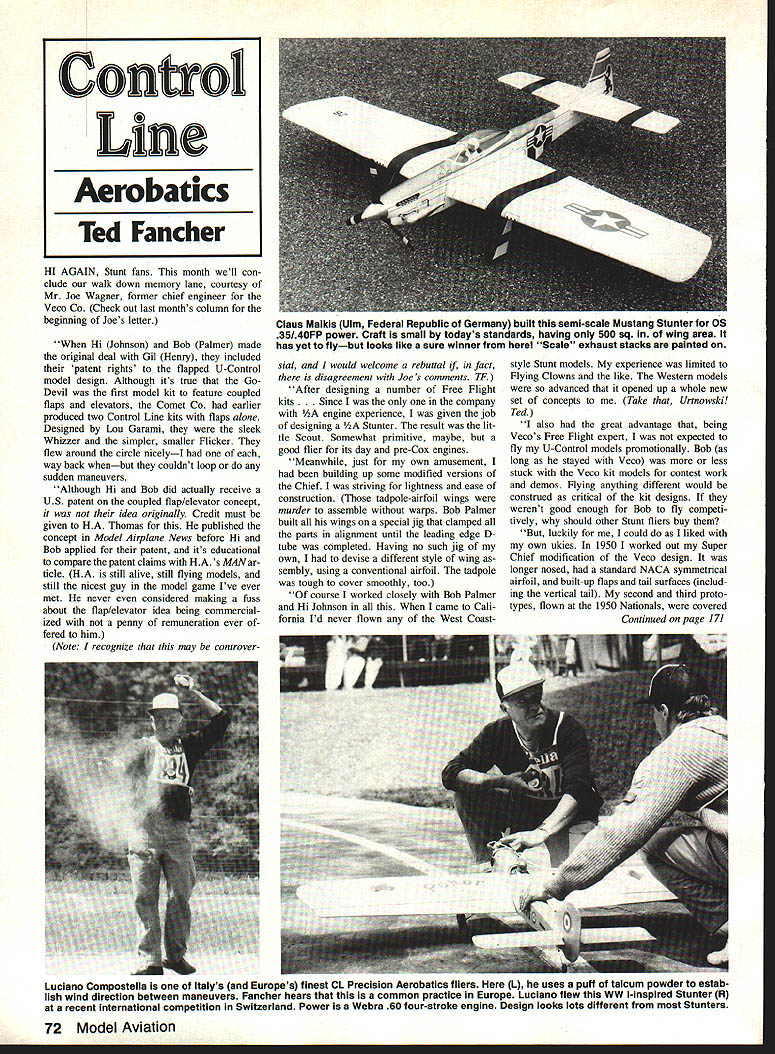
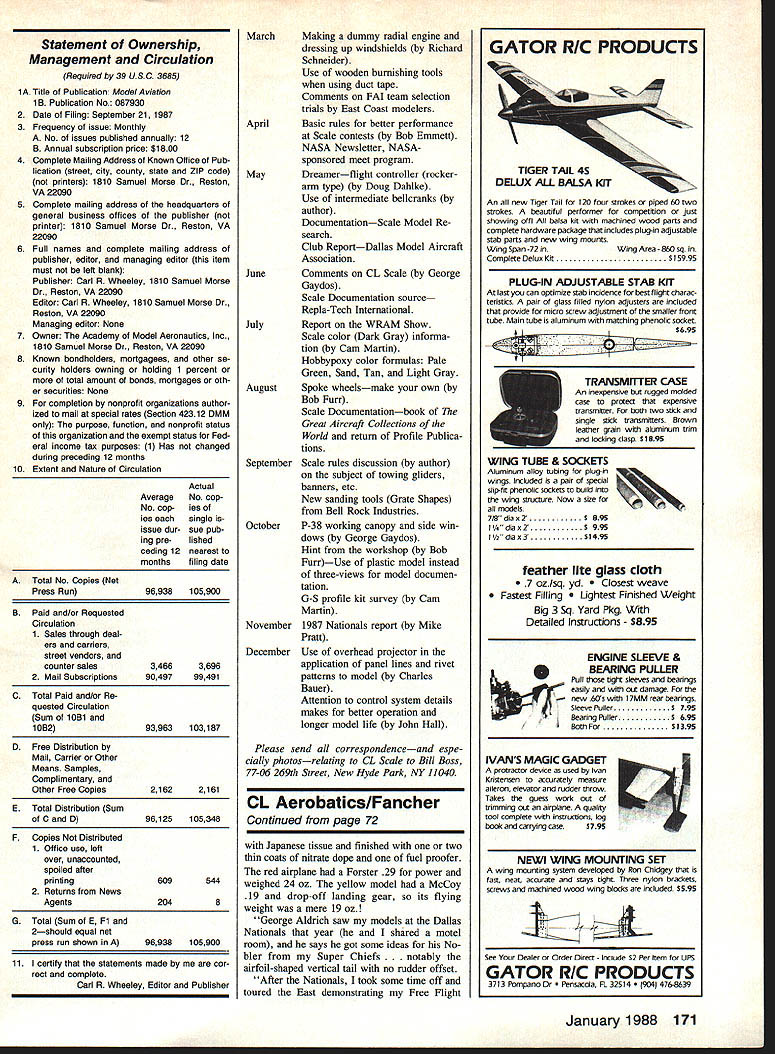
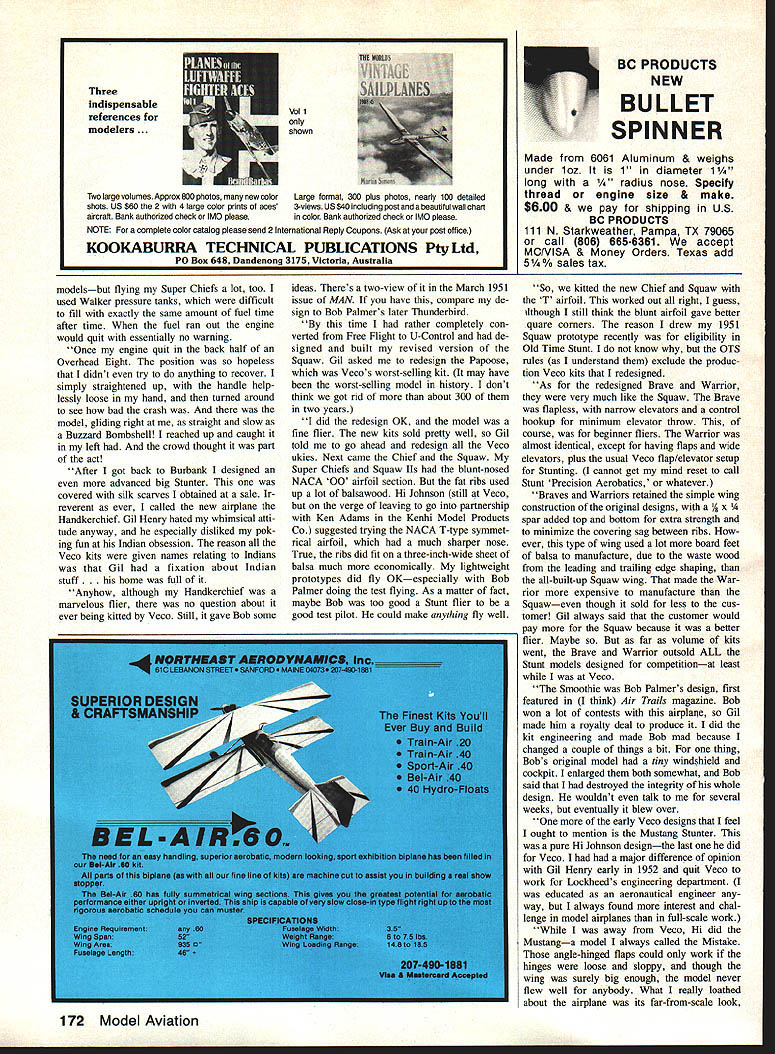
Control Line: Aerobatics
Ted Fancher
Hi again, Stunt fans. This month we'll conclude our walk down memory lane, courtesy of Mr. Joe Wagner, former chief engineer for the Veco Co. (Check out last month's column for the beginning of Joe's letter.)
From Joe Wagner
When Hi (Johnson) and Bob (Palmer) made the original deal with Gil (Henry), they included the patent rights to the flapped U‑Control model design. Although it's true that the Go‑Devil was the first model kit to feature coupled flaps and elevators, the Comet Co. had earlier produced two Control Line kits with flaps alone. Designed by Lou Garami, they were the sleek Whizzer and the simpler, smaller Flicker. I flew around the circle nicely—I had one of each, way back when—but they couldn't loop or do any sudden maneuvers.
Although Hi and Bob did actually receive a U.S. patent on the coupled flap/elevator concept, it was not their idea originally. Credit must be given to H. A. Thomas for this. He published the concept in Model Airplane News before Hi and Bob applied for their patent, and it's educational. He is still the nicest guy in the model game I've ever met. He never even considered making a fuss about the flap/elevator idea being commercialized, with not a penny of remuneration ever offered to him. (Note: I recognize that this may be controversial, and I would welcome a rebuttal if, in fact, there is disagreement with Joe's comments. —TF)
After designing a number of Free Flight kits, since I was the only one in the company with 1/2A engine experience, I was given the job of designing a 1/2A Stunter. The result was the little Scout. Somewhat primitive, maybe, but a good flier for its day and pre‑Cox engines.
Meanwhile, just for my own amusement, I had been building up some modified versions of the Chief. I was striving for lightness and ease of construction. Those tadpole‑airfoil wings were murder to assemble without warps. Bob Palmer built his wings on a special jig that clamped all the parts in alignment until the leading‑edge D‑tube was completed. Having no such jig of my own, I had to devise a different style of wing assembly, using a conventional airfoil. The tadpole was tough to cover smoothly, too.
Of course I worked closely with Bob Palmer and Hi Johnson in all this. When I came to California I'd never flown any of the West Coast‑style Stunt models. My experience was limited to Flying Clowns and the like. The Western models were so advanced that it opened up a whole new set of concepts to me. (Take that, Urtnowski! —TF.)
I also had the great advantage that, being Veco's Free Flight expert, I was not expected to fly my U‑Control models promotionally. Bob (as long as he stayed with Veco) was more or less stuck with the Veco kit models for contest work and demos. Flying anything different would be construed as critical of the kit designs. If they weren't good enough for Bob to fly competitively, why should other Stunt fliers buy them?
But, luckily for me, I could do as I liked with my own U‑Control models. In 1950 I worked out my Super Chief modification of the Veco design. It was longer‑nosed, had a standard NACA symmetrical airfoil, built‑up flaps and tail surfaces (including vertical tail). My second and third prototypes, flown at the 1950 Nationals, were covered with Japanese tissue and finished with one or two thin coats of nitrate dope and one coat of fuel proofer. The red airplane had a Forster .29 for power and weighed 24 oz. The yellow model had a McCoy .19 and a drop‑off landing gear, so its flying weight was a mere 19 oz.
George Aldrich saw my models at the Dallas Nationals that year (he and I shared a motel room), and he says he got some ideas for his Nobeller from my Super Chiefs—notably the airfoil‑shaped vertical tail with no rudder offset.
After the Nationals, I took some time off and toured the East demonstrating my Free Flight models. There’s a two‑view of the Super Chief in the March 1951 issue of Model Airplane News. If you have this, compare my design to Bob Palmer’s later Thunderbird.
By this time I had rather completely converted from Free Flight to U‑Control and had designed and built my revised version of the Squaw. Gil asked me to redesign the Papoose, which was Veco’s worst‑selling kit. (It may have been the worst‑selling model in history. I don't think we got more than about 300 of them in two years.)
I did the redesign OK, and the model was a first flyer. The new kits sold pretty well, so Gil told me to go ahead and redesign all the Veco ukies. Next came the Chief and the Squaw. My Super Chiefs and Squaw I kept the blunt‑nosed NACA 0006 airfoil section. But the fatter section used up a lot of balsa. Hi Johnson (still at Veco, but on the verge of leaving to go into partnership with Ken Adams in the Kenni Model Products Co.) suggested trying the NACA T‑type symmetrical airfoil, which had a much sharper nose. True, the ribs did fit on a three‑inch‑wide sheet of balsa much more economically. My lightweight prototypes did fly OK—especially with Bob Palmer doing the test flying. As a matter of fact, maybe Bob was too good a Stunt flier to be a good test pilot. He could make anything fly well.
So, we skinned the new Chief and Squaw with the NACA T‑type airfoil. This worked out all right, I guess—although I still think the blunt front airfoil gave better square corners. The reason I drew my 1951 Squaw prototype vertical like that was for eligibility in Old Time Stunt. I do not know why, but the OTS rules (as I understand them) excluded the production Veco kits that I redesigned.
As for the redesigned Brave and Warrior, they were very much like the Squaw. The Brave was flaps‑less, with narrow elevators and a control hook for minimum elevator throw. This, of course, was for beginner fliers. The Warrior was almost identical, except for having flaps and wide elevators, plus the usual Veco flap/elevator setup for Stunting. (I cannot get my mind to rest to call Stunt "Precision Aerobatics," or whatever.)
Braves and Warriors retained the simple wing construction of the original designs, with a 1/4 x 1/4 spar added top and bottom for extra strength and to minimize the covering sag between ribs. However, this type of wing used a lot more balsa for its slab‑type manufacture, due to the more wasted wood from the leading and trailing edge shaping, than the all‑built‑up Squaw wing. That made the Warrior more expensive to manufacture than the Squaw—even though it sold for less to the customer! Gil always said that the customer would pay more for the Squaw because it was a better flier. Maybe so. But as far as volume of kits went, the Brave and Warrior outsold ALL the other Stunt models designed for competition—at least while I was at Veco.
The Smoothie was Bob Palmer’s design, first featured in (I think) Air Trails magazine. Bob won a lot of contests with this airplane, so Gil made him a royalty deal to produce it. The kit engineering changes made Bob mad because he changed a couple of things a bit. For one thing, Bob’s original model had a tiny windshield and cockpit. I enlarged them both somewhat, and Bob said that I had destroyed the integrity of his whole design. He wouldn’t even talk to me for several weeks, but eventually it blew over.
One more of the early Veco designs that I feel I ought to mention is the Mustang Stunter. This was a pure Hi Johnson design—the last one he did for Veco. I had had a major difference of opinion with Gil Henry early in 1952 and quit Veco to go work for Lockheed’s engineering department. (I was educated as an aeronautical engineer anyway, but I always found more interest and challenge in model airplanes than in full‑scale work.)
While I was away from Veco, Hi Johnson finished the Mustang. I don’t remember its details. Those angle‑hinged flaps could only work if the hinges were loose and sloppy, and though the wing was surely big enough, the model never flew well for anybody. What I really liked about the airplane was its far‑from‑scale look, especially the bubble canopy, which Hi designed "by eyeball."
Gil came over to Lockheed in May of 1952 and asked me to come back to Veco on new and improved terms. I did, of course, and managed to stick it out there until around the end of 1953 when I was pleased to accept Ken Adams' bid for me to come down to Anaheim and join him and Hi Johnson at Kenhi. I'm sure glad I did that. Ken was the nicest guy to work for I've ever met.
Many thanks to Joe Wagner for sharing his important part in Stunt history with us all. I hope you've enjoyed this special glimpse into the past as much as I have.
Ted Fancher 158 Flying Cloud Isle Foster City, CA 94404
Transcribed from original scans by AI. Minor OCR errors may remain.

