
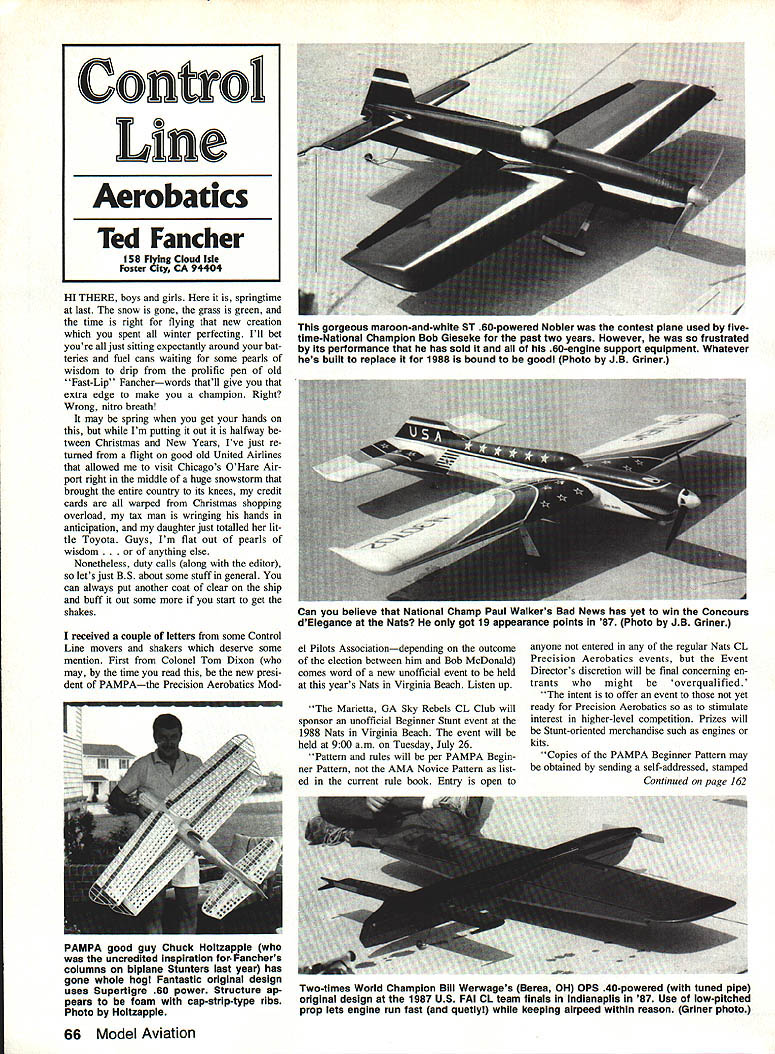
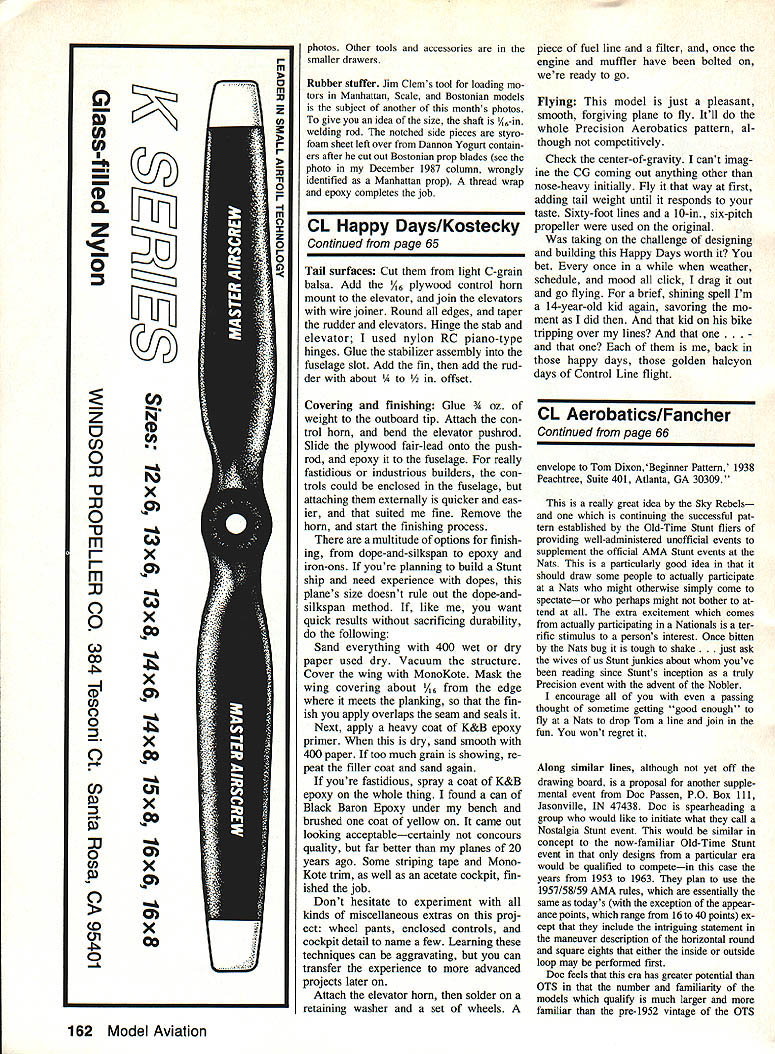
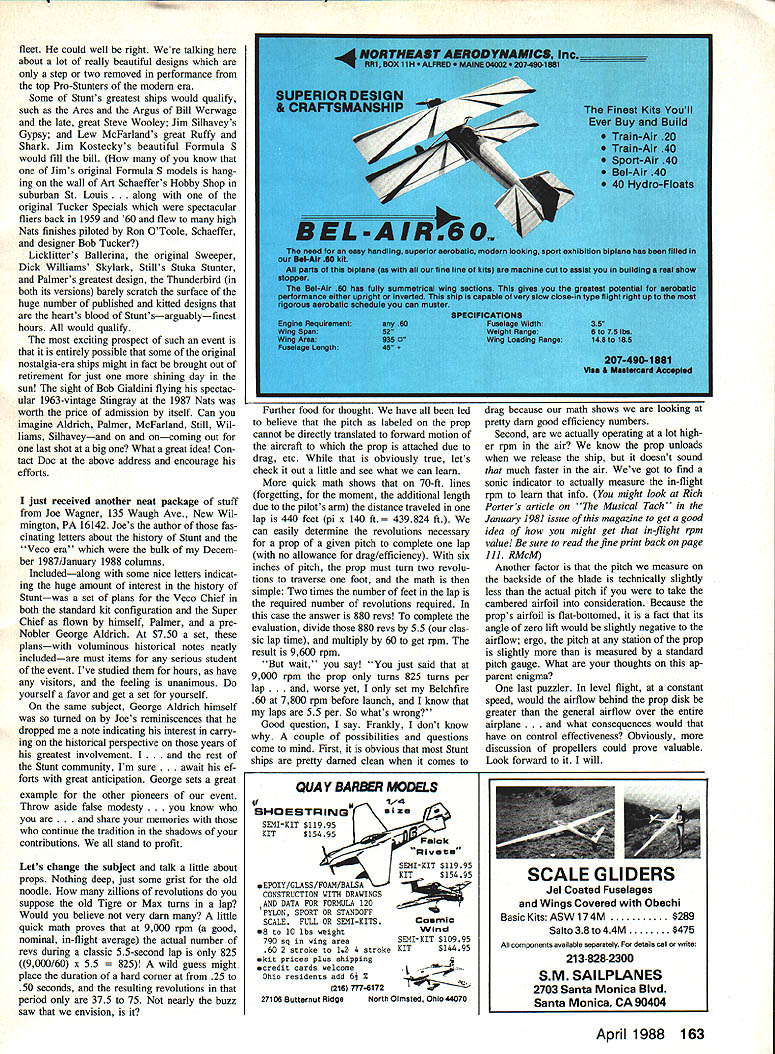
Control Line: Aerobatics
Ted Fancher
158 Flying Cloud Isle Foster City, CA 94404
Hi there, boys and girls. Here it is, springtime at last. The snow is gone, the grass is green, and the time is right for flying that new creation which you spent all winter perfecting. I'll bet you're just sitting expectantly around your batteries and fuel cans waiting for some pearls of wisdom to drip from the prolific pen of old "Fast-Lip" Fancher—words that'll give you that extra edge to make you a champion. Right? Wrong, nitro breath!
It may be spring when you get your hands on this, but while I'm putting it out it is halfway between Christmas and New Years. I've just returned from a flight on good old United Airlines that allowed me to visit Chicago's O'Hare Airport right in the middle of a huge snowstorm that brought the entire country to its knees, my credit cards are all warped from Christmas shopping overload, my tax man is wringing his hands in anticipation, and my daughter just totaled her little Toyota. Guys, I'm flat out of pearls of wisdom... or of anything else.
Nonetheless, duty calls (along with the editor), so let's just B.S. about some stuff in general. You can always put another coat of clear on the ship and buff it out some more if you start to get the shakes.
PAMPA Beginner Stunt at the 1988 Nationals
I received a letter from Colonel Tom Dixon (who may, by the time you read this, be the new president of PAMPA—the Precision Aerobatics Model Pilots Association—depending on the outcome of the election between him and Bob McDonald) with word of a new unofficial event to be held at this year's Nats in Virginia Beach. Listen up.
- Sponsor: Marietta, GA Sky Rebels CL Club
- Event: Unofficial Beginner Stunt
- Date/time: 9:00 a.m., Tuesday, July 26 (1988 Nats)
- Pattern/rules: PAMPA Beginner Pattern (not the AMA Novice Pattern listed in the current rule book)
- Entry: Open to anyone not entered in any of the regular Nats CL Precision Aerobatics events; Event Director's discretion on entrants who might be "overqualified"
- Intent: Offer an event to those not yet ready for Precision Aerobatics and stimulate interest in higher-level competition
- Prizes: Stunt-oriented merchandise such as engines or kits
- To obtain PAMPA Beginner Pattern: Send a self-addressed, stamped envelope to Tom Dixon, "Beginner Pattern," 1938 Peachtree, Suite 401, Atlanta, GA 30309
This is a really great idea by the Sky Rebels—and one which continues the successful pattern established by the Old‑Time Stunt fliers providing well-administered unofficial events to supplement the official AMA Stunt events at the Nats. It should draw people who might otherwise simply spectate—or might not attend at all. The extra excitement that comes from actually participating in a Nationals is a terrific stimulus to a person's interest. Once bitten by the Nats bug it is tough to shake... just ask the wives of us Stunt junkies about whom you've been reading since Stunt's inception as a truly Precision event with the advent of the Nobler. I encourage all of you with even a passing thought of someday getting "good enough" to fly at the Nats to drop Tom a line and join in the fun. You won't regret it.
Nostalgia Stunt proposal
Along similar lines, although not yet off the drawing board, is a proposal from Doc Passen, P.O. Box 111, Jasonville, IN 47438. Doc is spearheading a group that would like to initiate a Nostalgia Stunt event. This would be similar in concept to the now-familiar Old‑Time Stunt event in that designs from a particular era would be qualified to compete—in this case the years from 1953 to 1963.
- Rules: Use the 1957/58/59 AMA rules (essentially the same as today's, except appearance points range from 16 to 40)
- Notable: Maneuver descriptions for the horizontal round and square eights include the intriguing statement that either the inside or outside loop may be performed first
Doc feels this area has greater potential than OTS because the number and familiarity of the models that qualify is much larger and more familiar than the pre‑1952 OTS fleet. He could well be right. We're talking about a lot of really beautiful designs, which are only a step or two removed in performance from top Pro‑Stunters of the modern era.
Some of Stunt's greatest ships would qualify: the Ares and the Argus of Bill Werwage and the late Steve Wooley; Jim Silhavey's Gypsy; Lew McFarland's Ruffy and Shark; Jim Kostecky's beautiful Formula S (one of Jim's original Formula S models is hanging on the wall of Art Scheaffer's Hobby Shop in suburban St. Louis); and one of the original Tucker Specials which were spectacular fliers back in 1959 and flew to many high Nats finishes piloted by Ron O'Toole, Scheaffer, and designer Bob Tucker.
Licklitter's Ballerina, the original Sweeper, Dick Williams' Skylark, Still's Studa Stunter, and Palmer's Thunderbird (in both versions) barely scratch the surface of the huge number of published and kitted designs that are the heart's blood of Stunt's finest hours. All would qualify.
The most exciting prospect is that some of the original nostalgia‑era ships might be brought out of retirement for one more shining day in the sun. The sight of Bob Gialdini flying his spectacular 1963‑vintage Stingray at the 1987 Nats was worth the price of admission by itself. Can you imagine Aldrich, Palmer, McFarland, Still, Williams, Silhavey—and on and on—coming out for one last shot at a big one? What a great idea. Contact Doc at the above address and encourage his efforts.
Veco Chief plans and Stunt history
I just received another neat package from Joe Wagner, 135 Waugh Ave., New Wilmington, PA 16142. Joe's the author of those fascinating letters about the history of Stunt and the "Veco era" which were the bulk of my December 1987/January 1988 columns. Included—along with some nice letters indicating the huge amount of interest in the history of Stunt—was a set of plans for the Veco Chief in both the standard kit configuration and the Super Chief as flown by Joe, Palmer, and a pre‑Nobler George Aldrich.
- Price: $7.50 a set
- Includes: Plans plus voluminous historical notes
These plans are must items for any serious student of the event. I've studied them for hours, as have any visitors, and the feeling is unanimous. Do yourself a favor and get a set.
On the same subject, George Aldrich himself was so turned on by Joe's reminiscences that he dropped me a note indicating his interest in continuing the historical perspective on those years of his greatest involvement. I—and the rest of the Stunt community, I'm sure—await his efforts with great anticipation. George sets a great example for the other pioneers of our event. Throw aside false modesty... you know who you are... and share your memories with those who continue the tradition in the shadows of your contributions. We all stand to profit.
Props — a few puzzlers
Let's change the subject and talk a little about props. Nothing deep, just some grist for the old noodle. How many zillions of revolutions do you suppose the old Tigre or Max turns in a lap? Would you believe not very darn many? A little quick math proves that at 9,000 rpm (a good, nominal, in‑flight average) the actual number of revs during a classic 5.5‑second lap is only 825:
- (9,000 rpm / 60) × 5.5 sec = 825 revs
A wild guess might place the duration of a hard corner at from 0.25 to 0.50 seconds, and the resulting revolutions per corner are only 37.5 to 75. Not nearly the buzz saw that we envision, is it?
Further food for thought. We have all been led to believe that the pitch as labeled on the prop cannot be directly translated to forward motion of the aircraft due to drag, etc. While that is obviously true, let's check out a little and see what we can learn.
More quick math shows that on 70‑ft lines (forgetting, for the moment, the additional length due to the pilot's arm) the distance traveled in one lap is about 440 feet:
- Lap circumference = π × (2 × line length) = π × 140 ft ≈ 439.8 ft
We can determine the revolutions necessary for a prop of a given pitch to complete one lap (with no allowance for drag/efficiency). With six inches of pitch, the prop advances 6 inches (0.5 ft) per revolution, so the prop must turn two revolutions to traverse one foot. Thus:
- Required revolutions per lap = 2 × number of feet in the lap = 2 × 440 = 880 revs
To get the rpm corresponding to a 5.5‑second lap:
- rpm = (880 revs / 5.5 sec) × 60 = 9,600 rpm
"But wait," you say, "You just said that at 9,000 rpm the prop only turns 825 turns per lap, and worse yet, I only set my Belchfire 60 at 7,800 rpm before launch, and I know that my laps are 5.5 per. So what's wrong?"
Good question. Frankly, I don't know why. A couple of possibilities and questions come to mind.
- It is obvious that most Stunt ships are pretty darned clean when it comes to drag because our math shows we are looking at pretty good efficiency numbers.
- Are we actually operating at a lot higher rpm in the air? We know the prop unloads when we release the ship, but it doesn't sound much faster in the air. We've got to find a sonic indicator to actually measure the in‑flight prop to learn that info. (You might look at Rich Porter's article on "The Musical Tach" in the January 1988 issue of this magazine to get a good idea of how you might get that in‑flight rpm value—be sure to read the fine print back on page 18. RCMcM)
- Another factor is that the pitch we measure on the backside of the blade is technically slightly less than the actual pitch if you take the cambered airfoil into consideration. Because the prop's airfoil is flat‑bottomed, its angle of zero lift would be slightly negative to the airfoil; ergo, the pitch at any station of the prop is slightly more than is measured by a standard pitch gauge.
One last puzzler. In level flight, at a constant speed, would the airflow behind the prop disk be greater than the general airflow over the entire airplane—and what consequences would that have on control effectiveness? Obviously, more discussion of propellers could prove valuable. Look forward to it. I will.
Transcribed from original scans by AI. Minor OCR errors may remain.

