
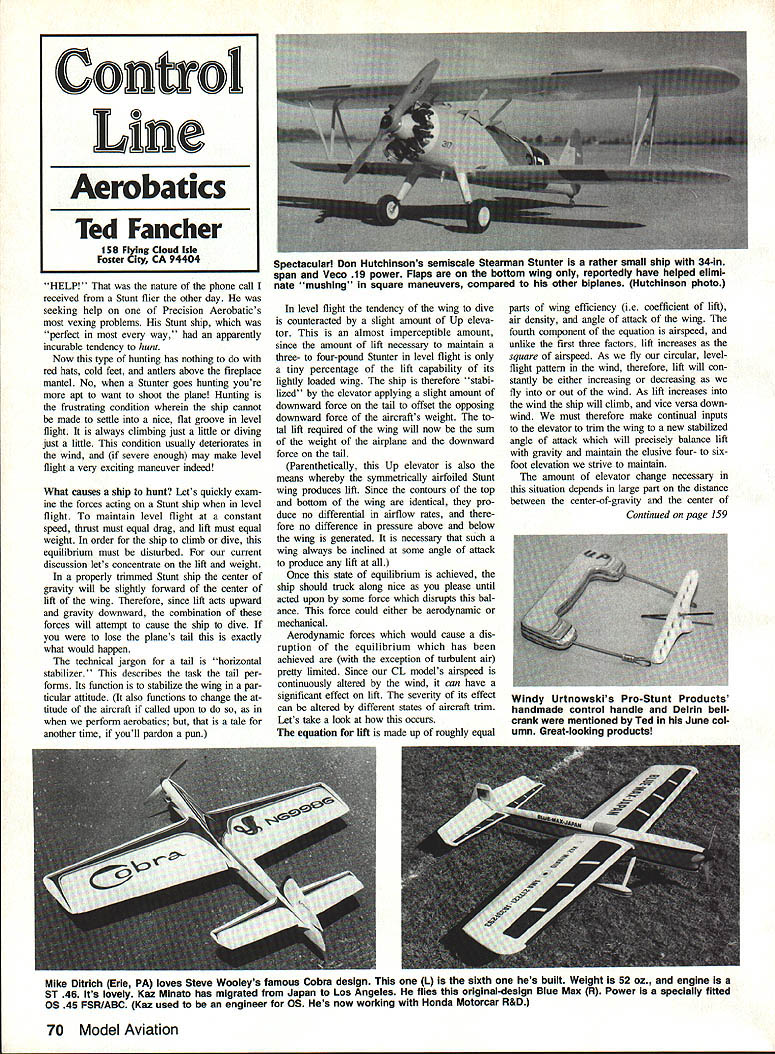
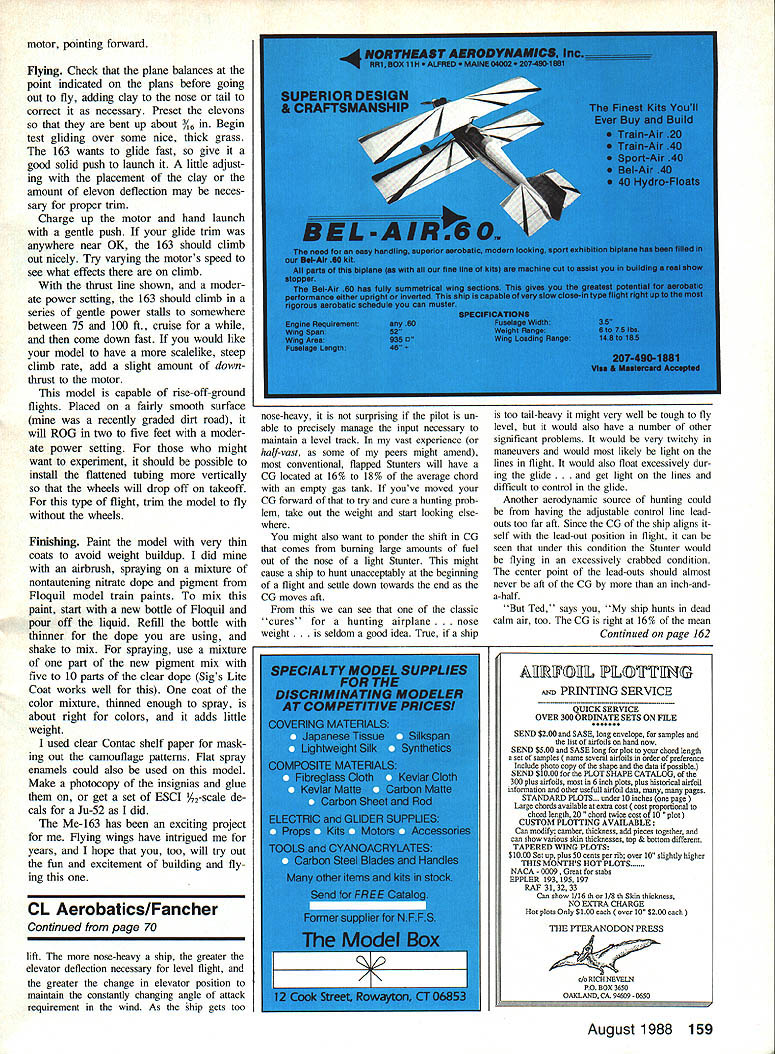
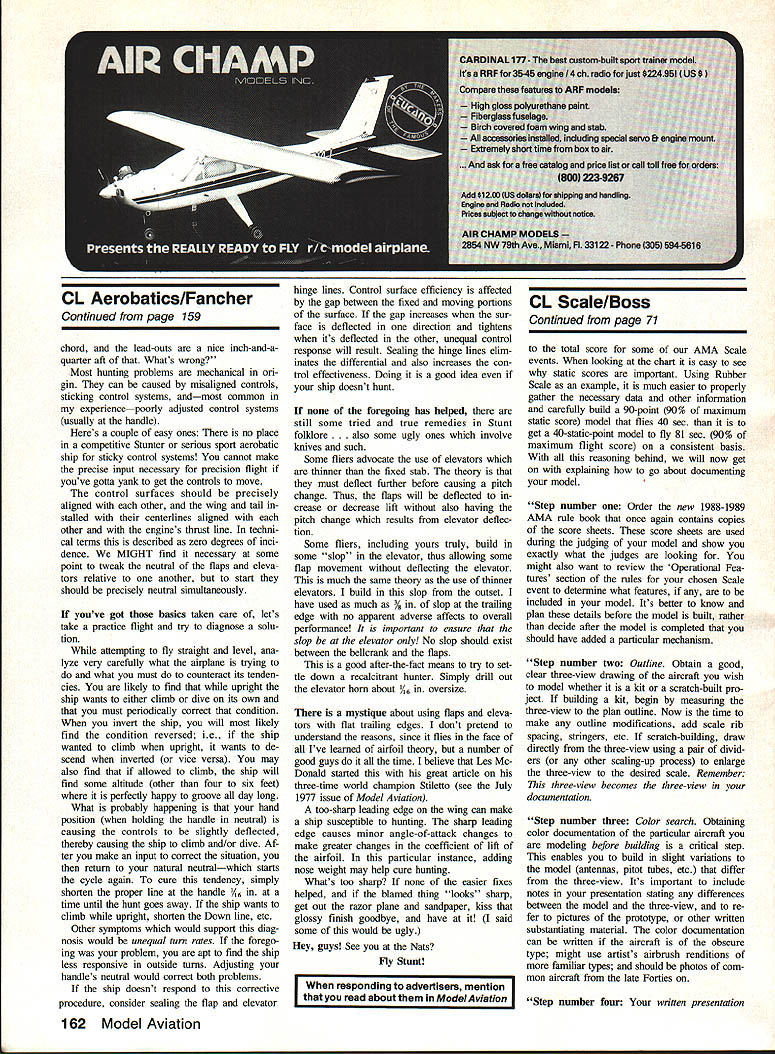
Control Line: Aerobatics
Ted Fancher 158 Flying Cloud Isle Foster City, CA 94404
"HELP!" What was the nature of the phone call I received from a Stunt flier the other day? He was seeking help on one of precision aerobatics' most vexing problems. His stunt ship, which was "perfect in most every way," had an apparently incurable tendency to hunt.
What is hunting?
This type of hunting has nothing to do with hats, cold feet, or antlers above the fireplace mantel. No — when a stunter goes hunting you're apt to want to shoot the plane! Hunting is the frustrating condition wherein the ship cannot be made to settle into a nice, flat groove of level flight. It is always climbing just a little or diving just a little. This condition usually deteriorates in the wind and (if severe enough) may make level flight a very exciting maneuver indeed.
Forces in level flight
To maintain level flight at a constant speed, thrust must equal drag, and lift must equal weight. If either of these equilibrium conditions is disturbed, the airplane will change attitude or altitude. For our discussion, concentrate on lift and weight.
In a properly trimmed stunt ship the center of gravity (CG) will be slightly forward of the center of lift of the wing. Since lift acts upward and gravity downward, the combination of these forces will attempt to cause the ship to dive. If you were to lose the plane's tail this is exactly what would happen.
The technical jargon for a tail is "horizontal stabilizer." Its function is to stabilize the wing in a particular attitude (and to change the attitude when called upon, as in aerobatics).
In level flight the tendency of the wing to dive is counteracted by a slight amount of up elevator. This is an almost imperceptible amount, since the lift necessary to maintain a three- to four-pound stunter in level flight is only a tiny percentage of the wing's lift capability. The elevator applies a slight downward force on the tail to offset the opposing moment of the aircraft's weight. The total downward force of the wing will now be the sum of the weight of the airplane and the downward force on the tail.
Parenthetically, this up elevator is also how a symmetrically airfoiled stunt wing produces lift. Since the top and bottom contours are identical, they produce no airflow differential and therefore no pressure difference unless the wing is inclined at some angle of attack.
Once this equilibrium is achieved, the ship should truck along until acted upon by some force which disrupts the balance. This force could be aerodynamic or mechanical.
Aerodynamic causes of hunting
Aerodynamic forces that disturb equilibrium (aside from turbulent air) are fairly limited. Wind changes airspeed constantly in a circular, control-line flight pattern, and airspeed has a strong effect on lift. The lift equation depends on roughly equal parts coefficient of lift (wing efficiency), air density, angle of attack, and airspeed. Unlike the first three factors, lift increases as the square of airspeed. As a result, flying out with or into the wind continuously increases or decreases airspeed and therefore lift. As lift increases the ship will climb, and vice versa. The pilot must make continual inputs to the elevator to trim the wing to a new stabilized angle of attack that balances lift with gravity and maintains the four- to six-foot elevation we strive to hold.
The amount of elevator change necessary depends largely on the distance between the CG and the center of lift. The more nose-heavy a ship, the greater the elevator deflection necessary for level flight, and the greater the change in elevator position required to maintain angle-of-attack in the wind. As the ship becomes too nose-heavy, the pilot may be unable to precisely manage the inputs to maintain a level track.
In my experience, most conventional flapped stunters will have a CG located at 16% to 18% of the average chord with an empty gas tank. If you've moved your CG forward of that to try to cure a hunting problem, take out the weight and start looking elsewhere.
Also consider CG shift from burning fuel out of the nose on a light stunter. This might cause a ship to hunt at the beginning of a flight and settle down toward the end as the CG moves aft.
From this we see that the classic "cure" for a hunting airplane — nose-weight — is seldom a good idea. If a ship is tail-heavy it might be tough to fly level, but it would also be twitchy in maneuvers, light on the lines in flight, and would float excessively during a glide.
Another aerodynamic source of hunting could be having the adjustable control-line lead-outs too far aft. Since the CG of the ship aligns itself with the lead-out position in flight, an aft lead-out position can cause the stunter to fly in an excessively crabbed condition. The center point of the lead-outs should almost never be aft of the CG by more than an inch-and-a-half.
"But Ted," you say, "my ship hunts in dead calm air, too. The CG is right at 16% of the mean chord, and the lead-outs are a nice inch-and-a-quarter aft of that. What's wrong?"
Mechanical causes and handle-neutral problems
Most hunting problems are mechanical in origin. They can be caused by misaligned controls, sticking control systems, and — most common in my experience — poorly adjusted control systems (usually at the handle).
There is no place in a competitive stunter or serious sport aerobatic ship for sticky control systems! You cannot make the precise inputs necessary for precision flight if you've got to yank to get the controls to move.
Controls should be precisely aligned with each other, and the wing and tail installed with their centerlines aligned with each other and with the engine's thrust line (zero degrees of incidence). We might find it necessary to tweak neutral positions of flaps and elevators relative to one another, but to start they should be precisely neutral simultaneously.
If you've got those basics taken care of, make a practice flight and try to diagnose the problem.
While attempting to fly straight and level, analyze carefully what the airplane is trying to do and what you must do to counteract its tendencies. You are likely to find that while upright the ship wants to either climb or dive on its own and that you must periodically correct that condition. When you invert the ship, you will most likely find the condition reversed (i.e., if the ship wanted to climb when upright, it wants to descend when inverted). You may also find that if allowed to climb, the ship will find some altitude (other than four to six feet) where it is perfectly happy to groove all day long.
What is probably happening is that your hand position (when holding the handle in neutral) is causing the controls to be slightly deflected, thereby causing the ship to climb and/or dive. After you make an input to correct the situation, you then return to your natural neutral — which starts the cycle again. To cure this tendency, simply shorten the proper line at the handle 1/2 inch at a time until the hunt goes away. If the ship wants to climb while upright, shorten the down line, etc.
Other symptoms that support this diagnosis include unequal turn rates. If this was your problem, you are apt to find the ship less responsive to outside turns. Adjusting your handle's neutral would correct both problems.
Hinge gaps and control effectiveness
If the ship doesn't respond to the handle-neutral corrective procedure, consider sealing the flap and elevator hinge lines. Control surface efficiency is affected by the gap between the fixed and moving portions of the surface. If the gap increases when the surface is deflected in one direction and tightens when deflected in the other, unequal control response will result. Sealing hinge lines eliminates the differential and also increases control effectiveness. It's a good idea even if your ship doesn't hunt.
Other remedies (some conventional, some folklore)
If none of the foregoing has helped, there are some tried-and-true remedies in stunter folklore — also some ugly ones which involve knives and such.
- Use thinner elevators than the fixed stabilizer: The theory is that thinner elevators must deflect further before causing a pitch change. Thus, flaps can be deflected to increase or decrease lift without immediately causing elevator-induced pitch changes.
- Build in slop in the elevator: Some fliers, including yours truly, allow some slop in the elevator so flap movement can occur without deflecting the elevator. This is similar in effect to thinner elevators. I build in this slop from the outset; it has been as much as 3/8 inch of slop at the trailing edge with no apparent adverse effects on overall performance. It is important that the slop be in the elevator only — no slop between the bellcrank and the flaps. A practical way to try this after the fact is to drill out the elevator horn about 1/16 inch oversize.
- Flat trailing edges on flaps and elevons: There is a mystique about using flaps and elevons with flat trailing edges. It flies in the face of conventional airfoil theory, but a number of successful fliers do it all the time. Les McDonald popularized this approach with his three-time world champion Stiletto (see the July 1977 issue of Model Aviation).
- Soften a too-sharp leading edge: A too-sharp leading edge on the wing can make a ship susceptible to hunting. The sharp leading edge causes more angle-of-attack changes to produce greater changes in the coefficient of lift. In this case, adding more weight may help cure hunting. If none of the easier fixes helps and the plane looks sharp, get out the razor plane and sandpaper and be prepared to reshape the leading edge.
See you at the Nats? Fly stunt!
Transcribed from original scans by AI. Minor OCR errors may remain.

