
Aerobatics
Wynn Paul
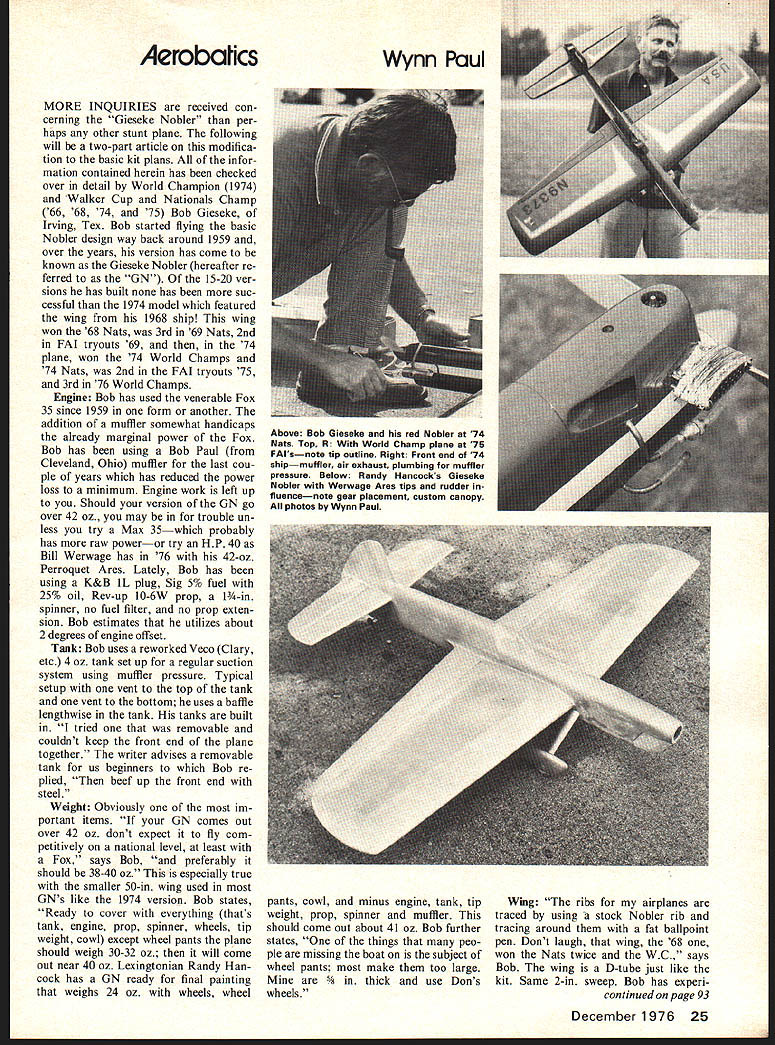
MORE INQUIRIES are received concerning the "Gieseke Nobler" than perhaps any other stunt plane. The following will be a two-part article on this modification to the basic kit plans. All of the information contained herein has been checked over in detail by World Champion (1974) and Walker Cup and Nationals Champ ('66, '68, '74, and '75) Bob Gieseke of Irving, Tex. Bob started flying the basic Nobler design way back around 1959 and, over the years, his version has come to be known as the Gieseke Nobler (hereafter referred to as the "GN"). Of the 15-20 versions he has built none has been more successful than the 1974 model which featured the wing from his 1968 ship! This wing won the '68 Nats, was 3rd in '69 Nats, 2nd in FAI tryouts '69, and then, in the '74 plane, won the '74 World Champs and '74 Nats, was 2nd in the FAI tryouts '75, and 3rd in '76 World Champs.
Engine: Bob has used the venerable Fox 35 since 1959 in one form or another. The addition of a muffler somewhat handicaps the already marginal power of the Fox. Bob has been using a Bob Paul (from Cleveland, Ohio) muffler for the last couple of years which has reduced the power loss to a minimum. Engine work is left up to you. Should your version of the GN go over 42 oz., you may be in for trouble unless you try a Max 35—which probably has more raw power—or try an HP 40. Bill Werwage has in '76 with his 42-oz. Perroquet Ares. Lately, Bob has been using a K&B 1L plug, Sig 5% fuel with 25% oil, Rev-up 10-6W prop, a 1-1/4-in. spinner, no fuel filter and no prop extension. Bob estimates that he utilizes about 2 degrees of engine offset.
Tank: Bob uses a reworked Veco (Clary, etc.) 4 oz. tank set up for a regular suction system using muffler pressure. Typical setup with one vent to the top of the tank and one vent to the bottom; he uses a baffle lengthwise in the tank. His tanks are built in. "I tried one that was removable and couldn't keep the front end of the plane together." The writer advises a removable tank for us beginners to which Bob replied, "Then beef up the front end with steel."
Weight: Obviously one of the most important items. "If your GN comes out over 42 oz. don't expect it to fly competitively on a national level, at least with a Fox," says Bob, "and preferably it should be 38-40 oz." This is especially true with the smaller 50-in. wing used in most GN's like the 1974 version. Bob states, "Ready to cover with everything (that's tank, engine, prop, spinner, wheels, tip weight, cowl) except wheel pants, the plane should weigh 30-32 oz.; then it will come out near 40 oz." Lexingtonian Randy Hancock has a GN ready for final painting that weighs 24 oz. with wheels, wheel pants, cowl, and minus engine, tank, tip weight, prop, spinner and muffler. This should come out about 41 oz. Bob further states, "One of the things that many people are missing the boat on is the subject of wheel pants; most make them too large. Mine are 5/16-in. thick and use Don's wheels."
Wing: "The ribs for my airplanes are traced by using a stock Nobler rib and tracing around them with a fat ballpoint pen. Don't laugh, that's what the '68 one won the Nats twice and the W.C.," says Bob. "The wing is a D-tube just like the kit. Same 2-in. sweep." Bob has experimented with wing spans from 50 to 53 1/4 in., excluding the 48-3/4-in. span of the 1976 ship which has not seen competition at this writing. The '74 version has a span of 50.25 in. with one-in. unequal panels. Bellcrank location is the same as on the Nobler plans. The root and tip chords are 10 and 8 in. which are just about the same as the kit. Bob uses adjustable leadouts that are individually adjustable so leadout placement is not critical in building. The '74 wing is fully sheeted using 3/32-in. wood. The spar is built from 1/16-in. stock, "quarter-grain super-light balsa."
Generally speaking, his wing tips are slightly squared off as shown in the pictures. The tips are usually solid blocks that have been hollowed out. Bob generally uses about one ounce of tip weight, but make yours adjustable.
Foam Gieseke Nobler wings are available from Control Specialties Company (205 Wood Ave., P.O. Box 268, Middlesex, N.J. 08846). Foam Nobler wings are available from C.S.C. and from Arnold Stott, Mankato Models, 628 West 6th St., Mankato, MN, 56001. The chief difference between the foam models is that the C.S.C. Gieseke Nobler wing is slightly thicker than the stock Nobler wing.
Flaps: Here is a factor that Bob has changed, cut, added, put on tabs, taken off tabs, fiddled with, bent, used electrical tape, and "gone plumb crazy" with. He has tried flap spans from full to 75% of the span. The flaps on the successful W.C. plane had a root chord of 2 3/4 in. and a tip chord of 3/4 in. The flaps on this plane finally came out at 20.25 in. for the outboard and 19.875 in. for the inboard. Yes, the inboard flap is shorter than the outboard. However, Bob suggests that modelers use an inboard flap of 21 in. and an outboard flap of 20.25 in. Bob stated, "You can carry more tip weight with less outboard flap . . . suppose the experts will have a lot to say over this one . . . however, it works for me. The larger inboard flap will cut down on the disadvantages of too much tip weight. Everyone of my planes is different . . . even change them from one year to another . . . just play with weight and flaps till I get happy and then stop . . . wonder when that will occur! I go crazy when it's time to cut a flap for a new wing." He uses 1/4 in. x 1/4 in. balsa stock for the flaps.
Flap Horns: If you are starting from a Nobler kit or from scratch it is advisable to use accessory items Top Flite flap horns, not the kit supplied ones, and not Veco items. "Lost a Veco horn in '63. Took about a dozen Vecos and Top Flites down and had them magnafluxed. All the Top Flites passed, but none of the Vecos," says Bob.
Tail Plane: The stabilizer in the W.C. plane has a root chord of 3 in. and a tip chord of about 2 in. The span is 20 in., although Bob has tried spans up to 24 in. The elevators are 3 in. at the root chord and 2 in. at the tip. To build his stab, Bob relates, "I actually start with a fat 1/4 in. in outline from light balsa, then cut out the center and use 3/32 in. ribs.... Fat means slightly over 1/8 in. thick. Many versions have been built with less than 1/8 in. thick stab and elevators by others in this area (Texas) and they do not go right. Seems they build up speed in the wind. I know it is hard to get light 1/8 in. for this, but if you don't, you might as well forget it and build something else. Stab and elevators have 1/16 in. sheeting."
Bob's 1976 version was flying pretty good until just before leaving for the World Championships. Minor differences include a 48-3/4 in. wing span and elevators that are 3.25 in. at the root chord. Bob stated, "The '76 ship is really very good. I had it going very well and thought it could go better and finally messed it up. Cut too much of the flaps, then burned up a Fox. Was leaving in a month for Holland and, this serious illness in the family, decided to go to get the '68-'74 plane down and go with it."
In next month's installment we will take up the fuselage, force moment arms, finishing, flying and other miscellanea.
— Wynn Paul, 1640 Maywick Dr., Lex., Ky. 40504
Transcribed from original scans by AI. Minor OCR errors may remain.

