

Control Line: Aerobatics
Ted Fancher 158 Flying Cloud Isle Foster City, CA 94404
Introduction
Due to the curse of publishing lead time, by the time you read this epistle you will most likely know the results not only of the 1988 Virginia Nats but also of the Kiev, Russia CL World Championships. Unfortunately, as I write it is late June, and my new ship for the Nats isn't done, the old ship needs a really good engine, and the old reflexes just don't seem to be what they used to be when I do find the time to go practice. I just received an engine from Tom Lay at T&L Specialties which he guarantees is a monster, and I'd much rather be out running it. However, duty calls, so stand clear for another month of Stunt stuff.
Hunting and control sensitivity
I received a well-deserved rebuke from George Lieb (Omaha, NE) regarding the August column which dealt with curing hunting in a Stunt ship. He quite properly stated that a common cause of hunting, especially for newer Stunt fliers, is a control system which is too sensitive to handle movement.
George's comments were particularly apt, since this turned out to be precisely the problem that was bedeviling the modeler whose complaint had planted the seed for the column in the first place. Shortly after his call to me we chanced to get together at the Northwest Regional Championships in Eugene, OR, Memorial Day weekend. This modeler, by the way, was not a novice but a very adept and upcoming Advanced flier who, even with his serious control problem, managed a well-deserved third place in Advanced.
His problem was the result of "out-pro-stunting" himself with new technology more than from lack of understanding. He had developed a clever new control system which replaced the bellcrank with a two-pulley-and-sliding-bar mechanism. Unfortunately this system resulted in a very fast control response, wherein one inch of lead-out displacement resulted in one inch of pushrod travel. The bottom line was that he obtained full elevator deflection with about an inch-and-a-half of lead-out movement. This response rate is much too fast. Let's take a look at why, what to do about it, and how to avoid it.
Often a new Stunt flier will incorrectly assume that since he wants to turn tight corners he must have a control setup which gives much elevator deflection with minimal movement of the control handle. Wrong. In fact, it's wrong for a couple of reasons.
First, and briefly since it doesn't really fit into our discussion on hunting, such a setup is seriously lacking mechanical advantage over the airloads on the elevators and flaps when they are deflected. Even though the controls respond abruptly on the ground, it is quite possible that the airloads will prevent them from doing so in the air, because the system is in "high gear." It's like trying to get your car to climb a hill in fifth gear from a dead stop.
Second (and the main point here), it allows very small handle inputs to cause relatively large control deflection. Thus minor corrections at the handle cause the aircraft to respond more than desired—especially if the airplane is otherwise not precisely trimmed. As we discussed in the August column, this overcontrolling and out-of-trim situation in level flight will be compounded, and the ship will be nearly impossible to fly "on rails" in level flight.
Rule of thumb for lead-out travel (IMPORTANT)
This rule of thumb assumes you are using a handle with approximately four-inch spacing between the Up and Down lines. Most commercially available handles are within a fraction of this measure, or have a spacing that approximates it. In my opinion the nearly ideal spacing was a stroke of genius by the maker of the now-defunct EZ-Just Hot Rock handle.
Measure how far one lead-out moves when going from full Up elevator to full Down. (This assumes you have the normal 35°–45° of both Up and Down elevator travel.)
- Ideally your lead-out should move somewhere between 2 1/4 and 3 inches when using a 3-in. bellcrank, and between 2 1/2 and 3 1/2 inches when using a 4-in. crank.
- The smaller number would be acceptably fast response, and the larger acceptably slow. Most fliers could adapt to response rates in this range.
- Anything much slower than this will be very unresponsive to normal handle movements and, worst of all, may make it geometrically impossible to obtain full control deflection should it be needed.
- Anything faster, on the other hand, may indicate that your hunting problem is caused by too-fast controls.
Fixing too-sensitive controls
There are two ways to address this problem in a completed model:
- Desensitize the control system on the plane itself (best method). This should be accomplished either by moving the bellcrank-to-flap pushrod closer to the bellcrank pivot, or (easiest) further from the flap pivot (hinge line). This is simple on a profile but would require cutting into a ship with built-in controls. If you choose this route, adjust until you get the appropriate amount of lead-out travel.
- Narrow the distance between the Up and Down lines on your adjustable handle (simpler but less efficient). As this space is reduced, a given amount of handle deflection causes less control deflection, thus desensitizing the control feel to the pilot. This fix can probably be used down to a minimum of two inches between the lead-outs. Anything less than this will reduce the feel at the handle to an unacceptable level.
This fall I hope to address the control system more completely. I hope this helps in the meantime.
Flying with Tom Dixon
In my profession as an airline pilot I flew to Atlanta for layovers all month, and was able to arrange a flying session with PAMPA President (and Stunt booster extraordinaire) Tom Dixon. After three or four flights on his new Sig Magnum I was very impressed by a couple of items.
First, the airplane itself was a very competitive machine—much more so, I felt, than other Magnums I have flown. When I told Tom how much I liked the response of the ship, he said he wasn't surprised. The reason harkens back to our discussion on control response rates.
Tom felt that the control setup shown on the Magnum plans and in the construction booklet is too sensitive. Still using the Sig 3-in. bellcrank from the kit, he drilled a new hole 1/16 in. from the pivot for attaching the pushrod to the flap horn. The pushrod attached to the flap horn one inch from the hinge line. The flap-to-elevator pushrod was installed equidistant from the respective hinge lines to give a one-to-one flap-to-elevator deflection ratio. This resulted in a moderately acceptable range of lead-out movement which proved very pleasant to fly. It was never sensitive but always responsive.
The Royal .40 engine
The second impressive item was the engine in Tom's Magnum: one of the Royal .40s which he sells. The Royal is a Schnuerle-ported ABC (aluminum piston running in a brass liner which has been chrome plated) engine. This engine is almost a direct copy of the OS .40FSR which was very popular for a couple of years until the ST .60 became the "in" engine among the Stunt cognoscenti.
Although very powerful, the earlier Schnuerle-ported engines had several characteristics undesirable to many serious Stunt fliers:
- A tendency to break into a two-cycle and stay there. The engines were designed for high performance and high rpm and didn't take kindly to attempts to make Fox .35s out of them.
- A habit of running rich in the inside portions of figure eights and two-cycling in the outsides, which made flying equal-sized insides and outsides difficult or impossible.
Tom's Royal .40 seems to have eliminated both defects. His Magnum weighed a hefty 59 oz. and was flown on 69-ft. (center of airplane to handle) lines. Lap times were in the 5.4-second range, and tension was outstanding at all times, even in the hot, dead-calm air in which we flew that day. There was absolutely no tendency to run away—quite the opposite. I flew about a minute of continuous round and square eights during which the engine would break into and out of a two-cycle at all the appropriate times. When I finally brought it back to level flight it returned to its original four-stroke, level-flight speed immediately.
The engine earned a final star in my book in that it only required 4.25 oz. of 10%-nitro fuel to perform the pattern. I am a firm believer in minimizing fuel burn to reduce CG change during a pattern, and this engine certainly fills the bill. Although Tom didn't quite wean me off my ST .46s, he's sure working on it. Since the ST is far more practical for many purposes, I feel the Royal may be its heir apparent for those like myself who are not sold on the dominance of the .60 in Control Line Stunt. You can bet I'll be getting one for testing this fall.
Tom performs a minor modification to the timing of these engines and sets them up for Stunt use. The price is around $100 (current price may change with currency exchange rates). If you're interested contact him at:
Suite 401 1938 Peachtree Road Atlanta, GA 30309
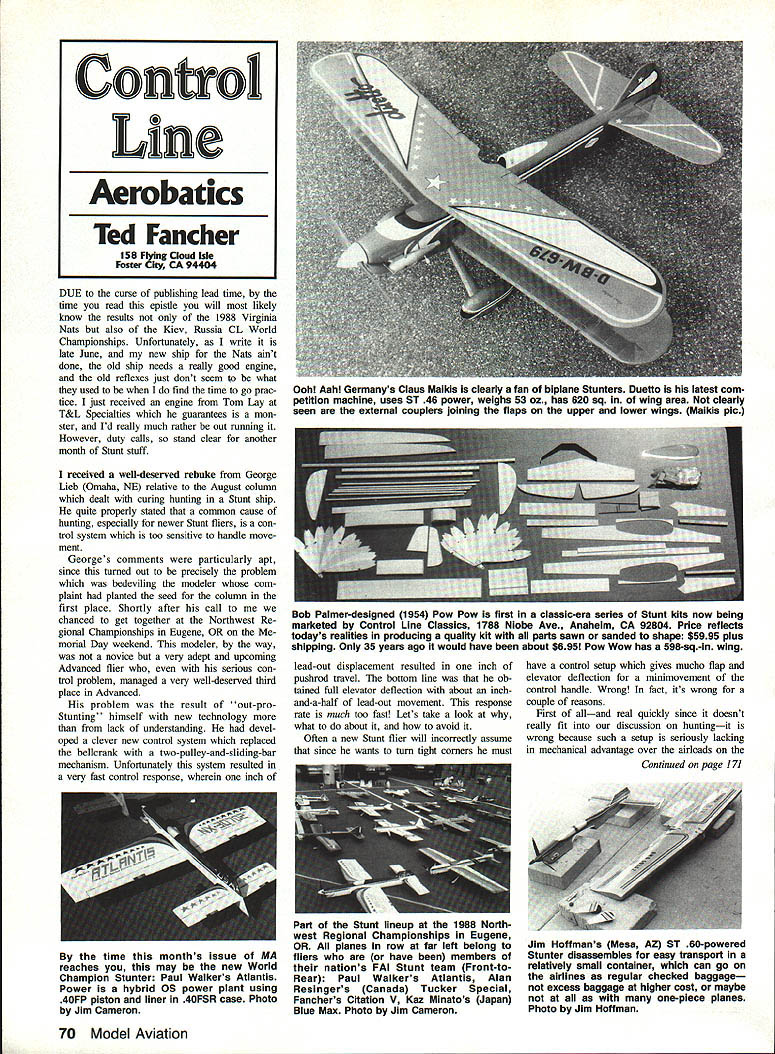
Duetto biplane
The final item for this month should make our stateside biplane enthusiast Chuck Holzapfel stand up and take notice. My good friend and faithful correspondent Claus Malkis from Ulm, West Germany, sent pictures of his new Duetto biplane Stunt ship. He explains the name Duetto by stating that it should end once and for all the inquiries as to whether his original Stunters are modified Stilettos.
Claus says the ship is now flying and being trimmed out. He has already won a contest against good European competition with the ship, which illustrates its potential. He feels, however, that the ship was really up to the score he received, but that—as so often happens with innovative and impressive new Stunters—perhaps the judges reacted very positively to the plane itself rather than to the precision of its maneuvers.
Claus feels that the ship, although impressive, is not the equal of a good monoplane Stunter. From his descriptions, however, it sounds like there is more performance yet to be wrung out of the concept. I expect that between Claus and Chuck we should get a pretty good idea of the merits of the biplane within the next year or so. I hope they are both considering construction articles on the ships after they get them trimmed to their full capability. Heck, even if they don't fly too great they sure look slick!
Transcribed from original scans by AI. Minor OCR errors may remain.

