
Control Line: Aerobatics
Ted Fancher 158 Flying Cloud Isle Foster City, CA 94404
Holy cow, guys! Those other fellows have really learned how the game is played. In this case, those other fellows are our comrade stunt fliers from the People's Republic of China and the U.S.S.R.
World Championships — results and U.S. finish
For any of you who haven't heard by now, the Chinese and Russian teams did it to the rest of us yet again at last August's CL World Championships. Once again these two teams beat all comers, reversing their placings of two years ago. The P.R.C. won both the team and individual honors as 1986 runner-up Zhang Xiang Dong took the gold medal. 1986 champ Andrei Kolisnikov was a very close second, followed fractionally by China's Wang Jian Zhang.
- Zhang Xiang Dong (P.R.C.) — gold
- Andrei Kolisnikov (U.S.S.R.) — silver
- Wang Jian Zhang (P.R.C.) — bronze
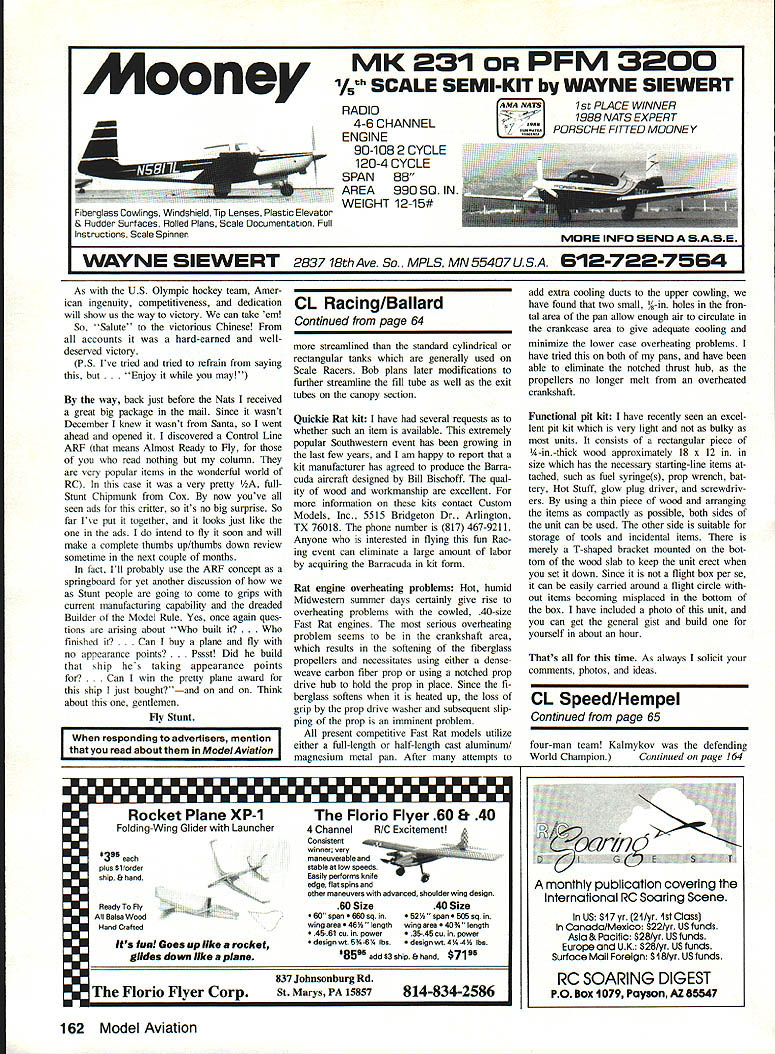
Our U.S. team members were competitive but were held out of the individual medals by the strong performance of the two Eastern nations. Jimmy Casale placed fourth, Paul Walker fifth, and Bob Baron tenth. The U.S. team finished in third place and garnered a bronze medal for its efforts.
While it's difficult to complain about a third-place finish when flying against the best fliers in the world, it must be looked at as a definite challenge for the historically unbeatable U.S. stunt team to regain its former prominence. Why are we now getting beaten at our own game?
One thing I can tell you: it isn't because of lack of effort on the part of our team. I've done battle with all three of these guys and generally come away battered and bloody. These guys can fly, and all three have a commitment to purpose that makes them formidable competitors under any circumstances.
In search of an answer to that question, I contacted the members of our team to find out what happened and to ask their opinions as to what we need to do to reestablish our preeminence in world-class stunt.
For the first time our team included a coach, Don McClave of Portland, OR. This was particularly fortuitous, since Don was able to critically observe the flights and teamwork of the competition. His duties rewarded us with expert and informed insight into the differences between our team and the winners — an outlook we've never had before.
Don sent me a brief analysis of his perceptions of the competition. I thought I'd share those thoughts with you. In addition, I'll be annotating his remarks with collaboration from my notes from conversations with the team members themselves. Here's Don's report.
Don McClave's observations
"Judging good. FAI scoring system should be changed to U.S. system, which allows finer discrimination by judges."
Unlike the 1986 Championships where judging suffered from last-minute replacements, all members of the team felt that the judging this time was fair and impartial, notwithstanding the presence of three Eastern Bloc judges.
The FAI scoring system employs a score of 1 to 10 for each segment of a maneuver; i.e., each of three loops gets an individual score. This score is then multiplied by a K-factor of from 1 to 10 depending on the difficulty of the maneuver. Thus a pilot whose square eights are only very slightly inferior to another's might get two sevens while the better maneuverer receives two eights. However, when the K-factor of 8 for the initial maneuver and 10 for the second maneuver are considered, the minimum difference becomes 18 points:
- Flier one: 7 x 8 + 7 x 10 = 126 points
- Flier two: 8 x 8 + 8 x 10 = 144 points
When you consider that one flier may have flown at 8:00 a.m. and the other at 6:00 p.m. in the same round, you can see where the coarseness of the scoring becomes a factor. — Ted
"Winner and runner-up flew very well and would be tough to beat anywhere in the world."
"It was unanimous that Xiang Dong and Kolisnikov deserved their placings. These guys are the crème de la crème of stunt right now, and we've got to find a way to beat them." — Ted
Style and equipment favored by FAI judges
- The preferred style by FAI judges is smooth flying with precise five-foot bottoms, good shapes, and accurate intersections. Judges do not like blind-spotting corners, bobbles, or line-kinks.
- Quiet airplanes are now the norm in world competition; .60 engines are the power plant of choice.
- Size of maneuvers: the Chinese flew small; the Russians and the U.S. flew slightly larger. Italy's Cosmetta (ninth place) flew very large. Size didn't matter much as long as the total presentation was crisp, flowing, precise, and smooth.
- Many top ships were fairly small — approximately 650 sq. in. — flown by home-built engines slightly under .60 displacement. Weights were in the low 50-ounce range. The common thought was that a high power-to-weight ratio was a determining factor. The controlled excess of power allowed pilots to give the same presentation regardless of weather conditions. They always flew the same. — Ted (Jimmy commented this was the most significant factor in the Chinese dominance.)
"Judges appeared to give consideration to whether the ship bounced or rolled in flight and didn't care for ships that were loud. One judge commented to Walker that, 'Although it didn't affect my scoring, your airplane was too loud.'"
Don commented on the "dirty or patchy" intersections by some teams, but Walker suggested the Chinese were almost machine-like in their presentation — all 5-ft. bottoms on all maneuvers, especially the wing-over which sets the tone for the rest of the flight. Baron commented on the precision of their shapes, suggesting that perhaps poor geometry has become a weakness of current U.S. styles.
"The top pilots were all flying around five-second laps with Kolisnikov slightly slower at around 5.2. They were, however, flying on less than maximum line length, which gave their patterns a crisp and compact look."
Paul and Jimmy disagreed a bit with Don on corners. They felt the Chinese flew very tight corners, while Jimmy felt the Russians tended to be bigger and smoother. Bob agreed with Don, so take your choice.
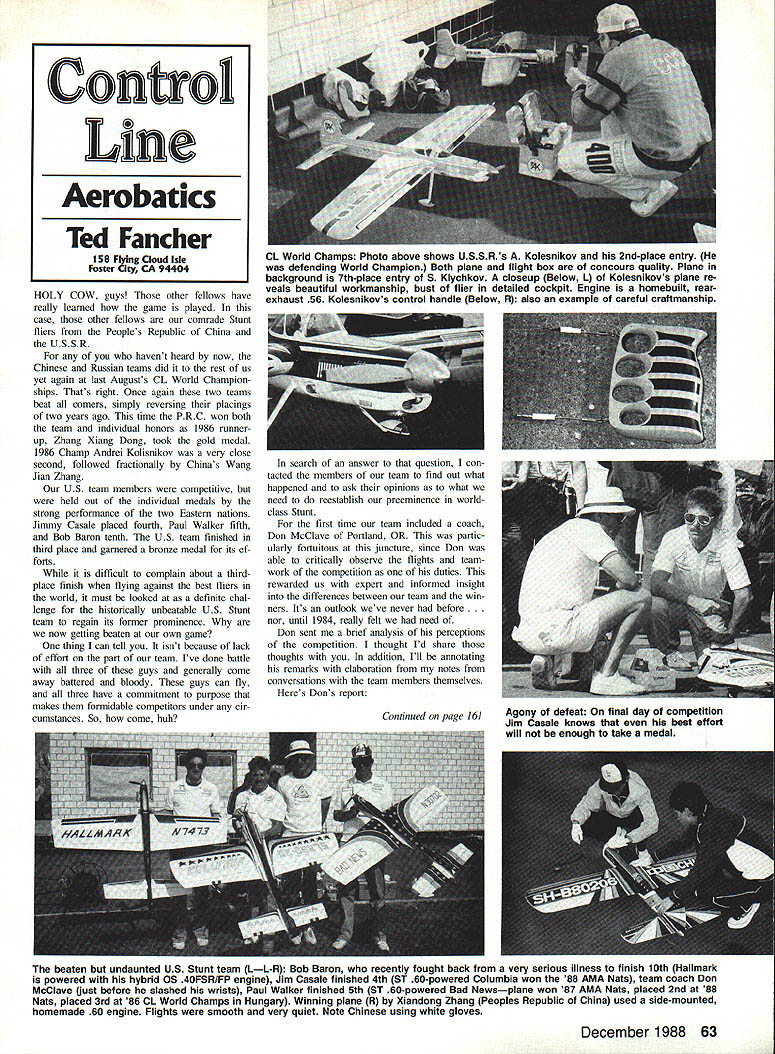
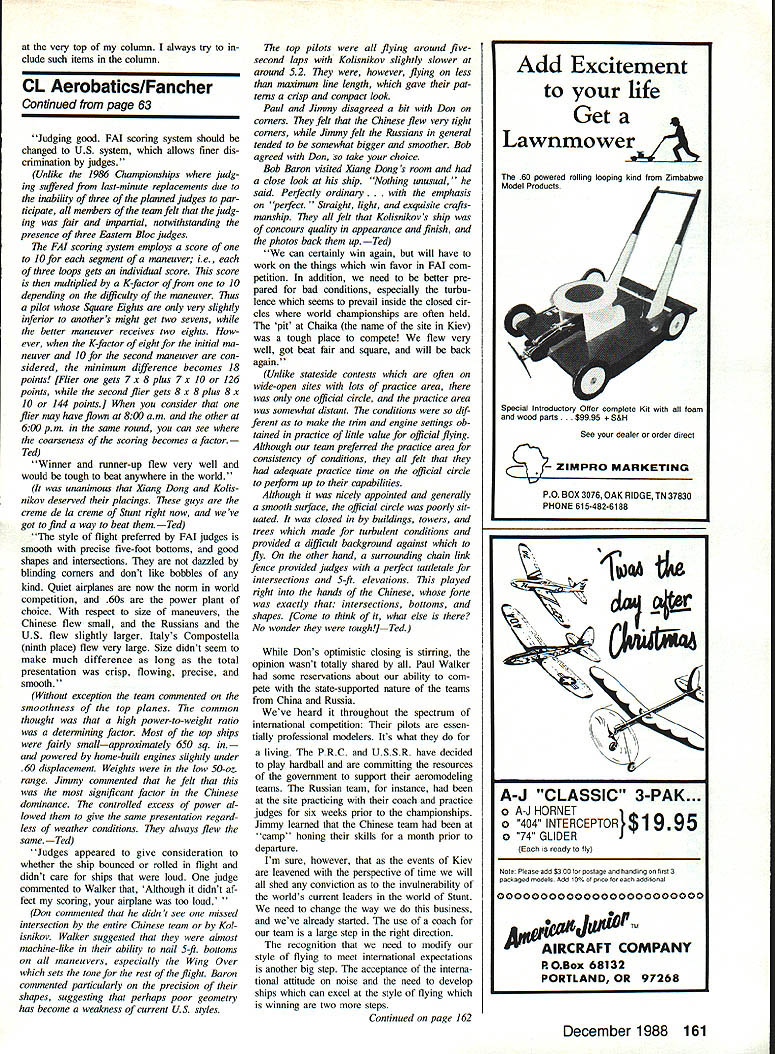
Bob Baron visited Xiang Dong's room and had a close look at his ship. "Nothing unusual," he said. "Perfectly ordinary," with emphasis on "perfect." Straight, light, and exquisite craftsmanship. They all felt that Kolisnikov's ship was concours quality in appearance and finish, and the photos back them up. — Ted
Conditions, practice, and the official circle
"We can certainly win again, but will have to work on the things which favor in FAI competition. In addition, we need to be better prepared for bad conditions, especially the turbulence which seems to prevail inside the closed circles where world championships are often held."
"The 'pit' at Chaika (the name of the site in Kiev) was a tough place to compete! We flew very well, got beat fair and square, and will be back again."
Unlike stateside contests which are often on wide-open sites with lots of practice area, the Chaika site had only one official circle and the practice area was only some 25 meters distant. The conditions were so different as to make the trim and engine settings obtained in practice of little value for official flying.
Although our team preferred the practice area for consistency, they all felt they had adequate practice time on the official circle to perform up to their capabilities.
The judging was nicely appointed and generally smooth; the official circle was poorly sited. It was closed in by buildings, towers, and trees which made for turbulent conditions and provided a difficult background against which to fly. On the other hand, a surrounding chain-link fence provided judges with a perfect tactile for intersections and 5-ft. elevations. This played into the hands of the Chinese, whose forte was exactly that: intersections, bottoms, and shapes. — Ted
State support and preparation by Eastern teams
Paul Walker had reservations about our ability to compete with the state-supported nature of the teams from China and Russia.
- We've heard it throughout the spectrum of international competition: their pilots are essentially professional modelers. It's what they do for a living.
- The P.R.C. and U.S.S.R. commit government resources to support their aeromodelling teams. For example, the Russians had been at the site practicing with their coach and practicing judges for six weeks prior to the championships. Jimmy learned that the Chinese team had been at "camp" honing their skills for a month prior to departure.
I'm sure, however, that as the events of Kiev are learned with the perspective of time we will all shed any conviction as to the invulnerability of the world's current leaders in the world of stunt. We need to change the way we do this business and we've already started. The use of a coach for our team is a large step in the right direction.
The recognition that we need to modify our style of flying to meet international expectations is another big step. The acceptance of the international criteria on noise and the need to develop ships which can excel at the winning style are two more steps.
As with the U.S. Olympic hockey team, American ingenuity, competitiveness, and dedication will show us the way to victory. We can take 'em!
So, salute to the victorious Chinese! From all accounts it was a hard-earned and well-deserved victory.
(P.S. I've tried and tried to refrain from saying this, but ... "Enjoy it while you may!")
Miscellany and closing
By the way, just before the Nats I received a big package in the mail. Since it wasn't December I knew it wasn't from Santa, so I opened it. I discovered a control-line ARF (Almost Ready to Fly). They are very popular in the world of R/C. In this case it was a very pretty ship. So far I've put it together and it looks just like the one in the ads. I intend to fly it soon and will make a complete thumbs-up/thumbs-down review sometime in the next couple of months.
In fact, I'll probably use the ARF concept as a springboard for another discussion of how we, as stunt people, are going to come to grips with current manufacturing capability and the dreaded "Builder of the Model" rule. Yes, once again questions are arising about "Who built it? Who finished it? Can I buy a plane and fly with no appearance points?" Did he build that ship he's taking appearance points for? Can I win the pretty-plane award for this ship I just bought? ... and on and on. Think about this one, gentlemen.
Fly stunt.
Transcribed from original scans by AI. Minor OCR errors may remain.

