
Control Line: Aerobatics
Ted Fancher
158 Flying Cloud Isle Foster City, CA 94404
The Dance
It is with but a touch that you come alive. I run to seek your control so that you can lift to be where you belong with me. I raise my hand to show we're ready. We are one, to do what we are destined to do. With the accuracy of a machine and the grace of weightless snow, we perform the beauty only we can know. Together we climb to the stars and attack the ending ground. Then turn away and laugh with joy at the shouting of the crowd. We dance the circles and leap away to another part of time. We spin and loop and blow 'em away: because it is we who love to fly. And now it's time to end this dance which lasts just moments and dies. Thus I bring you down to touch the ground as graceful as you fly.
Author unknown.
NICE, huh? Thanks to Tom Lay for sending this my way. He says he found it amongst his old love beads from the flower child era — which by classic carbon-dating methods should work out to the early Sixties. I suspect that the author might just still be around to claim credit. Let me know.
Is it just me, or do you agree that a Control Line Stunt column is the only place in modeling where one might find poetry an acceptable form of divertissement? I suspect the artistic element that is common to almost all Stunt fliers predisposes them to appreciate the inherent beauties of other forms of expression.
When I first read "The Dance" I was listening to a broadcast of Vladimir Horowitz playing Mozart for an appreciative audience in his native Russia, his first such performance since he had left the country some 60 years before. In a personal way, the emotional response of his audience welcoming him back triggered similar feelings between myself and thoughts of my lifelong affair with Stunt.
Reflections and Preparations
The impact of the moment was charged in no small degree by the presence of my nearly complete Ares, which I am preparing for the upcoming Nostalgia Era events. That this design, which I last built as a teenager, would stir excitement and appreciation by its beauty nearly 30 years later lends credence to the belief that it is more than just balsa and glue.
In an emotionally charged moment while accepting the Walker Cup in 1979, Bob Gieseke stated that "Stunt is a lot more than just toy airplanes." Although the statement had an intensely personal message for Bob, it spoke volumes about the nature of the Stunt event and the people who fly it. Stunt as an artistic expression? Darn right!
On the other hand, maybe it was that third glass of good California Cabernet. (Naaah.)
I stopped by the flying field the day after Christmas (eat your hearts out, East Coasters!) and ran across young Paul Pomposo trying to trim out his new imitation. You may recall that last month we discussed how we resolved the problem of Paul's hard-starting, powerless .46 — which we discovered had been improperly re-assembled.
Well, this week Paul had the ship in the air and was hoping to try some patterns with it. I agreed to stick around and work with him. Right off the bat I could tell he had a serious problem. In level flight the outboard wing was substantially up, and when inverted it was down. Obviously something was out of whack.
Remember in our review of Cox's Super Chipmunk a few months back we talked about the deterioration (that means bad, Whitey) effects of this condition? Because the lift of the wing is at right angles to the wing's span when the ship is banked into the circle, some of that lift is trying to fly the ship toward the pilot. In the case of the Chipmunk it was lack of tip weight that caused the problem. Thus the outboard wing was elevated with the model flying either upright or inverted.
While this is often a symptom of a warped wing, in Paul's case it wasn't the wing which was warped, but the flaps. The outboard flap was bowed down and the inboard one bowed up. Together they acted like ailerons, the control surfaces which control movement about the roll axis on un-twisted airplanes. This is precisely what they were doing to Paul's ship. Without the restraining action of the control lines Paul's ship would have been performing continuous and uncontrolled barrel rolls!
Flap-related problems and cures
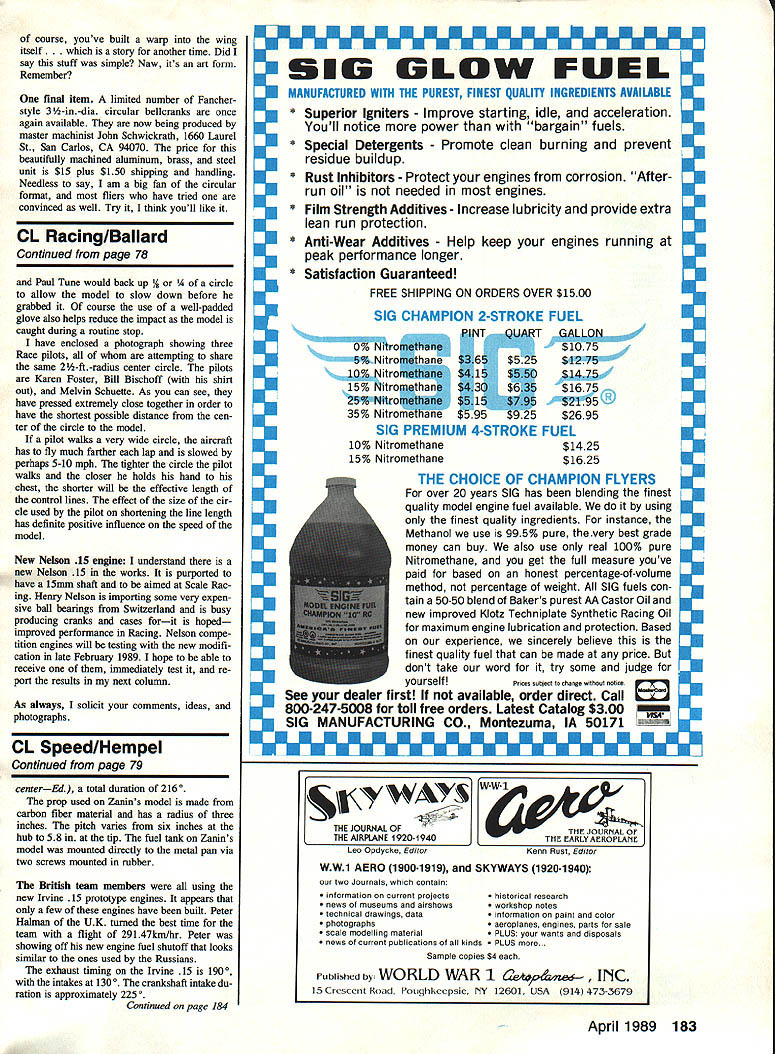
There are three ways that flaps can cause this problem:
- The flaps can be warped. This is usually the result of the covering being shrunk unevenly.
- The flap horn itself may be bent so that the left and right arms aren't parallel; or the holes in the flaps may not have been drilled parallel to the center line, so that the flaps aren't neutral at the same time.
- The flaps themselves may have been improperly tapered so that they have a built-in twist from root to tip.
These problems are most easily noted from the rear of the aircraft. See the computer-generated sketches.
In the first and third cases you may never have a problem IF both flaps are twisted or warped in the same direction. In this case the flaps won't be as effective in helping the model to turn in one direction as in the other, but at least you won't get the undesirable bank. You can live with this, although down deep you'll know that it ain't as good as it could be. (Hint: If your wings are level in both upright and inverted flight, overcome any urge to inspect the flaps closely. You'll sleep better at night.)
It is generally easy to correct warps, depending on the type of finish.
- If the flap is covered with heat-shrink film, reshrink the covering while holding the flap twisted in the opposite direction to the original warp by an amount roughly equal to the original warp. When released it should return about half the amount of twist, which may make it straight.
- On a doped finish, depending on the severity of the warp, a flap can be straightened either by heating it in the steam over a kettle and then blocking it in place overnight, or (in extreme cases) by placing a heavy coat of clear dope with some retarder in it. This will soften the paint down to the wood. When the paint is dry enough to handle without marring the finish, block the flap up and allow it to dry for a couple of days.
- If you've painted with epoxies or a urethane paint, you have a real problem since these paints do not soften with additional coats and are impervious to moisture. I have had some success injecting water into the wood with a hypodermic needle at the hinge line where the holes won't show, and then blocking in place. Don't hold your breath waiting on this one, however. If worse comes to worst you may have to remove the warped flaps and replace them.
The best solution to a warped flap is to never warp it in the first place. To avoid warps:
- Be careful to shrink the covering evenly when using film.
- When painting, especially with aerosols which shrink tremendously, always put equal amounts of paint on both the top and bottom of the flaps. If you put less paint on the bottom to save weight you'll probably end up with a warpy flap which gets progressively worse as the extra paint on the top shrinks more than on the bottom.
The cure to the second problem is simple: grasp the flaps in the vicinity of the horn arms and twist until both flaps are neutral at the same time. By the way, this is only simple if you don't break your flaps while doing it! Some horns are very tough to tweak. When I am trimming a new ship I always take four pieces of 1/8-in. plywood with me which I can use to grip the flaps while tweaking. This spreads the pressure over a larger area and prevents the horn arm from breaking through the flap. An even smarter method is to inset a piece of hardwood into the flap to accept the horn. This allows you to tweak on the hardwood rather than the balsa.
The third problem, improperly tapered flaps, is the result of an improper building procedure and must be addressed during construction or the offending units must be removed and replaced.
Generally speaking, Stunt flaps are tapered from root to tip. For example, the root may be three inches in chord and the tip one inch. Most builders shape the flaps so that they decrease in thickness from the hinge line to the trailing edge, both for aesthetic reasons and because good aerodynamic design principles require it.
The proper way to do this is to remove equal amounts of wood from both the top AND bottom of each flap. Unfortunately this is also the more difficult way to do things. The most common mistake builders make is to taper the flap on one side only, or to remove wood from the top only. This results in a twisted flap which will be difficult if not impossible to correct after the fact.
Here is the method I use to ensure equal thickness in top and bottom taper and thus an untwisted flap: check out the drawings for details. Of course, if you've built a warp into the wing itself . . . that's a story for another time. Did I say this stuff was simple? Naw, it's an art form. Remember?
Parts availability
One final item. A limited number of Fancher-style 3-1/2-in. dia. circular bellcranks are once again available. They are now being produced by master machinist John Schwickrath, 1660 Laurel St., San Carlos, CA 94070. The price for this beautifully machined aluminum, brass, and steel unit is $15 plus $1.50 shipping and handling.
Needless to say, I am a big fan of the circular format, and most fliers who have tried one are convinced as well. Try it, I think you'll like it.
Transcribed from original scans by AI. Minor OCR errors may remain.

