
Control Line: Aerobatics
Ted Fancher 158 Flying Cloud Isle Foster City, CA 94404
Claus Maikis ("Henri") — correspondence and clarification
First order of business this month is to make an honest man of "Henri." You will recall that the subject of the last two months' columns was an exchange of letters between myself and a European flier whom I christened "Henri." I did this because the subject of our letters was the attitudes and expectations of American fliers in international competition. Henri (as I called him) had some fairly outspoken opinions on the subject, and I took it upon myself to disguise his identity. Well, "Henri" wrote back and made it quite clear that he had no need or desire for anonymity and would very happily stand behind his words as written, thank you very much. So, for the record, the author of the provocative letter was actually Claus Maikis of Ulm, West Germany. Claus is both a master of the event and one of my most consistent correspondents. He has had a great many of his ideas, designs, and pictures published both here and in articles and columns of his own.
Claus, one of the most respected fliers in the world, certainly deserves to have his opinions aired, especially in the area of international competition wherein he is especially knowledgeable. Specifically, he had the following last words to say about the subject and about the unrequested nom de plume.
"I would like to make one thing quite clear: The viewpoints presented were mostly my opinions. They are not necessarily common thinking in Europe, with the exception of views about 'loud, fast,' etc. The rest of the world doesn't view the American Stunters so negatively (rather, the opposite is true). Even I don't. If my story sounded so, I'm sorry ...
"I tried to write as short and precisely as possible. Obviously this short form was not appropriate. I should have included many more explaining details. Thus, Ted, your arguments didn't hit the point. Sorry, but I still stand behind my statements ... (although) I think our disagreement is not as big as it might appear.
"Without my name given, people might think I write anonymous letters and hide behind the ominous 'Henri.' That's what I'd like least. If I wouldn't dare to be known I'd better shut up."
So, troops, what do you think? Should we be taking a hard look at ourselves as Claus suggested? Or should we continue doing what has worked so well in the past—only do it better? Time will tell, won't it?
Vintage Stunt Championships — Whittier Narrows, Los Angeles
This is my first chance to wax enthusiastic about the first annual Vintage Stunt Championships held at Whittier Narrows in Los Angeles, CA on February 18–19. What a terrific occasion! Event directors JoAnn and Mike Keville did an excellent job making all the pieces come together for an exceptional episode.
The two-day competition/fun-fly consisted of two rounds each of both Old-Time Stunt (per the Garden State Circle Burner rules) and the newly created Vintage Stunt event.
Vintage Stunt mandates entries that were designed at least 25 years ago. They receive appearance points according to a modified schedule and fly the current Stunt pattern. The rule which allows any ship 25 or more years old to qualify makes it possible for a flier to fly the same ship in both OTS and Vintage: they simply fly the 1952 pattern in OTS and the current one in Vintage.
Winners were determined by adding the scores from each day's flying in each event. However, the thrills of victory or the agonies of defeat weren't the dominant emotions at this event. The prevailing reaction was the joyous reliving of Stunt glories of yesteryear by the several hundred participants, competitors, spectators, and honored guests who attended. Being a part of this coming together of people and planes of bygone eras was a special feeling for all concerned.
I didn't count them all (I'm sure someone did), but there were in the vicinity of 60 aircraft on the field. They ranged from:
- Madman Yates' Madman
- Jim Safty's Ziches
- Bill Netzeband's Fierce Arrows
- Ed Southwick's Larks and Skylarks
- Bill Werwage's Ares
- George Aldrich's Noblers
- Palmer Thunderbirds
- Still Strukas
- Kenhi Panthers
- deBolt Sportwings and All Americans
- Charly Mackey's Lark and an El Conquistador
- Electras, Barnstormers, and Ringmasters
And that was just for starters.
The airplanes were great, but the people were better. We had your basic legends in attendance. How about a lineup that included George Aldrich (flying a replica of the original Nobler) and Bob Palmer, two-time national champion and designer of the incomparable Thunderbird and Smoothie among many others. Bob no longer flies, but was obviously in his element for an entire chilly day. No way was he leaving early!
Ed Southwick was there and brought along one of the two original Skylarks that graced the full-color cover of the Sterling kit. It still looked as good as new—beautiful. Dick Williams, Ed's teammate at the 1962 World Championships, was there. Mr. Monarch, Dale Klinz, attended along with the actual Monoline-equipped Thunderbird about which he wrote in Model Airplane News back in the late Fifties.
Many-time national Combat champ Riley Wooten wouldn't have missed it. Control line aerodynamics wizard and designer of the incomparable Fierce Arrow series of stunt-built flying wings Bill Netzeband stopped by too, and stayed. Charles Mackey not only attended (and watched Atlanta's Tom Dixon place second flying his Lark design), but brought along several "Sunburst" kits which he had only recently finished and was showing to folks.
Joe Wagner, whose fascinating accounts of the early days at the V-8s model factory graced these pages a year ago, came all the way from Pennsylvania to attend, as did the one and only Doc Laird Jackson, acknowledged den mother of U.S. Control Line World Championship teams. And they didn't come the farthest to attend. They weren't even close!
That honor went to Mr. Atae Yamasaki, who came all the way from Hyogo, Japan to cover the event for his spectacular, full-color magazine, Model Sports. Unfortunately Model Sports is published only in Japanese, but that didn't stop anybody present from devouring the beautiful full-color pictures of the recent Kiev World Champs in the sample magazines Mr. Yamasaki brought along.
To say that the first annual Vintage Stunt Championships is due an encore is a huge understatement. JoAnn and Mike have readily agreed to do it again next year. "Bigger and better," they say. While it could be larger, I suppose, there's no way it could be better. The first sip of a vintage brew is always the best. I liked it; why not plan to give it a try yourself next year?
Vibration — a simple, effective Stunt hint
Here's the best Stunt hint I've heard in about a zillion years, courtesy of New York's own Large James Greenaway. Maybe everybody else in the world already knows this, but it had escaped me for more years than I care to remember and probably would have made a difference of several places for me at a number of big meets. Here's the story.
At last year's Virginia Beach Nats I was experiencing an all-too-familiar phenomenon for me. My engine was running erratically. I was unable to get a needle setting on the ground that would hold in the air. Once in the air the engine might get leaner or richer (or occasionally a little of each), but I was never sure which. Although I tried every trick in my bag to no avail, I was unable to diagnose the problem, let alone cure it.
During one practice session I was sharing a circle with former Rookie of the Year Mike Rogers. Mike was putting in one nice flight after another with flawless engine runs. I, on the other hand, was alternately red-faced with frustration at my Super Tigre, and green-faced with envy at Mike's consistent and predictable power.
Swallowing my pride, I asked Mike, "How come, Mike, how come?" He said, "Beats me, Ted. But I'll call my guru, Large James, tonight and see what he says."
The next day Mike advised me of his findings. Large (as he is known to his friends) said that my erratic runs were symptoms of vibration problems. Although I don't feel my ship vibrates an unusual amount, the source of the problem nonetheless proved to be vibration-induced, although subtle in nature.
Jim feels that the stock Super Tigre needle valve is susceptible to the harmonic type of oscillation which causes the tip of the valve to vibrate rapidly inside the spraybar. The stock needle is prone to do this because it is supported in only one place where the collet is tightened on the spraybar. Jim theorizes that this vibration at the collet point is what causes the inconsistencies in the engine runs.
Jim believes that a needle with a two-point suspension system is less prone to the problem, and therefore uses either Enya or OS needle valves in his engines. These needles are supported by both the larger-diameter threaded area and by the spring steel retainer.
I immediately investigated my needle valve and, sure enough, it was not tightly secured by the collet. I have habitually removed the right-angle bend at the end of the Tigre needle and replaced it with a small star gear. This prevents the needle from running into the muffler. Unfortunately it also reduces the leverage available to turn the needle, and thus I had a tendency to tighten the collet no more than absolutely necessary.
The bottom line was that this simple fix—tightening the collet until I could just barely adjust the needle—cured the problem like magic. All of a sudden an engine which was almost unusable for serious Stunt work became docile and predictable. I have since replaced all of my Tigre valves with OS ones and have found the engine runs to be, if possible, even more consistent.
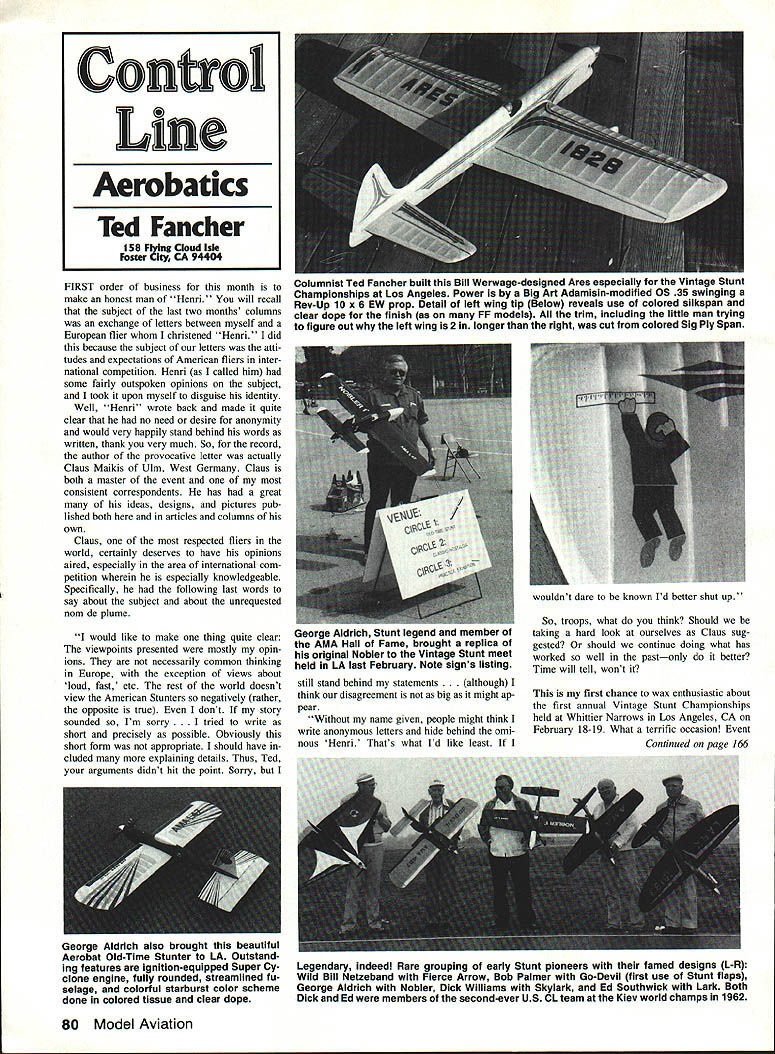
Additional proof came when the Art Adamisin-modified OS.35 in my Vintage Stunt Ares started to exhibit similar symptoms. Art replaces the OS valve with a Tigre unit. (I know, I know. You don't have to ask the obvious question. The answer is: "I don't know! Ask Big Art.") Flying partner Bob Hatzle reminded me of the problem I had experienced with my Tigres, and sure enough, investigation showed another floppy needle valve. A tweak on the collet, and bingo! Problem cured.
Try it out. If it works, thank Large James Greenaway.
By the way, this isn't all Large has to say about vibration and Stunt engines. Windy Urtnowski, in his sage column in Flying Models magazine, has commented at length on the need for rock-solid front ends, especially for the currently popular ST .60s which are renowned for their high level of vibration. Doublers made from 1/8" ply, 1/8" x 3/4" maple mounts, small dowel openings, and gluing the engine mounts to the wing center section as well as the fuselage to increase the vibration-damping mass are all part of the gospel according to Large James. Listen up!
Transcribed from original scans by AI. Minor OCR errors may remain.

