
Control Line: Aerobatics
Ted Fancher 158 Flying Cloud Isle Foster City, CA 94404
SEVERAL times over the years I've suggested the use of sealed hinge lines as a refined trimming technique. At various times they've been suggested as a possible cure for such diverse trim diseases as unequal inside/outside turns, hunting, unwanted rolling tendencies in turns, and assorted other undesirable characteristics.
Events of the last several months have reinforced my conviction as to the indisputable value of sealed hinge lines. Quite frankly, I'm now prepared to state sealed hinge lines should be a routine part of flight preparation for any Control Line model whose purpose in life is performing aerobatics with any degree of predictability and precision.
Here's why I've decided on such a strong position: over the last few years I've been privileged to fly quite a number of OPPs (Other People's planes, in case you're wondering). No, I don't mean top-gun, Pro-Stunt killer ships such as Casale's Spectrums, or Walker's Bad News. I'm talking about the less refined efforts of beginner and advanced pilots who are trying to climb the ladder using off-the-shelf hardware such as Banshees, Twisters, etc. The opportunity to do so has occurred at several Stunt clinics in which I've been asked to participate (a great idea, by the way, if you've got the happy combination of enthusiastic newcomers and cooperative experts in your area).
In many cases I've had the pilots tell me that if only they could fly as well as their ships they would be competitive. Because they appear to have fulfilled all the physical requirements for a good Stunter, and since they lack experience with a truly well-trimmed Stunt ship, they logically assume that the plane is fine and the problem is the nut holding the handle. Surprisingly, when I've flown their ships I've discovered that very often the reverse is true. Many pilots, perfectly capable of flying better, are being held back by the limited capabilities of their ships. In the majority of these cases the performance of these ships could be helped measurably by sealing the hinge line of at least the elevator—and oft-times the flaps as well.
Why seal hinge lines?
Many unscientific birdmen believe that a flap or elevator performs its function by "deflecting" the airflow over it. If you angle the surface up it will deflect the airflow and push the surface away, thus making the ship turn. Not so.
What actually takes place is a change in the shape of that total control-surface airfoil. In neutral the airfoil is symmetrical and the air pressure above and below the surface is equal. When the movable surface is deflected either up or down you have created a cambered airfoil. Because the airflow over the convex "top" of the airfoil must move farther than that on the concave "bottom," it must move faster in order to get to the trailing edge at the same time as the air flowing over the opposite side.
This faster flow reduces pressure on the "top" of the surface while the pressure on the bottom actually increases. The differential in pressure produces lift in the direction of the low-pressure side. This lift creates a turning moment around the center of gravity. This increases the angle of attack of the wing, which increases lift, which allows the aircraft to loop, etc. Obviously, the greater this difference in pressure the greater the force applied about the CG, and the faster the ship will change direction.
Here's where sealing the hinge line comes into play. Remember that 1/32-in. (or so) gap between the stab and elevator caused by the diameter of the hinge? That gap occurs at almost exactly the point where the difference in air pressure between the top and bottom of the surface is greatest. Nature abhors a vacuum, and if the high-pressure air can get to the low-pressure side it will—right through the hinge-line gap. To the degree that the pressure differential is minimized by this flow-through, control effectiveness is diminished. The larger the gap, the more effectiveness will be lost.
Case study: Michael Hawk's Sig Banshee
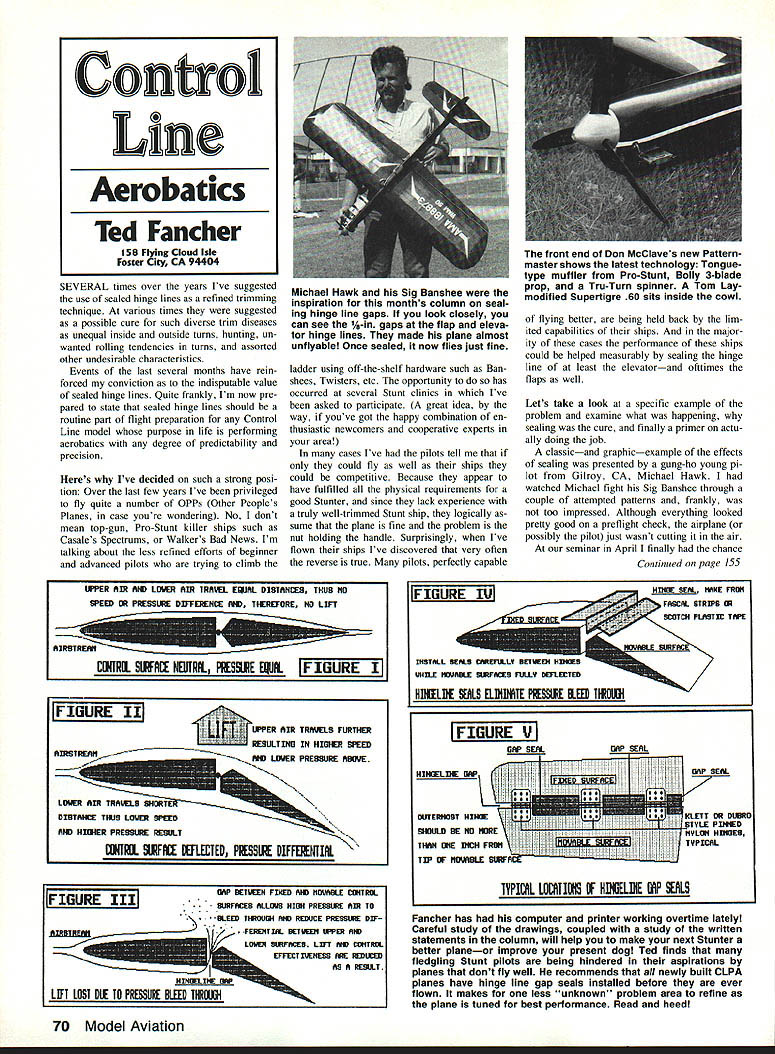
A classic—and graphic—example of the effects of sealing was presented by a gung-ho young pilot from Gilroy, CA, Michael Hawk. I had watched Michael fight his Sig Banshee through a couple of attempted patterns and, frankly, was not impressed. Although everything looked pretty good on a preflight check, the airplane just wasn't cutting it in the air.
To make a long story short, I nearly crashed it when I first flew Michael's ship! This ship only turned half-heartedly inside and was nearly impossible to turn outside. Ninety-degree ground loops weren't the fault of poor piloting—the airplane simply would not turn any tighter.
After surveying the flight I examined the Banshee more closely. The standard answer to a lack of corner (or lack of any turn at all, in this case) is to move the CG aft. Experienced Stunters told me, however, that Mike's CG was plenty far back, and moving it more would cause more harm than good. He had plenty of control movement, the pushrod was properly supported by fairleads, and the tension was adequate to insure full deflection of the controls—yet the ship still couldn't turn.
The solution to the problem was to seal the elevator hinge line. Michael had installed the control using Kline-Du-Bro-style pinned nylon hinges. The pinned part of these hinges is about 3/32 in. in diameter. A recess is made in the control surface during construction; the result is a gap at the hinge line. Once we sealed the gap the ship took on new life and was perfectly capable of rule-book-size flying patterns, square corners, and nicely balanced rates of turn both inside and outside.
By sealing the elevator gap the ship gained two important improvements:
- The airplane turned much better overall because the tail produced more effective force both inside and outside.
- Because the tail was equally powerful up and down, the response to control inputs became satisfyingly consistent—no more flick-your-wrist for insides and yank-for-all-you're-worth on outsides.
Most important, the ship was then capable of flying a recognizable AMA pattern at a task well beyond its previous capabilities.
Once the tail was working well, another weakness showed up. During hard corners the wing would occasionally stall. The evidence of the stall was a sort of double turn in the last corner of the triangle: the ship would turn 90° or so, suddenly stop turning momentarily, and then complete the last part of the corner. We cured this tendency by sealing the gap in the flap hinge line. Now the wing was able to produce the amount of lift required for the corner without stalling.
This stall was the result of two factors:
- The pressure flow-through at the hinge gap caused premature disruption of the airflow over the top of the wing and caused a stall well before the wing had reached its normal critical angle of attack.
- Michael had installed the outermost hinges a full three inches or more from the ends of the flaps. Under load, the flaps almost certainly bent or fluttered beyond that hinge and this disrupted the airflow even more.
I make it a rule never to have more than one inch of flap beyond the outermost hinge. So should you.
Practical benefits and trim considerations
While the positive effects of sealing are so obvious, it is the absence of negative aspects which finally brought me to the conclusion that sealed hinge lines should be accepted practice even for beginners and advanced pilots. On a brand-new ship you will eliminate from the outset any number of possible trim problems before they even raise their ugly little heads.
If retrofitting an already trimmed-out airplane, the very worst thing that could happen would be that it would become more responsive to control input—too quick on the controls. This, however, isn't really a negative at all, but merely something that can be trimmed out and in the final analysis can make the ship a better performer.
Examples and options:
- If the ship had seemed a little light on the lines before sealing, you could now afford to move the CG forward a bit without sacrificing cornering ability. You would gain line tension and also add a bit of additional stability. That advantage made Nats winner out of my Intimidation in 1982.
- If you like the CG where it is and the line tension is adequate or better, you can still improve the performance by reducing the spacing on your handles to slow down your perceived response rate. The net effect is an identical feel for the same rate of response, but the airplane will be operating more efficiently, since smaller control deflections will be required for that rate of response.
Materials and installation
Although there are several types of hinges on the market that automatically seal the hinge line when installed, these were really designed for RC planes, and I don't recommend them for CL use. Without exception these types of hinges introduce some stiffness to the controls and are therefore not appropriate for our use. In RC, where constant force is available from the servo, the minor stiffness is of little consequence; but, since line tension is so variable in a Stunt ship, any stiffness is simply not acceptable.
I've included some sketches that show the way I seal my controls. They are pretty much self-explanatory, but here are a few hints:
Materials
- Fascal (clear, sticky Mylar used by Combat fliers) — works well and is free of stiffness but can come loose over time and is difficult to remove entirely.
- Scotch Brand Plastic Tape (specifically Plastic, not Magic Mending Tape) — goes on aggressively, seems to seal well, and can be removed easily without leaving a gooey residue. If it lasts, it appears to be the better choice for seals.
Installation tips
- Install the seals only between the hinges. If you seal over the hinge itself, the tape sticks to the hinge and causes stiffness.
- Always install the seal on the bottom for aesthetic reasons.
- Hold the control fully deflected while you tape, or rubberband while installing the seal so that there is no tension caused by the seal between the fixed and movable surfaces.
- The seal should be wide enough to extend onto the flat part of the control surfaces for a half-inch or so for good adhesion.
- Oil will work into the tape from the opposite side, and if the seal loosens it will be obvious along the edge. Inspect your seals regularly to ensure that the gap itself remains sealed. Replace the seals if necessary.
Fancher has had his computer and printer working overtime lately! Careful study of the drawings, coupled with a study of the written statements in the column, will help you to make your next Stunter a better plane—or improve your present dog! Ted finds that many fledgling Stunt pilots are being hindered in their aspirations by planes that don't fly well. He recommends that all newly built CLPA planes have hinge-line gap seals installed before they are ever flown. It makes for one less "unknown" problem area to refine as the plane is tuned for best performance. Read and heed!
Transcribed from original scans by AI. Minor OCR errors may remain.

