
Control Line: Aerobatics
Ted Fancher 158 Flying Cloud Isle Foster City, CA 94404
TELL you what. This month let's talk about warts.
What! Warts, Ted says? All along you thought Model Aviation was the official journal of the Academy of Model Aeronautics, not the American Medical Association. What do warts have to do with Control Line Stunt?
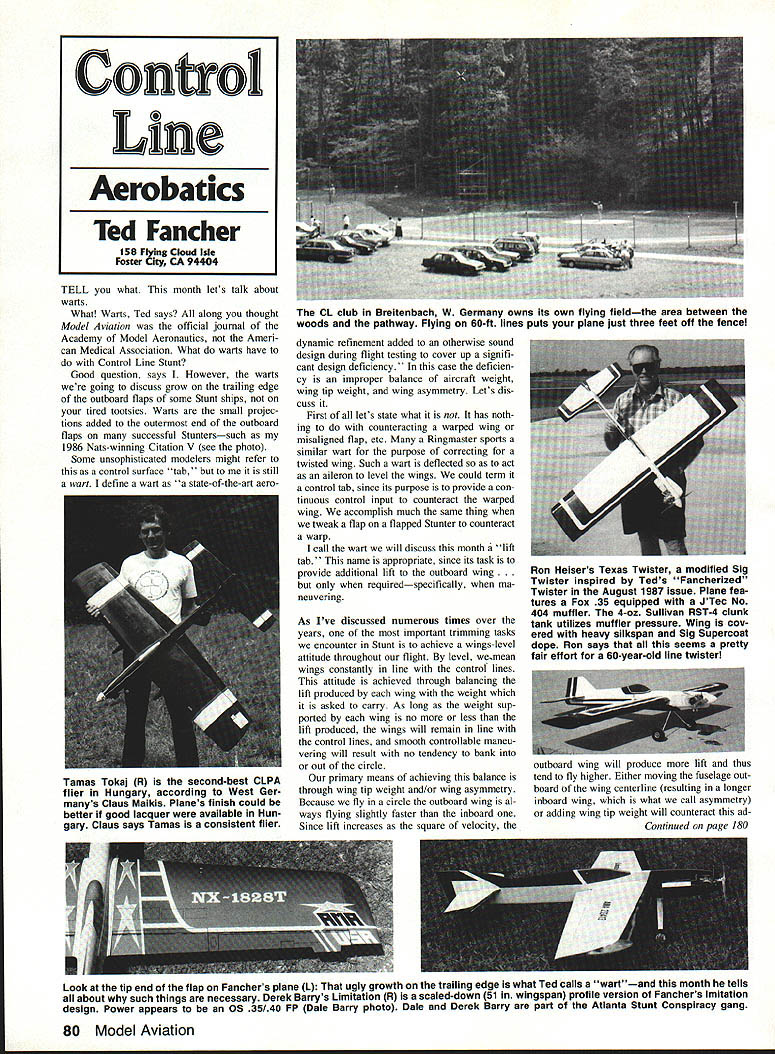
Good question. However, the warts we're going to discuss grow on the trailing edge of the outboard flaps of some Stunt ships, not on your tootsies. Warts are the small projections added to the outermost end of the outboard flaps on many successful Stunters — such as my 1986 Nats-winning Citation V (see the photo).
Some unsophisticated modelers might refer to this as a control surface "tab," but to me it is still a wart. I define a wart as "a state-of-the-art aerodynamic refinement added to an otherwise sound design during flight testing to cover up a significant design deficiency." In this case the deficiency is an improper balance of aircraft weight, wing tip weight, and wing asymmetry. Let's discuss it.
What a wart is not
First of all, let's state what it is not. It has nothing to do with counteracting a warped wing or misaligned flap, etc. Many a Ringmaster sports a similar wart for the purpose of correcting a twisted wing. Such a wart is deflected so as to act as an aileron to level the wings. We could term it a control tab, since its purpose is to provide a continuous control input to counteract the warped wing. We accomplish much the same thing when we tweak a flap on a flapped Stunter to counteract a warp.
I call the wart we will discuss this month a "lift tab." This name is more appropriate, since its task is to provide additional lift to the outboard wing — but only when required — specifically, when maneuvering.
Wings-level trimming and causes of imbalance
As I've discussed numerous times over the years, one of the most important trimming tasks we encounter in Stunt is to achieve a wings-level attitude throughout our flight. By level, we mean wings constantly in line with the control lines. This attitude is achieved through balancing the lift produced by each wing with the weight which it is asked to carry. As long as the weight supported by each wing is no more or less than the lift produced, the wings will remain in line with the control lines, and smooth controllable maneuvering will result with no tendency to bank into or out of the circle.
Our primary means of achieving this balance is through wing tip weight and/or wing asymmetry. Because we fly in a circle the outboard wing is always flying slightly faster than the inboard wing. Since lift increases as the square of velocity, the outboard wing will produce more lift and thus tend to fly higher. Either moving the fuselage toward the outboard wing centerline, resulting in a longer inboard wing (what I call asymmetry), or adding wing tip weight will counteract the additional lift caused by the increased speed.
Early Stunters' common cure was a considerable amount of wing asymmetry. The DeBolt-designed All American, Sr., for instance, had an inboard wing nearly three inches longer than the outboard one and utilized no tip weight. The Ares, Chief, Nobler, and others of the vintage era had inboard wings roughly two inches longer and had anywhere from zero to one ounce or so of wing tip weight. The lighter the overall weight, the less tip weight would be called for. All of these ships had wingspans of roughly 50 in. and were very competitive in their time.
Modern Stunters are much larger in span, averaging 60 in. or so, and often have little or no asymmetry. Equal-span wings are common, and many designers advocate them for reasons not germane to our current discussion. A common denominator in all of these equal- (or nearly so) span ships is the need for significant amounts of tip weight. Three, four, or even more ounces are often necessary to counteract the additional lift of the faster-flying, equal-sized outboard wing.
So far, the problem and its solution seem simple: if the outboard wing is too large and flies high because of its excess lift, you simply load it down with tip weight until it "don't do that no mo'." Problem solved, yes? Well . . . not exactly.
The problem with tip weight under maneuvering loads
Unfortunately, that three-ounce (or whatever) tip weight weighs three ounces only in level flight. Any time you maneuver the ship you will feel very significant acceleration ("G") loads, and that three-ounce mass is proportionately multiplied. Because wing tip weight is a concentrated mass of high-density material located a fair lateral distance from the model's CG, its effect is greater than the mass of the inboard wing which it statically balances in one-G level flight. In a 15-G hard corner it becomes 45 oz.—and that's the good news! The bad news (with apologies to Paul Walker) is that since the 45 oz. is generated 30 in. or so outboard of the center of gravity, it creates a rolling moment about the CG.
The result is a tendency to bank away from the pilot during maneuvers. We Stunters call this tendency "hinging." Hinging is most obvious during hard corners such as the right of the Triangle where the outboard wing might drop or tip so far as to be visible to the pilot. While it's not a major error, an expert pilot should recognize this as an undesirable trimming condition which might adversely affect his score. He should be able to properly evaluate and correct it.
Diagnosing hinging
To correctly diagnose hinging it is important to observe three distinct symptoms:
- First, in level flight—both upright and inverted—the wings should be absolutely level. If the outboard wing is up with the plane in one attitude and down when it's in the opposite attitude, you have a warp which must be corrected. If it's up both ways—or down both ways—tip weight should be added or subtracted as appropriate. This step assures that the static balance of tip weight is correct for level flight.
- Second, as accurately as possible ascertain that the lead-outs are correctly placed. Improperly located lead-outs, especially if too far aft, can also induce hinging. A good ballpark criterion is to observe that the outboard wheel is visible just slightly aft of the inboard one in calm air (assuming that the landing gear is accurately aligned to start with). If, on any ordinary 35- to 50-powered ship, the midpoint of the lead-outs falls within 1 1/4 to 1 1/2 in. aft of the CG when the plane is on the ground, you can consider it adequate for this purpose.
- Third—and most important—you must consistently observe that the bottom of the outboard wing is visible in inside maneuvers and the top of the outboard wing is visible in outside maneuvers. Perhaps the most obvious place to observe this is at the intersection of the down lines and the landing-gear strut. Also watch transitions of the round eights when changing from inside to outside loops. If the ship is hinging, you will clearly see the roll as first the top and then the bottom of the wing becomes visible in the transition.
If your observations satisfy all three criteria, you are most likely in need of a lift tab or wart.
How a wart (lift tab) works
Because that three-ounce weight which was balanced in level flight weighs proportionately more in a maneuver, it is necessary to develop proportionately more lift to support it. Unfortunately, a basic, unadorned outboard wing will increase lift at exactly the same rate as the inboard one and will not, by itself, be able to overcome the increased load caused by the accelerated tip weight. The wart is an addition to the outboard flap which is sized by trial and error to increase lift so as to balance as closely as possible the increased force caused by maneuvering acceleration acting on the tip weight.
Because at low angles of flap deflection the flap—and therefore the wart—has a negligible effect, the wart does nothing to disrupt the level-flight balance of the wings. When maneuvering, however, the displacement of the flap/wart increases proportionately with the control inputs, and the more the controls are displaced, the more effective becomes the wart, thus offsetting the rolling tendency caused by the tip weight.
I should mention that the wart is a flight-trim accessory and is not ordinarily a part of the plane's design criteria. It should be noted, however, that most modern designers throw in a few tricks which accomplish much the same thing. It is quite common for designers to advocate equal-span flaps regardless of wing asymmetry. Many also suggest a wider chord for the outboard flap—which of course accomplishes much the same effect as a wart.
You may be amused to learn that yours truly—after adding warts to several ships in succession, including the 1982 Nats-winning Intimidator—designed and built the Citation V with a wart; trimmed it off prior to its 1986 Nats victory; and then added one back on prior to the 1987 and '88 campaigns. Flying may be a precise science, but trimming sucks!
How big should the wart be?
The obvious question is, of course, how big should the wart be?
The answer is: you find out by trial and error. The best solution is to temporarily add an adjustable tab of balsa or cardboard which is taped to the outboard flap as far out as possible to gain the maximum effect for the least area. I've found that making it about 3/4 x 3 in. is a good place to start. Careful observation of flight tests will then allow precise refinement of its size until you are turning good flat corners as hard as you wish.
Final thoughts on asymmetry
One last point which I'm hesitant to speak about is this: If the All American, Ares, USA-1, etc. (champions all) utilized wing asymmetry to eliminate the need for any tip weight, why are all of us modern designers trying to ignore the obvious wisdom of that approach? Is it merely because inbound wings which are readily seen as being longer aren't aesthetically pleasing?
There isn't a one of us who hasn't repeatedly increased the addition of what I sometimes refer to as "cosmetic" devices. Do we merely give lip service to the search for optimum performance while eschewing the gains to be had by elimination of this unnecessary burden? Could I have avoided this entire discussion of warts by merely throwing away the last outboard rib from every ship I've built since 1957? Suck it to me, Large James.
Transcribed from original scans by AI. Minor OCR errors may remain.

