
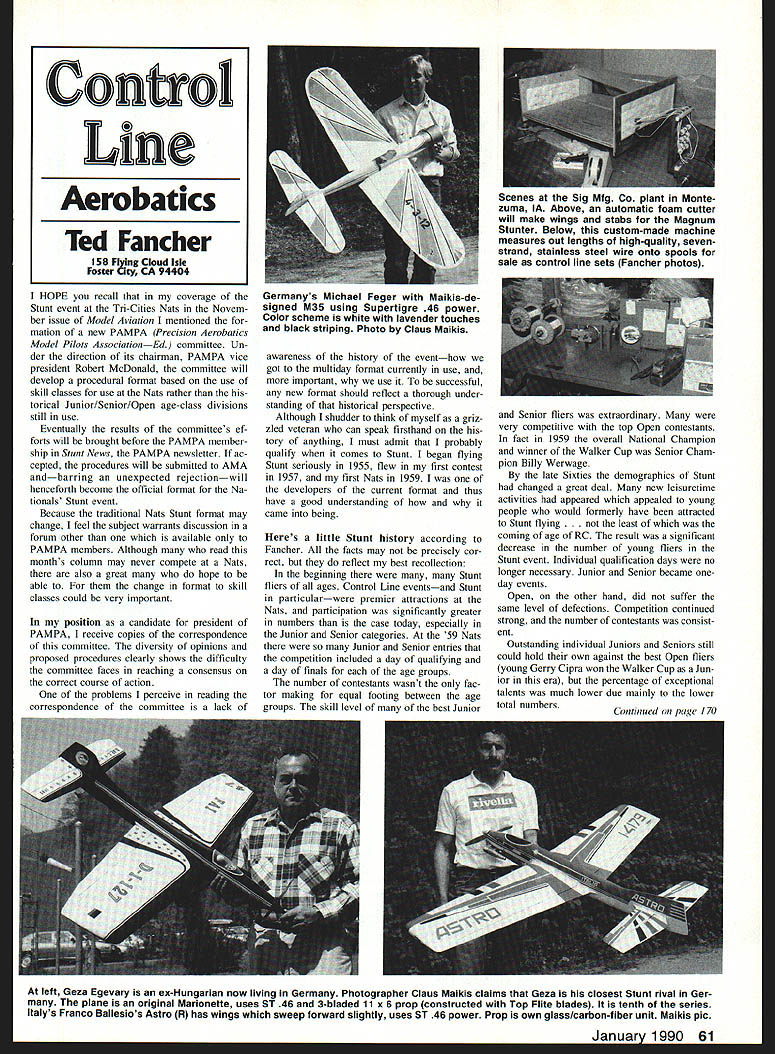
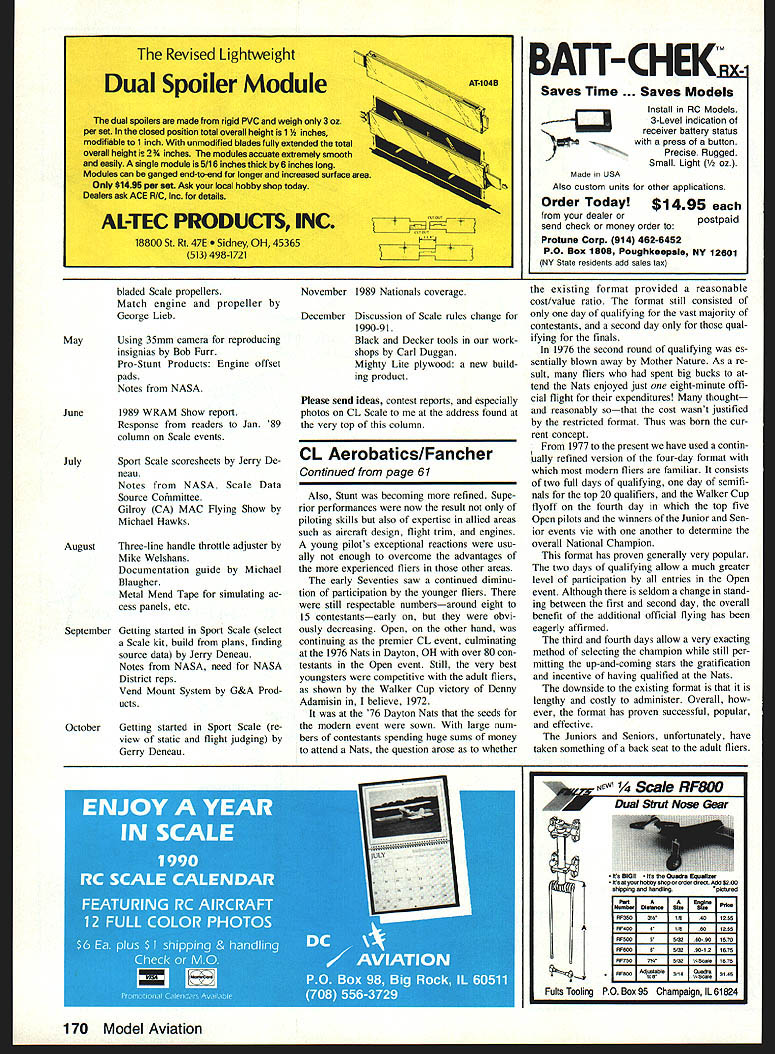
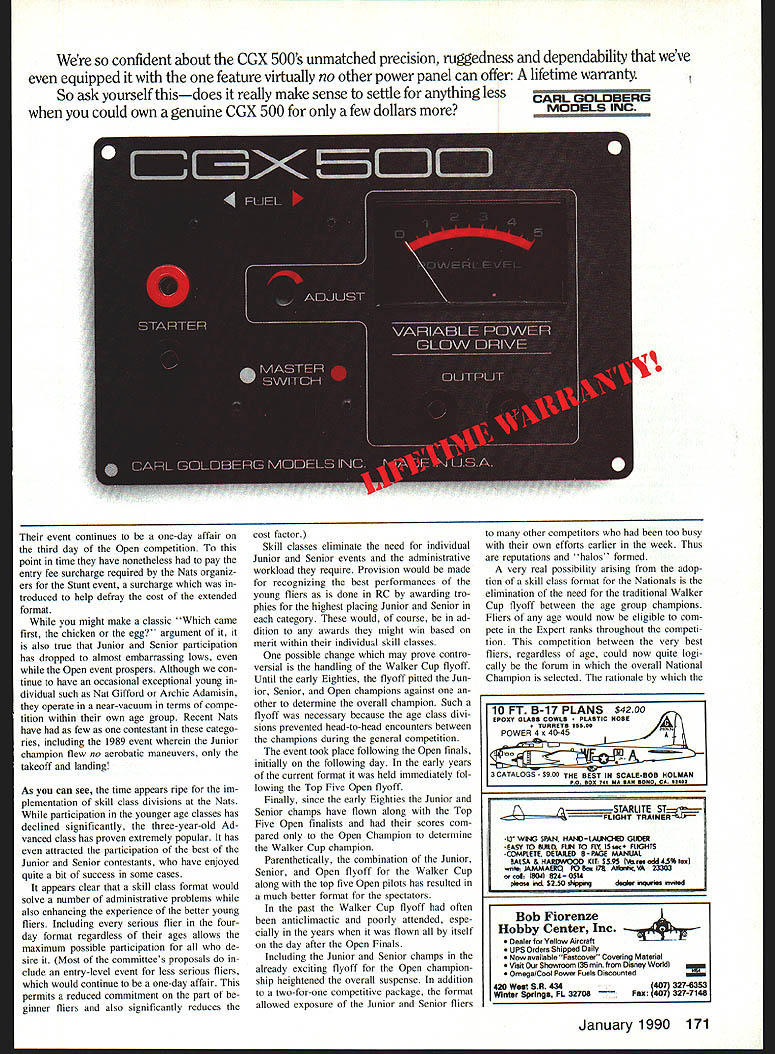
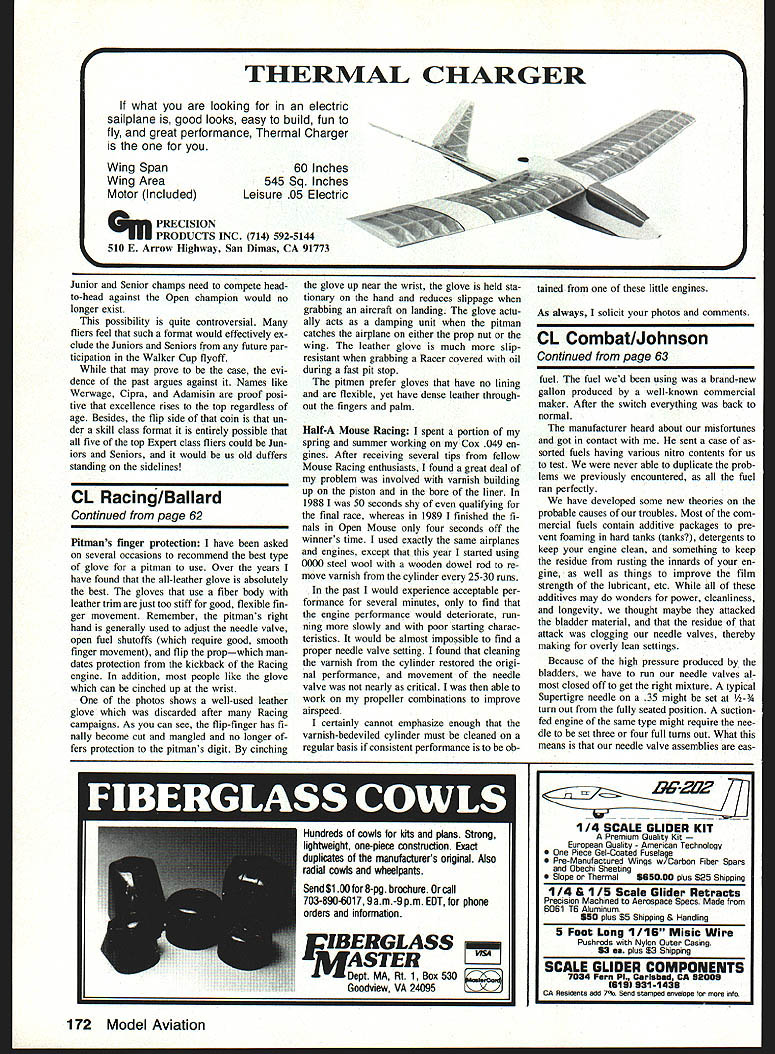
Control Line: Aerobatics
Ted Fancher 158 Flying Cloud Isle Foster City, CA 94404
I hope you recall that in my coverage of the Stunt event at the Tri-Cities Nats in the November issue of Model Aviation I mentioned the formation of a new PAMPA (Precision Aerobatics Model Pilots Association — Ed.) committee. Under the direction of its chairman, PAMPA vice president Robert McDonald, the committee will develop a procedural format based on the use of skill classes for use at the Nats rather than the historical Junior/Senior/Open age-class divisions still in use.
Eventually the results of the committee's efforts will be brought before the PAMPA membership in Stunt News, the PAMPA newsletter. If accepted, the procedures will be submitted to AMA and—barring an unexpected rejection—will henceforth become the official format for the Nationals' Stunt event.
Because the traditional Nats Stunt format may change, I feel the subject warrants discussion in a forum other than that which is available only to PAMPA members. Although many who read this month's column may never compete at a Nats, there are also a great many who do hope to be able to. For them the change in format to skill classes could be very important.
In my position as a candidate for president of PAMPA, I receive copies of the correspondence of this committee. The diversity of opinions and proposed procedures clearly shows the difficulty the committee faces in reaching a consensus on the correct course of action.
One of the problems I perceive in reading the correspondence of the committee is a lack of awareness of the history of the event—how we got to the multiday format currently in use, and, more important, why we use it. To be successful, any new format should reflect a thorough understanding of that historical perspective.
Although I shudder to think of myself as a grizzled veteran who can speak firsthand on the history of anything, I must admit that I probably qualify when it comes to Stunt. I began flying Stunt seriously in 1955, flew in my first contest in 1957, and my first Nats in 1959. I was one of the developers of the current format and thus have a good understanding of how it came into being.
Early history
In the beginning there were many, many Stunt fliers of all ages. Control Line events—and Stunt in particular—were premier attractions at the Nats, and participation was significantly greater in numbers than is the case today, especially in the Junior and Senior categories. At the 1959 Nats there were so many Junior and Senior entries that the competition included a day of qualifying and a day of finals for each of the age groups.
The number of contestants wasn't the only factor making for equal footing between the age groups. The skill level of many of the best Junior and Senior fliers was extraordinary. Very competitive top Open contestants—in fact, in 1959 the overall National Champion and winner of the Walker Cup was Senior Champion Billy Werwage.
Late 1960s — changes in demographics
By the late Sixties the demographics of Stunt had changed a great deal. Many new leisure-time activities had appeared which appealed to young people who would formerly have been attracted to Stunt flying as they were coming of age. RC, as a result, significantly decreased the number of young fliers in the Stunt event. Individual qualification days were no longer necessary. Junior and Senior became one-day events. Open, on the other hand, did not suffer the same level of defections. Competition continued strong, and the number of contestants was consistent.
Outstanding individual Juniors and Seniors still could hold their own against the best Open fliers (young Gerry Cipra won the Walker Cup as a Junior in this era), but the percentage of exceptional talents was much lower due mainly to the lower total numbers. Also, Stunt was becoming more refined. Superior performances were now the result not only of piloting skills but also of expertise in allied areas such as aircraft design, flight trim, and engines. A young pilot's exceptional reactions were usually not enough to overcome the advantages of more experienced fliers in those other areas.
Early 1970s and the build-up to 1976
The early Seventies saw a continued diminution of participation by the younger fliers. There were still respectable numbers—around eight to 15 contestants—early on, but they were obviously decreasing. Open, on the other hand, was continuing as the premier CL event, culminating at the 1976 Nats in Dayton, OH, with over 80 contestants in the Open event. Still, the very best youngsters were competitive with the adult fliers, as shown by the Walker Cup victory of Denny Adams, I believe, in 1972.
It was at the 1976 Dayton Nats that the seeds for the modern event were sown. With large numbers of contestants spending huge sums of money to attend a Nats, the question arose as to whether the existing format provided a reasonable cost/value ratio. The format still consisted of only one day of qualifying for the vast majority of contestants, and a second day only for those qualifying for the final.
In 1976 the second round of qualifying was essentially blown away by Mother Nature. As a result, many fliers who had spent big bucks to attend the Nats enjoyed just one eight-minute official flight for their expenditures. Many thought—and reasonably so—that the cost wasn't justified by the restricted format. Thus was born the current format.
The four-day format (1977–present)
From 1977 to the present we have used a continually refined version of the four-day format with which most modern fliers are familiar. It consists of:
- Two full days of qualifying,
- One day of semifinals for the top 20 qualifiers,
- The Walker Cup flyoff on the fourth day in which the top five Open pilots and the winners of the Junior and Senior events vie with one another to determine the overall National Champion.
This format has proven generally very popular. The two days of qualifying allow a much greater level of participation by all entries in the Open event. Although there is seldom a change in standing between the first and second day, the overall benefit of the additional official flying has been generally affirmed.
The third and fourth days allow a very exciting method of selecting the champion while still permitting the up-and-coming stars the gratification and incentive of having qualified at the Nats. The downside to the existing format is that it is lengthy and costly to administer. Overall, however, the format has proven successful, popular, and effective.
Impact on Juniors and Seniors
The Juniors and Seniors, unfortunately, have taken something of a back seat to the adult fliers. Their event continues to be a one-day affair on the third day of the Open competition. To this point they have nonetheless had to pay the entry-fee surcharge required by the Nats organizers for the Stunt event, a surcharge which was introduced to help defray the cost of the extended format.
Junior and Senior participation has dropped to almost embarrassing lows, even while the Open event prospers. Although we continue to have an occasional exceptional young individual such as Nat Gifford or Archie Adamisin, they operate in a near-vacuum in terms of competition within their own age group. Recent Nats have had as few as one contestant in these categories, including the 1989 event wherein the Junior champion flew no aerobatic maneuvers, only the takeoff and landing.
The case for skill classes
As you can see, the time appears ripe for the implementation of skill-class divisions at the Nats. While participation in the younger age classes has declined significantly, the three-year-old Advanced class has proven extremely popular. It has even attracted the participation of the best of the Junior and Senior contestants, who have enjoyed quite a bit of success in some cases.
It appears clear that a skill-class format would also enhance the spectator appeal of the Nats by allowing better pilots to fly and thereby, in the four-day format regardless of their ages, allowing the maximum possible participation for all who desire to enter. Most of the committee's proposals do include an entry-level event for less serious fliers, which would continue to be a one-day affair. This permits a reduced commitment on the part of the beginner fliers and also significantly reduces the cost factor.
Skill classes eliminate the need for individual Junior and Senior events and the administrative workload they require. Provision would be made for recognizing the best performances of the young fliers as is done in R/C by awarding trophies for the highest placing Junior and Senior in each category. These would, of course, be in addition to any awards they might win based on merit within their individual skill classes.
Walker Cup flyoff — history and controversy
One possible change which may prove controversial is the handling of the Walker Cup flyoff. Until the early Eighties, the flyoff pitted the Junior, Senior, and Open champions against one another to determine the overall champion. Such a flyoff was necessary because the age-class divisions prevented head-to-head encounters between the champions during the general contest.
The event took place following the Open finals, initially on the following day. In the early years of the current format it was held immediately following the Top Five Open flyoff. Finally, since the early Eighties the Junior and Senior champs have flown along with the Top Five Open finalists and had their scores compared only to the Open champion to determine the Walker Cup champion.
Parenthetically, the combination of the Junior, Senior, and Open flyoff for the Walker Cup along with the five Open pilots has resulted in a much better format for the spectators. In the past the Walker Cup flyoff had often been anticlimactic and poorly attended, especially in the years when it was flown all by itself on the day after the Open Finals. Including the Junior and Senior champs in the already exciting flyoff for the Open championship heightened the overall suspense. In addition to a two-for-one competitive package, the format allowed exposure of the Junior and Senior fliers to many other competitors who had been too busy with their own efforts earlier in the week. Thus are reputations and "halos" formed.
A very real possibility arising from the adoption of a skill-class format for the Nationals is the elimination of the present format for the traditional Walker Cup flyoff between the age-group champions. Fliers of any age would now be eligible to compete in the Expert ranks throughout the competition. This competition between the very best fliers, regardless of age, could now quite logically be the forum in which the overall National Champion is selected.
The rationale by which the Expert class champion would be recognized as the National Champion is that the Expert event would, by definition, contain the very best competitors, and the winner of that class would be the rightful overall champion. The need for Junior and Senior champs to compete head-to-head against the Open champion would no longer exist.
This possibility is quite controversial. Many fliers feel that such a format would effectively exclude the Juniors and Seniors from any future participation in the Walker Cup flyoff. While that may prove to be the case, the evidence of the past argues against it. Names like Werwage, Cipra, and Adams are proof positive that excellence rises to the top regardless of age. Besides, the flip side of that coin is that once a skill-class format is in effect it is entirely possible that all five of the top Expert-class fliers could be Juniors and Seniors, and it would be us old duffers standing on the sidelines!
Closing
The committee faces a difficult task in reaching consensus, and any new format should be guided by an understanding of how Stunt evolved to its present form. Skill classes offer the potential to increase participation, reduce administrative burden, enhance spectator appeal, and still recognize outstanding young fliers. The debate will no doubt continue in PAMPA and Stunt News, and ultimately the membership and AMA will decide whether to adopt a new direction for the Nationals.
Transcribed from original scans by AI. Minor OCR errors may remain.

