
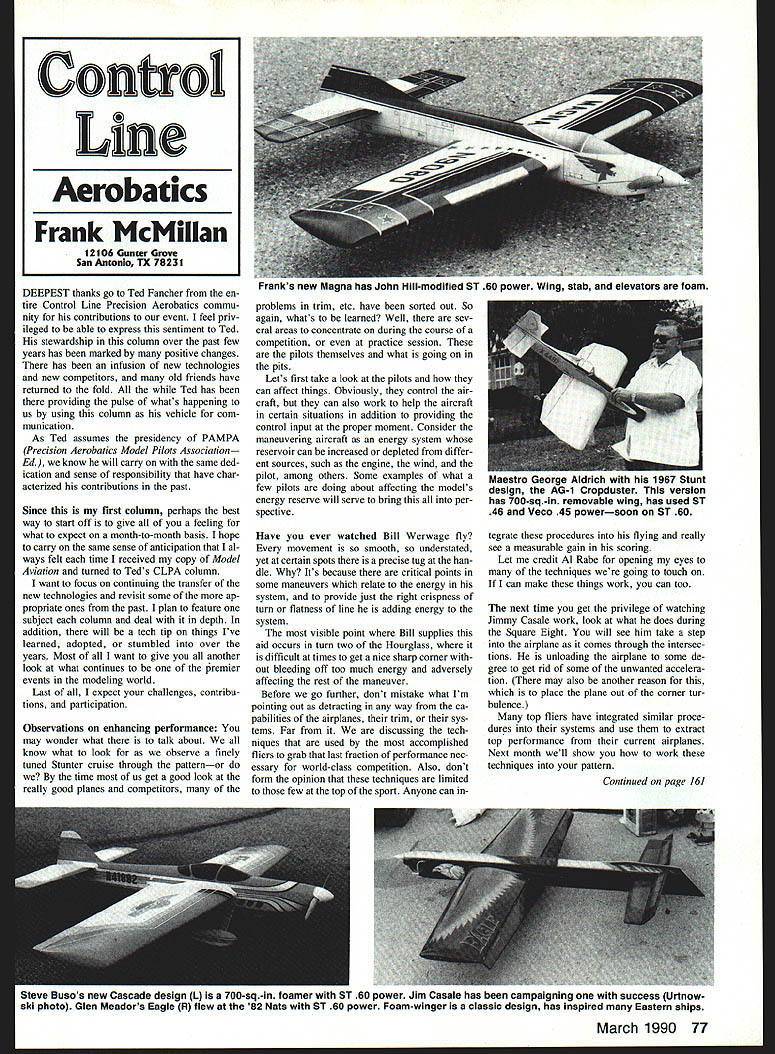
Control Line: Aerobatics
Frank McMillan
12106 Gunter Grove San Antonio, TX 78231
Deepest thanks go to Ted Fancher and the entire Control Line Precision Aerobatics community for their contributions to our event. I feel privileged to be able to express this sentiment to Ted. His stewardship in this column over the past few years has been marked by many positive changes. There has been an infusion of new technologies and new competitors, and many old friends have returned to the fold. All the while Ted has been there providing the pulse of what's happening to us by using this column as his vehicle for communication.
As Ted assumes the presidency of PAMPA (Precision Aerobatics Model Pilots Association—Ed.), we know he will carry on with the same dedication and sense of responsibility that have characterized his contributions in the past.
Since this is my first column, perhaps the best way to start off is to give all of you a feeling for what to expect on a month-to-month basis. I hope to carry on the same sense of anticipation that I always felt each time I received my copy of Model Aviation and turned to Ted's CLPA column.
I want to focus on transferring new technologies and revisiting some of the more appropriate ones from the past. I plan to feature one subject each column and deal with it in depth. In addition, there will be a tech tip on things I've learned, adopted, or stumbled over the years. Most of all I want to give you all another look at what continues to be one of the premier events in the modeling world.
Last of all, I expect your challenges, contributions, and participation.
Observations on enhancing performance
You may wonder what there is to talk about. We all know what to look for as we observe a finely tuned Stunter cruise through the pattern—or do we? By the time most of us get a good look at the really good planes and competitors, many of the problems in trim, etc., have been sorted out. So again, what's to be learned? There are several areas to concentrate on during the course of a competition, or even at a practice session. These include the pilots themselves and what is going on in the pits.
Let's first take a look at the pilots and how they can affect things. Obviously, they control the aircraft, but they can also work to help the aircraft in certain situations in addition to providing the control input at the proper moment. Consider the maneuvering aircraft as an energy system whose reservoir can be increased or depleted from different sources, such as the engine, the wind, and the pilot, among others. Some examples of what a few pilots are doing to affect the model's energy reserve will bring this into perspective.
Have you ever watched Bill Werwage fly? Every movement is so smooth, so understated, yet at certain spots there is a precise tug at the handle. Why? It's because there are critical points in some maneuvers which relate to the energy in his system, and to provide just the right crispness of turn or flatness of line he is adding energy to the system.
The most visible point where Bill supplies this aid occurs in turn two of the Hourglass, where it is difficult at times to get a nice sharp corner without bleeding off too much energy and adversely affecting the rest of the maneuver.
Before we go further, don't mistake what I'm pointing out as detracting in any way from the capabilities of the airplanes, their trim, or their systems. Far from it. We are discussing the techniques that are used by the most accomplished fliers to grab that last fraction of performance necessary for world-class competition. Also, don't form the opinion that these techniques are limited to those few at the top of the sport. Anyone can integrate these procedures into his flying and really see measurable gain in his scoring.
Let me credit Al Rabe for opening my eyes to techniques I am going to touch on and to show that they can work for you, too.
The next time you get the privilege of watching Jimmy Casale work, look at what he does during the Square Eight. You will see him take a step into the airplane as it comes through the intersections. He is unloading the airplane to some degree to get rid of some of the unwanted acceleration. (There may also be another reason for this, which is to place the plane out of the corner turbulence.)
Many top fliers have integrated similar procedures into their systems and use them to extract top performance from their current airplanes. Next month we'll show you how to work these techniques into your pattern.
CL Aerobatics / McMillan
Tips — tuning a small woodworking plane
Have you ever wondered why your small wood plane never produced those transparent balsa shavings the way "everyone" said it should? You're not alone. But there is hope to make these super tools perform properly. Like many tools, they must be tuned to extract their full potential.
There are really only two areas to address:
- Blade alignment
- Surface flatness
To flatten the sole of the plane: place some 400-grit wet-or-dry sandpaper on a flat piece of glass and carefully dress the plane in a figure-of-eight pattern. You will quickly see how true the surface is. Continue the process until the sole is flat.
Now look at the blade. You want the edge parallel to the surface of the sole, so examine how the blade sits on the sole and where the edge is in relation to the flat of the sole. You will probably find that adjustments are necessary, but some careful work with small files is all that's required.
Thirty minutes, at most, is a small investment to gain the return of many hours of real pleasure using one of these small planes. Try it. You will be amazed!
Using composites and adhesives
Model Products (1337 Pine Sap Ct., Orlando, FL 32825) would like to show you the way to high performance through the use of composites. Jim Bradley sends a nice little newsletter/information sheet with items like this, and Curt Stevens at MRL sends out a small book. Send either of them (or both) a stamped, self-addressed envelope (SASE), and you'll receive some good information on products that may put you in the winner's circle.
MRL had a section on some adhesive tests they'd done in bonding cured carbon fiber to wood. All adhesives were rated on a scale of 1 to 10, with 10 being best:
- Plast-i-Stic (made by PIC): 10.0
- Plex (made by Pacer Technologies): 7.8
- Some 24-hour epoxy: 2.9
- Low-viscosity epoxy: 1.0
- Model cement: 1.0
Most other manufacturers will soon have products similar to Plast-i-Stic, but remember when using any of them to clean grease and fingerprints off the carbon with acetone or a similar solvent before applying the adhesive. Carbon doesn't do much good if it doesn't stick to what you want to strengthen.
MRL also had a strength-to-weight chart of building materials (approximate ratings):
- Balsa, spruce, fiberglass: ~4.0
- Kevlar: 3.82
- Carbon: 3.95
- Carbon fiber pultrusion: 4.85
- Boron: 5.85
Boron isn't suggested for use unless you're very sophisticated in using these types of materials. The fibers are dangerous and just not what you want laying around your shop.
Keep in mind that the above ratings are based on weight and strength. Spruce is about three times as strong as balsa, but it's also about three times as heavy. You won't be making 80-layer laminates out of boron.
Transcribed from original scans by AI. Minor OCR errors may remain.

