
Control Line: Aerobatics
Frank McMillan
12106 Gunter Grove, San Antonio, TX 78231
Introduction
Excited by the prospect of some new gadget, engine, or prop? If you're like me, you are easily stirred by the prospect of some new product to use in our flying or building. Over the last few years we've been very lucky in our favorite CL event to have many dedicated people develop and market items that help us enjoy the sport. From time to time I'll devote space in this column to new products.
New products and kits
I received a letter from Tom Dixon, who has amassed an extensive line of engines, Bolly props, and plans. In addition to working with the new owner of Merco Engines on some new Stunt power plants, Tom is developing a line of Nostalgia kits. First in the line is the Black Tiger, a Bob Elliott design that won the 1953 Nats. Several kits are under construction, so we'll revisit this for a review after I see them fly.
Other kits in the works are the '52 Nobler, prototype Skylark, a second Thunderbird, and possibly a Ruffy. I'm sure the production kits will meet Tom's high standards. Contact Tom at 1938 Peachtree, Suite 401, Atlanta, GA 30309 for price and availability.
Stooge (mechanical launcher)
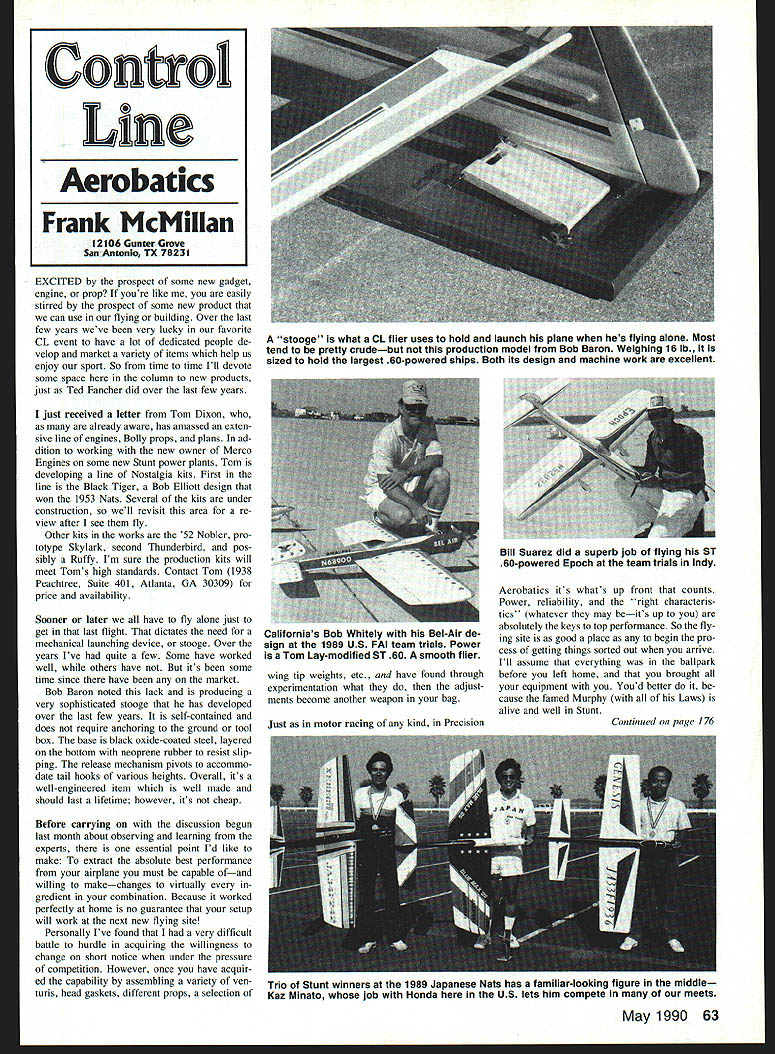
Sooner or later we all have to fly alone and need a mechanical launching device, or stooge. Over the years I've had quite a few; some worked well, others not so much. Bob Barron noted the lack of reasonably priced production models and has developed a very sophisticated stooge over the last few years. Key features:
- Self-contained; does not require anchoring to the ground or toolbox.
- Base is black-oxide-coated steel with a neoprene rubber layer to resist slipping.
- Release mechanism pivots to accommodate tail hooks of various heights.
- Well-engineered and well made; should last a lifetime, but it is not cheap.
Willingness to change (critical point)
To extract the absolute best performance from your airplane you must be capable of—and willing to make—changes to virtually every ingredient in your combination. Because it worked perfectly at home is no guarantee your setup will work at the next flying site.
Personally, I had a difficult battle acquiring the willingness to change on short notice under competition pressure. Once you assemble a variety of venturis, head gaskets, different props, wing tip weights, etc., and find through experimentation what they do, adjustments become another weapon in your bag. The flying site is as good a place as any to fine-tune things when you arrive. Assume everything was in the ballpark before you left home; you better do it, because Murphy's Laws are alive and well in Stunt.
Observing and learning from the experts (continued)
Watch some of the good fliers put up their first practice flights right after they arrive at a contest. You can learn a lot; here are a few common problems and checks:
- Loops and engine sound
- If the weather is a little cool (say under 80°F), the engine may sound like it's about to lose fire, flood, and quit on the inside, or have trouble running smoothly through the pylon. Often the remedy is to lean the needle a little.
- Check for fuel flow restrictions and dirt in the fuel system.
- If the engine appears too lean on the outside, try a slightly richer setting.
- Loop shape
- If loops are not round, check incidence and thrust line and make sure wing tips are not warped or cupped.
- Small changes in tip weight and down-elevator trim can make a big improvement in loop shape. Make small adjustments and note their effects.
- Approach and landing
- Some fliers trim for precision and then forget to practice the landing pattern; this can cost points. Practice a consistent pattern and power setting for landing.
Please send comments, contest activity reports, and especially photos on CL Aerobatics activity to me at the address at the top of this column.
Diagnosing and treating performance problems
If a flier notices unwanted acceleration in some maneuvers or other symptoms, here's a common sequence of corrective actions observed at contests:
- Hot glow plug/decompression
- If running on a very hot glow plug (such as a Glo-Devil 300), a flier may remove the head and add a thicker gasket or shim to lower the compression ratio.
- Start with an .008-in. shim and expect you may add another .004 in. The goal is to suppress the symptom; decompressing also takes a slight edge off overall power. One or two flights will help settle things out.
- Loss of power at altitude or in cool air
- Symptoms: loss of crispness in the corners of square maneuvers, loss of line tension when flying above 45° elevation and in the outer limits of Square Eights.
- Remedies (systematic approach):
- Try the next largest venturi size. Many use a .295-in. bore; try a .302-in. first, then possibly a .308-in. if needed.
- Change fuel nitro content. Move from 5% to 10%, or higher only if you have experience with it.
- "Gear" the engine: use a thinner version of your baseline prop, reduce diameter, or lower pitch to get the engine higher on its torque curve.
This survey covers some of the most effective adjustments. If you can make these work, you'll handle most situations. The sequence above actually happened at the Nats. Next month we'll get into trimming the plane for existing conditions.
Tips: controlling finish weight
Controlling the weight of our future Nats winners is a never-ending struggle. One area where weight gets away from us is the color coats in the finish. Many top fliers use unusual methods to keep weight down and still get uniform color:
- Jimmy Casale and Paul Walker use Aeroglaze in spray cans for light weight and excellent coverage.
- Bob Barron favors mixed media: epoxy on the fuselage and MonoKote on the wings.
Another simple trick consistent with normal dope finishing is to increase pigment (toner) in the dope to improve hiding power so fewer coats are required. Suggested procedure:
- Use an acrylic lacquer toner in the appropriate color.
- Start with a little less than one ounce of toner per pint of thinned, ready-to-spray dope and adjust from there.
- You may need to increase the amount slightly, but don't add more than an additional one-half ounce.
- Shoot a test panel to check coverage. When in the ballpark, two passes with the spray gun will give a nice, solid color.
- Be careful: too much toner can create adhesion problems.
Once you find the right proportions they will be consistent for any color.
Closing
As always, I solicit your comments, ideas, and photos to pass on to other Control Line enthusiasts who read this column.
Frank McMillan 12106 Gunter Grove San Antonio, TX 78231
Transcribed from original scans by AI. Minor OCR errors may remain.

