
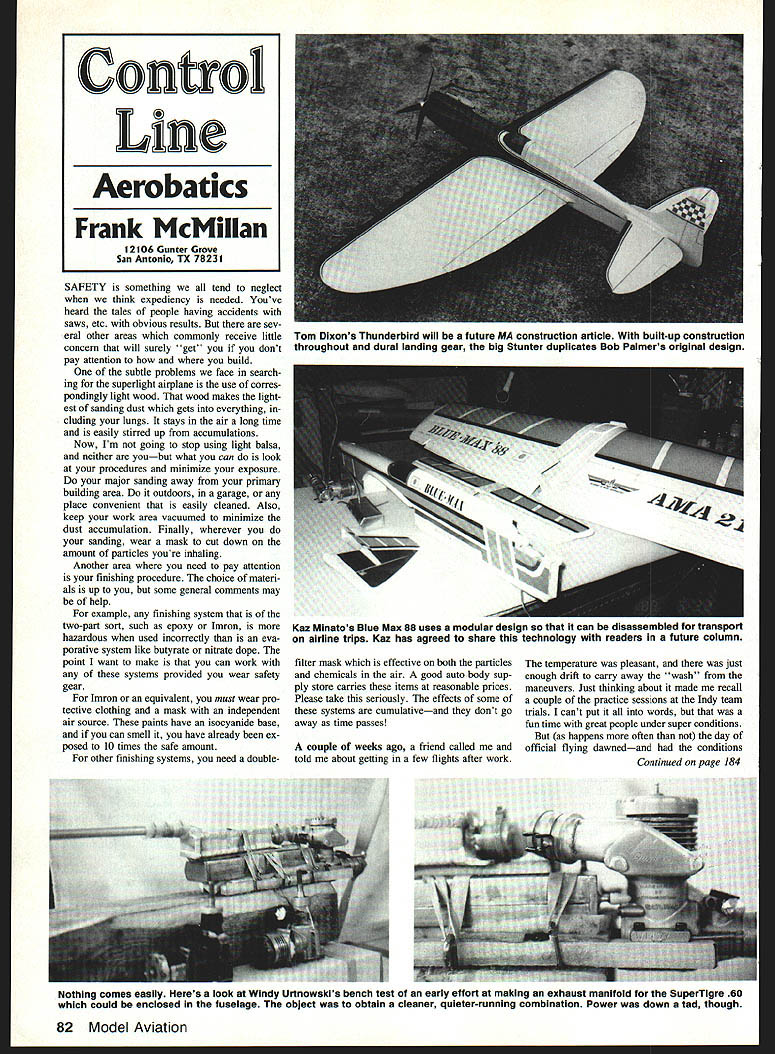
Control Line: Aerobatics
Frank McMillan 12106 Gunter Grove San Antonio, TX 78231
Safety
SAFETY is something we all tend to neglect when we think expediency is needed. You've heard the tales of people having accidents with saws, etc., with obvious results. But there are several other areas which commonly receive little concern that will surely "get" you if you don't pay attention to how and where you build.
One of the subtle problems we face in searching for the superlight airplane is the use of correspondingly light wood. That wood makes the lightest sanding dust which gets into everything, including your lungs. It stays in the air a long time and is easily stirred up from accumulations.
I'm not going to stop using light balsa, and neither are you — but you can look at your procedures and minimize your exposure:
- Do your major sanding away from your primary building area: outdoors, in a garage, or any place convenient that is easily cleaned.
- Keep your work area vacuumed to minimize dust accumulation.
- Wherever you do your sanding, wear a mask to cut down on the amount of particles you're inhaling.
Another area where you need to pay attention is your finishing procedure. The choice of materials is up to you, but some general comments may be of help.
- Two-part finishing systems (epoxy, Imron, etc.) are more hazardous when used incorrectly than evaporative systems (butyrate or nitrate dope).
- You can work with any of these systems provided you wear proper safety gear. For Imron or equivalents you must wear protective clothing and a mask with an independent air source. These paints have an isocyanate base; if you can smell it, you have already been exposed to about 10 times the safe amount.
- For other finishing systems, use a double-filter mask effective on both particles and chemicals. A good auto body supply store carries these items at reasonable prices. Take these precautions seriously — the effects of some finishes are cumulative.
Weather and contest preparation
A friend called me recently about getting in a few flights after work. The temperature was pleasant, and there was just enough drift to carry away the "wash" from the maneuvers. It reminded me of practice sessions at the Indy team trials — fun times with great people under super conditions.
But (as happens more often than not) the day of official flying dawned — and everything had changed. The temperature had dropped, and the wind was up and lively. Now what do you do, since you've got everything dialed in for good conditions?
The answer is that you need a series of tried-and-proven options, tested under similar conditions, which you can be confident will get you into the ballpark. Obviously, this assumes that you have practiced in adverse conditions, so that you have options in hand.
Most airplanes are capable of flying quite well in rotten weather, and as long as you don't get carried away with test flying in these conditions, you can learn the effects of the variables and still be safe. Keep the bottoms of the maneuvers up and watch your positioning relative to the wind. Also vary the positioning to find out how the airplane behaves with different trim combinations. Keep notes — use a logbook so you have information that you can access quickly.
Adjusting CG and propeller
I suggest you focus your efforts on two general areas: varying the location of the center of gravity (CG), and modifying or changing the propeller.
- Changing the CG
- Start here because the effect tends to be fairly linear: removing nose weight generally increases roll rate without increasing turn.
- Begin by reducing the nose weight about a half ounce per flight and see what happens. Control pressure should decrease, and the turns should become squarer.
- Find limits so that you know the best setting and when you must replace some weight.
- Propeller changes
- When the airplane is in the ballpark, consider prop changes. Reducing diameter will give you a quicker turn.
- Thinning the blades and reducing blade area will also help. Some props respond to slight reductions in pitch at the tips.
- There isn't one universal answer. Systematically try combinations until one works best; even then, there may not be a clear choice.
As you explore prop and CG changes, note what your engine is doing. Some increase in rpm in the wind is normal. When the weather is somewhat cooler than you've been used to, the engine will need more power. If you sense something's not quite right, changes are not hard to make; do not hesitate to make adjustments in the range of .004–.008 in. just to take the edge off the power.
Contest procedures and preparation
- Practice in adverse conditions so you have options when the weather changes.
- Keep bottoms of maneuvers up and vary positioning relative to wind.
- Use a logbook to record trim, CG, prop, and engine settings so you can quickly revert to successful combinations.
- Systematically test CG and prop changes one at a time to learn effects and limits.
In future columns I intend to survey various components we use or make and present practical ways to solve problems, construction techniques, and how to avoid pitfalls.
PAMPA (Precision Aerobatic Model Pilots Association)
One point I haven't mentioned until now is the PAMPA organization. Take it from one who's been around Stunt for 38 years: we, as a community, have never had it so good. Much of that is due to PAMPA and the hard work of dedicated people such as Keith Trostle, Wynn Paul, Windy Urtnowski, Arlie Presler, Art Adamisin, and many others who gave freely of their time to build a solid foundation. It's hard to believe it's been 16 years!
Technical tip: Working with props
Working with props is a fact of life. It's great when you get the one that really works, and frustrating when you break it at the wrong time. To ease the process of trying many variations, I use the following technique for balancing and protecting prop finish:
- Use a slow-setting cyanoacrylate (CYA) glue and rub it on with a tissue.
- Do one coat, rub until it starts to set, then sand with fine paper (320 wet or dry).
- Apply another coat. If you've been balancing as you modify the prop, you'll already be close.
- Apply more glue and sand to bring the prop into balance. Three or four applications with sanding will produce a respectable, durable finish that takes very little time.
- You can even compound the prop to produce a satin-smooth shine.
Balance is primarily a matter of attention to material added or removed, but this CYA layering method speeds finishing and helps protect the prop.
Share your tips
I'm sure you all have practical tips we'd appreciate knowing about. Gather them up and let's hear from you. Although I would like them for my column, you might also send them to the PAMPA newsletter editor:
- Mike Keville
- 6109 E. Ivyglenn, Mesa, AZ 85205
- Phone: 1-602/985-3363
Transcribed from original scans by AI. Minor OCR errors may remain.

