
Control Line: Aerobatics
Frank McMillan
12106 Gunter Grove San Antonio, TX 78231
If you missed the recent (March 24–25, 1990) Tucson Old-Timer/Nostalgia meet, you missed a happening! The hot weather warmed old bones much chilled from a long winter, and many old friends created lots of new ones.
The Cholla Choppers club's home field was an absolutely beautiful site which, it can be hoped, will be the host for this event for many years to come. Most of all, the spirit of re-creating some of the golden days of Stunt was alive and well. In truth, that experience alone was worth the effort to be there.
George Aldrich served as the foundation for many of the old-timer tales, with many of the legendary pilots of recent years doing a first-rate job of flying their vintage ships. The least that can be said is that a lot of people came and flew with unusual planes, some with more success than others. But to a man, all had a great time just being part of the scene. Some special recognition and our sincere thanks go to Mike Keville and family for making all this happen. His ideas, desire, and display of selfless dedication are what it's all about.
The Old-Timer event is the first of the "past eras" movement that has been building momentum in the Stunt world over the last few years. The Precision Aerobatics Model Pilots Association (PAMPA) has the complete set of rules available, but they can be generalized by stating that Stunt aircraft designs published, kitted, or flown prior to December 1952 are eligible.
The flight pattern is from that era and comprises mostly round maneuvers and "lazy" eights. It's not difficult and can be performed easily with a respectable non-flapped design. Since non-flapped designs and those using ignition engines enjoy built-in handicaps, the competitive situation is generally evened out. (I do believe that ignition ships need more points to achieve equality—say at least 30 points versus the present 10 points.) Based on my observations, I'd say that a good non-flapped plane, well flown, will come out on top.
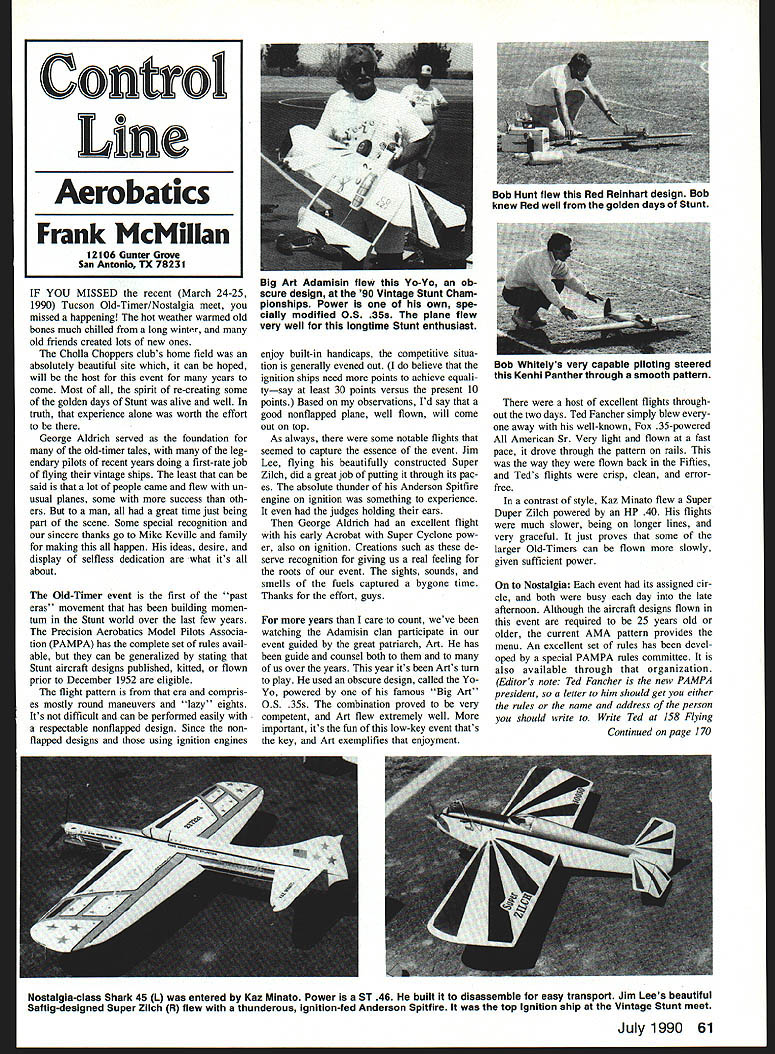
As always, there were some notable flights that seemed to capture the essence of the event. Jim Lee, flying a beautifully constructed Super Zilch, did a great job putting it through its paces; the absolute thunder of his Anderson Spitfire engine on ignition was something to experience. It even had the judges holding their ears.
Then George Aldrich had an excellent flight with his Acrobat Super Cyclone power, also on ignition. Creations such as these deserve recognition for giving us a real feeling for the roots of our event. The sights, sounds, and smells of the fuels captured a bygone time. Thanks for the effort, guys.
For more years than I care to count, we've been watching the Adamisin clan participate in our events, being guided by the great patriarch, Art. He has been guide and counsel both to them and to many of us over the years. This year it's Art's turn to play. He used an obscure design called the Yo-Yo, powered by one of his famous "Big Art" O.S. .35s. The combination proved very competent, and Art flew extremely well. More important, it's the fun of this low-key event that's the key, and Art exemplifies that enjoyment.
Ted Fancher simply blew away the field with his well-known, Fox .35-powered All American Sr. Very light and flown at a fast pace, it drove through the pattern on rails—the way they were flown back in the Fifties. Ted's flights were crisp, clean, and error-free.
In contrast of style, Kaz Minato flew a Super Duper Zilch powered by an HP .40. His flights were much slower, being on longer lines, very graceful. It just proves that some of the larger Old-Timers can be flown more slowly, given sufficient power.
Nostalgia
Each event had its assigned circle and both were busy into the late afternoon. Although the aircraft designs flown in this event are required to be 25 years old or older, the current AMA pattern provides the menu. An excellent set of rules has been developed by a special PAMPA rules committee. It is available through that organization. (Editor's note: Ted Fancher is the new PAMPA president, so a letter to him should get you either the rules or the name and address of the person you should write to. Write Ted at 158 Flying Cloud Isle, Foster City, CA 94404.)
This era marked the evolution of the true, integrated, flapped airplanes. The list of such stunters includes the Nobler, Chief, and many other variants.
For many years, the Fox .35 was the only engine, but slowly even that mood moderated with Bob Palmer using the Veco .45s, and others adopting the "new" .45-size RC engines. These years were marked more by a gradual evolution in design than a revolution in the dominant technologies.
One plane that could be considered the bold stroke of that time was the Shark 45, designed and flown by Lew McFarland to a national championship in the early Sixties. It was huge, at 650 sq. in. of wing area, compared with the smaller, 550 sq. in. Nobler. The Shark had excellent flight characteristics.
We were fortunate to have several Sharks with us at Tucson, one of which was really the class act of the meet: Kaz Minato's modern rendition. Powered by an ST .46, it was every bit as elegant as any modern Nats "front row" ship, sporting a finely integrated color scheme of white with silver metallic flake and dayglo orange. Kaz flew as well as his ship looked.
Bob Whitely was back with his outstanding Kenhi Panther re-creation powered by an O.S. .35. This red-and-black ship flies as well as any .35-powered ship I've seen in many a year. It has that "locked-in" look that is characteristic of many of Bob's ships and even handled the wind extremely well. Bob and Kaz had a super duel going through the whole weekend.
Ted Fancher's Ares was another superb example of a bygone time. I could not believe how light (30 oz.) this O.S. .35-powered ship is. The clear tissue covering highlights beautiful woodwork and exceptionally clean construction. Best of all, it flat-out flies!
Lots of memories were recalled, and many more were created. Watching the sun go down and reflecting about the early days with longtime friends like Bob Hunt and George Aldrich is the essence of the Nostalgia movement. Let me encourage you all to take this opportunity next year to be part of the history of our event. We have a great site, super administrators, and lots of enthusiasm—that's what's making it so successful.
Planning is all underway and we aim to make next year's VSC III even better. Make your plans now for the same weekend and same location. We'll have increased emphasis on the early designs with recognition and awards for the more unique and obscure designs. Also, to encourage and perpetuate the ignition birds, we'll have a separate event for them. Most of the events will probably be divided into two skill classes to give everyone an opportunity.
We're also going to have a demonstration of the old Mirror Mount stunt pattern with Bobby Hunt and myself going through it. The thought is that this will make a good, challenging, fun event.
CL Aerobatics / McMillan (Continued)
Tech tips
Stress management sounds like a seminar for executives, but this one really isn't! There's a lot applicable to constructing durable, long-lasting aerobatic aircraft in those words. If not properly addressed and managed, stress (mechanical stress, that is) will induce cracks at key structural points even though you have significant structure and mass in that area. There is no secret to avoiding this situation, just attention to detail. This insight is not going to make you fly better, but it will make your planes last longer and let you build lighter.
Let's talk some basics and let you fit these into your own techniques:
- Avoid right angles at the surface of the plane.
- Make a radius at any place where mating surfaces form angles.
- Connect all internal structure to the exterior skin of the aircraft.
- Triangulate the structure where possible.
Sounds too simple to do much good, but this works! Examine one of your old planes, and look at the cowl separation line, the wing and tail hinge lines, etc. If there are cracks, think about the points just made. Again, attention to detail is what makes a winner.
Transcribed from original scans by AI. Minor OCR errors may remain.

