
Control Line: Aerobatics
Frank McMillan 12106 Gunter Grove San Antonio, TX 78231
Installation and modification
I modified last year's ship to accept Randy Smith's setup: a V‑Max .46 engine, a 12 x 4 three‑bladed carbon‑fiber prop, and the heart of the system — a Bob Hunt carbon tuned pipe.
- The plane was already set up for an ST .60.
- Installing the V‑Max .46 required a little grinding in the engine bay to accommodate the longer crankcase and slotting the mounting holes for the new pattern.
- The whole installation took about 30 minutes.
Pipe installation
Installing the tuned pipe required cutting into the belly of the fuselage (the engine is installed inverted, as is common with most Stunters). I wanted a neat, semi‑enclosed pit with enough space to adjust pipe length.
- I drew the rough outline on the bottom, made a rough cut, then shaped the hole using various sizes of dowels wrapped with 80‑grit sandpaper. This took time but wasn't difficult.
- For the interior covering I initially considered 1/8‑ply, but it was too rigid. Scrap wing‑skin material (0.040‑in. balsa) proved best. The pipe shape has four tapered areas; I pushed the flexible skin material into the shaped hole for a trial fit.
- Once satisfied with clearance, I Hot Stuffed the new sheeting to the fuselage structure and fitted a rear pipe mount (the only hard attachment for the pipe). Lots of small Hot Stuff joints and grinding produced a smooth interior. A coat of clear dope, sanding, then a final coat of black finished a neat installation.
Preflight trim and setup
- I was told the V‑Max .46 responds to slightly longer pipe settings than .40 engines, even though both use the same pipe. I initially set the pipe length to 16-3/4 in., measured from the glow plug to the initial high point of the pipe.
- I ran a pressure line to the pipe from a standard uniflow vent on a normal .60‑size fuel tank and positioned the tank as low in the ship as the installation allowed.
- The engine sounded great at startup — very smooth. I brought the rpm up to about 10,300 for the first runs and leaned the needle slightly.
Flight impressions
- Initial flights showed heavy line tension, but lap times were only about 5.4 seconds. The plane sounded fast but actual speed didn't match the perceived sound. Up close the engine noise seemed less heavy than a .60; in the air the higher rpm gave it a Combat‑type sound — different, and it took getting used to.
- The tank setup worked well both upright and inverted, though the mount had no anti‑slosh control and probably caused the ship to be a bit flitty in rolls.
- The smaller prop increased turn rate noticeably; the plane could corner much better and the triangle felt very nice.
Adjustments and tuning
- I trimmed the plane to even out heavy line tension, which tended to be softer on the up circle below about 45°.
- After several flights I had to reset the needle valve between runs — the engine would not always reproduce the same runs. With limited engine hours I wasn't overly concerned.
- Occasionally the engine seemed to "fall off the cam," a subtle effect mainly noticeable on top end. Based on feedback I lengthened the pipe to about 17-1/2 in. by pulling it back out of its coupler a bit. This required setting the needle richer, which shortened flight duration and increased climb — both improvements.
- There was a tendency to be on or off the pipe from flight to flight with the same rpm and prop, but the maneuver runs were consistent. The wind rose to about 12–15 mph and I didn't experience the expected "wind up" during maneuvers despite the high rpm.
Notes from the field
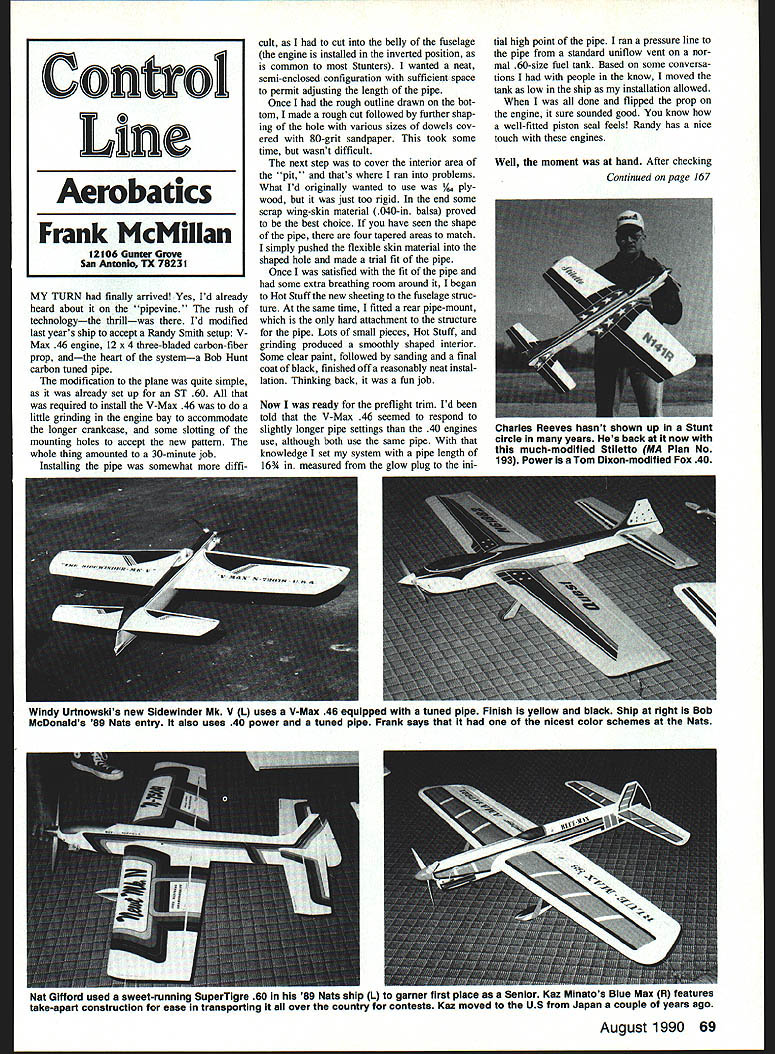
- Nat Gifford used a sweet‑running SuperTigre 60 to win Senior at the '89 Nats.
- Kaz Minato's Blue Max features take‑apart construction for easy transport; Kaz moved to the U.S. from Japan a couple of years ago.
- Charles Reeves has returned to the Stunt circle with a much‑modified Stiletto (MA Plan No. 193), powered by a Tom Dixon–modified Fox .40.
- Windy Urtnowski's new Sidewinder Mk V uses a V‑Max .46 with a tuned pipe.
- Bob McDonald's '89 Nats entry also used .40 power with a tuned pipe.
- Prop fabrication note: prop blades can warp as moisture evaporates during cure; use thin plastic between blade form halves during curing to minimize sticking and warping.
Pennyplane evolution
The Pennyplane evolution project showed a high‑drag problem, probably from a thick wing. The new wing followed the airfoil and planform used successfully by Jim Clem: constant‑chord center section with tip panels swept back about 1 inch.
- First flight: under‑elevated.
- Second flight: trim nearly right; the new wing unloaded the flexible prop and rpm soared to 206 with much lighter rubber. A conservative flight produced 6:06 with significant ceiling scrubbing. For comparison, Jim Clem's model in the same session touched the ceiling for eight seconds and finished at 9:38 (a record tie).
- Next steps planned included a higher‑pitch, stiffer prop and more power. The final flight of the session hung up and broke the tail boom; there was no time to repair. Despite that, the new wing was a success. Over the next month I tested three props for pitch range and rebuilt the boom stronger.
Transcribed from original scans by AI. Minor OCR errors may remain.

